In May 1945, the thousand-year Reich collapsed into ash and rubble. As the Red Army stormed Berlin and the Western Allies swept across the Rhine, a desperate scramble for survival began among the architects of the Holocaust. Thousands of high-ranking Nazi officials, SS commanders, and concentration camp guards discarded their blood-stained tailored uniforms. They traded their silver death’s head insignia for the ragged clothes of refugees, hoping to vanish into the chaotic sea of millions of displaced persons wandering across a fractured Europe.
Among these fugitives was a man whose bureaucratic efficiency had orchestrated the darkest chapter in human history. Rudolf Höss. As the commandant of Auschwitz-Birkenau, Höss was personally responsible for the mechanized slaughter of over one million men, women, and children. He was not a raving psychopath in the traditional sense. He was the ultimate bureaucrat of death—a man who viewed genocide as a logistical puzzle to be solved.
When the war ended, Höss fled north toward Flensburg, hoping to find refuge with Heinrich Himmler and the short-lived successor government. But as British forces closed in, SS officers were ordered to melt away. Höss acquired the identification papers of a deceased German Navy sailor. He transformed himself into Franz Lang, making his way to a small, isolated farm in Gottrupel, just four miles from the Danish border.
The man who had overseen an empire of gas chambers and crematoriums found work as a humble farmhand. For eight long months, he milked cows, tended to horses, and slept in a cold barn, utterly convinced that the world had lost his trail in the ashes of the war. He was tragically wrong.
The monumental task of tracking down the vanished elite of the SS fell to specialized Allied intelligence teams. Leading the search for Höss was the number one war crimes investigation team, spearheaded by a British Army captain named Hans Alexander. Alexander’s involvement was a profound stroke of poetic justice. He was not a traditional British officer. He was a German-born Jew who had fled the virulent anti-Semitism of Berlin in 1936, finding refuge in England. He had joined the British military to fight the regime that had stolen his homeland. Now, as an intelligence officer, Alexander was fueled by a quiet, burning need for retribution.
Alexander wasn’t working alone. His team frequently collaborated with members of the Jewish Brigade, battle-hardened soldiers who had lost their entire extended families in the very camps that men like Höss had commanded. These soldiers were not conducting a polite police inquiry. They were hunting monsters.
They utilized a relentless, aggressive strategy informally known as Operation Haystack. Instead of looking for the needle, they systematically squeezed the hay—targeting the families, wives, and children of missing Nazi officials until someone cracked.
The critical breakthrough in the hunt for the commandant of Auschwitz didn’t happen in a field or a barn, but in the freezing confines of a converted sugar factory in Lüneburg, which the British were using as a makeshift prison. Alexander had successfully tracked down Höss’s wife, Hedwig, and their five children. But Hedwig was infamous in her own right. She had lived a life of luxury in a villa situated mere yards from the Auschwitz crematoriums, referring to herself as the “queen of Auschwitz” while utilizing stolen goods from murdered inmates.
For days, Hedwig remained stubbornly defiant in British custody. She insisted her husband had died in the final days of the war. But Alexander was an astute reader of human psychology. He knew that the only thing Hedwig cared about more than her husband was her children.
Alexander orchestrated a brutal, calculated psychological gambit. He entered her cell and delivered a terrifying ultimatum. If she did not reveal her husband’s exact location, her eldest son, Klaus, would be immediately handed over to the Soviet Union to be deported to the Siberian gulags. To emphasize the reality of the threat, Alexander had timed his interrogation perfectly. Just outside the prison walls, a steam train engine suddenly roared to life, its whistle shrieking in the cold air. The auditory illusion was devastating. The sound of the train—the very symbol of the deportations her husband had engineered—broke Hedwig’s resolve. Terrified that her son was about to be loaded into a boxcar, she asked for a pencil and a scrap of paper. With a trembling hand, she scribbled the location that would change history: The farm of Peter Hansen, Gottrupel.
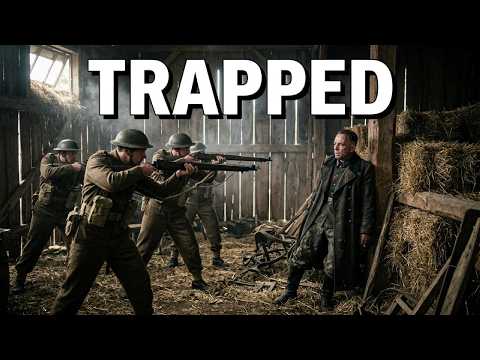
On the freezing, pitch-black night of March 11th, 1946, the British intelligence team and a heavily armed squad of soldiers descended upon the quiet farmhouse in Gottrupel. They did not arrive with a polite knock or a formal arrest warrant. The soldiers kicked in the doors in the dead of night, their Sten submachine guns raised, flashlights piercing the darkness. They dragged the man known as Franz Lang out of a small sleeping niche in the barn, forcing him into the cold night air wearing nothing but his pajamas.
Höss was a master of bureaucratic deception. Even as he stood shivering, surrounded by furious British soldiers, he maintained his cover story flawlessly. He calmly insisted he was a simple, hard-working sailor—a low-ranking farmhand who knew absolutely nothing of the SS or the concentration camps. He was so convincing that some of the British soldiers began to wonder if Hedwig had given them a false lead.
But Captain Hans Alexander was meticulous. He noticed a single, subtle detail that betrayed the disguise: a gold wedding band glittering on Lang’s finger. Alexander stepped forward, his flashlight blinding the suspect, and ordered the man to remove the ring. Höss hesitated, claiming the ring had been on his finger for so long that it was stuck and impossible to take off. Alexander, rapidly losing his patience and acutely aware of who he was likely standing in front of, drew his sidearm. He informed Lang, in flawless, menacing German, that if he did not remove the ring immediately, Alexander would simply cut the finger off with his combat knife.
Realizing the game was over, Höss relented. He bit his finger, lubricating it with saliva, and painfully slid the gold band over his knuckle. He handed it to the British captain. Alexander held the ring up to the beam of his flashlight, squinting at the inner band. Engraved clearly in the gold were two names: Rudolf and Hedwig.
The mask shattered instantly. The illusion of the simple farmhand evaporated into the cold night air, and the commandant of Auschwitz stood completely unmasked.
What happened next was rarely detailed in the sanitized official British reports, but the soldiers present never forgot it. The arrest party included several Jewish men who had personally witnessed the apocalyptic horror of the liberated camps. They did not extend their prisoner the standard British reserve expected of military police.
Höss was dragged back into the barn for an immediate interrogation. Ax handles, heavy military boots, and bare fists expressed the collective rage of millions of victims. The beating grew so severe and unrestrained that the medical officer had to physically intervene.
Hans Alexander finally pulled his men off the bleeding commandant—not out of mercy, but out of cold calculation. A dead Nazi was merely a corpse. A living commandant could stand in the dock at Nuremberg and confess the undeniable scale of the Holocaust to the entire world.
Before the prisoner was dragged to the transport vehicle, the medical officer forced his mouth open and shone a light down his throat. They were checking for a hidden cyanide capsule tucked inside a false tooth—the exact method Heinrich Himmler had used to cheat justice a year earlier. They found nothing. Höss would live to answer for his crimes.
Once safely in British custody, a chilling transformation occurred. The defiance vanished, replaced by an eerie, robotic cooperation. He did not plead for his life. He did not claim insanity. He expressed not a single ounce of remorse for the men, women, and children he had murdered.
Instead, he became the ultimate cooperative witness. During the Nuremberg trials, and later in his own prison memoirs, Höss meticulously detailed the daily output of the gas chambers as though he were a factory manager discussing automobile production quotas. He spoke of the efficiency of Zyklon B over carbon monoxide with a cold, clinical detachment that unnerved even his interrogators.
Most horrifying of all came when an Allied investigator suggested that three million people had perished at Auschwitz. Höss calmly corrected him. The number was inaccurate, he explained—he had murdered two and a half million, while another half million had died of starvation and disease. He offered the correction the way a clerk might fix a rounding error in a ledger.
To the British soldiers guarding him, this absolute absence of humanity was more terrifying than any raving madman. They realized they were in the presence of a terrifyingly sane individual who had simply optimized mass murder as a logistical exercise.
Following his testimony at Nuremberg, the British handed Rudolf Höss over to the Supreme National Tribunal of Poland. The Poles had suffered unimaginably under his regime, and it was decided that he should face justice on the soil where his crimes were committed. He was tried in Warsaw, found guilty of crimes against humanity, and sentenced to death by hanging.
In a final act of poetic justice, he was transported back to Auschwitz for his execution. On April 16th, 1947, Rudolf Höss was marched to a specially constructed gallows. It stood just a few dozen yards from the crematoriums he had overseen—and within sight of the luxurious villa where his children had once played while millions turned to ash next door.
The British soldiers who dragged him out of that freezing barn in Gottrupel didn’t just capture a fugitive. They secured the historical record. By unmasking the simple farmhand, they proved to the retreating Nazis that no barn was remote enough, no disguise clever enough, and no alias strong enough to hide the truth from those determined to bring it into the light.
Yet the capture of Höss was only one thread in a vast and tangled web. Across the shattered continent, thousands of other architects of the Final Solution were still moving through the ruins—some hidden in monasteries, some smuggled along ratlines toward South America, some quietly resuming ordinary lives under borrowed names. The men of Operation Haystack had proven that the hunters could find their prey. Now they would learn just how far the trail could stretch—and how many doors, in the highest places, were quietly being closed to protect the guilty.
The months that followed tested Alexander’s team in ways the Höss case never had. The ratlines were not the work of scattered fugitives. They were networks—organized, funded, and shielded by men in cassocks and men in suits. Some of the most wanted names in Europe were slipping through ports in Italy and Spain while Allied clerks filed their paperwork in triplicate.
Alexander spent long nights in the converted sugar factory, chain-smoking and staring at maps. He had learned something from Gottrupel that he carried with him into every subsequent interrogation: the monsters always believed their own disguises. Give them enough silence, and they would hang themselves with their own vanity.
But he also learned something darker. For every Höss dragged shivering from a barn, a dozen more were being quietly absorbed into new lives by people who preferred forgetting to justice. The war was over. The world was tired. And tiredness, Alexander understood, was the fugitive’s greatest ally.
Still, the ring had been read. The name had been spoken aloud. And in the cold arithmetic of history, that mattered. One commandant had been marched back to his own crematoriums and hanged in the shadow of his victims’ ashes. It was not everything. It was not even close to everything. But it was a beginning—and beginnings, as Hans Alexander knew better than most, were the only thing a survivor could ever truly claim.
The hunters kept their lists. The lists kept growing. And somewhere in the rubble of a broken continent, another farmhand was milking cows under a borrowed name, certain the world had forgotten.
How many of them, do you think, were never found at all?
Report this article
Select a reason for reporting:






