The Vietnam War was a quagmire of blood and secrets, where the line between soldier and monster blurred into the jungle mist. In the shadows, a staggering 300,000 North Vietnamese and Vietcong prisoners vanished into a system designed not just to detain, but to destroy. What happened behind the barbed wire and concrete walls of America’s detention centers is a story of horror that has been whispered for decades, but rarely told in full.
From the infamous Coconut Tree Prison, with its 15 layers of barbed wire and 40,000 inmates, to the claustrophobic tiger cages of Phu Quoc and Con Son, the treatment of prisoners was a calculated descent into savagery. Bones were shattered with crude tools, teeth ripped out with pliers, and minds broken in isolation so profound that many never recovered. This was not war as we know it—this was a systematic campaign of terror, justified by the fog of conflict and the desperate need for intelligence.
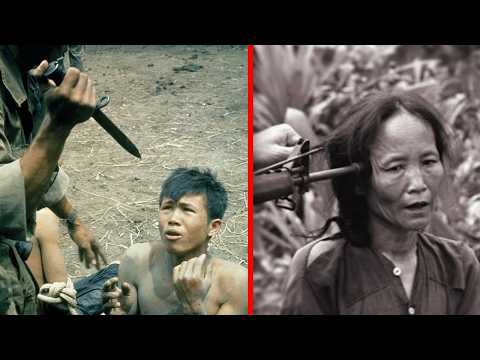
But the brutality did not end on the battlefield or in the prison cells. The Phoenix Program, a covert operation launched in 1967, took the war into the villages and hamlets of South Vietnam. Under the guise of neutralizing Vietcong infrastructure, CIA-trained squads carried out assassinations, torture, and intimidation on a scale that shocked even seasoned warriors. The program’s methods—electrocution, mock executions, and threats against families—were designed to break the will of the enemy, but they often ensnared innocent civilians in a web of fear and death.
The use of Agent Orange added another layer of horror, as millions of gallons of toxic chemicals rained down on forests and farmlands, poisoning the land and its people for generations. Children were born with deformities, cancers ravaged communities, and the environment was scarred beyond recognition. The bombing campaigns in Laos and Cambodia, meant to disrupt supply lines, turned those neutral nations into graveyards, littered with unexploded ordnance that continues to kill today.
And then there were the free-fire zones, where anything that moved was considered a legitimate target. In these lawless areas, American soldiers were given carte blanche to unleash hell, and civilians paid the price. The My Lai Massacre stands as a testament to the depths of depravity—over 300 unarmed civilians, including women and children, were slaughtered in cold blood. The sole conviction of Lieutenant William Calley, whose sentence was reduced to three years of house arrest, only underscored the impunity with which these atrocities were committed.
As the war dragged on, the scars deepened. Veterans and civilians alike bore the weight of trauma, while the U.S. government struggled to contain the fallout. Investigations and reports surfaced, revealing widespread violations of the Geneva Conventions and the moral bankruptcy of a strategy that treated human lives as collateral damage. Yet, accountability was rare, and the stories of survivors were often drowned out by the noise of politics and propaganda.
This is the untold story of what American soldiers did to the Vietcong—a story of torture, assassination, and chemical warfare that forever changed the landscape of Vietnam and the souls of those who lived through it. It is a story that demands to be heard, not for the sake of blame, but for the sake of remembrance and the hope that such horrors are never repeated.
The survivors who emerged from those prisons carried their scars in silence. Many were shunned by their own communities, unable to speak of what they had endured, their stories buried beneath decades of shame and fear. Some turned to alcohol or drugs to numb the memories, while others simply disappeared into the countryside, their names forgotten by history.
But the war’s cruelty was not confined to the prison cells or the free-fire zones. The Phoenix Program’s legacy lived on in the villages, where neighbors turned on neighbors, and the line between informant and victim was often decided by a personal grudge. Entire families were wiped out on the word of a single coerced witness, and the assassins rarely faced justice.
Agent Orange, too, refused to fade. In the years following the war, Vietnamese hospitals reported a surge in rare cancers and birth defects, while American veterans filed thousands of disability claims for conditions linked to dioxin exposure. The chemical had seeped into the soil, the water, and the food chain, ensuring that its poison would be passed down through generations.
The U.S. government, for its part, denied responsibility for decades. It was not until 1991 that Congress passed the Agent Orange Act, acknowledging the link between the herbicide and certain diseases in veterans. But for the Vietnamese victims, compensation was slow and inadequate, and many families still struggle to afford care for children born with deformities.
In Laos and Cambodia, the unexploded bombs continued to claim lives long after the guns fell silent. Farmers plowing their fields struck cluster munitions left over from American bombing raids, and children playing in the dirt picked up bomblets that looked like toys. International demining efforts made progress, but the scale of the contamination was staggering—an estimated 80 million unexploded ordnance still littered the Laotian countryside.
The My Lai Massacre, too, remained a wound that would not heal. In 1971, the world learned of the slaughter, and the subsequent cover-up by the U.S. military only deepened the outrage. Photographs of dead women and children, shot execution-style in a ditch, shocked the American public and fueled the anti-war movement. Yet the trials that followed were a travesty—most of the accused walked free, and Calley’s brief house arrest became a symbol of the impunity that shielded those who committed atrocities.
As the years passed, historians and investigators continued to unearth the truth about the war’s darkest chapters. Declassified documents revealed that the Phoenix Program’s kill lists were often based on faulty intelligence, and that the CIA had knowingly allowed the torture of prisoners in its custody. The American public, weary of the war, largely turned away, unwilling to confront the full extent of what had been done in their name.
But the story did not end with the war’s conclusion. For the survivors of the tiger cages and the Phoenix Program’s assassins, the trauma echoed through their families, their communities, and their nations. The Vietnam War left a legacy of pain that no treaty or reparation could fully erase—a legacy that continues to shape the lives of millions to this day.
In the decades that followed, a handful of survivors found the courage to speak. Their testimonies, recorded by human rights organizations and oral historians, painted a picture far more complex than the neat narratives of victory and defeat. They spoke of the small kindnesses that had sustained them—a guard who slipped extra rice into a bowl, a fellow prisoner who shared a whispered poem in the dark—and of the betrayals that cut deeper than any whip.
One such survivor, a former Vietcong courier named Tran Van Duc, described his years in the tiger cages of Con Son. He had been arrested in 1969, accused of carrying messages for the resistance, and spent four years in a cell so small he could not fully extend his arms. When he was finally released, he discovered that his wife had remarried, believing him dead, and his children did not recognize the gaunt, silent man who returned to their village.
Duc’s story was not unique. Across Vietnam, thousands of former prisoners struggled to reintegrate into a society that had moved on without them. Many were denied the pensions and recognition given to soldiers who had fought on the front lines, their suffering deemed less honorable because it had happened in captivity rather than combat.
The American veterans who had served as guards and interrogators faced their own reckonings. Some returned home with nightmares they could not explain, haunted by faces they had tried to forget. A few, like a former military intelligence officer who spoke to investigators under condition of anonymity, admitted that the torture had been routine—not the work of a few sadistic outliers, but a policy endorsed from the highest levels.
“We were told they were not human,” he said, his voice trembling. “We were told they had no rights. And we believed it, because it was easier than believing we were monsters.” His confession, buried in a classified report for years, was eventually made public, but it changed little. The men who had designed the interrogation programs had long since retired, many to comfortable lives, and no international tribunal ever called them to account.
Meanwhile, the children of Agent Orange grew up in a world that did not want to see them. In orphanages and rural villages, they were often hidden away by families ashamed of their deformities, their existence treated as a curse rather than a consequence of war. Some found work as beggars on the streets of Hanoi and Ho Chi Minh City, their twisted limbs and scarred faces a living reminder of the chemical that had poisoned their parents.
International aid organizations tried to fill the gap left by governments. Groups like the Vietnam Association for Victims of Agent Orange filed lawsuits against the chemical companies, but the courts in the United States repeatedly dismissed their claims, ruling that the manufacturers could not be held liable for the military’s use of their product. The legal battles dragged on for years, consuming resources and energy that could have gone toward care for the victims.
In Laos, the story was one of quiet, grinding tragedy. Every year, dozens of people—mostly children—were killed or maimed by unexploded ordnance. Demining teams worked tirelessly, but the scale of the contamination was overwhelming. A single cluster bomb could scatter hundreds of bomblets across a field, each one capable of killing a farmer or a child years after the war had ended.
One deminer, a Laotian woman named Khampheng, described the moment she found a live bomblet in a schoolyard. “It was lying there, small and shiny, like a toy,” she said. “The children had been playing around it for days. We evacuated the school and destroyed it, but I could not stop shaking for a week.” Her team had cleared thousands of devices, but she knew they had barely scratched the surface.
As the 20th century drew to a close, a new generation of Vietnamese and American scholars began to revisit the war’s history. They pored over declassified documents, interviewed survivors, and cross-referenced military records with village ledgers. What they found was a pattern of atrocity that was not the exception, but the rule—a system that had dehumanized the enemy so thoroughly that killing became as routine as breathing.
One historian, a Vietnamese-American woman whose father had fought for the South, described her research as a journey into her own family’s complicity. “I found my uncle’s name in a Phoenix Program file,” she said. “He was listed as an informant. I do not know if he was paid or coerced, but I know that his information led to the deaths of people whose names I will never know.” She paused, then added, “The war did not end in 1975. It is still ending, in every family that carries its secrets.”
The survivors of the prisons and the massacres grew old, their numbers thinning with each passing year. Some found a measure of peace in forgiveness, while others carried their hatred to the grave. But as long as the unexploded bombs remained in the fields and the dioxin lingered in the soil, the war would continue to claim new victims, long after the last soldier had gone home.
And in the archives, the documents waited—thousands of pages of testimony, investigation reports, and intelligence memos that told a story the world had tried to forget. For those willing to read them, the truth was there, buried beneath layers of euphemism and denial, waiting to be unearthed.
Today, the demining teams still walk the same fields, and the clinics still treat the same dioxin-scarred children. “We cannot undo the past,” Khampheng said, “but we can refuse to look away.” In Hanoi, Tran Van Duc’s granddaughter now studies medicine, determined to heal what war broke.
The archives remain open, the testimonies preserved, the bombs still buried. History does not close its books; it waits for each generation to turn the page. What will we choose to remember—and what will we finally do?
Report this article
Select a reason for reporting:






