In late summer 1900, a railroad crew working a narrow gap in Montana’s Pryor Mountains set a fourth charge of dynamite into the limestone face and pulled back. When the dust settled, there was a chamber in the rock where no chamber should have been. It was not a cave. It was not a mine shaft. Its walls carried no chisel marks, no pick marks, no curves cut by water. The rock looked as if it had once gone soft and then frozen that way.
And in the middle of the chamber stood a machine: a giant drum lying on its side, eleven feet high, seventeen feet long. The crew measured it. They sketched it. They wrote its location in a notebook. The Crow felt no need to measure it. They already had a name for it. This was where the little people worked, they said, and this was what they had left behind.
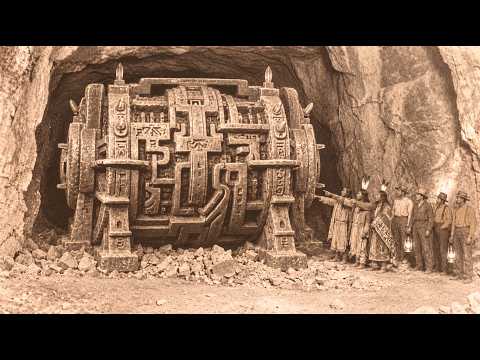
Every inch of the machine was cut with deep, angular channels. They wound like a labyrinth, yet never once crossed. From its top and its flanks rose rods of crystal as clear as ice, each about a hand’s span long. There were eight sockets, seven crystals.
Seven years later, a twenty-four-year-old anthropologist from the American Museum of Natural History in New York, Robert Lowie, arrived among the Crow and began writing down everything he was told about the little people. The notes he made in 1907 described what was inside that chamber at Pryor Gap in the words of people who had never seen it.
This is where the story begins.
Before we can understand what was found, we need to understand the gap itself. The Pryor Mountains are a dry limestone massif on Montana’s southern border stretching toward Wyoming. Geologists call this rock the Madison limestone. Deposited on the floor of a shallow sea over 300 million years ago, then uplifted and dried out. It is a light gray, hard and dense rock. To the east lies the deep canyon carved by the Big Horn River. To the west, the Clark’s Fork Valley. Viewed from the north, the mountain rises like a sheer wall. The only natural path through the wall is a narrow gorge that cuts through the center of the mountain like a knife.
On maps, it is called Pryor Gap. The Crow have another name for it. Hits with the Arrows.
There is a reason for this name. For generations, every Crow traveler coming through the gap would stop and shoot an arrow into its rock wall. Sometimes instead of an arrow, a bead, a piece of cloth, or a pinch of tobacco would be left. This was not decoration. It was a request for permission because according to the Crow, these mountains were not empty inside. Inside them lived a people no taller than a man’s knee, very strong and very old. The gap was their door. Whoever passed through a door gave a greeting.
The Crow called themselves Apsáalooke. It means children of the big-beaked bird. In the early eighteenth century, they had settled in the Yellowstone River Valley and made these lands between the Big Horn and Pryor Mountains their hunting grounds and homeland. Every pass, every spring, and every rocky outcrop in the mountains was known by a name, a story, and a rule. That is why the creek that runs out of the gap was called Arrow Creek. White mapmakers named it Pryor Creek.
Under the 1868 Treaty of Fort Laramie, the northern half of these mountains remained within the Crow reservation. In the mid-1880s, the Crow’s most renowned chief, Plenty Coups, built his home on the banks of Arrow Creek, a few hours’ walk from the gap. For the rest of his life, Plenty Coups told of a vision he had at nine years old. In that vision, his guide was the chief of the little people.
Then came the railroad.
In the spring of 1899, engineers from the Chicago, Burlington, and Quincy Railroad surveyed a line that would run from the station at Toluca in Montana to the town of Cody in Wyoming. Cody was Buffalo Bill’s town, and Buffalo Bill wanted a railroad. Sixty-eight of the line’s 130 miles would pass through the Crow Reservation, and the only way through the mountain was Hits with the Arrows.
Construction began in the spring of 1900. Most of the grading crews came from Mormon families who had migrated from Utah to the Big Horn Basin that year. At the north end of the gap, at its narrowest point, they would drive a tunnel.
The Crow did not want that tunnel. The elders said that the little people did not like the noise. They said that driving a railroad into the mountain was not knocking on a door. It was breaking it down.
This objection was never recorded in any official correspondence, but north of the gap, just past the tunnel, there is a small cemetery that still stands today. It is the cemetery for the workers who died during the construction of that tunnel in 1900. The records disagree on the cause of death. One source cites smallpox, another typhoid, yet another cites a cave-in, and none of the records mentioning the cave-in say what it opened up.
The first record is an engineer’s field book. Asa Whitcomb was thirty-one years old. He had grown up in the town of Galesburg, Illinois, in the shadow of the Burlington Railroad’s workshops. His father was a boilermaker in those shops. Asa had studied surveying and construction at Knox College and in the spring of 1900 had been sent to Montana as assistant engineer on the Pryor Gap section of the line. His job was simple: to maintain the tunnel’s alignment, measure the cross-section after each blast, and record everything.
Whitcomb recorded everything. His field book was the railroad standard issue, leatherbound, filled with pencil entries, each page bearing a station number. It was his seventh. Until the last week of August, the pages were all identical. Cross-section, depth, rock type, dynamite used, and the plan for the next day. Then opposite station 1240, the handwriting changes.
According to Whitcomb’s record, the western wall of the tunnel collapsed inward with the fourth blast. The foreman of the excavation crew was a Mormon named Josiah Hale from Utah. He pulled his men back and took roll call. Fourteen had gone in, fourteen came out. When the dust settled, there was a void behind the collapsed wall. From the void, cool, dry air flowed in, contrasting with the hot air of the tunnel.
Hale refused to go inside. Whitcomb took a lantern and went in alone.
He recorded the measurements exactly as they were. The chamber was thirty-eight feet wide and twenty-four feet high. It was sixty feet deep. The floor was flat. The ceiling curved like a dome. There was not a single tool mark on the walls. Whitcomb had underlined a sentence. The wall looked not as if it had been cut, but as if it had been cast.
He had jotted down another note in the margin. At the base of the wall, the rock had sagged downward like the melting edge of a candle, freezing in layer upon layer of folds. Whitcomb touched them. It was stone, hard, cold, ordinary limestone, but its shape was that of something that had once flowed.
He spent two full pages drawing the thing in the middle of the chamber from the front, the side, and the top, with measurements: eleven feet high, seventeen feet long. At the left end of the body, a round hub the size of a wagon wheel. Beneath it, two heavy skids holding it a hand’s span off the floor. And everywhere the channels.
Whitcomb tried to follow one channel by lantern light. He writes that it took an hour. The channel wound around the body, turned, folded back, and passed right by itself. But it never crossed itself anywhere. Nowhere did it merge with another channel. Whitcomb concluded that the entire body contained a single unbroken path. The path began at the hub. He never found its end.
He had written a single word next to the crystals: cold.
It was the end of August. The inside of the tunnel was suffocating with dynamite smoke and stagnant air, but every man who touched the crystal rods pulled his hand away. Whitcomb wrote that they were clear, contained no air bubbles or cracks, and did not reflect the light of the lantern. Light did not pass through them. It remained inside.
Something on the floor of the chamber had also caught his attention. There should have been dust in a void that had been sealed for centuries. Rock debris, bat droppings, animal bone. Whitcomb found none of these. The floor was as clean as the floor of a workshop that had been swept just yesterday. The only marks were those left by his own boots.
In the center of the hub, at the left end of the body, there was a recess. Whitcomb measured that, too. Four inches wide, one and a half inches deep, with five small hollows shaped like the pads of fingers. It looked like a place where a hand could fit. Whitcomb’s own hand would not fit. A child’s hand might have. All eight sockets were the same size. The one closest to the hub was empty.
And beside his drawing of that empty socket, Whitcomb wrote one sentence he never explained. Someone was here before us.
The second record is the object itself. In Whitcomb’s notebook, the four days following the discovery of the chamber passed without a single tunnel cross-section being measured. All the pages for those four days are devoted to the body. What they did on the first day was what a railroad crew would do. To learn what it was, they hit it. One of Josiah Hale’s men brought a twelve-pound sledgehammer down on one of the skids. Whitcomb noted the sound. There was no ringing, none of the long shiver of struck iron. The sound was short and dead, like a blow on solid stone. But the sledgehammer’s head left no mark where it struck. The face of the sledgehammer itself, however, was dented.
They brought a magnet. It didn’t stick. It wasn’t iron. They tried a drill bit, a steel bit, spun along the edge of the body for twenty minutes. The bit dulled. Not a single scratch remained on the body. Whitcomb described its color: dark, almost black, with a matte finish like damp stone. But to the touch, it wasn’t like stone. It had a smooth, slippery texture, like an old coin that didn’t stick to the hand.
On the second day, they tried to move it from its spot. The railroad had everything it needed for this: a jack, a lever, a chain, and teams of horses that pulled the camp’s freight wagons. Twelve horses leaned into a chain made fast to the skids. Whitcomb summed up the result in a single line. It didn’t budge even a quarter of an inch.
The reason became clear that evening. Hale took a lantern and looked under the skids. The skids weren’t resting on the ground. They were embedded in the ground. The rocks surrounding the skids, just like the folds at the base of the wall, had once flowed, encased the skids, and frozen in place. The machine had not been set into the chamber. The chamber had formed around the machine.
On the third day, the channels were measured. Each channel was two inches wide and three inches deep. The edges were sharp, and the corners were at right angles. The bottoms were polished. Whitcomb ran his finger along the inside of a channel, and his finger did not catch on a single rough spot. He took the measurements again at the turns of the channels. The width remained constant. The depth remained constant. A uniformity that no hand-carved groove on a seventeen-foot body could possibly hold.
Whitcomb noticed something else that day. The crystals were not arranged randomly. Each one stood at the exact center of a bend, at the point where the unbroken channel looped back upon itself. It was as if the path had meandered there on purpose. Whitcomb counted the bends. There were eight bends, eight sockets. He was also carrying a thermometer. Survey teams carried thermometers to account for the expansion and contraction of steel due to heat. Inside the tunnel at noon, the mercury was above eighty degrees. Inside the chamber, it was forty-eight. When he held it against the base of a crystal at the lip of its socket, the mercury dropped to thirty-four degrees, two degrees above freezing in August inside a mountain.
On the fourth day, one of the men tried to pry one of the crystals loose. His name is not in the field book. It simply states that he was a young worker from Hale’s team. He set a crowbar against the rim of the socket. The crystal didn’t budge. When he let go of the crowbar, he said his right hand had gone completely numb. The numbness lasted two days. Whitcomb didn’t record this as an injury. He recorded it as an observation.
That afternoon, a horseman arrived at the mouth of the tunnel. Two Crow wagon drivers who had been hauling hay to the camp had ridden back to Arrow Creek the evening the chamber was opened and recounted what they had seen. The next morning, an elderly man set out from the Pryor area. Whitcomb did not write down his name. He merely noted that the man was elderly, that his hair fell in two braids down to his shoulders, and that he spoke through an interpreter. The old man did not enter the chamber. He stood in front of the opening, looked inside for a while, and said just one thing. The interpreter relayed it as follows. Theirs. Take nothing out. Close it. Then he mounted his horse and rode back.
On the fifth day, a telegram arrived from the railroad’s engineering office in Omaha. The copy pasted into Whitcomb’s field book is brief. Wall up the cavity. Shift the alignment. Note the date. Proceed. The crew sealed the mouth of the chamber with a six-foot-thick wall of mortar-bound stone. The tunnel alignment was shifted forty feet east, and Whitcomb’s seventh field book began to fill up again with cross-sections, depths, and the amount of dynamite used. But beneath the page where he recorded the dimensions of the wall, there is one more note he never explained. While the wall was being built, before the final stone was set, the cool draft coming from inside the chamber had stopped. Before it stopped, Whitcomb writes that it reversed direction for a moment.
There is a version of this story in which everything is comfortably explained, and that version deserves a fair hearing first. The Pryor Mountains are full of caves. Madison limestone is a rock that has been dissolved and eroded by groundwater over thousands of years. Big Ice Cave, located within what is now the Custer National Forest, is a natural cave that holds ice even in the middle of summer and is situated in the same mountain range. In these mountains, a tunnel blast breaking into a natural solution cave would be nothing unusual.
It is also not impossible to find an abandoned machine inside. In the 1860s, the Bozeman Trail ran east of these mountains. In 1866, the army established Fort C. F. Smith on the banks of the Big Horn River, forty miles east of the gap, and abandoned it two years later. During those same decades, miners were searching for gold and silver in every mountain in Montana. The miners carried heavy stone mills and crushers to grind the ore. They stored these in caves during the winter and returned in the spring. Some never returned.
According to this account, what was found in 1900 was an old ore crusher that had been hauled into a cave thirty or forty years earlier, after which a rockfall had blocked the entrance. The crystals were quartz or calcite crystals commonly found within limestone. The channels were decorative patterns left by the casting molds of heavy machinery, and the railroad had walled up the cavity and moved on, not wanting to fall behind schedule.
There is another basis for this explanation: the records themselves. Whitcomb was a young engineer who had grown up on the plains of Illinois and was working in the mountains for the first time. He had never seen a limestone cave before. Railroad camps were also known for spinning tales: a long summer, weary men, dynamite, a dark room, the sound of a sledgehammer blow, the reading of a thermometer, a worker’s numb hand. Each of these taken separately fits into a straightforward explanation. And the railroad’s own annual report notes that a natural cavity was encountered at Pryor Gap that summer, that it was walled up, and that work continued with only a brief delay.
This is a reasonable explanation. It does in fact account for part of the record, but it does not account for the rest.
The chamber had no entrance. For four days, Whitcomb scanned every wall of the chamber with a lantern and found no hole, no crack, no closed opening leading to the outside. The chamber was completely sealed off until dynamite opened it. How did a miner get his machine in there? The walls of a natural cave are rough. They are crusted with flowstone. Stalactites hang from the ceiling. The walls of this chamber were smooth, and the floor was clean. No casting mold would leave a channel that forms a single unbroken path seventeen feet long with no variation in width or depth. No quartz crystal remains cold enough in the August heat to make every hand that touches it pull back. An ore crusher is made to fit the hand of the man who will operate it. Its handles are sized for the hands that turn them. And on this body, despite all of Whitcomb’s searching, there was not a single handle, a single arm, or a single wheel made to fit an adult’s hand. The only place made for a hand was that recess with its five hollows in the center of the hub, and an adult’s hand would not fit there. And no ore crusher stays in the same spot long enough for the rock beneath it to soften and wrap around it.
The official explanation may be correct, but it does not explain the stone around the skids. The only record that explained the stone was not in the railroad’s hands. It was in the hands of the Crow.
The third record is the unwritten one, or rather, it is the one that was passed down orally through generations until it was finally written down. Robert Harry Lowie was born in Vienna in 1883. When he was ten years old, he immigrated to New York with his family. He graduated from City College and became a student of Franz Boas, considered the founder of American anthropology, at Columbia University. By 1907, he was working in the anthropology department of the American Museum of Natural History. The department’s curator, Clark Wissler, sent young researchers out west every summer to work among the Plains peoples. The previous summer, Lowie had worked with the Shoshone people in the Lemhi Valley in Idaho. In the summer of 1907, he arrived at the Crow reservation for the first time.
There was one thing that set Lowie apart from his contemporaries. He had decided to learn the language. In the years that followed, from 1910 to 1916, he would spend every summer among the Crow and with the help of his interpreter, James Carpenter, compile three volumes of texts in the Crow language. He learned the Crow language, in his own words, well enough to ask a simple question and not miss the subtleties of the answer. But in 1907, he was still just getting started. And that summer in the Pryor district along Arrow Creek, he jotted down a series of notes in his notebook that never made it into any of his published books.
At the center of these notes is an elderly man whose name Lowie did not record. Lowie refers to him only as the old man from Pryor and once writes that the man asked him not to include his name in his books. We too will honor that request.
The old man did not recount the story of the little people as if it were a fairy tale. Lowie specifically notes this. He described them just as one might describe beavers in the river or bears in the mountains: where they lived, when they were seen, what they loved and what they feared. They stood knee high, he said, but they were stronger than the strongest man. They lived inside the mountain, inside the Pryor, beneath Medicine Rocks, behind the canyon walls. They were not gods. People did not pray to them. They were treated with respect, just as one would treat a neighbor.
They weren’t all the same, though. The old man divided them into three groups based on where they lived. Those who lived among the cliffs of Medicine Rocks were helpful. They’d guide a lost traveler back on track and sometimes drive game toward a hunter. Those of the canyon walls were tricksters. They would lead a traveler in circles around the same hill and hide his belongings. Those living in the depths of Pryor, however, were the least seen. They were the most powerful, and the tools belonged to them.
Lowie asked the old man who had taught him these things. The answer was not a name but a chain: from his father’s father and from his father’s father before that. When he asked how long this had been known, the man did not understand the question itself. Always, he said. It’s like asking how long a river has been flowing.
That same week, Lowie spoke with a second old man from the same region without mentioning anything the first man had told him. The second man also listed three places in the same order with the same characteristics. The only difference was that he said the people in the canyon weren’t playful but jealous. Lowie wrote down this difference as well. He didn’t resolve the discrepancy. He recorded it.
And they were makers. According to the old man, the little people didn’t chisel the stone. They softened it. In their hands, they carried a rod that was as clear as ice and glowed. When they set the rod against the rock and sang a single note, the rock would soften like wet clay. They would shape it as they pleased. Then the rock would harden again. And once the rock had hardened, it would never soften on its own again.
Lowie writes that he asked a question at this point. Every rock? No, said the old man. The gray stone of the mountain would soften. The black stone in the riverbed would not soften. And if the stone they softened did not take its shape before the sunset, it would freeze in its unfinished state. Lowie had emphasized this point because in a fairy tale, power is limitless. In this story, however, power came with conditions.
He described their light. It did not come from fire, he said. It gave no smoke and no heat. It was like the light of a full moon gathered into a single point. The one who held it could dim it or brighten it, but over time the light would fade. A fading light was carried back into the mountain where it was fed again. What fed it, the old man did not know.
There was also a sound. In winter, on the coldest nights, those who camped at the foot of the Pryor would hear a rumbling coming from inside the mountain. It wasn’t like thunder. It was rhythmic, steady, and could be felt both in the chest and in the ground at the same time. The elders said the little people were at work. Lowie asked what the song sounded like. Instead of answering, the old man closed his eyes and without moving his lips, let out a single sound from deep within his chest. A low, flat, unchanging hum. It lasted until his breath ran out. Lowie noted that he tried to write down that sound with musical notes, but the sound didn’t fit any note. It seemed to hover somewhere between two notes.
Then the old man told a family story. When his grandfather was young, near Medicine Rocks at the foot of a boulder, he had found a clear rod about the length of a finger. The rod was cold. In the dark, it glowed faintly on its own. His grandfather picked it up, looked at it for a while, and then placed it back exactly where he had found it, at the exact angle he had found it. When he came back the next morning, the rod was gone. But at the base of the rock, there was a small stone bowl that hadn’t been there the night before. Its interior was smooth. There was not a single tool mark on its rim. The bowl had been passed down through generations in the family, and the old man showed it to Lowie. Lowie described the bowl, but he did not sketch it or take any measurements. The old man would not allow it.
And there were rules. Anyone passing through the gap shot an arrow into its wall. If an object belonging to the little people was found, it would be left where it was. One would not look directly at them, and what was known about them would not be told to outsiders. Lowie asked why the old man had broken this last rule for him. The answer was a single sentence. Because the iron road has come, he said, and they are leaving.
The most important page in Lowie’s notebook is from the second day of this conversation. That day, the old man spoke of the little people’s workshops. Inside the mountain, he said, were places where they made their tools, softening and shaping the stone. And inside one of these places, a great thing of theirs stood. Lowie took down the description through the interpreter, word for word. A round thing lying on its side, as big as a lodge. Its whole face cut with paths, but no path crosses another. One path, it has a beginning, its end is inside the mountain. Where the path turns back, ice stones stand that never melt. Eight places, one is empty. At one end, a round face. On that face, the place where the little people put their hands.
Lowie asked about the empty one. It was taken a long time ago, said the old man. Before the iron road, before the white men, no one knows who took it. Ever since that stone was taken, the great thing has been sleeping. Then what was it for? The old man placed his hand on his chest. It sang the song, he said. The song the little people sang to the stone. With their rods, they did only small work. When the mountain itself had to be softened, the great things sang.
Lowie knew nothing of Whitcomb’s notebook. The railroad’s annual report said nothing more than that a natural void had been walled up at Pryor Gap. Everyone who knew what had been found in that chamber seven years earlier had either left the gap or gone quiet. Josiah Hale had returned to the Mormon colony in Wyoming. Asa Whitcomb had been transferred to another line in another state.
One August day, by the light of a lantern, an engineer had counted a single unbroken channel along a seventeen-foot-long body. Eight bends, eight sockets, one empty. At one end, a recess with five indentations just big enough for a child’s hand. An old man who had never seen that chamber had counted the same things. A single path, eight spots, one empty. At one end, a place where small hands had rested. These two descriptions never appeared side by side in the same notebook. In 1907, only one of them was before Lowie, and it described something no one had ever described to the old man.
The next morning, Lowie took an interpreter and a horse and rode to the gap. The train was still running. He entered through the mouth of the tunnel and walked along the west wall. One section of the wall was different from the rest. It wasn’t rock, but mortar-bound stone, six feet of masonry. Lowie pressed his palm against that wall. What he wrote in his notebook consisted of three short sentences. The stone was cold, colder than the rest of the tunnel, and after he took his hand away, a faint tingling stayed in his palm for a while, the kind a hum leaves behind. Lowie didn’t interpret it. On the next line, written that night on the hill north of camp, he noted only that he would come back the following summer and speak with the old man again.
When he returned the following summer, the old man was dead. And these pages of Lowie’s never found their way into anything he published during his lifetime.
The fourth record comes from the other side of the wall, from the men who walked past it every day after it was built. In 1908, the section foreman on the Pryor Gap section was a man named Martin Ostrander, who was born in Sweden. A section foreman’s job was to walk along every track, every tie, and every culvert in his section and send a monthly report to the railroad’s Sheridan district office in Wyoming. Ostrander’s reports, like every section report of the era, are dry and brief. Number of broken ties, snow clearing hours, a rockfall. But between November 1908 and March 1910, there are three lines that recur in these reports.
The first is frost. On the west wall of the tunnel, in front of the masonry section, the tracks are covered with frost every morning. There is no frost in the rest of the tunnel. Ostrander first mentions this in November 1908, then again in July 1909. In July.
The second is the sound. During the coldest week of January 1909, Ostrander writes that while on night patrol, he felt a vibration in the tracks. There was no train. There was no wind. The vibration, in his own words, was as regular as the distant turning of a millstone, and it came from beneath his feet, from within the tracks. When he placed his hand on the track, he wrote that the vibration grew stronger as it approached the masonry wall.
The third is the wall itself. In February 1910, Ostrander reported that the stones in the bottom course of the masonry wall had shifted from their places. They hadn’t broken. They hadn’t fallen. They were buried in the ground by the width of a hand, as if the rock beneath them had momentarily turned to mud and then hardened again. Ostrander drove stone wedges into the gaps and included a request at the end of his report that the wall be rebuilt. The file holds no reply from Sheridan.
A year later, this issue lost its significance. At three o’clock in the morning on April 13, 1911, the line’s conductor C. J. Merritt received a telegram. The line stretching from Toluca to Cody, Pryor Gap section and all, was being shut down. The line that had carried the first train into Cody for Buffalo Bill’s celebration in November 1901 ended with a telegram in the middle of the night. Traffic was rerouted. The tracks were torn up. The tunnel stood empty.
The Crow told the story of that closing differently. The little people do not like noise, they said. They sent the iron road away.
That summer, as the tracks were being removed, arrows began striking the walls of the gap once again. In the gorge, where the train whistle had echoed for eleven years, Crow travelers would once again dismount from their horses, leaving behind an arrow, a bead, or a pinch of tobacco. No one celebrated this as a victory. It was like greeting a door once more.
The tunnel, however, remained empty. In the years following the closure of the line, riders crossing the gap could walk through the tunnel. Some stopped in front of the walled-off section on the west wall and asked why it was there. There was no one left to answer.
And seventeen years later, the most powerful voice in this story was hosting a guest on the porch of his own home. Frank Bird Linderman, born in Ohio in 1869, had come to Montana at the age of sixteen. He had worked as a trapper, worked as an assayer in a mining town, published a newspaper, and served in the state legislature. But his true life’s work was listening to the elders of Montana’s indigenous peoples and transcribing their stories onto paper. He strove to write everything down in the exact words of the person speaking.
Plenty Coups, meanwhile, was the most respected voice of the Crow nation at that time. In 1921, he was invited to Washington, D.C., where, at the dedication of the Tomb of the Unknown Soldier in Arlington, he laid his war bonnet and coup stick on the tomb on behalf of all Native American peoples. In 1928, he donated his home and the surrounding land so that it might belong to all peoples.
In the summer of 1928, Linderman spent weeks at that house on the banks of Arrow Creek with Plenty Coups, who was now approaching eighty, and recorded his life story. The book was published in 1930. In it, Plenty Coups recounts the vision he had at the age of nine. In the vision, the chief of the little people guided him. That chief taught him to listen. He taught him to learn from the mistakes of others.
A conversation that did not make it into the book, however, remains among Linderman’s scattered notes. Linderman had asked Plenty Coups about the gap, about Hits with the Arrows. According to Linderman’s account, the old chief said the little people had a work lodge there. The white men built a wall in front of its door, he said. Then he added one more sentence. Linderman wrote it down twice, something he never did in any of his other notes. A wall is not a door.
The fifth record comes from outside Pryor Gap. First up close, then from very far away. About two hundred miles south of the Pryor Mountains in the middle of Wyoming, the Shoshone tell of another small people. The Shoshone call them the Nimerigar. Like the Crow’s little people, they were knee high, lived inside the mountain, and were very powerful. But unlike the little people of the Crow, the Nimerigar were not benevolent. The Shoshone elders recounted that they attacked with poisoned arrows.
In October 1932, two miners searching for gold in the Pedro Mountains of Wyoming, Cecil Main and Frank Carr, blew up a thick rock wall with dynamite. Behind it was a chamber four feet high, four feet wide, fifteen feet deep. A sealed chamber. It had no entrance. Inside the chamber, sitting on a stone ledge cross-legged, arms folded over its knees, was a small mummified figure fourteen inches tall. The figure passed from hand to hand for years, was examined, exhibited, and then disappeared. Subsequent X-ray evaluations suggested that it might have been a baby born with a severe birth defect. This explanation should be taken seriously, but two distinct details remain. As in Pryor, an American crew at Pedro used dynamite to open a sealed chamber with no entrance. And the records that best described both chambers were the stories each region told about its own small people.
Similar tales exist on the other side of the ocean as well. Around 1220, the Icelandic writer Snorri Sturluson compiled the Prose Edda. In the Edda, two dwarf brothers, Brokkr and Eitri, who live inside a rock, forge tools for the gods. Their forge is inside the stone. Eitri places a piece of material in the forge and tells his brother to keep the bellows working non-stop. If he stops, the work will be ruined. A fly stings Brokkr’s eyelid. Brokkr pauses for a moment. The tool being forged at that very moment, Thor’s hammer, Mjölnir, turns out flawless. Only the handle is too short. Here too, there is a workshop. Here too, there are small craftsmen working inside a rock. And here too, technique comes hand in hand with its conditions. If the process is interrupted, the tool remains unfinished.
Iceland carries this story forward to this day. In 2013, when plans were made to build a road through the Gálgahraun lava field near Reykjavík, protesters sat in front of the construction machinery, claiming that this was the home of the hidden people, the Huldufólk. The road was built in 2014, but a seventy-ton boulder along the route at Kirkjuhóll was not demolished because it was believed to be the church of the hidden people. It was carefully lifted by cranes and moved to a new location.
In Hokkaido in northern Japan, the Ainu people tell of a small folk called the Koropokkur. What their name means: people under the butterbur leaves. According to the Ainu, the Koropokkur were in these lands before the Ainu arrived. They traded with the Ainu, but only at night and only through the window, by showing their hands. One day, an Ainu youth grabbed an outstretched hand and pulled it inside. The Koropokkur left that day and never returned. The English missionary John Batchelor recorded this tale in 1901 in his book on Ainu folklore.
Montana, Wyoming, Iceland, Hokkaido. Four peoples who have never come into contact with one another. In all four there is a small folk, an underground realm or the hollow of a stone, a hand, a tool. And in all four, the same ending. When someone crosses the boundary, the small folk withdraw.
The sixth and final record is not the file itself, but the trail of the file. The archives of the Chicago, Burlington, and Quincy Railroad are housed today at the Newberry Library in Chicago. Thousands of boxes: contracts, maps, engineers’ logs, correspondence. Asa Whitcomb’s seventh notebook is there, but it’s not under the heading Pryor Gap. It’s in a box containing cross-sections of the line between Toluca and Cody, covering stations numbered 1170 through 1260, filed by station number. No one who has not opened that box would know there is a chamber drawn inside it.
The index at the back of the notebook lists eleven pieces of correspondence concerning the Pryor Gap wall dating from 1900 to 1911. The index records who sent each letter and to whom: from Whitcomb to Omaha, to the office of George Holdrege, general manager of the line, on September 2, 1900. From Holdrege’s office to Whitcomb two months later. From the Sheridan district manager to Omaha regarding Ostrander’s reports on three separate dates. And finally from Omaha to Sheridan in March 1911, three weeks before the line closed.
There are four of these in the file: the telegram from Omaha, two of Ostrander’s reports, and a short letter dated March 1901. The letter went from the railroad’s engineering office in Omaha to the National Museum, affiliated with the Smithsonian Institution in Washington. It reports that a rock sample taken from the cavity at Pryor Gap had been sent for examination. A piece of limestone from the base of the wall, from the curves that drooped and froze like the melting edge of a candle. The National Museum’s registers give every such shipment an accession number. The number is recorded in the ledger. Sender, date, description: limestone, Pryor Mountains, Montana, sent by the railroad. But the examination column opposite the number is blank. And in the corner of the card, in a later hand, are two words: sample not found.
The story of Robert Lowie’s 1907 notebook runs the same way. Lowie left New York in 1921 to join the University of California and taught at Berkeley for thirty years. He died in 1957. His papers are now housed at the Bancroft Library in Berkeley. The 1907 Crow notebook, however, is not located there under the Crow heading, but in a box labeled Lemhi Shoshone, 1906, miscellaneous. The reason is simple. Lowie had begun using that notebook the previous summer in Idaho. The first twelve pages are filled with Shoshone word lists. The person compiling the catalog looked at the first page and placed the notebook under Shoshone. The Crow pages begin on the thirteenth page. They are written in pencil, hastily, with English equivalents squeezed in next to the Crow words here and there.
On the margin of the page where the old man’s description is written, there is a small drawing by Lowie. Not the machine. A hand. A small hand, palm facing down, fingers slightly spread. Beneath it, a single word: here. Nothing in the notebook explains why Lowie drew it or whose hand it was.
No one hid anything. No one destroyed anything. A notebook ended up in the wrong box. A specimen on the wrong shelf. And seven letters went to a place no one knew. And each one taken separately could be explained as a simple archival error.
There is a version of this story in which everything resolves into comfortable categories. And that version, point by point, deserves to be taken seriously.
First, the little people. Stories of a strong hidden people, knee high, living inside mountains appear in nearly every region of North America and in many parts of the world. Folklorists explain this as similar responses to the same fears and the same curiosity, given by human communities unaware of one another. Dark caves, echoing canyons, unexplained sounds. The Pryor Mountains are also full of rock art. It stands to reason that the small human figures carved into the rocks would over generations evolve into the narrative of a small people.
Second, the cave. The caves of the Pryor Mountains are not only numerous but also cold. The reason the ice inside Big Ice Cave does not melt throughout the summer is that the heavy cold air that sinks into the cave in winter remains trapped there all summer long. Cavers recognize such voids as cold-air traps. A wall built in front of such a void could coat the rails with frost every morning. Caves also breathe. When air pressure changes, their interior volumes exhale and inhale with a deep rumble. The vibration a maintenance worker felt on the tracks at night could be this breathing. The collapse of the bottom row of the wall, meanwhile, is simply the result of the freeze-thaw cycle that occurs every winter in the limestone ground.
Third, the witnesses. Whitcomb’s journal is a single source. Ostrander’s reports are brief and offer no interpretation. Linderman’s notes are scattered, and Plenty Coups’s statement could very well be a metaphor.
Fourth, and perhaps most compelling, is Robert Lowie himself. In a brief commentary he wrote for the journal American Anthropologist in 1915, Lowie explicitly stated that he could not under any circumstances ascribe any historical value to oral traditions. Two years later, as president of the American Folklore Society, he expanded on this view in a speech. In other words, the man who listened to the old man in Pryor and transcribed his words into a notebook read those words not as history but as tradition. Perhaps that is why he never published the 1907 pages.
Fifth, the object itself is missing. Today, there is no crystal, no channel fragment, no skid from Pryor Gap in any museum or storage facility. The only specimen sent to the Smithsonian is lost. All the evidence is on paper, and evidence on paper, no matter how consistent, cannot take the place of an object.
In this version, no one hid anything. No one suppressed anything. An engineer saw a cave. An anthropologist heard a story. A chief used a metaphor. And the files, as is the case in every archive, were scattered.
Each of these explanations is reasonable on its own. But when read together, there is something they do not explain. A cold-air trap can cool crystals. A metaphor can describe a wall. A tradition can arise from rock paintings. None of them explains how two people who had never seen each other counted the same number of bends, the same number of sockets, and the same empty socket on the same body in the same room.
The railroad is real. The tunnel is real. Lowie, Linderman, and Plenty Coups are real. The unanswered questions begin only after that point.
Today, the only road through Pryor Gap is a narrow, dusty gravel road. A section of the road runs over the embankment of the old rail line, whose tracks were removed in 1911. A careful observer can still see that straight line at the north end of the gap curving up the mountainside. The small cemetery north of the tunnel is still there. The graves of workers who died in the summer of 1900. Most of the headstones are unmarked. Records still do not agree on the cause of the deaths.
South of the gap lies the Pryor Mountain Wild Horse Range, established in 1968. Herds believed to be descended from Spanish horses roam freely today on those limestone ridges. To the north, along the banks of Arrow Creek, Plenty Coups’s home is now a state park. The spring in front of the house, at the chief’s own wish, is open to everyone, and the Crow still greet the gap. Even today, some Crow families passing through Hits with the Arrows leave a bead, a piece of cloth, or a pinch of tobacco at the base of the rock wall. This is not a memento. It is an ongoing connection.
Most of the Pryor Mountains are public land today. Part of it belongs to the Custer Gallatin National Forest, part to the Bureau of Land Management, and part to the Crow Reservation. The gap sits where the boundaries of these three jurisdictions nearly intersect. Anyone wishing to obtain a research permit must knock on three separate doors for the same cliff face. To date, no such application has been filed.
Medicine Rocks still stands. Those rocky outcrops where Crow families bring offerings once a year remain within the reservation today and are protected as a place not shown to outsiders. The whereabouts of the stone bowl, which had been kept in the elderly man’s family in Pryor for generations, are unknown today. Lowie’s notebook does not record the name of its last owner.
The documents are still where they were. The reading room at the Newberry Library is open to researchers, as is that of the Bancroft Library. The Smithsonian’s accession records are preserved along with their numbers, dates, and the two accompanying words. But to date, no measurements have been taken to see what lies behind that stone wall. A ground-penetrating radar could reveal in a single afternoon whether there is a sixty-foot void behind a six-foot stone wall. A seismometer could record in a single night the vibration Ostrander felt on the tracks that winter. Neither is expensive. Neither is complicated. Neither has ever been done. Not because it was suppressed, but because no one asked.
At the end of the summer of 1900, a blast of dynamite opened the limestone wall of Pryor Gap, and when the dust settled, there was a chamber that should not have been there. An engineer walked into that chamber, and by the light of a lantern, he counted a single unbroken path, eight bends, seven crystals, and an empty socket. Seven years later, an old man who had never seen that chamber recounted the same details to an anthropologist. And twenty-eight years later, the most revered chief of the Crow spoke a single sentence about the wall built across its door. A wall is not a door.
No one knows who took that eighth crystal, nor when it was taken. The old man said before the iron road, before the white men. And he said that ever since that stone was taken, the great thing has been sleeping.
If your family carries a story handed down from the Crow, the Shoshone, or any other people about small craftsmen who worked inside the mountains, write it in the comments. None of these stories have made it into an archive. Perhaps they’ll find each other there.
Because the wall at Pryor Gap is still standing.
Report this article
Select a reason for reporting:






