June 5th, 1944. 11:47 p.m. A C-47 transport shakes violently over the English Channel. Inside, a paratrooper from the 101st Airborne Division cinches the leather straps tighter around his right boot. The knife secured there weighs just 7 ounces—6.75 inches of carbon steel blade, stacked leather washers for a grip, an angular steel crossguard. Cost to the United States Army: roughly three dollars.
In 18 hours, that knife will save his life twice. Once to cut himself free from a tree after a bad landing. Once in a barn near Sainte-Mère-Église, when an enemy soldier comes through the door and there’s no time to unsling his M1 Garand. He’ll reach down, pull the knife from his boot, and thrust upward in a single motion. 6.75 inches of American carbon steel does its job. The enemy falls without a sound.
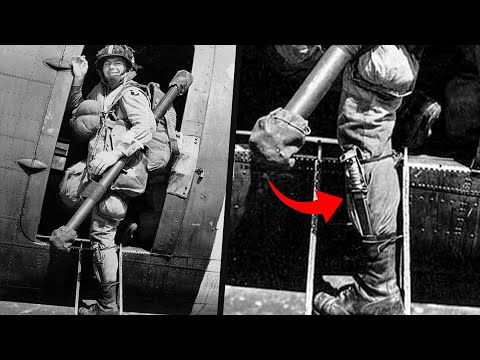
The knife that made that possible wasn’t supposed to exist. It was a compromise—a cheap replacement, a wartime expedient manufactured by nine different companies across America, none of them famous knife makers. But by August 1944, over 2.5 million had been produced. More than any fighting knife in American military history.
Paratroopers strapped them to their boots. Rangers tucked them into their webbing. Tank crews kept them within reach. And the British SAS—the most elite special forces unit in the world—chose the American M3 over their own legendary Fairbairn-Sykes fighting knife because the American design was tougher, more reliable, more brutal in the field.
This is the story of the knife nobody wanted, but everybody needed. The blade so effective it replaced every other American trench knife design. The weapon that cost less than a steak dinner and outlasted the war.
December 8th, 1941. Washington, DC. War Department Ordnance Division. America has been at war for exactly one day. Mobilization orders flood in from every branch. Rifles, ammunition, helmets, boots, bayonets. An ordnance officer opens a dusty file cabinet in the basement. Inside: stacks of World War I surplus inventory reports. He finds what he’s looking for—Mark 1 trench knives from 1918 production. 23 years old, still in storage. Thousands of them wrapped in oiled paper, waiting in arsenals from New Jersey to California.
The officer picks up a phone. “Issue them,” he says. “Airborne gets priority. Rangers second.” Nobody questions it. America needs fighting knives, and there aren’t enough to go around. The KA-BAR hasn’t entered production yet. The Fairbairn-Sykes dagger is British. The Mark 1 is what’s available, so they ship them out through spring and early 1943.
Paratroopers at Fort Benning open crates and pull out weapons their fathers might have carried in France. Six and three-quarter-inch double-edged blade. Cast bronze handles shaped like brass knuckles. Spiked guards across each finger hole. Skull-crusher pommel cap on the end, designed to stun an enemy if the blade breaks. Weight: 1 pound 3 ounces. Overall length: 11 and three-quarter inches. The knife looks medieval, brutal, intimidating as hell.
A young private from the 82nd Airborne examines his issued Mark 1. He slides his fingers through the brass knuckle guard, tries a few practice grips. The bronze is cold, slippery. The finger holes don’t quite fit his hand. He tries shifting to a reverse grip. Can’t. The brass knuckles block every position except one. He looks at the sergeant. “How am I supposed to carry this?” The sergeant shrugs. “You’ll figure it out.”
The Mark 1 trench knife was designed in June 1918 by a panel of American Expeditionary Force officers who tested every fighting knife on the Western Front. They wanted the ultimate close-quarters weapon—something that could stab, slash, and punch. The result was impressive in theory. In practice, it had problems. Big problems.
Fort Bragg, North Carolina. Summer 1942. A Ranger lieutenant tests his Mark 1 against a training dummy. He thrusts. The blade penetrates deep. Good. He tries a slashing stroke. Awkward—the brass knuckles throw off the balance. He switches to a backhand grip. Can’t—the finger guards prevent it. He tries punching with the brass knuckles. His fist slides on the smooth bronze surface. No purchase, no control.
Reports like this pour into the War Department from Rangers training in Tennessee, from paratroopers preparing for North Africa, from Marine Raiders in California. The complaints are consistent. The Mark 1 looks terrifying, but fights poorly. The brass knuckle design—meant to provide protection and a secondary striking weapon—actually limits the knife’s effectiveness. And there’s another problem. Cost.
War Production Board, Washington DC. January 1943. An economist presents his findings to the board. “The Mark 1 trench knife requires cast bronze for the handle—4 ounces per unit. We’re producing 15,000 per month. That’s thousands of pounds of strategic bronze that could be used for shell casings, electrical components, or aircraft parts. And the manufacturing process is complex. Each handle must be cast, machined, and chemically blackened. Labor hours per unit: approximately two hours. Cost per knife: estimated 8 to 12 dollars, depending on the contractor.”
The chairman leans back. “We need 2 million fighting knives by the end of 1944. That’s 16 to 24 million dollars—plus the bronze.” He looks around the table. “What’s the alternative?”
An ordnance officer stands. “We simplify. Carbon steel blade, leather washer handle—stacked leather discs turned on a lathe. Simple steel crossguard. No brass, no complex casting. Production time per unit: under 30 minutes. Estimated cost: around three dollars.”
Silence. The chairman does the math. Three dollars versus ten. Six million versus twenty million. Seven times faster to produce. And no strategic metals except carbon steel for the blade. He nods. “Do it. But it has to work. Give it to the Rangers and paratroopers first. If they approve it, we go into full production.”
March 1943. US Army Ordnance Department approves the M3 fighting knife for production. The design is almost insultingly simple. 6.75-inch bayonet-style spear-point blade. Carbon steel, blued or Parkerized finish. Three-and-a-half-inch sharpened secondary edge—the false edge designed for backhand slashing strokes. Stacked leather washer handle with eight grooves, though some manufacturers produce versions with five, six, or seven. Angular steel crossguard with a thumb rest bent at one end. Steel pommel cap. Total weight: 7 ounces—one-third the weight of the Mark 1.
The official description filed with the War Production Board reads: “The trench knife M3 has been developed to fill the need in modern warfare for hand-to-hand fighting. While designated for issue to soldiers not armed with the bayonet, it was especially designed for such shock units as parachute troops and rangers.”
Nine companies receive contracts. Aerial Cutlery, Boker, Camillus, Case, Imperial, PAL, Robeson, Utica, and Kinfolks. Each manufacturer stamps their mark somewhere on the knife. Production begins immediately. 50,000 knives by April. 100,000 by May. By June, enough M3 knives are coming off production lines to equip every airborne soldier preparing for the invasion of Europe.
Fort Benning, Georgia. April 1943. The first M3 knives arrive in wooden crates. A master sergeant from the 101st Airborne pries one open. He lifts out a knife, feels the weight. Seven ounces—light. Almost too light compared to the Mark 1. He examines the blade. 6.75 inches. Double-edged spear point. Sharp on both sides. He tests the grip. The stacked leather washers fit his hand perfectly. Warm, dry, good friction even when damp. He tries different grips—forward, reverse, ice pick, saber. The simple crossguard and leather handle allow every position. He shifts from one to another in seconds.
He checks the balance. Perfect. The blade’s narrow profile keeps the weight forward without being top-heavy. The sergeant tests it against a wooden post. Stabs. The blade penetrates two inches deep. He withdraws and slashes. The edge cuts clean through a hanging canvas target. He tries again with a reverse grip. Same result—effective from any angle. He examines the blade after 20 strikes. No chips, no cracks, no bending—just scratches on the Parkerized finish.
He writes in his evaluation: “The M3 is superior to the Mark 1 in every measurable category. Weight, balance, versatility—recommend immediate widespread issue.”
Across America, nine factories run 24 hours a day. Workers stack leather washers onto steel tangs. Machinists turn the handles on lathes. Grinders sharpen the blades. Inspectors check each one. The process is fast, efficient, simple. A skilled worker can assemble one M3 every 20 to 30 minutes. Compare that to the Mark 1, which required hours of specialized casting and machining. By summer 1943, production hits 200,000 per month. The M3 becomes the most widely distributed fighting knife in the American arsenal.
But the real test isn’t in training. It’s in combat.
Sicily. July 10th, 1943. 2:00 a.m. Operation Husky. Paratroopers from the 82nd Airborne drop in darkness over the Italian countryside. High winds, anti-aircraft fire, scattered drop zones. Many troopers land miles from their objectives.
A lieutenant from the 505th Parachute Infantry Regiment hits the ground hard in an olive grove. His parachute snags in the branches, leaving him suspended ten feet up. He can’t reach his harness release. The tree limbs are too thick to break. Enemy voices echo in the distance. Getting closer.
He reaches down to his right boot, pulls the M3 from its M6 leather sheath. The blade catches moonlight. He saws through the suspension lines—three, four, five. The double-edged blade cuts through nylon like paper. The canopy collapses. He drops, rolls, and comes up with the M3 still in his hand.
Stories like this repeat across Sicily, then Italy, then France. The M3 becomes the silent weapon of choice for airborne troops operating behind enemy lines. Light enough to carry without fatigue. Balanced enough to use in any grip. Sharp enough to cut parachute lines, rope, canvas, leather—or flesh.
Normandy. June 6th, 1944. 1:30 a.m. The same Pathfinder team. The same paratrooper. He jumps into darkness, chute deploys, landing comes fast and hard—into a tree again. Enemy voices, close. He pulls the M3, cuts free in seconds, drops, rolls, comes up ready.
Three hours later, in a barn near Sainte-Mère-Église, the door opens. A silhouette. Enemy uniform. Rifle. No time to shoulder the Garand. He draws the M3 from his boot in one motion. The knife does what it was designed to do.
By morning, over 13,000 paratroopers are scattered across Normandy. Almost all carry M3 knives. The knife becomes as essential as ammunition—more than a weapon, a tool, a last resort. If the rifle jams, if the pistol runs dry, if the grenades are gone, the M3 is there. Seven ounces of carbon steel. Silent. Reliable. Brutal.
Across Europe and the Pacific, the M3 earns its reputation. Rangers use them in Italy. Paratroopers carry them into Holland during Market Garden. Tank crews keep them for close-quarters defense. Combat engineers cut wire and open crates. The British SAS trade their elegant Fairbairn-Sykes daggers for American M3s whenever possible. The FS knife is a precision instrument. The M3 is a combat tool. Special operations troops prefer tools that don’t break.
By August 1944, over 2.5 million M3s have been manufactured—more than any other American fighting knife of the war. Then production stops. The M4 bayonet for the M1 Carbine incorporates the M3 blade design, serving dual purpose. But for the soldiers who carry M3s, nothing changes. The knife still works.
Korea, 1950. Seven-year-old knives with worn leather handles and scratched blades—still functional. Vietnam, 1965. Tunnel rats in Cu Chi prefer the narrow blade for confined spaces. Over 30 years of service. Five conflicts. From paratroopers in Normandy to tunnel rats underground.
Today, original M3s are collector’s items. Early blade-marked examples sell for $800 to $1,500. Museums display them in World War II collections. The M3’s DNA runs through 70 years of American edged weapons—the M4, M5, M6, M7. All borrowed elements from the knife designed in 1943.
But the real legacy isn’t in museums. It’s in the soldiers who carried them. The paratrooper who cut himself free from a tree. The Ranger who moved silently through Sicily. The tank crewman in the Ardennes. Every one of them carried a knife that cost the Army just a few dollars to produce. Seven ounces of carbon steel and stacked leather. No frills. No complexity. Just brutal efficiency.
The Mark 1 was designed by committee to be the ultimate close-quarters weapon. The M3 was designed by economists to conserve strategic materials. One failed. The other became a legend.
Sometimes the best weapon isn’t the most sophisticated. Sometimes it’s the one that works when everything else fails. The one that’s light enough to carry without thinking about it. Simple enough to maintain in the field. Reliable enough to trust your life to. A three-dollar solution to a million-dollar problem.
All because someone in the War Production Board said, “What if we just made it simpler?”
That’s the story of the M3 trench knife. The knife nobody wanted. The blade everyone needed. The weapon that cost almost nothing and proved that in war, simplicity and reliability outfight sophistication every time.
So here’s my question for you: if you were that paratrooper hanging in a tree with enemy voices closing in, would you trust a three-dollar knife with your life—or would you want something more sophisticated strapped to your boot? Let me know in the comments below.
Report this article
Select a reason for reporting:






