On the night of February 27, 1942, twelve Whitley bombers roared across the English Channel, their engines a low growl against the darkness. Inside, 120 elite paratroopers sat in silence, their hearts pounding, their minds focused on a mission that could alter the course of the war. They were about to jump into occupied France, onto a cliff-top radar installation that had been secretly photographed just weeks before. The stakes couldn’t have been higher.
Just months earlier, a lone Spitfire had captured an image that sent shockwaves through British intelligence. The photo revealed a mysterious German radar device near the village of Bruneval—a device that threatened to cripple RAF bombing runs. Dr. R.V. Jones, one of Britain’s top scientific minds, had long suspected German radar superiority. Now, he had proof. The only solution? Steal it.
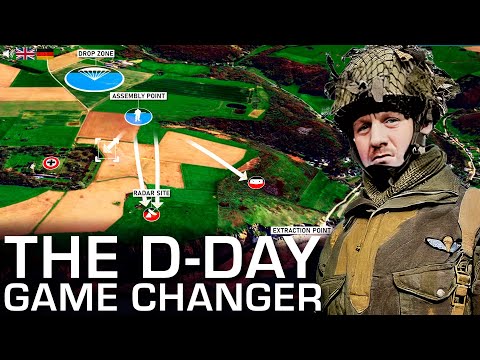
The mission, codenamed Operation Biting, was audacious. A team of paratroopers led by Major John Frost would drop behind enemy lines, assault the villa housing the radar, dismantle it, and escape by sea—all under the nose of a heavily defended German garrison. The plan relied on surprise, precision, and no small amount of luck.
As the bombers approached the French coast, the men prepared to jump. Among them was Sergeant McCloud Forsyth, who later recalled the moment: “When the red light went on, you got ready to jump. The first man with his feet in the hole, Corporal Walker. I was watching him and I saw his face turn a different color. The green light came on and it was bang bang bang like that. Go go go.” Forsyth barely had time to react before he was hurtling through the night sky.
But not everything went according to plan. Two aircraft, including one piloted by Wing Commander Pickard, missed the drop zone entirely, leaving Frost with fewer men than expected. On the ground, the paratroopers assembled in the snow, their radios malfunctioning, forcing them to rely on runners. Yet, remarkably, there was no gunfire—the Germans had been caught completely off guard.
Frost’s force moved swiftly. The villa was captured with barely a shot fired, and the radar team, led by Flight Sergeant Charles Cox, began dismantling the precious equipment. They had only minutes to saw away components and photograph key parts. The flash of a camera triggered the first enemy fire, and the night erupted in chaos.
As the raiders worked, the beach party secured the extraction point, capturing German positions and a casino-turned-headquarters. But as Frost’s men began their descent down the snow-covered cliff, carrying heavy equipment and wounded comrades, they were met by a hail of bullets. “A rattle of gunfire showed that it had not been taken,” the transcript recounts. CSM Storm was badly wounded, and two men were killed.
Just when it seemed they might be overwhelmed, the Nelson party struck from the rear, silencing the German guns. Within minutes, the beach was secured, and the landing craft arrived. By 2:35 a.m., the raiders were scrambling aboard, their precious cargo—and two prisoners—in tow. As Forsyth recalled, “I was on the last landing craft that came in on a wave, and when the wave went away, it was caught on a jutting out piece of rock. The navy man says, ‘Get underneath it and lift it.’ I said, ‘Christ, lift this up. We’re prisoners.’ The Germans by this time, some of them have gotten the cliff top and are firing down at us. Trees are flying everywhere. Ricochets, you know. Luckily enough, we eventually got off all right.”
The Bruneval Raid was over in just 140 minutes, but its impact would last for years. The captured Würzburg radar revealed German capabilities far beyond what the Allies had imagined, and the intelligence gleaned would prove crucial in the fight against the Reich. But the story was far from finished—for the men who survived, and for the war itself, that night was only the beginning.
The intelligence haul from Bruneval did not sit quietly in a laboratory. Within days of the raiders’ return, the components were rushed to the Telecommunications Research Establishment at Swanage, where Dr. R.V. Jones and his team began the painstaking work of reconstruction. What they found astonished them. The Würzburg’s parabolic dish and its associated electronics were more sophisticated than anything British radar experts had anticipated—its accuracy at short range was frighteningly good.
Jones later admitted that the raid had handed the Allies a double victory. Not only did it reveal the technical secrets of German radar, but it also exposed a critical weakness in the German defensive mindset. The official German report on the raid concluded that the operation had been “well planned and executed with great discipline,” but it also triggered a reaction that would haunt the Reich for the rest of the war.
Hitler, furious at the humiliation, ordered that every radar station along the Atlantic Wall be ringed with barbed wire and heavily defended. It was a decision born of anger, but its consequences were felt far beyond Bruneval. For RAF photo reconnaissance pilots, the new defenses were a gift. “This small but significant change made it much easier for Allied photo reconnaissance to identify previously unseen installations all along the Atlantic coast,” the transcript notes—installations that had long eluded Bomber Command.
But the human cost of the raid lingered long after the headlines faded. Two men, Private Scott and Private McIntyre, had been killed in the snow-covered gully during the descent to the beach. They were buried in Le Havre Cemetery, far from the Scottish hills many of their comrades called home. Eight more raiders were wounded, and six were left behind in the confusion of the night—men who would spend the rest of the war in German prison camps.
For Major John Frost, the raid was a proving ground. He had led his men with calm precision under fire, and the experience would serve him well in the years ahead. Less than two years later, Frost would find himself at the center of another airborne operation—this time at Arnhem, where his battalion would hold the bridge for days against overwhelming odds. Bruneval had taught him what airborne soldiers could achieve when surprise and discipline aligned.
Sergeant McCloud Forsyth returned to Britain with the others, but the night never left him. Like many veterans of the raid, he carried the memory of the tracers, the snow, and the desperate scramble onto the last landing craft. For the men of C Company, Bruneval was not merely a mission—it was a brotherhood forged in 140 minutes of chaos and courage.
Yet even as the raiders recovered and the intelligence was analyzed, the wider war pressed on. The Germans were still deep in Soviet Russia, the Atlantic convoys were still running the gauntlet of U-boats, and the Allies were still searching for a way to strike back. Bruneval had been a success, but it was a single blow in a long and brutal campaign. The lessons learned there—about radar, about airborne assault, and about the value of audacity—would soon be tested on far larger stages.
The men who returned from Bruneval found themselves swept into a whirlwind of debriefings, medical examinations, and quiet congratulations. Yet there was little time for celebration. Within weeks, several of the raiders were already being tapped for new operations, their experience too valuable to leave idle. The British high command had learned something profound from the raid: a small, well-trained force striking from the sky could achieve what fleets and bombers could not.
Among those who recognized the significance was Lord Mountbatten, chief of Combined Operations. He studied Frost’s after-action report with intense interest, noting how the paratroopers had adapted when their radios failed, how the beach party had improvised its assault on the German rear, and how the entire force had melted back into the darkness before the enemy could organize a proper response. “Bruneval proved that airborne forces could seize and hold vital objectives, even against fortified positions,” Mountbatten wrote in a memorandum that circulated through the War Office.
The raid also sent ripples through the German command that went far beyond barbed wire and reinforced guard posts. Field Marshal von Rundstedt, commander of German forces in the West, ordered a full review of coastal defenses. The conclusion was uncomfortable: if the British could land paratroopers on a cliff-top radar station, they could do the same to bridges, fuel depots, and command posts. The Atlantic Wall, vaunted as impregnable, suddenly seemed to have cracks.
Perhaps the most lasting legacy of Bruneval was the transformation it wrought in British airborne doctrine. Before the raid, the parachute battalions were still viewed by many senior officers as little more than glorified commandos—useful for raids, but not for sustained operations. After Bruneval, that skepticism evaporated. The success at Bruneval directly influenced the expansion of airborne forces and their integration into major invasion planning.
For the men of C Company, however, the war did not pause to let them savor their place in history. Many returned to their unit and began training replacements, knowing that the next jump would not be a raid but a full-scale assault. Frost himself was promoted and given command of the 2nd Parachute Battalion, a role that would place him at the sharp end of some of the war’s most ferocious fighting.
And in a quiet laboratory at Swanage, the components snatched from that French cliff top continued to yield secrets. Jones’s team discovered that the Würzburg operated on a frequency that could be jammed with the right equipment—a finding that would lead directly to the development of Window, the strips of aluminum foil that would blind German radar during the D-Day bombings. The chain of events set in motion by a single photograph and a 140-minute raid was still unfolding, reaching toward beaches far to the west.
But for now, the men who had jumped into the snow and darkness of Bruneval scattered to their next assignments, carrying with them the quiet knowledge that they had changed the war—and that the war, in turn, would call on them again.
The raid’s final chapter belongs to the men who never came home. Private Scott and Private McIntyre were buried in Le Havre Cemetery, their graves tended by the same French villagers who had watched the raiders descend. Six more men, left behind in the confusion, spent the rest of the war behind barbed wire. Their sacrifice was not forgotten—but neither did it slow the march of events.
By the summer of 1944, the lessons of Bruneval were etched into every airborne operation on the Allied planning boards. When the first Pathfinders dropped over Normandy to mark landing zones for the D-Day armada, they carried equipment born directly from the intelligence snatched on that French cliff top. The Würzburg’s secrets had become the Allies’ shield.
John Frost, promoted and battle-hardened, would lead his 2nd Parachute Battalion into Arnhem in September 1944—holding the bridge for days against impossible odds, just as he had held the villa at Bruneval. He survived the war, but many of his Bruneval veterans did not.
For those who did, the night of February 27, 1942, remained burned into memory. “It was a night they would never forget,” the record states—140 minutes that proved audacity could beat fortification, that a small band of determined men could change the course of a war.
And yet, the story of Bruneval raises a question that still echoes today: how many other quiet acts of courage, hidden in the shadows of history, changed the world without ever being told?
Report this article
Select a reason for reporting:






