There is a country in Southeast Asia where the government has never officially acknowledged what happened to its last king. No public funeral. No memorial. No grave that anyone can visit. Just silence—the kind that lasts for decades and grows louder with every passing year.
This is the story of Sisavang Vatana, the final monarch of a 600-year-old dynasty. A man who was given a meaningless title, stripped of his crown, separated from his people, and then erased from history inside a remote jungle prison camp that most of the world has never heard of. The circumstances of his disappearance raise questions that the Lao government still refuses to answer.
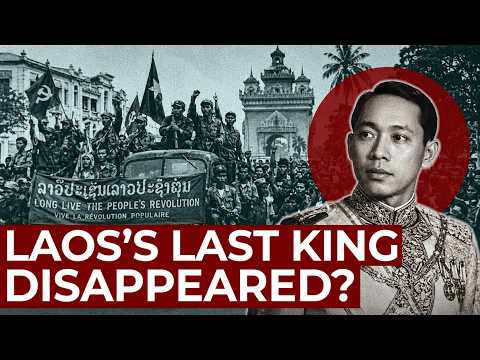
But to understand why this king vanished—and why nobody came to save him—you have to understand the country he ruled, the impossible position he was placed in, and the forces that conspired to tear his kingdom apart.
Long before the borders of modern Laos existed, the land along the Mekong River was home to one of the most powerful kingdoms in Southeast Asia: Lan Xang, the Land of a Million Elephants. Founded in 1353 by a warrior prince named Fa Ngum, it stretched across present-day Laos and into parts of Thailand, Vietnam, and Cambodia. Fa Ngum brought with him a golden Buddha statue called the Phra Bang, which became the sacred symbol of the Lao people, and established Theravada Buddhism as the state religion with his capital in the mountain city of Luang Prabang.
For roughly 350 years, Lan Xang endured—fighting wars with the Burmese, the Vietnamese, the Siamese. Its kings commanded standing armies of 150,000 men and an elephant corps that was the envy of every neighboring power. But by the early 1700s, internal power struggles split the kingdom into three rival factions: Luang Prabang in the north, Vientiane in the center, and Champasak in the south. Divided and weakened, these kingdoms became easy prey for the Siamese, who established control for much of the 18th and 19th centuries.
Then came the French. In 1893, after a tense standoff with Siam, France forced the Siamese to cede all Lao territories east of the Mekong. Laos became part of French Indochina—a buffer zone between their more valuable Vietnamese colonies and the Siamese kingdom to the west.
Under French rule, the kingdom of Luang Prabang became the principal Lao monarchy. King Sisavang Vong ascended to the throne in 1904 and would hold it for over 50 years. During World War II, Japan occupied French Indochina, and in March 1945, King Sisavang Vong was pressured to declare Lao independence under Japanese supervision. His son, Crown Prince Sisavang Vatana, was sent to Saigon to protest the Japanese actions directly at their headquarters—a brave and defiant act that showed the young prince’s willingness to confront power, even when the odds were hopeless.
After Japan’s surrender in August 1945, a burst of nationalism swept through Laos. A movement called Lao Issara briefly united the three old kingdoms under an independent government. But the French returned in early 1946, and with British support, they reoccupied the country. The Lao Issara government collapsed, and its leaders scattered into exile in Thailand.
Here is where the seeds of everything that would follow were planted. Among those exiles was a prince named Souphanouvong—a member of the royal family, a trained engineer, and a man deeply sympathetic to the communist cause. While in exile, he traveled to Vietnam and met with Ho Chi Minh. He returned to Laos with a new purpose, and in 1950 he helped establish the Pathet Lao, a communist revolutionary movement that would spend the next 25 years fighting to seize control of the country.
So from the very beginning, the conflict in Laos was a family affair. On one side, the royal government led by Prince Souvanna Phouma and backed by the monarchy. On the other side, his own half-brother Prince Souphanouvong leading a communist insurgency. Brothers from the same royal house tearing their country apart from opposite ends of the political spectrum.
And hovering above all of it was King Sisavang Vong, growing old and frail, watching his country descend into a civil war he was powerless to stop.
In 1947, France granted Laos a degree of autonomy with a new constitution. In October 1953, France officially recognized Lao independence. The 1954 Geneva Conference reaffirmed Laos as an independent and neutral nation. But neutral is a dangerous word in a region rapidly becoming the front line of the Cold War.
On October 29, 1959, King Sisavang Vong died. His son Sisavang Vatana informally ascended to the throne. And I say informally because here is a haunting detail that tells you everything about the state of his kingdom: Sisavang Vatana was never officially crowned. He kept deferring his coronation, saying he would hold the ceremony only when peace returned to Laos. That peace never came. He spent his entire reign as an uncrowned king, wearing the weight of a crown that was never placed upon his head.
Sisavang Vatana was 51 years old when he became king. Educated in France, fluent in French, he was known as a thoughtful, deeply Buddhist man who took his responsibilities seriously. He was not a firebrand or a warmonger. By all accounts, he was a quiet, dignified figure who genuinely cared about his people. But he inherited a kingdom being pulled apart by forces far more powerful than anything he could control.
To the east, North Vietnam was using Lao territory as a supply corridor—the infamous Ho Chi Minh Trail ran directly through eastern Laos. For the North Vietnamese, Laos was not a sovereign country to be respected. It was a highway.
To the west, the United States was terrified that Laos would fall to communism and trigger a domino effect across the region. And so the Americans decided to fight—but not openly. The 1962 Geneva Accords had declared Laos neutral and prohibited foreign military presence. So instead, the Central Intelligence Agency launched what became known as the Secret War.
Starting in the early 1960s, the CIA began recruiting soldiers from the Hmong ethnic minority, a highland people who lived in the mountains of northern Laos. The man they chose to lead the secret army was a young Hmong military officer named Vang Pao. Under CIA direction, he assembled a guerrilla force that eventually grew to an estimated 40,000 fighters. They fought the Pathet Lao and the North Vietnamese on the ground, disrupted supply lines along the Ho Chi Minh Trail, rescued downed American pilots, and gathered intelligence. They were, in every sense, America’s proxy army in a war that officially did not exist.
Meanwhile, the skies above Laos were being torn apart. From 1964 to 1973, the United States Air Force conducted approximately 580,000 bombing missions over Laos, dropping more than 2 million tons of ordnance on this small landlocked country—more tonnage than was dropped on Germany and Japan combined during the entirety of World War II. It worked out to roughly one plane load of bombs every eight minutes, 24 hours a day, for nine consecutive years. Laos became the most heavily bombed nation per capita in the history of the world.
And the king sat in his palace in Luang Prabang, powerless.
Think about the impossible position Sisavang Vatana was in. His country was being bombed into rubble by one foreign power while being infiltrated by another. His own half-uncle was leading the communist insurgency against him. His government was propped up by American money and American weapons—but the Americans wouldn’t even publicly acknowledge their involvement. Coalition governments formed and collapsed. Coups and counter-coups reshuffled the political deck every few years.
Through it all, the king tried to hold the center together, to maintain some semblance of Lao sovereignty and dignity in a situation where sovereignty was a fiction and dignity was a luxury nobody could afford. He was not naive. He understood what was happening. He made numerous attempts to broker peace, to bring the warring factions together. But the forces arrayed against him were simply too powerful.
This was not a Lao war anymore. This was a Cold War battlefield. And the Lao people were caught in the middle of a struggle between Washington and Moscow, between superpowers that viewed this tiny country as nothing more than a square on a geopolitical chessboard.
And then in 1973, the game changed. The United States signed the Paris Peace Accords, ending its direct involvement in Vietnam. As part of the agreement, America pulled out of Laos. Just like that, the lifeline was cut. The Royal Lao government, which had depended on American support for its very survival, was left exposed. The Hmong fighters, who had sacrificed tens of thousands of men and boys in America’s secret war, were abandoned. General Vang Pao and some of his closest supporters were airlifted to Thailand. But most of the Hmong—and most of the Lao people who had supported the royalist side—were left behind to face whatever came next.
What came next was the Pathet Lao. With North Vietnamese military support and without American opposition, they moved quickly. By the spring and summer of 1975, they advanced across the country, taking one province after another. On August 23, 1975, a contingent of fifty Pathet Lao women symbolically entered Vientiane, marking the end of royalist control. There was no dramatic final battle, no last stand at the palace gates. The kingdom simply dissolved quietly, almost anticlimactically, like a candle being snuffed out in a dark room.
On December 1, 1975, a Pathet Lao-organized body called the National Conference of People’s Representatives voted to abolish the monarchy. The next day, King Sisavang Vatana was forced to abdicate. The Kingdom of Laos, which traced its lineage back 600 years to the founding of Lan Xang, ceased to exist. In its place, the Pathet Lao proclaimed the Lao People’s Democratic Republic—a one-party communist state. Prince Souphanouvong, the king’s own relative and the figurehead of the revolution, was installed as president. The real power, however, belonged to a man named Kaysone Phomvihane, who became prime minister—the true architect of the communist movement for decades.
Now, you might expect that this is where the story of the king ends. Abdication, exile, perhaps a quiet life in France or Switzerland like so many deposed monarchs before him. But the Pathet Lao had something very different in mind.
Initially, the new government appeared to treat the former king with a degree of respect—or at least the appearance of it. They gave him the hollow title of Supreme Adviser to the President. He was allowed to remain in the royal palace in Luang Prabang. He continued to draw a monthly salary. To the outside world, it looked like the transition had been remarkably smooth, even civilized.
But behind the facade, something much darker was taking shape. In April 1976, the king was quietly moved out of the main palace and relocated to the former royal residence at Houay Sai. It was a downgrade, a signal that his status was changing. But it was still within Luang Prabang—still within sight of the golden spires and the Mekong River he had known his entire life.
Then came the re-education camps. The Pathet Lao called them seminar camps—a chillingly bureaucratic term for what were essentially forced labor and political indoctrination centers scattered across the remote northern provinces. The regime modeled them on similar systems in the Soviet Union and China, places where enemies of the revolution could be reformed through labor and ideological instruction. In reality, they were brutal. Prisoners were starved, forced to work in fields and forests, subjected to endless sessions of political criticism and self-denunciation, and denied medical care. Many did not survive.
Even before the formal communist takeover, the first groups of high-level officials had been lured to these camps through deception. Provincial governors and district chiefs received letters signed by the outgoing prime minister, Souvanna Phouma, ordering them to attend what was described as an important meeting in Vientiane. The officials arrived in full dress uniform expecting a conference. Instead, after an overnight stay, they were flown to the Plain of Jars and then transported to the camps. The atmosphere was initially described as almost festive—designed to prevent panic. But once they arrived, the reality set in quickly. There was no meeting. There was no conference. There was only the jungle, the barbed wire, and the guards.
Thousands of people were sent to these camps—former soldiers, police officers, government officials, teachers, monks, anyone deemed associated with the old regime. There are no official figures on how many were imprisoned because the entire camp system was kept secret from the outside world. Estimates range from 10,000 to 40,000, though some sources suggest the number could be higher. The camps were located in some of the most remote and inhospitable terrain in the country—in the mountains and caves of Houaphanh province, near the old Pathet Lao wartime headquarters at Viengxay.
And it was to this place—to this network of hidden jungle prisons—that the last king of Laos was taken.
In March 1977, the Pathet Lao arrested the king, his wife Queen Khamphoui, Crown Prince Vong Savang, and his brother Prince Sisavang. They were flown by helicopter to Camp Number One near Sop Hao in Houaphanh province—a prison reserved for the regime’s most dangerous symbols.
The man who had once guarded a 600-year-old dynasty now grew his own rice, cleared jungle from dawn to dusk, and slept on hard ground. Malaria and dysentery swept through the camp. Medical care did not exist.
Crown Prince Vong Savang died on May 2, 1978. Eleven days later, the king himself was gone—starved to death at seventy years old. Queen Khamphoui followed in December 1981. All three were buried in unmarked graves outside the perimeter, without funeral rites, without a single family member notified.
For over a decade, the government said nothing. Then in December 1989, Prime Minister Kaysone Phomvihane casually confirmed the king’s death during a visit to France—attributing it to old age. No apology. No explanation. It was treated as a footnote.
Today the royal palace is a museum. Tourists wander the throne room and the king’s library, never told what happened to the man who lived there. The Phra Bang still rests in Luang Prabang. The graves remain unmarked and unvisited.
Sisavang Vatana could have fled. He chose to stay, telling those around him that a king does not abandon his people. He was never crowned—and the world has largely forgotten him.
But now you know his story. And maybe that is a small kind of justice.
Should the Lao government finally acknowledge what happened to its last king—and allow his family to bring him home? Tell us in the comments below.
Report this article
Select a reason for reporting:






