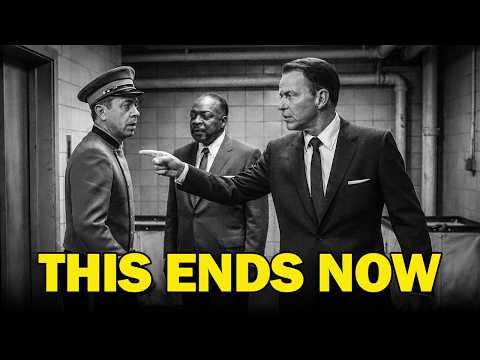
Las Vegas, November 1955. The Sands Hotel was a glittering playground for the rich and famous—but behind the neon lights, a brutal segregationist policy ruled. Black performers could headline sold-out shows, yet they were forbidden from staying in the hotels they filled, eating in the restaurants, or even walking through the front door. They were directed to service entrances and freight elevators, treated like cargo rather than artists. Most people accepted this as the price of doing business in a segregated city. But on one fateful afternoon, Frank Sinatra saw something that made him stop cold—and what he did next would change Las Vegas forever.
At 3:00 p.m. on November 3rd, Frank was walking through a back hallway of the Sands, heading to the showroom for a rehearsal. As he turned a corner near the kitchen, he saw Count Basie—the legendary bandleader whose music had filled that very showroom the night before—being directed toward the freight elevator by a hotel porter. The freight elevator. The one used for laundry, garbage, and kitchen supplies. Basie nodded quietly and walked toward it, his head down, as if he’d done this a hundred times before. Because he had.
Frank stood there for exactly three seconds. Then he walked straight to the hotel manager’s office. “If Count Basie has to use the freight elevator, then so do I,” he told the manager, Jack Entratter. “And if you don’t change this policy by tomorrow, I cancel every show I have booked here. Every single one.” The room went silent. Entratter knew Frank wasn’t bluffing. The next day, a memo went out to all Sands staff: all performers, regardless of race, were to be treated as guests. Word spread quickly through every hotel in Las Vegas. Within a year, most major hotels had quietly changed their policies—not out of moral conviction, but because Frank Sinatra had made discrimination bad for business.
Count Basie never spoke about the incident publicly, but years later, when he and Frank recorded Sinatra at the Sands together, he told someone backstage, “Frank didn’t just fight for me that day. He fought for every black musician who’d been treated that way. He didn’t have to, but he did. That’s the kind of man he is.” Frank and Basie remained friends for the rest of Basie’s life. And whenever anyone asked Frank about that day, he’d say the same thing: “Count Basie is one of the greatest musicians who ever lived. Making him use a freight elevator was an insult to music itself. I just corrected it.”
But the story doesn’t end there. What Frank did that afternoon didn’t just change policy at the Sands—it sent shockwaves through the entire entertainment industry. Other performers took notice. Other hotels took notice. And the question lingered: would Frank’s stand be enough to dismantle the deep-rooted segregation that had defined Las Vegas for decades? The answer would unfold in the months and years to come, as one man’s defiance sparked a quiet revolution.
The immediate aftermath was messier than the memo suggested. Entratter’s single sheet of paper couldn’t erase decades of habit overnight, and Frank knew it. He didn’t simply walk away once the policy changed on paper—he stayed watchful. For the rest of his engagement at the Sands, he made a point of it: if he saw a black musician heading toward the service corridor, he’d fall into step beside them and steer the conversation toward the main lobby instead.
“Ride with me,” he’d say, casual as anything, as if it were the most natural invitation in the world. And it was, when Frank Sinatra was standing next to you.
The staff learned quickly. A porter who once pointed Count Basie toward the freight elevator now found himself opening the guest elevator doors with a nod. The rules had changed, but more importantly, the man enforcing them had made it personal. Nobody wanted to be the one caught directing a headliner to the garbage chute on Frank Sinatra’s watch.
Word traveled the way it always did in Vegas—through bartenders, valets, and chorus girls with sharp ears. By the end of November, the Flamingo’s management held a tense meeting of their own. The Desert Inn followed. The question on every owner’s lips was the same: What happens when Sinatra hears about this? Because the answer was simple. He’d make a scene, and the scene would make the papers, and the papers would cost them.
But not everyone saw it as progress. Some of the older casino men resented being pushed, and a few let it be known that Frank had overstepped. One owner reportedly grumbled that a singer had no business telling hoteliers how to run their properties. The remark reached Frank’s ears within a day.
He didn’t shout. He didn’t threaten. He simply let it be known, quietly and through the right channels, that any hotel that still segregated its performers would never see him walk through its doors again—and neither would the acts he mentored, the arrangers he hired, or the musicians he brought with him. In an industry built on who you knew, that was a sentence worse than any lawsuit.
Meanwhile, Count Basie went back to work. He had a band to conduct, arrangements to refine, a show to deliver. He never made a speech about the elevator. He never demanded an apology. But those close to him noticed a change in how he carried himself in the Sands lobby—shoulders a little squarer, stride a little freer. He had always been a proud man. Now he had proof the world could be made to see it.
And Frank? Frank never framed it as heroism. When a young reporter once asked him why he’d risked his contract over an elevator, he shrugged and said the only thing he ever said about it.
“Because it was wrong. And I was in a position to say so.”
It was that simple to him. It was never simple to anyone else.
Still, the change at the Sands created a strange, uneasy weather inside the building. Some of the white staff who had enforced the old rules for years now avoided eye contact with the black performers, unsure whether to apologize or pretend nothing had ever happened. Others overcorrected, falling over themselves with nervous courtesy. Basie found it all faintly amusing. He’d spent his whole life reading rooms, and he could read this one—guilt, relief, and resentment, all swirling together in the same carpeted hallway.
Frank noticed it too, and he didn’t much care for the resentment. One afternoon he caught two dealers muttering behind the bar, their eyes tracking Basie as he crossed the lobby toward the guest elevator. Frank didn’t confront them. He simply walked over, ordered a coffee, and stood there in silence until the muttering died. Then he smiled, thanked them for the coffee, and left. Nobody ever underestimated how much a smile from Sinatra could feel like a warning.
What Frank hadn’t anticipated was how the story would travel beyond Vegas. A columnist for a New York paper picked it up, then a radio commentator, then a string of small Black newspapers that had been covering the indignities of the road for years. For them, the elevator wasn’t news—it was Tuesday. But a white superstar threatening to walk over it? That was something new. That was leverage.
By early 1956, the pressure had a name. Promoters began writing rider clauses into contracts—quiet, unglamorous lines buried in the fine print. All performers and their orchestras shall be afforded equal use of guest facilities. No marches, no headlines. Just paperwork. And paperwork, it turned out, was harder for a hotel to ignore than a protest.
Basie’s orchestra felt the shift first. The bus that used to drop them at the service alley now pulled up to the front. The rooms they’d never been allowed to book were suddenly available, though the clerks always seemed to find them on the least desirable floors. It wasn’t equality. It was the beginning of it, which is a different and more fragile thing.
Frank understood that fragility better than most. He’d grown up on the wrong side of the tracks himself, had been told he wasn’t good enough a hundred times—too skinny, too Italian, too much. He knew that a door held open for you could slam shut the moment the man holding it turned away. So he kept his hand on it.
One night after a late set, he and Basie sat alone in the nearly empty showroom, the chairs stacked, the lights dimmed to a single amber glow over the piano. Basie played something slow and unhurried, no audience, no charts, just his hands finding the keys the way other men found their way home.
Frank leaned back and listened. When the last chord faded, he said, “You know, Count, they’ll write books about this one day. And they’ll get it all wrong.”
Basie laughed softly. “They always do. Long as the music’s right, let ’em write what they want.”
Frank nodded, and for a moment neither of them spoke. Outside, the neon hummed and the desert wind pushed against the glass. There was still so much left to change—so many hotels, so many towns, so many quiet humiliations waiting in so many hallways. The memo had opened a door, but the corridor beyond it stretched long and dark, and neither man could yet see where it ended.
Frank reached over and tapped the piano lid, twice, the way a man knocks on wood. “Then let’s make sure the music stays right,” he said.
Basie smiled and played one more chord—soft, final, like a period at the end of a sentence. “It always does, Frank. It always does.”
Years later, when Sinatra at the Sands was recorded in that same room, the two men walked through the main lobby together, side by side, past the guest elevators, past the front desk, past every door that had once been closed to one of them. Nobody pointed. Nobody redirected. The building had changed its rules, and the world outside was slowly catching up.
Frank never called himself a hero, and Basie never called himself a victim. They were just two musicians who believed that dignity wasn’t a privilege to be negotiated—it was the baseline, the downbeat before any song could begin.
“Making him use a freight elevator,” Frank once said, “was an insult to music itself. I just corrected it.” And in correcting it, he reminded everyone watching that power means nothing unless you spend it on someone else.
So here’s the question that lingers long after the neon fades: when you hold even a little power, will you use it to open a door for someone else—or just walk through it alone? Tell us in the comments.
Report this article
Select a reason for reporting:






