The seventh chair sat empty. In a room where every seat held power, where silence was a weapon, the absence of one man spoke louder than any threat. Lucky Luciano, the architect of the Mafia Commission, had summoned the bosses of New York’s crime families. They came—Vito Genovese, Frank Costello, and others—each aware that defiance meant death. But Bumpy Johnson, the Harlem kingpin, did not show. Instead, he sent an envelope. Not a bribe. Not a plea. A statement.
That night, the Commission learned a new kind of fear. Not the fear of bullets, but the fear of a man who refused to play by their rules. Bumpy Johnson had built an empire in Harlem, not with violence, but with precision. His numbers game, inherited from the legendary Stephanie St. Clair, ran like clockwork. The community trusted him. The police left him alone. And now, the Mafia wanted a piece.
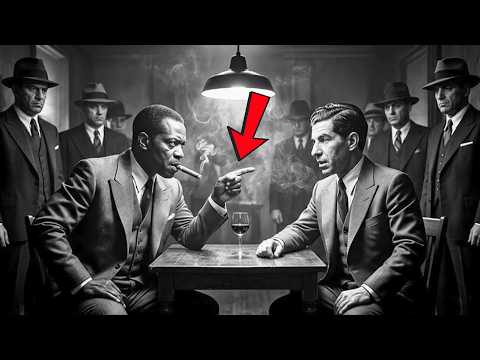
Luciano understood immediately. The envelope contained a cut of Harlem’s earnings—generous, but calculated. It wasn’t submission; it was a negotiation. Johnson was saying: I’ll pay, but I won’t bow. The other bosses waited for Luciano’s reaction. He took a slow sip of water. “We’ll handle it,” he said. Two words that meant everything and nothing.
Back in Harlem, Bumpy Johnson finished his eggs at a diner on 125th Street. He folded his newspaper, left exact change, and walked out into the cold November air. He knew they would remember. Men like Luciano always did. But Johnson had grown up in a world where being remembered was leverage. He had watched others reach for guns too fast and end up dead. He chose composure.
The numbers game was Harlem’s lifeblood. Born in the 1920s, it had been built by a woman named Stephanie St. Clair, who ran it like a business—paying on time, protecting her runners, fighting off Dutch Schultz with lawyers and newspapers. When Schultz died in 1935, the territory shifted. St. Clair stepped back, and Bumpy Johnson stepped forward. He commanded respect from 110th to 155th Street.
But the Commission’s attention turned to Harlem’s profits. Vito Genovese, hungry for expansion, sent collectors. They arrived in suits that didn’t belong, speaking to shopkeepers with assumed surrender. Bumpy let them collect. His lieutenants were confused. He told them to be patient. Then, every dollar was returned—intact, no note, no explanation. Genovese’s men had no protocol for it. You couldn’t threaten a man who had already given the money back. It was a bureaucratic ghost.
Harlem kept running. No violence, no headlines. Because Bumpy Johnson understood: Harlem’s power wasn’t just economic. It was social. The community saw him as their buffer, the man who kept worse things out. But then a shopkeeper refused to pay. Not Genovese’s men—Bumpy’s own collector. A test. Word had gotten out that Johnson let Genovese’s men walk into his territory. To the street, it looked like weakness. And in Harlem in 1935, the appearance of weakness was the actual weakness.
Bumpy handled it quietly, firmly. The details aren’t fully recorded, but the dry goods store continued operating, the owner continued paying, and no further refusals occurred. But the crack had appeared. Loyalty in Harlem wasn’t bought with money; it was held together by the fear of losing order.
The meeting was arranged through an intermediary who no longer exists in any documented record. The restaurant was downtown, in a part of the city where a black man walking in the front door of a fine dining establishment in 1935 would have been turned away. The location itself was a statement. Luciano chose it deliberately. Bumpy Johnson walked in through the front door. The maître d’ moved to stop him. One of Luciano’s men said something quiet. The maître d’ stepped aside.
Lucky Luciano was already seated. He stood when Johnson entered. This detail matters. In a world where every gesture carried weight, Luciano chose to rise. They shook hands. They sat. They ate. The conversation covered boxing, the weather, a fight at Madison Square Garden. Then Luciano set down his fork. “I’m going to be direct with you,” he said. “Harlem runs through my city. Everything runs through the commission. That’s not a threat. That’s geography. What I’m asking for is a signature—a formal acknowledgement that Harlem operates under commission structure. You keep your people, your income, your street. I get the paperwork.”
Johnson set his wine glass down slowly. “You have 17 families operating in New York right now,” he said. “Three are running at a loss because they keep fighting over the same blocks. One has been skimming from commission payments for two years, and you haven’t moved on it because you need the manpower. Harlem has none of those problems. Harlem is stable. Harlem pays. Harlem doesn’t bleed into your other operations.” He paused. “Now you want to put Harlem under commission structure, which means commission disputes come to Harlem, commission politics come to Harlem, commission enemies come to Harlem. And the thing that makes Harlem valuable—the stability, the quiet—all of that becomes a casualty of paperwork.”
The room was silent. Then Luciano smiled. “You’re playing my game,” he said. It wasn’t a compliment. Johnson did not smile back. “I’m playing the only game there is,” he said. The dinner ended without a signature, without a formal agreement. But both men left knowing something had changed. The Commission had extended its hand and found it held briefly in a grip that communicated everything without committing to anything.
The arrest came at dawn. Two detectives climbed the narrow stairs of a brownstone on 138th Street. They found narcotics wrapped in wax paper inside a flower tin. Not scattered. Not hidden poorly. Placed. By noon, the word was moving faster than the patrol car. The man they took was named Curtis—mid-level, careful, loyal. Police do not discover men like Curtis by accident.
Bumpy Johnson did not go to the station. He stayed upstairs in his office above the funeral parlor. “How much did they find?” he asked. “Enough.” “How clean was it?” “Too clean.” Johnson nodded. Someone had opened a door from the inside. By late afternoon, the rumor had changed shape: Johnson’s operation had cracks. The Commission had finally decided Harlem needed correction. Patience at dinner had been mistaken for weakness.
One of Johnson’s lieutenants leaned across the desk. “We should answer this,” he said. “Genovese sends men into our blocks. Then this happens. You let it sit. They think we’re scared.” Johnson stared at him long enough for the radiator to hiss twice. “Answer who?” he asked. The lieutenant swallowed. There was no name, just smoke.
Curtis was arraigned the next morning. Bail was set high. Johnson waited six hours before posting it—long enough for doubt to bloom. Then he sent a lawyer with a check so crisp it might have been printed for the occasion. Curtis walked out pale, jaw tight. He said the police had known where to look. He said they mentioned details he had only spoken inside a trusted room. He said nothing about betrayal. But his hands trembled when he lit a cigarette.
Johnson reassigned Curtis that night. Not a demotion, not protection—just distance. Then he began counting. Five men had known about that shipment. Four had reason. One had ambition. Ambition has a smell. It is sharp, metallic, like blood on a cold coin. The fifth man was named Isaiah Reed—younger, smooth voice, always early to meetings. He had begun talking about expansion, about modernizing routes, about bringing Harlem into alignment with larger systems. He used words like structure.
Johnson invited him upstairs after midnight. The office was dark except for a desk lamp that carved hard shadows. Outside, a train rattled over steel tracks. Isaiah entered smiling. “You wanted to see me?” Johnson gestured to the chair opposite him. “Curtis was arrested,” Johnson said. “I heard.” “You hear anything else?” Isaiah shrugged. “Police been sniffing around for weeks. Maybe he slipped.” Johnson leaned forward. “Curtis doesn’t slip.” Isaiah held his gaze. The smile did not fade, but it hardened. “You think I had something to do with it?” Johnson did not blink. “I think someone did.”
Isaiah’s jaw tightened. “With respect, people are talking. They say the commission doesn’t like being ignored. They say maybe it’s time Harlem picked a safer path.” The word safer landed heavy. Johnson stood slowly. He walked to the window and lifted the blind a fraction. “You met a man downtown two nights ago,” Johnson said softly. “The car was dark blue. Driver kept the engine running. That wasn’t a social call.” The silence shifted from defensive to dangerous.
Isaiah rose. “You’re losing control,” he said. “People see it. You let outsiders collect. You don’t strike back. Maybe Harlem needs someone who will.” The words hung between them like a drawn blade. Johnson stepped closer until the space between them disappeared. “Strike who?” he asked. “You think bullets fix rumors?” Isaiah’s breathing grew louder. “I think fear keeps order.” Johnson’s voice dropped to a whisper. “No. Fear burns order down.” For a moment, it seemed Isaiah might reach for something. He did none of those. Johnson opened the office door. “You’re done,” he said. “No noise. No spectacle. You walk out tonight and you don’t walk back in.” Isaiah’s face flushed with rage and humiliation. “You’re making a mistake.” Johnson’s eyes were cold. “No. You already did.”
Isaiah left without another word. There was no gunshot. No body in an alley. By morning, Isaiah Reed was gone from Harlem’s operations as if he had never existed. Access removed. Contacts closed. Oxygen cut off. Within days, the rumors softened. The collectors reported steady payments. Shopkeepers resumed their routines. The streets felt stable again, though quieter, as if they had witnessed something private.
Downtown, men who measured power in silence took note. Bumpy Johnson had been tested from within. He had not raised his voice. He had not fired a shot. He had removed a threat with nothing but patience and timing. In Harlem, that was more terrifying than violence because betrayal rarely walks through the front door. It sits at your table, waits for you to blink, and hopes you mistake restraint for weakness.
The indictment came faster than anyone expected. Three days after Isaiah disappeared, a federal warrant landed on a judge’s desk downtown. Narcotics conspiracy, distribution, intent. If convicted, Bumpy Johnson would lose years, not months. The news reached Harlem before the ink dried. Men stopped sweeping storefronts. Women pulled children inside.
Johnson read the indictment once, then folded it clean. “Set the meeting,” he told his lawyer. “With who?” “Luciano.”
They met above a shipping warehouse near the river. No wine. Just concrete, salt, and one tired bulb. Luciano stood by the window. “You look calm for a man about to be buried.” Johnson removed his gloves slowly. “If you wanted me buried, I wouldn’t be reading about it in a courtroom.” Luciano turned. “You think I pushed that indictment?” “I think you didn’t stop it.”
Luciano stepped closer. “I need you free. A man in a cell can’t control Harlem. And I am not interested in chaos.” Johnson watched him carefully. “You asked for a signature. And if I sign, you keep your operation. On paper, Harlem answers to the commission.” Johnson let it sit. “This isn’t about race. It’s about replacement. You’ve got men inside the commission who don’t like exceptions.”
Luciano did not deny it. He opened a folder—internal reports, one memo urging increased pressure on Harlem. “They want you squeezed. Not killed. Squeezed until you sign, or until someone else signs for you.” Johnson felt no anger, just clarity. “If I sign now, I teach every hungry man in your circle that a federal indictment is leverage.” Luciano’s voice sharpened. “If you don’t sign, they escalate.” Johnson looked directly at him. “Then let them.”
Luciano studied him. “You’re willing to gamble Harlem’s stability on pride.” Johnson shook his head once. “Not pride. Timing. If I fight this quietly, I stay in control of the narrative. If I sign under pressure, I become proof that pressure works.” “You’ll go to prison.” “A man in a cell still has a name. A man who signs away autonomy doesn’t.”
For the first time, something like reluctant respect crossed Luciano’s face. “You’re choosing prison.” Johnson put his gloves back on. “I’m choosing position outside.” A ship horn echoed across the river. Luciano walked him to the door. “If you’re wrong, you lose everything.” Johnson paused. “If I sign, I lose it anyway.”
Two days later, Bumpy Johnson surrendered in court. No speech, no resistance—just a man in a dark coat standing straight as cameras flashed. The cell door closed with a heavy steel echo. In Harlem, the rumors shifted again. Some called it weakness. Others called it strategy. The commission watched carefully, because now the signature they wanted could not be forced. And sometimes the strongest position a man can hold is the one behind bars.
So tell me—if you had been in that chair, would you have signed for safety, or chosen silence and paid the price?
Report this article
Select a reason for reporting:






