In the summer of 1939, a baron’s daughter moved into a Munich apartment that Adolf Hitler had arranged for her. According to one account, he paid the rent. The flat had belonged to a Jewish couple, evicted so she could take possession. She kept a pearl-handled pistol, a gift from him, for protection. She was one of six sisters, and each carried the family name to places no one could have predicted.
One married a millionaire and kept chickens. Another inherited a palace with an 80% estate tax. One betrayed her sister. One opened a bank account at twelve to escape, and ran until she reached a war. One gave up a vast fortune for a fascist. Six daughters of a lord who owned a gold mine in a place called Swastika. What did each of them do with a fortune that was already slipping away?
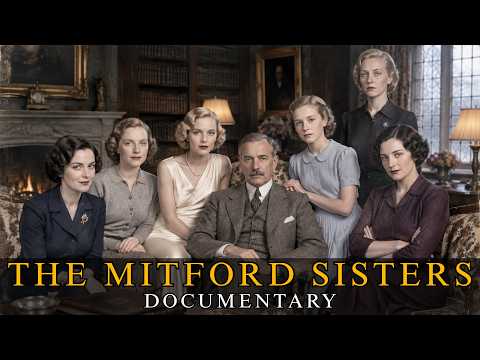
If you love hidden stories behind great family fortunes, subscribe, and I’ll keep bringing them to you. This is the story of six sisters and a dwindling fortune across six very different lives.
Chapter One: The Lord Who Kept Selling His Houses
In 1916, the younger son, who never expected anything, inherited a barony, a seat in the House of Lords, and a grand house called Batsford. His name was David Freeman-Mitford. He had not been raised to be a lord. The title was meant for his older brother, Clement, who was killed in the war in 1915. In 1916, the younger son became the second Baron Redesdale. He was 38. He had a wife, a growing family, and little experience managing money.
On paper, the estate looked vast. Batsford Park in the Cotswolds, Gloucestershire, and one source notes the estate was Batsford with 36,000 acres—a figure likely describing the family’s entire holdings, not the park alone. The land was real. The money was not. According to one source’s summary, the properties were poorly developed and rents were low. David Mitford, as records show, was not a rich man. He had seven children to support and five servants to pay. Batsford was a grand house built for a large income, which he did not have. A few years after inheriting it, he sold it.
Accounts differ on whether the sale was in 1918 or 1919, but they agree on the reason: upkeep costs were beyond his means. And so began a habit that would shape his daughter’s childhood. He bought a house, threw himself into it, then sold it. His next home was Asthall Manor in Oxfordshire, near his farms, amid rolling hills and woods, beside a trout-rich stream where he fished. He bought it in 1919 as a temporary base, then set about improving it. He converted an old tithe barn into a library and music room in Arts and Crafts style, with tall windows, hundreds of old books, a grand piano, sofas, and upstairs bedrooms connected to the main house by corridors. The older children made the barn their refuge.
Years later, his daughter Diana recalled it in her memoirs. She wrote: “This big room was the whole world for me and my brother Tom at Asthall. He played all day—Bach, Mozart, Brahms—while I lay on the sofa reading and listening.” In 1926, he sold Asthall too. The details of the sale the previous year had listed it with 2,178 acres. He had always considered it a stopgap. His real plan was to build a modern house of his own nearby at Swinbrook. He built it and moved the family there the same year. The older girls disliked the new house on sight. It lacked the freedom of Asthall, and one of them gave it a nickname that stuck. They called it Swinbrook. Only the youngest, who was six when they arrived, would remember it as the jewel of her childhood.
Sixty years after the move, in 1986, Diana returned to Asthall. She wrote what she thought of her father’s accounting. “What madness!” she wrote. “He did all that and sold it at a loss to build Swinbrook.” The record is clear on what became of his situation. One account says the move and the build nearly bankrupted him because he was bad at managing money. Another source adds that the family fortune dwindled significantly in the late 1920s due to a series of losing investments. Swinbrook itself was sold in 1938. There was also a house in London on Rutland Gate. And in the same year, 1938, the year the family gave up the house he built, David Mitford bought something new. A small island in the Inner Hebrides off the west coast of Scotland called Inch Kenneth. This island outlasted any house he owned in his life, and it ended up in the hands of the daughter least interested in dealing with it.
Adding up the numbers, the picture is stark: 36,000 acres, according to one generous account, at the start. A grand house sold within two or three years of inheriting it. Asthall bought in 1919 and sold in 1926. Swinbrook built in 1926 and sold in 1938. Seven children, five servants, and rental income that never sufficed. David Mitford was not equal to any of it. The family’s property situation declined step by step, house by house, and each step down was a choice made by the head of the family.
David had previously tried to earn a living. His father-in-law was Thomas Gibson Bowles, founder of the British Vanity Fair and in 1885 founded The Lady magazine, subtitled “A Journal for Ladies.” Bowles gave his son-in-law his first real job as manager of The Lady. But it didn’t last long. One account notes that David Mitford showed no interest in the work and had no talent for it. He loved the outdoors and field sports above all. And for many years, he loved a piece of land across the Atlantic. The family traveled regularly to Canada. There in Ontario, David Mitford owned a gold mine near a small town. He enjoyed the outdoor life that land provided, long days in the open away from any house needing mortgage payments. The town was called Swastika. Within 20 years, that word would carry a completely different meaning for the entire world, and one of his daughters would make it part of that meaning. Of her own myth. The claim never made him rich. No gold was ever found.
This is the first truth of this family’s fortune. It was mostly land, low-yield land. A title, a useless title. A series of houses bought and sold at a loss, and a gold mine that never yielded gold. And it was about to be divided, on hope and expectation, among seven children. One of them was a boy. Six were girls. Under the rules of their world, the boy would inherit almost everything. The girls were expected to inherit almost nothing.
Chapter Two: Six Daughters and Nothing of Their Own
The girls were educated at home. This was the rule of the Mitford nursery with few exceptions. Their father disliked formal education for girls almost as much as he disliked foreigners. Their brother would go to Eton. The six sisters would be taught at home by governesses in whatever rooms the current house provided. And what was expected of them with this education was simple. They were expected to marry a man of standing. Tom’s path went the opposite way. He went to Eton. And in the late 1920s, he traveled to Berlin to study law. There, in Germany in those years, he developed a leaning toward the Nazi Party, a sympathy he carried quietly with him into the war. The son was given education, travel, and the expectation of inheritance. The daughters were given the nursery.
The account of their births tells the story of a long marriage. David Mitford married Sydney Bowles in February 1904. Nancy was born the same year, 1904. Then Pamela in 1907. The only son, Tom, was born in 1909. Then Diana in 1910, Unity in 1914, Jessica in 1917, and Deborah, the last, in 1920. Six daughters over 16 years, and one boy in the middle, carrying on his shoulders the future of the entire name.
The path to that marriage went through certain rituals. Each daughter, at about eighteen, was to make her debut in the season of dances and presentations where a lord’s daughter is announced as available for marriage. Nancy made her debut at the Asthall barn in November 1922, and was presented at court the following June. Diana was presented at court at eighteen, and secretly engaged within a year. Unity made her debut in 1932. The rules of the English aristocracy were strict. A daughter could not inherit her father’s title. The barony passes through the male line to the son, and if there is no son, to the brother. Land and houses usually follow the title. A lord’s daughter could expect a name, a dowry if the family could afford it, and a husband if she was lucky. The Mitford girls got the name. Whether the family could afford anything else was a question already answered by the house sales.
Inside the nursery, they made their own world. They called each other names the outside world would later use. Pamela was called Woman. Unity was called Bobo. Jessica was called Decca, and Deborah was called Debo, though Nancy, ever sharp-tongued, also called her “Nine,” cruelly, thinking her little sister’s mind would never exceed nine years old. They invented private languages. Unity and Jessica spoke a language they called “Boudledidge,” and each called the other “Boud.” There was another language called “Honnish,” the language of the “Hons,” the children who hid from adults in a warm linen cupboard. They called it the “Hon cupboard.” Decades later, Jessica wrote that she still remembered the same suffocating, distinctive smell, and the same enchanting promise of total privacy from adults.
Their mother was cold, remote, and frugal. She was the daughter of the magazine founder, and it was hard for her children to connect with her. Unlike her husband, she held pro-German sympathies she never entirely abandoned. Her responses to their rebellions were extremely harsh. When she learned years later that one of her daughters had become a communist, Jessica recorded her reaction. She said: “I think a communist would be much tidier, and cause a lot less extra work for the servants.”
Their father was entirely different. He was loud, quick-tempered, and suspicious of foreigners, and he had a wonderful sense of humor. His eldest daughter would one day immortalize him in her novels as Uncle Matthew, the roaring, benevolent tyrant, and readers would love him without realizing how close to reality he was. Then, in the 1930s, the private jokes of the nursery turned into political arguments. Jessica and Unity shared a bedroom. As small children, they divided it with a chalk line down the middle. On Jessica’s side were placed the hammer and sickle and pictures of Vladimir Lenin. On Unity’s side were placed the swastika and pictures of Adolf Hitler. The two sisters slept a few meters apart beneath the symbols of the two great movements that were about to tear Europe in half.
The parents were not immune to this enthusiasm. For a time, both were drawn to Hitler’s Germany. They attended the Nuremberg rallies in 1937 and 1938. And there they met Hitler himself. When Britain entered the war in 1939, David Mitford turned completely around. He became a fervent patriot and anti-German. His wife did not follow suit. In 1940, he wrote to The Times to justify his position, saying: “My only crime, if crime it be, is that I was one of thousands in this country who believed that our interests would be served by a friendly understanding with Germany.” The rift between husband and wife never healed. In 1943, after nearly forty years of marriage, they separated.
By then, the children had scattered across the political landscape of the century. Two daughters were involved in fascism, one of them joining Hitler’s ranks. Another joined communism and the Spanish war. A third moved toward the moderate left in the literary world. While two kept themselves away from politics. One to become a duchess, and another to a farm. One family. One dinner table. And gathered around it, all the sides of that era.
This, then, is the legacy the six sisters inherited. Their father’s fortune was low-yield land and sold houses. Their mother was frugal in everything she owned. The title would go to a man. And each of them, in her own way, had to answer a question her upbringing posed and never solved: What does a lord’s daughter do when her name is all she owns? The first to leave answered the question the old way, and quietly.
She answered it by marrying a millionaire and asking for nothing more than a farm. Pamela, the most rural of them all, died in 1994 among her chickens, the quiet control group in the experiment. Deborah answered it by turning a debt into an enterprise, and the palace survived. Nancy answered it with her pen, Jessica with her causes, Diana with her allegiances, Unity with her life.
And the fortune itself? It was never really there. The gold mine yielded nothing. The houses were sold at a loss. What the six sisters inherited was a name and a certainty that any choice a Mitford made would echo. They tore their family into six pieces and kept writing to each other for the rest of their lives.
In the end, the youngest, who saved the house, left the sentence that could be carved on all six graves: “Since everything in life is unfair, perhaps realizing that early is best.”
It is a long journey from a Hebridean island to a street in Munich. But the story ends where it began: a baron’s daughter in an apartment that was never hers, a pearl-handled pistol in the room, and a family fortune already gone.
Of the six Mitford sisters, who do you think made the right decision about the family money—Pamela, Deborah, Nancy, Jessica, Diana, or Unity? Share your thoughts in the comments.
Report this article
Select a reason for reporting:






