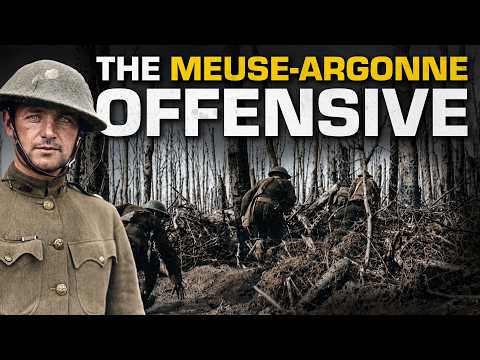
Ask anyone today to name America’s greatest battle, and you’ll likely hear Gettysburg, Normandy, or Midway. But the Meuse-Argonne? Almost never. Yet this forgotten offensive was the largest in U.S. history, involving over a million soldiers, and day-for-day it was deadlier than Normandy. More importantly, it was where future leaders like George Marshall, George Patton, Douglas MacArthur, and Harry Truman first learned to fight. So why has this pivotal battle been relegated to the shadows?
By September 1918, the First World War had ravaged Europe for four years. The landscape was a moonscape of trenches, craters, and barbed wire. Empires had fallen, economies were exhausted, and millions were dead. But the tide had turned. Germany’s last desperate offensives had failed, and the Allies were now advancing in the Hundred Days Offensive. For the first time, victory seemed possible. General John “Black Jack” Pershing, commander of the American Expeditionary Forces, saw an opportunity to strike a decisive blow—through the Meuse-Argonne.
The battlefield was a natural fortress. To the east, the Meuse River; to the west, the dense Argonne Forest; and in between, a corridor of ridges and fortified villages. At its heart stood Montfaucon, a hill 500 feet high that gave German observers a commanding view. The Americans would have to take it. But why attack here? The answer lay beyond the battlefield: the railway hub of Sedan. If the Americans could threaten it, the German army would be forced to withdraw. The Germans knew this and had spent years turning the sector into a deadly maze of machine-gun nests, trenches, and barbed wire.
Pershing believed his doughboys could crack it. They were eager, courageous, and physically fit, but inexperienced. Many had never seen combat. Yet just days earlier, they had won a stunning victory at Saint-Mihiel. Now Pershing wanted something bigger. The challenge was assembling 600,000 men, 15,000 vehicles, and 90,000 horses—at night, across a shattered landscape, without the enemy noticing. The task fell to Colonel George Marshall, who later called it “my greatest contribution to the war.” Within 14 days, the bulk of the AEF was in position. But getting there was just the beginning.
As the evening of September 25 drew to a close, hundreds of thousands of American soldiers moved quietly into their assembly positions. Among them was Major Charles Whittlesey, a New York lawyer, leading his men of the 308th Infantry toward the dark mass of the Argonne. Their fight would be slow and brutal. At precisely 2:30 a.m. on September 26, 1918, the silence was shattered as more than 2,700 guns opened fire along a 24-mile front. The bombardment was so intense that artillery captain Harry Truman had to douse his guns with water to keep the barrels from melting. His battery fired over 3,000 rounds in 24 hours. For the Germans, it was terrifying. For the Americans, it was the signal to advance.
Then, shortly before dawn, the barrage crept forward. Along the entire front, hundreds of thousands of doughboys climbed from their positions. Private Arthur Jewell of the 79th Division described the moment: “A company over. E company ahead. Third Platoon advance. Combat groups about 30 paces. Scouts out.” And the regiment began its part in one of America’s greatest battles. The area of bursting shells advanced ahead of the troops at about their own rate of speed. At first, the platoons were under good control, but soon squads and files were separated in the fog and smoke. Meeting mostly stunned defenders, the central attack started well, and before long the doughboys were advancing on the looming mass of Montfaucon.
On the east side, troops of the 3rd Corps pushed forward against the German front line and met with significant success. But further west, in the Argonne Forest, the 1st Corps entered a very different battlefield. Captain Walter Rainsford remembered: “I climbed out with the nearest platoon into darkness and impenetrable fog mixed with powder smoke. One could literally not see two yards and everywhere the ground rose into bare pinnacles and ridges or descended into bottomless chasms half filled with rusted tangles of wire.” It was a nightmare of confusion and hidden enemies.
Back in the center, by late morning, elements of the 79th Division approached the lower slopes of Montfaucon. To their left and right, more experienced divisions advanced rapidly, overrunning forward German positions. For a brief moment, it seemed the defenders might not put up much of a fight. Those hopes were quickly dispelled as the leading troops came into range of the veteran 11th Grenadier Regiment, waiting in their pillboxes. Private Arthur Jewell was there: “As if by prearranged signal, enemy machine guns, automatics and snipers located in trees, gullies, and bushes ahead and on the flanks opened with a hot fusillade which filled the air with snaps, cracks, and whines of flying lead.” For hours, German snipers and machine gunners swept the area with a steady sheet of fire. The leading infantry of the 79th took horrific casualties, stuck in the open with no way forward or back.
There was an opportunity to relieve the pressure. To the right of the 79th, the veteran 4th Division had made excellent progress and was already well ahead. Had they swung left around the back of Montfaucon, the defenders would have been cut off. But in a controversial decision still debated today, General Bullard did not authorize the move. Instead, the 4th pushed straight ahead. The result was more dead doughboys.
Further left, in the Argonne, progress had been slow. Fog, confusion, and the horror of discovering an unsuppressed machine gun at close range made the advance a nightmare for the men of the 77th Division. But they did make some progress. To their right, in the more open Aire River Valley, there had been real progress. The attacking troops had captured the town of Varennes early on and pushed on through the rolling plains. Here the Americans could use their two-man Renault light tanks, led by a young Colonel George S. Patton. When approaching the village of Cheppy, Patton got out and advanced on foot to scout ahead. He later recalled: “I yelled, ‘Who comes with me?’ A lot of doughboys yelled, but only six of us started. Soon there were only three, but we could see the machine gun right ahead. So, we yelled to keep up our courage and went on. Then the third man went down and I felt a blow in the leg.” Hit by a machine-gun bullet, Patton’s war—and nearly his life—came to an end just outside Cheppy.
Despite the problems, the first day was a considerable success. In some areas, troops advanced up to six miles and thousands of German prisoners were taken. But one major problem surfaced: logistics. By the second day, many infantrymen were out of rations and water, and traffic jams in the rear meant resupply was nearly impossible. But the attack had to go on. The entire focus now lay on Montfaucon. That morning, the 79th attacked again, aiming for the old monastery at the top of the hill, but after a bloody close-range fight, were forced back. It was only the intervention of the 37th Division attacking from the left that finally cracked the position. With tanks, artillery, and determined assaults, they prized open the defense, and by the afternoon of the 27th, the shattered church on the hill’s crest had been taken. Finally, the advance could continue.
Elsewhere, progress was good until hitting pockets of resistance. But the Americans were learning. Over the next few days, the pattern persisted: the German defense stiffened with reinforcements, and momentum slowed. But it was in the Argonne where the real problems lay. Major Whittlesey and his men had found themselves cut off when they advanced further than the units on their flanks. Then, on October 2, it happened again. This time, some 650 men from various units found a gap in the German line and passed through largely undetected before digging in in the Charlevaux Ravine. The problem was nobody else did. When the Germans re-sealed their line the following day, the “Lost Battalion”—which wasn’t a battalion and wasn’t even lost—found themselves trapped.
Their story would become legendary, but for now, the battle raged on. And another hero was about to emerge from the Meuse-Argonne: Alvin York.
Born in rural Tennessee in 1887, York was an unlikely hero. A wild child in his youth, he had experienced a religious conversion in 1915 and became a convinced pacifist, even writing on his draft registration card that he did not want to fight. Yet by October 1918, he found himself in the Aire River Valley, next to the Argonne. His division, the 82nd, was given the job of bypassing the German defenses in the forest and swinging left to cut them off from the rear.
That’s exactly what was happening on the morning of October 7 when his unit approached the village of Chatel-Chéhéry. Moments later, the entire regiment was brought to a standstill when multiple machine guns opened up to their front. A patrol of 19 men was sent around the flank of the German line. With them was Corporal Alvin York. Ambushed a short time later as they crossed a stream, the sergeant leading the patrol was wounded, leaving York in charge.
According to the traditional story, though it’s still hotly debated, he took up a position forward of his men and personally shot upwards of 20 Germans with his rifle. Minutes later, in a bid to get rid of the highly skilled marksman on their flank, a charge was made at the lone York, who reportedly single-handedly shot four men with his Colt .45 at just a few yards’ range. Several hours later, York and the remnant of his patrol emerged from the woods with a long line of prisoners in tow, having silenced the machine guns pinning down his comrades.
Meeting his commanding general a short time later, the famous exchange took place. “Well, York, it seems you’ve captured the whole German army.” “No, sir. I only got 132.” York was eventually awarded the Medal of Honor and became a somewhat reluctant national celebrity. His actions were truly important. With the Germans in the Argonne beaten and Whittlesey’s men relieved, the fight on the left could finally begin to move—but not quickly.
Behind the lines, the logistical snarl-ups continued and got so bad that even while the Argonne fighting raged, Pershing was forced to order an operational pause. During that time, it was noticed that increasing numbers of doughboys were being found back behind the lines with little or no reason to be there. The result was the excellently named Hobo Barrage, where thousands of men were employed rounding up stragglers and sending them back to their units, often at the point of the bayonet.
When the attacks restarted on October 12, the Americans were in better shape. Artillery—the real king of the battlefield—was used with increasing effectiveness to reduce strong points, as fresh divisions were brought in to pin the enemy in place while others outflanked them. When, within a couple of days, the French 17th Corps advancing on the right-hand side of the Meuse managed to clear the major gun batteries on the heights overlooking the American advance, the attack picked up speed.
Prominent among those leading the way was Lieutenant Colonel William “Wild Bill” Donovan, the man who would go on to head the OSS in World War II and become known as the father of the CIA. His Medal of Honor citation recalls how he personally led the assaulting wave against a very strongly organized position, and when his troops were suffering heavy casualties, he encouraged all near him by his example, moving among his men in exposed positions, reorganizing decimated platoons, and accompanying them forward. When he was wounded in the leg by machine-gun bullets, he refused to be evacuated and continued with his unit until it withdrew to a less exposed position.
Despite the continued success, logistical problems simply wouldn’t go away, forcing Pershing—who by now had split his force into two separate armies—to order another pause between the 16th and 31st of October to prepare for one final push toward the rail hub of Sedan. The men were exhausted, the roads were choked, and the rain had turned the battlefield into a sea of mud. But the end was in sight, and every soldier on the line could feel it.
The final offensive came at 3:30 a.m. on November 1, 1918, when a hurricane bombardment slammed into the German positions on the Barricourt Heights. This time, everything came together. Artillery, infantry, aircraft, tanks, and logistics finally worked with admirable cohesion. Over the course of several days, the Americans smashed through the German lines and sent them into a headlong retreat that would only end at 11:00 a.m. on November 11 with the signing of the armistice.
The Battle of the Meuse-Argonne was over. But it didn’t come cheap. All told, some 26,000 American troops lost their lives and more than 100,000 were wounded in just 47 days of battle—day-for-day bloodier than the Normandy Campaign.
Yet perhaps the real significance of the Meuse-Argonne is what it showed. When the offensive began, much of the American army had never fought a major battle. Forty-seven days later, it had helped break the German army and bring the First World War to an end. The cost had been enormous, but so too had the transformation. It was the battle in which America learned to fight a modern war.
So why has this pivotal battle been forgotten? And does it deserve to be remembered as America’s greatest battle? What do you think—should the Meuse-Argonne finally take its place alongside Gettysburg and Normandy?
Report this article
Select a reason for reporting:






