The rain fell in sheets, turning the red earth of Long Tan into a quagmire that swallowed every step. Major Harry Smith led 108 young Australians into the rubber plantation, expecting a routine patrol. Most were conscripts, barely out of their teens. They carried SLR rifles and packs that weighed more than they did. Visibility was thirty meters at best. The radio crackled with static. They had no idea they were walking into the staging area of a Viet Cong regiment—2,000 battle-hardened fighters preparing to attack the Australian base at Nui Dat. This was not a patrol. This was a trap.
When the first shots rang out, they came from everywhere. AK-47s barked from three sides. Bullets shredded rubber trees, sending bark and leaves raining down. Major Smith grabbed the radio, his voice calm over the chaos. “We’re staying. Hold your ground.” It was a direct violation of American doctrine, which dictated retreat and helicopter extraction when outnumbered. But the monsoon had grounded the helicopters. Running meant leading the enemy straight to a thousand sleeping Australians. So Smith spread his three platoons into a rough circle, each fighting independently, and prepared to face an army with only their rifles, their discipline, and each other.
The first wave hit 11 Platoon at 4:08 PM. Three hundred Viet Cong charged through the rubber trees, screaming. The Australians opened fire with measured, aimed shots—one bullet, one kill. The M60 machine guns tore through the ranks, tracers cutting red lines through the gray rain. “Aim. Fire. Pick another target,” the section commanders shouted. The enemy fell, but more came, stepping over their dead. The Australians held, their fire never slackening, their ammunition dwindling with every passing minute.
Forward observer Murray Stanley called in artillery from Nui Dat, four kilometers away. The first shells landed two hundred meters out, then walked closer—150, 100, 50 meters. “Danger close,” Stanley said into the radio. The crews hesitated, then fired. The ground erupted. Shrapnel scythed through the enemy, but also cut down Australians. The blast wave knocked men flat. Yet the attack broke. The survivors fled into the jungle, leaving behind a carpet of bodies.
By 6:30 PM, ammunition was critically low. Some sections had ten rounds per man. Then, through the rain, came the roar of diesel engines—armored personnel carriers bringing resupply. The soldiers grabbed the boxes, reloaded with shaking hands, and prepared for the next assault. The enemy came again at dusk, a final desperate push. They infiltrated through the gaps, trying to overrun the positions. At 11 Platoon, a young conscript’s rifle jammed. He cleared it with mud-slick fingers as enemy soldiers closed to thirty meters. He fired, dropped one, then another. The line held.
Private Errol Noack saw enemy flanking his section. He stood up, fully exposed, and fired from the hip to draw their attention. “Get down, Errol!” someone screamed. But he kept firing until a bullet struck his chest. He fell. His mates killed the attackers and closed the gap. Noack was twenty-one. His girlfriend, Jean, would receive a telegram two weeks later.
By 7:00 PM, the enemy had had enough. The fire stopped. The jungle swallowed the Viet Cong as suddenly as they had appeared. Silence fell, broken only by the rain and the moans of the wounded. The Australians held their positions, fingers on triggers, waiting. Nothing. Radio reports confirmed: enemy withdrawn. Against odds of twenty to one, D Company had survived. Eighteen Australians lay dead, twenty-four wounded. But at least 245 enemy bodies littered the plantation—a kill ratio of fourteen to one.
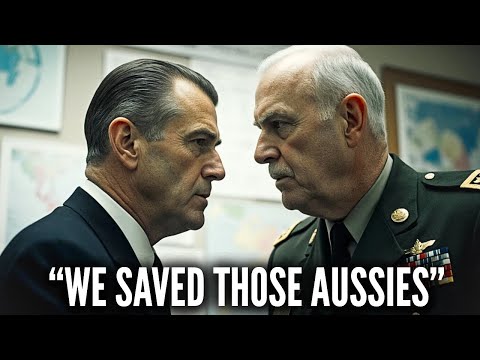
In Washington, American generals presented Long Tan as proof of their strategy. But when Australian Prime Minister Harold Holt told Richard Nixon the truth—that 108 Australians had held ground using tactics Americans had abandoned—Nixon’s response was quiet and devastating. “Your boys held their ground when ours would have called in the helicopters and left. There’s a lesson there we’re not learning.” The generals went silent. The victory had exposed the lie at the heart of the American war effort. And the lesson would echo for decades.
The silence in the briefing room was absolute. The maps on the walls, the pins marking troop positions, the clinical language of body counts—all of it suddenly felt like a flimsy stage set. Nixon did not raise his voice. He did not need to. He simply let the weight of the truth settle over the room like the monsoon rain itself.
General William Westmoreland, commander of American forces in Vietnam, was the first to speak. His jaw was tight, his medals catching the light as he shifted his weight. “Mr. President, with respect, our tactics are designed for the broader war. The Australians fought a single, fixed battle. We fight a war of movement and attrition. The situations are not comparable.”
Nixon turned to him slowly. He had heard this defense before, in different forms, from different generals. It was the same argument that had kept the war grinding on, year after bloody year. “Not comparable?” Nixon repeated. “A hundred and eight men held off two thousand. They didn’t run. They didn’t call for helicopters. They stood and fought and won. And you’re telling me that’s not comparable to what we’re doing?”
The general’s mouth opened, then closed. No words came. The other officers in the room—colonels, majors, intelligence analysts—studied their folders as if the answers to the war might be hidden in the paper. No one wanted to meet the President’s eyes.
Nixon walked to the large map of South Vietnam that dominated the wall. He tapped a finger on Phuoc Tuy province, a small coastal region that most Americans could not have found on a map. “The lesson isn’t about who won,” he said quietly. “The lesson is about how they won. They used old-fashioned discipline. They trusted their officers. They brought artillery in close and didn’t flinch. They didn’t rely on machines and volume. They relied on men and training and the will to hold.”
He turned back to the generals. “We have more helicopters, more bombs, more money than any army in history. And yet a hundred and eight Australians did what our units are told never to do—and they succeeded. What does that tell you?”
The room remained silent. The answer was obvious, and it was dangerous. It told them that the entire American way of war in Vietnam—the mobility, the firepower, the body counts, the endless search-and-destroy missions—might be the problem, not the solution. It told them that the enemy could be beaten, but not by the methods they had chosen.
General Westmoreland finally spoke again, his voice stiff. “With respect, sir, we cannot simply abandon our doctrine based on one battle. The Australians had the advantage of terrain and a fixed defensive position. Our forces operate across the entire country. We cannot be everywhere at once, holding ground like that.”
Nixon nodded, but his expression was cold. “No, General. You cannot be everywhere at once. But you can learn from those who did more with less. And you can stop claiming their victory as proof that your strategy is working.” He let the words hang. “That is the lie I will not tolerate. Long Tan was not an American victory. It was an Australian one. And it proved that our approach is failing. If we cannot admit that, then we have already lost.”
The generals exchanged glances. Some looked angry. Others looked defeated. But none of them argued. They had been outmaneuvered by a politician who understood, perhaps better than they did, that wars are not won by numbers alone. They are won by the willingness to adapt, to learn, and to admit when you are wrong.
That night, Nixon sat alone in his office, a glass of whiskey untouched on the desk. He thought about the young Australians in that rubber plantation—boys who had never heard of Long Tan before that morning, who had fought and died in a place they could not have found on a map. He thought about the American boys dying in other jungles, for other reasons, under other commanders who refused to see the truth.
He picked up a pen and wrote a single line on a notepad, a thought he would carry with him for years: “We are fighting the wrong war in the wrong way. And the price is paid in blood.”
He did not share the note with anyone. But the sentiment would echo through the corridors of power in the months and years to come, as the war dragged on and the body counts rose and the American public turned further against a conflict that seemed to have no end. The lesson of Long Tan—that courage and discipline and small-unit excellence could overcome impossible odds—was never fully learned by the American military. But it was remembered by the men who fought there, and by the families of those who did not come home.
In Australia, the survivors of D Company gathered each year on August 18th. They stood in the rain, just as they had on that day in 1966, and they remembered. They remembered the faces of friends who would never grow old. They remembered the sound of the guns and the smell of cordite and blood. They remembered the terror and the courage and the strange, terrible beauty of men standing together when everything else fell apart.
And they remembered the truth that Nixon had seen and the generals had refused to accept: that sometimes the bravest thing a soldier can do is hold his ground, and sometimes the hardest thing a nation can do is admit that the war itself is wrong.
Nixon never publicly repeated those words. But the note he wrote that night stayed with him. Years later, when the war had ended in defeat and the helicopters were lifting the last Americans off the rooftops of Saigon, he would think of Long Tan. Of 108 men who held. Of a lesson that was offered and refused.
The rubber trees at Long Tan grew tall again. Farmers returned to tap the latex. Children played in the fields where artillery had once churned the earth. The red soil, as it always does, forgave everything.
But the men who survived did not forget. They gathered each August 18th, fewer every year, and stood in the rain. They remembered Errol Noack, twenty-one, who stood up so his mates could live. They remembered the conscript who cleared his jammed rifle with shaking hands. They remembered the smell of cordite and blood and fear.
And they remembered that they had done everything right—and it had not been enough to win the war.
The lesson of Long Tan was never carved into any Pentagon wall. It lived only in the memories of old men and the silence of a rubber plantation. That courage and discipline can win any battle, but cannot save a nation from a war that should never have been fought.
So here is the question that still hangs over that red earth, waiting for an answer: if we had learned the lesson of Long Tan in 1966, how many names would never have been carved into a black granite wall in Washington?
Report this article
Select a reason for reporting:






