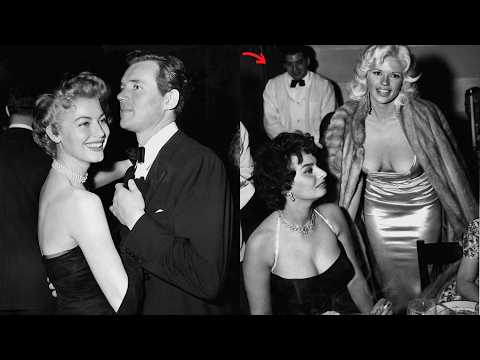
The air was thick with cigarette smoke and ambition. In the dimly lit corners of 1930s Hollywood, stars weren’t just born—they were manufactured. And behind the velvet ropes, away from the blinding flashes of premiere nights, another world existed. A world of whispered secrets, fragile egos, and fleeting moments of genuine humanity.
These are the moments that Retro Reel Archive has painstakingly preserved. Rare, unseen photographs that capture the essence of an era long gone but never forgotten. From the golden 40s to the dramatic 70s, each image is a portal to a time when movie stars were gods and goddesses, and their lives were the stuff of legend.
You’ve seen them on the silver screen, larger than life. But have you ever wondered what happened when the cameras stopped rolling? When the director called “Cut!” and the lights dimmed? That’s where our story begins.
“These rare visuals are something special,” whispers the archivist, carefully turning a page of a weathered album. The photographs inside are yellowed with age, but the faces are unmistakable. Clark Gable, his trademark smirk softened by a rare moment of vulnerability. Marilyn Monroe, caught in a candid laugh, her guard momentarily down. Humphrey Bogart, eyes squinting against the sun, a hint of a smile playing on his lips.
Each image tells a story. A story of laughter shared between takes, of stolen glances between co-stars, of quiet moments of reflection before stepping into the spotlight. These are not the polished portraits released by studio publicists. These are real. Raw. Human.
As we delve deeper into the archive, the decades unfold like a reel of film. The 1940s, with its wartime romance and noir shadows. The 1950s, a Technicolor dream of suburban bliss and rebellious youth. The 1970s, a gritty reawakening, where old Hollywood gave way to a new generation of rebels.
But amidst the glamour and the glitter, there’s a question that lingers: What price did these stars pay for immortality? The photographs offer clues—a tired smile here, a distant gaze there. They remind us that behind every legend is a person, with dreams and doubts, loves and losses.
So, step inside. The archive is open, and the stories are waiting to be rediscovered. Which era speaks to you the most? The golden 40s, stylish 50s, or dramatic 70s? The answer might just lie in the faces captured in these rare, unseen photos.
The archivist’s fingers paused over a particular photograph, tucked away in a sleeve marked only with a faded date: 1947. “This one,” she said softly, “this one always makes people stop and stare.”
It was a shot of Rita Hayworth, but not the Rita the world knew. No studio lighting, no perfect curls. Just a woman sitting alone on a folding chair behind a soundstage, shoes kicked off, a half-smoked cigarette burning down between her fingers. Her eyes were fixed on something beyond the frame—something none of us would ever see.
It’s the kind of image that doesn’t shout for attention. It waits. It lets you lean in closer, until you start to wonder what she was thinking. Was she running lines? Remembering a quarrel? Or simply wishing she were somewhere else entirely?
That’s the thing about these forgotten moments. They don’t offer answers. They offer presence. You feel the draft from the soundstage door, hear the distant clatter of a camera crew packing up for the night, sense the exhaustion that no amount of fame could erase.
Move a few pages forward and the mood shifts entirely. Here’s the 1950s in glorious color—a beachside party, sunglasses and swim caps, someone’s grandmother laughing with her head thrown back. “That’s the thing,” the archivist notes, “the 50s photos are the ones people smile at. They feel like home movies they never got to star in.”
But look closely at the edges of the frame. There’s always someone standing slightly apart, nursing a drink, watching the party rather than joining it. The stylish decade had its lonely corners too.
Then comes the 1970s—grainy, unposed, almost defiant in its honesty. A young Jack Nicholson, years before the legend hardened around him, caught mid-laugh with a script rolled up under his arm. A dressing room mirror lined with handwritten notes. A parking lot at dusk, where a director and an actress argue quietly beside a beat-up car, neither of them famous enough yet to be recognized.
“Every era leaves a different fingerprint,” the archivist says, closing the album gently. “The 40s hid their pain behind elegance. The 50s smiled through it. The 70s just let it all hang out.”
She slides the album across the table toward us, and there’s one more photograph resting on top—one we haven’t seen yet. A face turned away from the camera, half in shadow, half in light. Whoever it is, the moment was captured just before they turned around.
The archive, it seems, always keeps one secret in reserve.
The archivist noticed our eyes fixed on that final image. “That one’s a mystery even to me,” she admitted, tapping the corner of the print. “No name on the back, no studio stamp. Just a date—August 1953—and a single word scribbled in pencil: ‘Almost.'”
Almost what? Almost famous? Almost forgotten? The question hung in the air like dust caught in a projector beam.
She pulled another box from the shelf, this one labeled with a decade we hadn’t touched yet: the 1960s. The lid came off with a soft sigh, and suddenly the room smelled faintly of old paper and something sweeter—perfume, perhaps, soaked into the photographs over half a century.
“The 60s are the ones that surprise people,” she said, spreading a handful of prints across the table. “Everyone expects peace signs and revolution. But look here.”
A candid shot showed a young actress—barely twenty, by the look of her—curled up in the back seat of a limousine, fast asleep, her satin gown crumpled beneath her cheek. In the corner of the frame, a hand rested gently on her shoulder, steadying her as the car turned. The gesture was so small, so protective, it felt almost intrusive to witness.
“That’s what the cameras never caught,” the archivist said. “The tenderness. The way these people looked after each other when no one was watching.”
She was right. These weren’t the stories the fan magazines sold. There was no scandal here, no headline waiting to break. Just a tired girl and a kind hand, frozen in time.
Next came a photo so ordinary it was startling: two men in folding chairs on a studio lot, eating sandwiches out of wax paper, their tuxedo jackets draped over the backs of their seats. One of them was unmistakably Sidney Poitier, mid-bite, laughing at something off-camera. The other was a white crew member whose name history had long since forgotten.
“People ask me which photo feels the most emotional,” the archivist said, “and I always come back to this one. Because in 1964, on a studio lot in California, two men shared lunch like it was the most natural thing in the world. And maybe, for a few minutes, it was.”
The archive didn’t just preserve glamour. It preserved hope.
She turned the page again, and the mood shifted once more. A dressing room in 1968, walls plastered with hand-drawn signs and photographs of family. A telephone off the hook. A cigarette burning in an ashtray, forgotten. Whoever had been here had left in a hurry—or never wanted to be found.
“Every star had a room like this,” she said. “A place where the legend came off with the makeup.”
And then, just as we thought the tour was over, she reached into the very bottom of the box and drew out an envelope, unmarked and sealed.
“I’ve been saving this one,” she said quietly. “I think you’re ready for it.”
She slid her thumb beneath the flap—and stopped.
The archivist looked up, her eyes meeting ours with a strange, knowing glint. “Actually,” she said, setting the envelope down, “some secrets deserve to stay sealed a little longer.”
She pushed the envelope toward us instead. “Go on. You open it. Every visitor gets one turn.”
The paper was brittle, the seal giving way with a soft crack. Inside was a single photograph, smaller than the rest, its corners rounded from handling. A young woman stood in a doorway, half-turned, her face caught between laughter and tears. Behind her, a studio sign read “Stage 12.”
“August 1953,” the archivist murmured. “The same date as the mystery photo.”
It was her. The face turned away, now turned toward us—and she was nobody we recognized. Not a star, not a name in any credits. Just a girl who had almost made it, or almost lost everything, or almost said yes to something she shouldn’t have.
The archivist smiled gently. “That’s the thing about this archive,” she said. “It’s not just the legends. It’s the almosts. The ones who were there, who mattered to someone, even if history forgot their names.”
She began carefully returning the photographs to their sleeves, one by one. “The 40s hid their pain. The 50s smiled through it. The 70s let it all hang out. But the 50s? They left us the almosts. The ones who never got their close-up.”
As we rose to leave, she slid the mystery photo back into its envelope and pressed it into our hands. “Keep it,” she said. “Someone should remember her.”
Outside, the California sun was setting, casting long shadows across the parking lot. The envelope felt warm in our pocket, a secret passed from one pair of hands to another. Somewhere, a girl on Stage 12 was still waiting to be seen.
And the archive, quiet and patient, kept its doors open for the next visitor.
Which almost-forgotten face would you want to bring back into the light?
Report this article
Select a reason for reporting:






