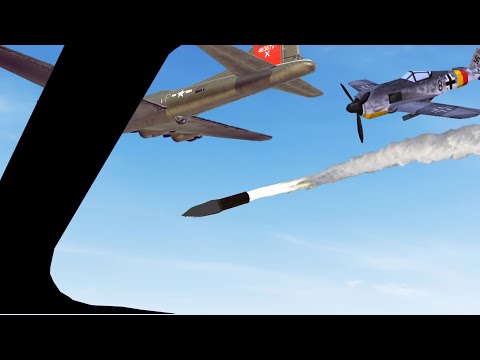
In the high-stakes world of aerial warfare, few scenes are as gripping as a formation of B-17s under rocket attack. But when it comes to Masters of the Air, the drama may have taken precedence over historical accuracy. The series depicts German fighters firing rockets from the side and even shows a surface-to-air missile striking a bomber. The reality, however, is far more nuanced—and far more fascinating.
During World War II, Germany deployed only two anti-bomber rockets, and neither behaved like the guided missiles seen on screen. The most common was the 21 cm WGr, a spin-stabilized rocket lobbed into bomber formations from under the wings of twin-engine fighters like the Bf 110. These rockets were not fired with precision; they were area weapons, designed to break up formations and sow chaos.
The 21 cm rocket was a brute: 49 inches long, 8.27 inches in diameter, and weighing 241 pounds. Its warhead contained 22.4 pounds of explosive—roughly ten times that of an 88 mm shell. But its fuse was a simple timer, set to detonate after about five seconds, by which time the rocket had traveled 1,000 to 1,300 yards. There was no proximity fuse, no guidance system, and no contact detonation. It was lobbed, not fired, and its trajectory was a parabola, not a straight line.
German tactics reflected this limitation. Twin-engine fighters would approach from the rear, match the bombers’ speed, and lob rockets into the formation from around 1,000 yards. The goal was to loosen the formation, reducing mutual fire support, and then attack stragglers with guns. “Concentrate attacks on a single combat wing or group,” a 1945 War Department manual advised. “Break up the formation with rockets and then attack stragglers with gunfire.”
But the series shows something different: rockets fired from the side, and even a ground-launched missile homing in on a B-17. “The series visual effects supervisor acknowledged the clips did not represent German rocket attack practice,” and that the production team wanted a side shot to service the story. In reality, side attacks would have required complex calculations of speed, direction, and deflection—something the simple timer fuse could not accommodate.
As for the surface-to-air missile in episode 9, the evidence is clear: Germany never fielded an operational surface-to-air anti-bomber missile. Post-war reviews of all German missile projects show that while they were working on guided systems, they lacked the necessary guidance, proximity fuses, and working platforms. “No belligerent in World War II deployed an operational missile homing system,” a 1946 AAF Scientific Advisory Group document states. Germany was still six months away from fielding a working proximity fuse when the war ended.
The scene where Rosie’s plane is struck by a ground-launched rocket is based on an eyewitness account from a post-mission report. But given the state of Germany’s missile program, that observer was almost certainly mistaken. “This is clearly an observer mistake,” the analysis concludes, “as no surface-to-air anti-bomber missiles were fielded by Germany in World War II.”
So why did the series include it? Perhaps for drama, perhaps for simplicity. But for history buffs, it’s a missed opportunity to show the real innovation and improvisation of German rocket tactics—and the deadly cat-and-mouse game that played out in the skies over Europe.
Yet the story of German rocket interceptors is not just one of technical limitation—it is also one of shifting tactics and desperate adaptation. By the time the 21 cm WGr entered service, the Luftwaffe was already losing the initiative in the air war. The rocket was a stopgap, a weapon born of necessity rather than design brilliance.
The Bf 110 crews who carried these rockets into battle faced a daunting task. They had to close to within 1,280 yards of a tightly packed B-17 formation—well inside the effective range of the bombers’ .50-caliber tail guns. The rockets themselves were unguided, their fuses set by a timer that could not be adjusted in flight. The pilot had to estimate range, speed, and angle, then lob the rocket into the formation and hope the five-second countdown detonated it at the right moment.
This is why German doctrine emphasized rear attacks. “Attacking from the rear was more accurate in estimating the rocket’s detonation range and allowed for an accurate no-deflection shot,” the analysis notes. The bomber crews, in turn, learned to weave slightly—since the rockets traveled at low velocity and followed a parabolic arc, a weaving formation could decrease the chances of the warhead detonating within the group.
But the window for these tactics was brief. The introduction of long-range escort fighters—the P-51 Mustang and P-38 Lightning—rendered the rocket-equipped twin-engine interceptors obsolete. As an April 1944 intelligence summary put it, rocket-equipped fighters needed their own fighter escort, which made them “a liability more than an asset.” The Luftwaffe’s rocket attack doctrine, so carefully developed in 1943, was already fading by the time the Allies gained air superiority over Europe.
This makes the series’ depiction of a 1945 surface-to-air missile strike even more jarring. By February 1945, Germany’s missile programs were in disarray. The V-1 and V-2 were in production, but the seven programs listed as top priority were all unguided missiles or rocket programs that never saw combat. “None of the air-to-ground rockets listed ever saw combat service,” the 1945 Combined Intelligence Objectives Subcommittee document states.
So what actually brought down Rosie’s B-17? The post-mission report claims an eyewitness saw a ground-launched rocket. But the historical record is unambiguous: no such weapon existed in Germany’s arsenal. More likely, the bomber fell to flak, fighter attack, or mechanical failure—the mundane and deadly realities of the air war that the series, in its pursuit of spectacle, chose to embellish.
The real story of German anti-bomber rockets is not one of futuristic guided missiles, but of crude area weapons lobbed from aging twin-engine fighters. It is a story of tactical ingenuity constrained by technological limits—and of a Luftwaffe that, by 1944, was running out of both time and options.
This mismatch between screen and record extends beyond hardware to the human drama. Rosie’s shootdown on February 3, 1945, remains one of the series’ most harrowing sequences, yet the mechanism of his loss has been reshaped for the camera. The real 100th Bomb Group veteran, Rosenthal, bailed out over Berlin after his B-17 was struck—but the historical record points to flak or fighter cannon fire, not a phantom missile streaking up from the ground.
What the series sacrifices in accuracy, however, it partially recovers in tension. The sight of a rocket trail arcing toward a stricken bomber captures the helplessness crews felt under attack—even if the specific weapon is fictional. “The observer mistake” cited in the post-mission report becomes, on screen, a dramatic certainty.
But consider what the real rocket attacks looked like from inside a B-17. A crew would first spot the twin-engine fighters—Bf 110s or Me 410s—closing from the rear, matching speed with eerie precision. Then, at roughly 1,000 yards, the fighters would release their rockets in a rippling salvo. The bombers’ gunners would open fire, tracers arcing toward the approaching planes, while the formation commander ordered a slight weave.
For five seconds, nothing happened. The rockets climbed and fell along their parabolic paths, invisible until the last moment. Then the air around the formation erupted in black bursts—not contact explosions, but timed detonations designed to shred aluminum and nerve. “The lethal range of the warhead was around 50 feet,” the analysis notes, meaning a near miss could still cripple a bomber.
Surviving crews described the rockets less as precision strikes than as a form of aerial artillery—a shotgun blast into a flock. The Germans knew this. Their manuals emphasized volume of fire over accuracy, hoping to break the formation’s cohesion rather than destroy individual aircraft. Once the rockets were spent, the twin-engine fighters would peel away, and single-engine Fw 190s or Bf 109s would swoop in to finish off damaged stragglers.
This layered tactic—rockets to disrupt, guns to kill—was the real innovation, and it is largely absent from Masters of the Air. The series instead compresses the sequence into a single, visually striking moment: a rocket fired from the side, or a missile rising from the ground. Both are dramatic. Neither is true.
Yet the question remains: does it matter? For a television drama, perhaps not. But for the historical record, the distinction is everything. The men who flew those missions faced a weapon system shaped by scarcity and improvisation, not science fiction. Germany’s rocket interceptors were a desperate gamble, and they failed—not because they lacked drama, but because they lacked guidance, proximity fuses, and time.
As the war entered its final months, the Luftwaffe’s rocket tactics faded into memory. The P-51s had seen to that. What remained was the flak—the deadly, unglamorous curtain of steel that actually brought down most bombers. And it is there, perhaps, that the series might have found its truest drama: not in a fictional missile, but in the relentless, impersonal arithmetic of anti-aircraft fire.
The eyewitness account of a ground-launched rocket striking Rosie’s B-17 is a case in point. Post-war analysis of German missile programs confirms that no surface-to-air anti-bomber missile was ever operational. The observer likely mistook a rocket trail or a flak burst for a guided missile. In the chaos of combat, such errors are understandable—but they should not be enshrined as fact.
So what does this mean for Masters of the Air? The series is a dramatization, not a documentary. It compresses events, invents scenes, and heightens tension. But in doing so, it sometimes distorts the very history it seeks to honor. The real heroes of the Eighth Air Force faced a relentless, improvised enemy—not a futuristic one.
“The rocket was a stopgap, a weapon born of necessity rather than design brilliance,” and that is precisely what makes it fascinating. The German attempt to break up bomber formations with crude area weapons is a story of ingenuity under pressure, of tactics evolving in real time. It deserves to be told accurately.
Perhaps the series’ greatest oversight is not the fictional missile, but the missed opportunity to show the true cat-and-mouse game: the weaving bombers, the timed detonations, the desperate rear attacks. That is a drama worth watching—and one that needs no embellishment.
As we close this fact-check, the question lingers: should historical dramas prioritize accuracy over spectacle, or is dramatic license an acceptable trade-off for storytelling? What do you think—did Masters of the Air go too far, or is it just entertainment?
Report this article
Select a reason for reporting:






