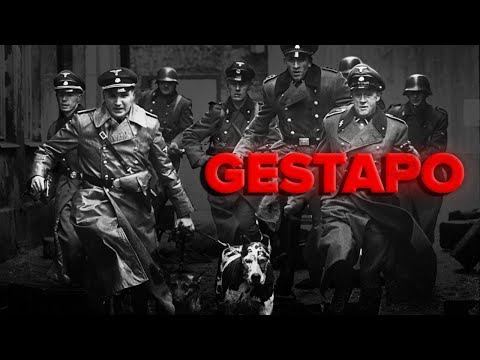
Three syllables that sowed terror across Europe for twelve years. The Gestapo. Behind its walls, ordinary men became architects of unimaginable cruelty, their names forgotten but their deeds etched into history. How did a small police force of 50 men evolve into a machine that could reach into every home, every conversation, every secret? The answer lies not in monsters, but in men who believed they were doing their duty.
In April 1933, the Gestapo was born—a modest organization under Rudolf Diels, with barely enough officers to fill a small auditorium. Yet within six years, it would grow to 15,000 members, a vast web of surveillance and repression. The real transformation came when Heinrich Himmler took command. With his relentless discipline and fanatical vision, the Gestapo ceased to be a mere police agency. It became the axis of totalitarian terror.
Himmler was an unlikely tyrant. Medium height, round-faced, with receding chin and thin lips, he looked more like a clerk than a killer. His pale, delicate hands seemed better suited to a lady than a ruthless leader. Yet behind those round steel glasses, his blue eyes held a fixed, penetrating gaze—a hunter studying his prey. He would tilt his head slightly, letting the light obscure his expression, and speak in deliberately ambiguous orders that forced his men to decipher his will or face deadly consequences.
His work ethic was legendary. From 8 a.m. until the early hours, he never stopped. Even on trains, his secretary took dictation. Every document crossed his desk, marked with a pale green pencil and his signature—two intertwined G’s. This meticulousness extended to his personal life. He abhorred the corruption of Göring, who signed documents in ostentatious red pencil. Himmler, by contrast, lived modestly, plagued by financial troubles from his double life—a wife he refused to divorce and a mistress with two children.
But beneath the bureaucratic facade lay a cauldron of mystical obsessions. He believed in magnetism, homeopathy, clairvoyants, and even witches. He consulted them before major decisions. His mentor, Hitler, provided the ideological framework: racial purity, elimination of the weak, and the primacy of vital energy. For Himmler, National Socialism was a new religion with biological objectives. Compassion was weakness. Reason was an obstacle.
When Himmler addressed his SS officers, he was blunt: “Our most urgent task is to locate all enemies, visible and hidden, of the Führer and national socialism. Defeat and annihilate them.” This was not mere rhetoric. It was a directive that would soon be carried out with methodical brutality across Germany and beyond.
By 1934, Reinhard Heydrich—a man of contradictions—took effective control of the Gestapo. A brilliant violinist with a volcanic temper, Heydrich was feared even by the most hardened torturers. His cruelty was boundless, his intellect sharp, his ambition insatiable. Together, Himmler and Heydrich built a machinery of terror that relied not just on force, but on information. The Gestapo’s secret intelligence apparatus, the Press and Information Agency, filtered newspapers from around the world, translating and filing every detail about exiles, marriages, births—anything that could be used as a weapon.
They intercepted communications, wiretapped phones, and bugged homes. No one was safe—not even high-ranking officials. Field Marshal Milch later testified: “Citizens feared the Gestapo more than the SS itself.” Everyone believed they were under surveillance, regardless of rank. The fragmentation of power among Nazi agencies created a network of mutual control, with each leader spying on the others. Even Göring’s own conversations were recorded.
The Gestapo’s reach extended far beyond Germany’s borders. In Poland, it became a laboratory for techniques of control, expulsion, and annihilation. Himmler was appointed Commissioner for the Strengthening of Germandom, with full powers to reshape the East. Poles and Jews were dispossessed, deported, and murdered. Children deemed racially valuable were torn from their families. The Auschwitz camp opened near Kraków, and millions would perish.
As the war progressed, the Gestapo’s methods grew more brutal. Arrests peaked between May and August 1944. In France, raids devastated entire neighborhoods. Torture became routine: prisoners were hung by their arms, beaten, mutilated, and subjected to electric shocks. Women were not spared. The sadism of executioners knew no bounds, and many found pleasure in inflicting pain.
Yet even as the Reich crumbled, Himmler clung to power. In the final days, he maneuvered for a separate peace, hoping to save his own skin. But his betrayal of Hitler was discovered. On May 23, 1945, captured by the British, he bit into a cyanide capsule and died. His legacy: a machine of terror that had turned ordinary men into killers and a continent into a prison.
But the story of the Gestapo does not end with Himmler’s death. The men who had carried out the arrests, the interrogations, the deportations—they were still alive, scattered across a broken continent, and they knew what awaited them. Some fled. Some hid. Some, like Heinrich Müller, vanished so completely that even today, historians argue over whether he died in a Berlin bunker, in Moscow, or in South America.
Müller was the exception. Most of the Gestapo’s officers were caught, and the trials that followed were not the swift vengeance they had feared but a slow, grinding process of documentation and testimony. The Nuremberg trials, which began in November 1945, were meant to establish a record—not just of the crimes, but of the men who committed them. Yet the courtroom revealed something unexpected: these men did not look like monsters.
Ernst Kaltenbrunner, Himmler’s successor at the RSHA, sat in the dock with the same broad shoulders and scarred face that had terrified his subordinates. He denied everything. “I was a soldier,” he insisted. “I followed orders.” The tribunal rejected the defense. He was hanged on October 16, 1946, alongside ten other Nazi leaders.
But Kaltenbrunner’s execution was the exception. Of the thousands of Gestapo officers who had served in occupied Europe, only a fraction ever faced justice. In France, the épuration—the purge—was swift and uneven. Some collaborators were tried and shot. Others simply disappeared into the chaos of liberation. In Belgium and the Netherlands, similar scenes unfolded: a handful of show trials, a few prison sentences, and then silence.
The Cold War changed everything. As the Soviet Union and the Western Allies divided Germany, the hunt for Nazi war criminals became a political tool rather than a moral imperative. Former Gestapo officers were recruited by both sides. The Americans wanted their intelligence networks. The Soviets wanted their files. Men who had ordered the deaths of thousands were given new identities, new jobs, and new lives.
Klaus Barbie, the “Butcher of Lyon,” was one of them. He had personally tortured Jean Moulin, the leader of the French Resistance, and sent hundreds of Jews to their deaths. After the war, he was recruited by the American Counterintelligence Corps and later fled to Bolivia. He lived there for thirty years, under the name Klaus Altmann, until he was finally extradited to France in 1983. His trial became a symbol of the long, unfinished reckoning.
Others were never found. The Gestapo’s archives, which had recorded every detail of its victims’ lives, were scattered across Europe. Some were captured by the Soviets. Some were burned. Some, like the files of the Press and Information Agency, simply vanished. The men who had compiled those files—translators, analysts, informants—melted back into civilian life. They became clerks, teachers, businessmen. Their neighbors never knew.
What became of the ordinary Gestapo agent? The man who had beaten prisoners in the basements of Avenue Foch? The woman who had typed deportation lists in a quiet office? Most were never tried. They lived out their lives in silence, carrying their secrets to the grave. Their children grew up without knowing who their fathers had been.
And yet, the question remains: how did it happen? How did ordinary men become instruments of terror? The answer, historians now believe, lies not in pathology but in banality. The Gestapo was not staffed by sadists—though sadists found a home there. It was staffed by bureaucrats who believed in the system, who wanted to advance their careers, who told themselves they were doing their duty.
This is the most unsettling truth of all. The Gestapo was not an aberration of human nature. It was a possibility. Given the right conditions—authoritarian rule, ideological fervor, and the slow erosion of moral restraint—it could happen again. The files may be gone, the men may be dead, but the lesson remains.
In the end, the Gestapo’s legacy is not just the millions it killed. It is the reminder that terror does not always wear a monstrous face. Sometimes it wears a clerk’s uniform, holds a pale green pencil, and signs its name with two intertwined G’s.
That reminder has echoed through every generation since. In the decades that followed, historians returned again and again to the same unsettling discovery: the machinery of terror had been operated by men who went home to dinner, kissed their children, and worried about their mortgages. The banality was not a footnote—it was the engine.
And so the reckoning never truly ended. Each new archive opened, each new trial held, each new testimony recorded forced the world to look again at the same question. How many more names were never spoken? How many more files were never found? The silence of the unpunished became its own kind of haunting.
Yet something else survived alongside the horror—the testimony of those who endured. Survivors spoke, wrote, and bore witness so that the truth could not be buried with the perpetrators. Their words became the counterweight to all the forgotten clerks and vanished officers.
Because in the end, the Gestapo’s story is not only about the men who built the machine. It is about the courage of those who refused to let it be forgotten. The files may have scattered, the agents may have melted into ordinary lives, but the memory of the victims remains—and memory is the one archive no regime can burn.
So the question returns to us, the ones who read and remember: when the machinery of fear is being built again, quietly, in ordinary offices, by ordinary people—will we recognize it in time? What would you have done, and what will you do now? Tell us in the comments below.
Report this article
Select a reason for reporting:






