In November 1897, 400 feet beneath the hill that is now the Santa Rita copper pit in New Mexico, a miner named Cresencio Baca swung his pick into a wall of red clay. The pick rang like a bell. Rock does not ring like that. Copper ore does not ring like that. Baca brought his lantern closer. Out of the clay came a pale, flat face of metal, as wide as a man’s back, as long as a door. The next morning, a second face was found beside the first, identical, parallel, two handspans lower. Two blades of a single tool.
Up on the surface, an old teamster named Viejo Tomas, Apache by birth, rode the bucket down that evening. He looked at the two blades and asked nothing. He said one sentence: “Lo dejaron.” They left it behind. He did not say who. The next morning, he would not go down again.
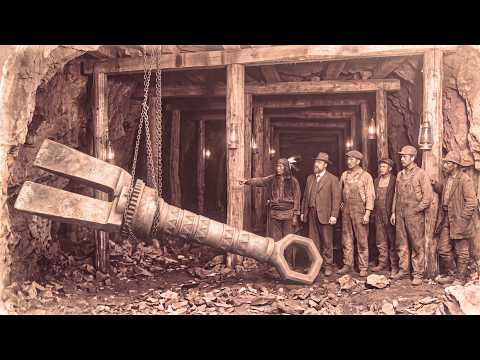
Over the next three weeks, the diggers uncovered the rest: a drum ringed with teeth, a thick carved shaft, and at the end, an eight-sided ring wide enough for a man to walk through. The tool was 32 feet 9 inches long. Its weight was estimated at around 60 tons. It could not have fit down any shaft in the mine. No one had lowered it there. The mine had been dug down to it.
Two years later, Santa Rita was sold for more than $5 million. On the new maps, that level was marked closed. And 37 years later, 200 miles to the east, an old Apache woman described the tool. She had never seen it. She had never read a line about it, but she knew which way its blades were pointing. That is where this case begins.
To understand why that tool should not have been there, we first need to understand Santa Rita itself. It is a high dry basin in the southwestern corner of New Mexico, in the southern foothills of the Black Range. On the east side of the basin, in front of a reddish cliff, a single pillar of rock stands alone. From a distance, it looks like a figure kneeling in prayer. The Spanish families called it the Kneeling Nun. Their legend says a young nun from a mission in this valley fell in love with a soldier, was cast out, climbed the mountain in a storm to pray, and was found at sunrise turned to stone, still on her knees. The hill below that rock was full of copper.
And the first person to show anyone that copper was an Apache. In 1799, a Spanish Lieutenant Colonel named Jose Manuel Carrasco, stationed at the Presidio of Janos, followed an Apache guide into this basin. The Apache led him to sheets of copper lying open on the ground. Carrasco described it six years later in a letter in his own hand. He did not write down the guide’s name. So the Europeans did not find the copper. They were taken to it. And the man who took them did not take them any deeper than the surface.
In 1804, the mine passed to Francisco Manuel de Elguea, a banker from Chihuahua. Elguea built a three-sided adobe fort at the foot of the hill with a round tower at each corner. Convicts did the digging. The copper went south on muleback to Janos, then to Chihuahua, then to the mint in Mexico City. For 40 years, most of the copper coins struck in Mexico came out of this hill.
Elguea died in 1806. The mine was leased out and passed from hand to hand—to a French merchant, then to an American named Robert McKnight. A German traveler later wrote that McKnight’s partner cleared half a million dollars here in seven years. In 1826, the American Patty family leased the mine. A young Kit Carson worked here for a while as a teamster. And every mountain around the mine belonged to the Chihenne, a branch of the Apache. The Spanish called them the Mimbreños. The Americans called them the Copper Mine Apaches. They called themselves the Red Paint People.
In the spring of 1837, an American trader named John Johnson invited the Chihenne leader Juan Jose and his people to a trading meeting and opened fire. It did not happen at Santa Rita. It happened in the Animas Mountains to the south. But what followed came to Santa Rita. The supply trains were cut. In 1838, the mine was abandoned.
In October of 1846, General Kearny’s dragoons rode into the basin. Lieutenant William Emory wrote down what he found: 20 or 30 adobe houses, 10 or 15 shafts, a smelter abandoned in a hurry. Emory named the cliff behind the Kneeling Nun after a Captain Ben Moore. In those same days, Kearny met the Chihenne leader Mangas Coloradas. In 1851, the boundary commission quartered inside the old fort. Its commissioner, John Russell Bartlett, wrote that he saw masses of pure native copper in the ground.
In January of 1863, Mangas Coloradas was seized under a flag of truce and killed at Fort McLane. In 1877, the Chihenne were forced onto the San Carlos Reservation. In 1880, their leader Victorio died in Mexico. In 1886, the last of the bands were put on a train to Florida. In 1894, they were sent to Fort Sill, Oklahoma, as prisoners of war. By 1897, there was not one free Chiricahua left in these mountains except Tomas. And Tomas had his own reasons for staying.
No one knew exactly where Tomas had come from. The camp said that after 1838, as a small boy, he had been taken south to Janos, raised there by a Mexican family, and given his name there. As an old man, he had come back north to the mountains he was born in. He still spoke Apache, but only to his mules.
The mine, meanwhile, kept changing hands. In 1881, a Boston promoter, Joel Parker Whitney, bought it. He brought in a mine captain from Michigan and miners from Cornwall. A 500-foot double-compartment shaft went down. Then the money ran out. From 1884 to 1897, Santa Rita sat almost empty.
In the spring of 1897, a new tenant arrived: the estate of George Hearst of San Francisco. Hearst had died six years before. The estate ran a smelter in Silver City, and the smelter needed rich sulfide ore to feed its furnaces. A new shaft was sunk at Santa Rita. The miners called it the Hearst shaft. It had two levels, one at 300 feet, one at 400. On the 400-foot level, the richest ore body in the mine’s entire history was being opened—a heavy, coal-black copper sulfide called chalcocite. The miners hollowed out of it a stope 200 feet long, 40 to 50 feet wide, and 100 feet high.
Most of the men in that stope were Mexican lessees. They were paid by the pound of ore they broke and sold what they brought out. Cresencio Baca was one of them. He had been born in the village of San Lorenzo in the Mimbres Valley. He was 27. He shared his contract with his brother-in-law, Ramon Olguin. Remember that name. It will come back.
The first record belongs to a lease book. Edwin Trask Row was 33. He had been born in California among the gold mines of Grass Valley. He had studied mining at the University of California. He had spent 10 years at the Hearst family’s Ontario mine in Utah, and in the spring of 1897, he was sent to run the Santa Rita lease. His job was to record every week how much ore came out, what each returned, and how far each working had advanced. He kept it all in a thick ledger bound in green cloth. On the cover, he had written the number three.
On the afternoon of November 9th, 1897, the shift captain, Thomas Rule, saw what Baca had found. He cleared the men out of the stope and put two of them at its mouth. Then he sent a boy up top with one instruction: “Bring the manager. Tell no one else.” The miners waited four hours. Row came down a little before 8:00 that evening, and he began to write.
The first line in the book for that night is a location: Hearst shaft, 400-foot level, north end of the big stope, 210 feet from the shaft. Row measured it the way he measured everything, with chain and compass. The second line is the air. The 400-foot level was wet. Water dripped from the back and pooled ankle deep on the floor. The pumps ran day and night, but the hollow that Baca’s pick had opened was dry. Row pushed his thermometer inside. 58 degrees in the stope, 64 in the hollow. A sealed space warmer than the rock around it.
The third line is the space itself. The tool was not lying in the clay. It was lying in a room, and the room had been filled with clay. As the diggers cleared it, the walls came into view: 41 feet long, 14 feet wide, 11 feet high at the crown. The walls were straight, the corners were rounded. The fourth line is the floor. Row pushed his pocket knife into the clay beneath the tool. That clay was packed as hard as stone. The clay above the tool was loose. It crumbled in his hand. The tool had not fallen onto that clay. The clay had been pressed down beneath it for years, perhaps for far longer.
The fifth line is a sound. At Row’s request, Rule struck one of the blades with a hand hammer. The entry reads: “The note lasted 40 seconds like a bell, but finer than a bell. Two of the diggers in the stope crossed themselves without a word.” That night, close to dawn, Row wrote one more line. He underlined it twice. “It resembles nothing that has ever come out of this hill, and it is made of everything that has.”
The second record is not a page. It is the object itself. Row measured the tool for three weeks. The diggers carried the clay out bucket by bucket, and every day Row drew whatever had been uncovered. The order never changed: first the blades, then the drum, then the shaft, last of all the ring.
The blades were flat, like the edge of a carpenter’s chisel, but the size of a door. Each one was 3 feet 6 inches wide, 11 inches thick at the root, thinning to a straight sharp line at the edge. The upper blade was 10 feet 4 inches long, the lower one 8 feet 2. The upper reached 2 feet farther forward than the lower. Between them was a gap of 22 inches, and Row measured that gap at six different points, from the root of the blades to their tips. All six measurements were the same. There was not a single nick along either edge. The clay at Santa Rita was full of quartz sand. In that clay, the point of a steel pick went dull in a week. These had not.
Behind them, both blades were seated in a heavy drum, 5 feet 8 inches across, 3 feet 2 inches wide. A toothed ring ran all the way around it like a gear. Row counted the teeth: 64. Then he measured 12 of them with calipers. Every one matched. Whatever difference there was, it was smaller than his calipers could read.
But the blades were only the front of it. Behind the drum, the shaft began. Round, 2 feet 9 inches thick, 15 feet long. It was wrapped in nine carved bands, and every band was made of stepped triangles, rising tier on tier. Row noticed something, and he wrote it down. Across those nine bands, there were hundreds of triangles. Every one of them pointed toward the blades. Not one exception.
At the end of the shaft was the ring. Eight-sided. 6 feet across on the outside. 3 and 1/2 feet across the opening. A man could walk through it without ducking. The whole tool was covered in a pale, flaking, scaly crust of old copper. But the eight inner faces of the ring were smooth. No crust at all. As if something had rubbed against those eight faces for a very long time.
Deep in the grooves, Row found red crystals. Tiny, perfect cubes. Every miner at Santa Rita knew them. Cuprite, an oxide of copper. It grew slowly all over that hill, on the walls of the oldest workings. According to Row’s notes, the cubes in the grooves of this tool were the largest he had seen in the mine.
The walls of the room held something strange as well. Every week, Row entered the assays of the ore coming out of the stope. Chalcocite from the middle of the stope ran 10 to 12 percent copper. Ore cut right up against the wall of the room ran 40. Row had it assayed three times. Three times the same. The copper grew richer the closer it lay to that room. As if over centuries the copper in that hill had been drifting toward it.
The page for December 1st is the first full drawing in the book. Row drew the tool from the side and from above with every measurement written beside it. Under the drawing there is one more small line. The direction the blades were pointing: south 52 degrees east. Row never wrote why he took that bearing. He never came back to it.
Row spent two full days cutting a two-pound piece from the ring. He broke three steel chisels doing it. In early December the piece went by stage to Socorro, to the New Mexico School of Mines. The answer came in January of 1898: 99.7% copper, no iron, no arsenic, no sulfur—and one unbroken grain. This copper had not been hammered. It had not grown in the ground. It had been cast in one pour.
Six men with iron pry bars tried to move the drum. It turned an eighth of a turn. Both blades turned with it, and the sound rose again inside the stope. This time it lasted more than a minute. Half the diggers walked out that day and did not come back.
Then, one night in February, Row went down alone. He set his lantern between the two blades, struck the upper one lightly, and pressed his ear against the lower. What he wrote was short. “The sound ended in the air. It did not end in the rock.”
The next week, Viejo Tomas’s wagon was found empty on the San Jose road. The mules were still in harness. No tracks. Nothing.
In 1899 the mine sold for more than $5 million. The 400-foot level was marked caved, not to be reopened. The water rose. In 1938, when the shovels finally cut down to that room, it was dry—and empty. In the hard clay floor lay a mold: two blades 22 inches apart, a drum with 64 notches, an eight-sided ring. No drag marks. No cut marks. Not one shaving of copper.
Today the room is empty air above the pit floor. Row’s book sits in Berkeley. Opler’s note sits at Cornell. Wade’s pit book sits in Silver City. The card sits in Socorro. The four have never been in the same room.
They left it facing the door so that it would be found. She did not say by whom.
If something is left facing a door—who is it waiting for?
Report this article
Select a reason for reporting:






