At 10:27 on the morning of October 24, 1944, the first American carrier aircraft dove out of the sky over the Sibuyan Sea, and the battleship Musashi—the largest, most heavily armored warship ever built—was about to face a force no designer had ever imagined. She displaced 72,800 tons, carried nine 46-centimeter guns (the largest naval rifles in history), and wore 410 millimeters of face-hardened steel on her belt and 650 millimeters on her turret faces. She was designed to be unsinkable. And for the next five hours, 259 American sorties would prove that assumption catastrophically wrong.
But here is the truth that most accounts miss: Musashi did not fail. Her armor held. Her damage control parties performed almost flawlessly for nine hours. What failed was the country that built her—and the industrial capacity that could not keep pace with a new kind of war.
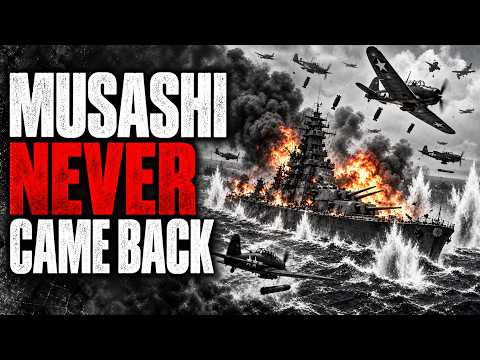
The first wave hit at 10:27. A bomb struck near the forward turret. A torpedo slammed into her starboard side amidships. The damage was serious—but not fatal. She stayed in formation, maintained speed, and her crew corrected the list. She was still a fighting ship.
Then the second wave arrived around midday. More torpedo hits. Her speed dropped. She fell out of the line. And in that moment, she stopped being part of a formation and became a target alone—the most obvious, most vulnerable ship in the entire sea. Every subsequent American aircraft would find her first.
The third and fourth waves concentrated on her with relentless precision. Torpedoes hit both flanks, and her damage control teams performed a desperate, brilliant dance—counter-flooding to correct each list, spending buoyancy to buy stability, keeping her upright for hours longer than anyone thought possible. They were not repairing the ship. They were converting a stability problem into a flotation problem, one compartment at a time.
Bombs wrecked her upper works. Anti-aircraft directors were destroyed. Gun crews were killed in the open. Her bridge was hit, wounding Captain Toshihira Inoguchi. She fired her main battery at the incoming aircraft using incendiary shrapnel shells—a spectacular, almost entirely ineffective display that American airmen watched with awe and no particular concern.
By mid-afternoon, she was down to 12 knots, settling by the bow, her forecastle taking water. The fifth wave found her nearly stationary and hit her again. By the end, she had absorbed something in the order of 17 bombs and 19 torpedoes—a figure without precedent in naval history.
At 15:30, Admiral Kurita turned his force west and reported a temporary withdrawal. American airmen saw the center force in retreat and badly damaged. Admiral Halsey, reading those reports and receiving word that Japanese decoy carriers had been located to the north, took the entire Third Fleet north after them—leaving the San Bernardino Strait unguarded.
At 17:15, Kurita reversed course and headed back for the strait. But Musashi could not follow. She was making a few knots, down by the bow, her forecastle awash. Kurita signaled her to run herself aground on the nearest island. Two destroyers stood by her. She never reached shallow water.
At 19:15, the order was given to abandon ship. At 19:35, on October 24, 1944, she rolled to port, capsized, and sank in the Sibuyan Sea. Roughly 1,023 of her crew died with her, including Captain Inoguchi, who remained aboard. About 1,376 men were taken off by the escorting destroyers.
The sinking was witnessed at close range from those destroyers. She went over slowly to port, hung for a period on her beam ends, and then rolled and went down. There was an underwater explosion as she sank.
But the story does not end there. What happened in the next twelve minutes—and in the days that followed—would reshape the entire Battle of Leyte Gulf. Because Musashi’s death was not just the loss of a ship. It was the reason there was a Battle of Samar. It was the reason Yamato and her consorts emerged from the San Bernardino Strait the next morning to face six American escort carriers and their destroyers in one of the most lopsided and desperate fights in naval history.
By dying slowly, Musashi did the only useful thing she ever did. Nine hours of visible, conspicuous sinking pulled an entire day’s air effort onto one hull—and away from the 31 ships around her. Those ships came through the Sibuyan Sea intact. Halsey read the reports of a broken center force and went north. Kurita turned around at 17:15 and went through an unguarded strait. And every part of that happened because the largest battleship in the world spent an afternoon absorbing bombs that would otherwise have gone somewhere else.
She was never any use as a weapon. She was decisive as a target.
But to understand why that afternoon unfolded the way it did, you have to go back six years earlier—to a covered slipway in Nagasaki harbor, where the ship was born behind a curtain of hemp.
Musashi was laid down at the Mitsubishi yard on 29 March 1938, the second ship of her class. Her sister Yamato was building simultaneously at Kure, in a dry dock deepened specifically for the purpose. Kure could be screened. Nagasaki could not. The slipway looked out across a working commercial harbor crowded with foreign shipping—vessels belonging to countries Japan fully expected to fight.
The solution was extraordinary. An enormous screen of hemp rope matting was erected around the entire building site, reportedly consuming a substantial fraction of Japan’s national hemp supply for the year. Workers were vetted and compartmentalized. Blueprints were numbered and accounted for. Employees who talked about their work were dealt with by the security services.
Japan built a 72,800-ton warship in a commercial harbor and successfully hid what it was building from every foreign intelligence service for years. American estimates through 1942 credited the class with 16-inch guns and a displacement of around 45,000 tons—because 45,000 tons and 16-inch guns was what a reasonable navy would build.
She was launched on 1 November 1940. The displacement wave from the launch was large enough to swamp small craft across the harbor and flood property on the far shore. The incident was reported locally as an unexplained tidal event.
The concealment carried a cost nobody in 1938 counted, and it is the same cost that secrecy always carries. A program that cannot be discussed cannot be argued with. Building two ships of that size consumed steel, machine tool capacity, dock time, and skilled labor on a scale nothing else in Japan could match—and it did so in exactly the years when the country’s most acute future shortages were already forecastable: merchant hulls, escorts, aircraft.
A commitment of that magnitude ought to have been contested inside the Navy and inside the government. It was not seriously contested because the number of people cleared to know what was being built was very small, and almost none of them had any incentive to question it.
The third hull of the class makes the point better than any argument. Shinano was still on the slipway when the war turned, and was converted during construction into an aircraft carrier—an admission made in steel by the same industry that the type had been the wrong answer. She was torpedoed by an American submarine ten days after commissioning in November 1944, having never operated an aircraft.
Musashi herself was commissioned on 5 August 1942—two months after Midway, where four Japanese fleet carriers had been destroyed by aircraft in a single morning. That timing is the origin of everything that followed. She entered service into a war that had already answered the question she had been built to settle.
And she spent the next two years as a flagship at anchor, moving between Truk and Brunei and the Inland Sea, waiting for a decisive battle-line engagement that was never going to happen. She carried Admiral Yamamoto’s flag from February 1943, and she carried his ashes home to Japan in May of that year after he was shot down over Bougainville.
That is a reasonable summary of what the ship actually did with her career.
To understand why she was thought unsinkable, the protection scheme has to be described properly—because it was not marketing. The main belt was 410 millimeters of face-hardened armor, inclined at 20 degrees to increase its effective thickness against flat-trajectory shellfire. Behind and below it, the belt continued downward in a tapering lower strake designed to defeat shells that fell short and traveled through water to strike the hull beneath the waterline.
The armored deck ran to 200 millimeters over the machinery and magazines. That figure matters enormously here, because deck armor is what stops bombs. 200 millimeters of plate was beyond the penetrative capacity of any bomb an American carrier aircraft could carry in 1944, and American planners knew it. Nobody expected dive bombers to sink Musashi. They expected them to wreck what was above the armor.
That distinction runs through the whole day, and it is worth holding on to. Bombs killed men, destroyed directors and rangefinders, stripped anti-aircraft mounts, and blinded the ship. Torpedoes killed the ship. The two weapons were doing entirely different jobs, and the bombing existed largely to make the torpedo runs survivable.
Underwater, the ship carried a multi-layer anti-torpedo system: an outer bulge intended to absorb and vent the explosion, then void and liquid-loaded compartments, then a heavy internal holding bulkhead. It was designed against a warhead of approximately 400 kilograms of explosive. The compartmentation was extensive—over 1,100 watertight compartments—and the ship carried a large, well-drilled damage control organization with the pumping and counter-flooding capacity to correct substantial lists.
That last capability is the one that decided how the 24th unfolded, and it is worth understanding as a resource rather than a skill. A ship can correct a list only as long as it has intact compartments left to flood on the opposite side. Counter-flooding is not repair. It is spending buoyancy to buy stability, and the supply is finite.
The anti-aircraft armament had been built up substantially by October 1944, and on paper it was formidable. Musashi carried somewhere in the region of 130 to 150 25-millimeter automatic cannon in triple, twin, and single mounts, packed onto every surface that would take one, alongside 24 high-angle 12.7-centimeter guns.
The 25-millimeter gun is where paper strength and real strength separate. It was a licensed French design with well-understood defects: a 15-round magazine that had to be changed constantly, heavy vibration that destroyed accuracy, and mountings that traversed too slowly to track a diving attacker. Japanese officers documented all of it and could not replace the weapon at the scale required.
So the battery that looks so impressive in the specification produced a wall of fire that was dense at close range, poorly directed, and largely ineffective beyond a few thousand yards. The high-angle guns were better weapons, and there were nothing like enough of them.
There was also a genuine flaw, and postwar analysis identified it precisely. At the point where the main belt met the lower belt, the joint between the two armor strakes was structurally weaker than either plate. A torpedo detonating near that seam could cause the joint to work and admit water into spaces beyond the design boundary of the anti-torpedo system. That flaw was known to Japanese constructors and could not be practically corrected once the ships were built.
Even so, the aggregate was formidable, and the ship had already proved it in a small way. On 29 March 1944, off Palau, the American submarine Tunny hit Musashi with a single torpedo in the bow. She took on roughly 3,000 tons of water, lost several men, and steamed to Kure under her own power for repair. One torpedo absorbed without drama, in a ship designed to take many.
That was the last data point anybody had before 24 October.
Now count what the Americans could bring against it, because the deficit was absolute and it was structural. The United States Navy in October 1944 possessed no weapon that could sink a Yamato-class battleship with a single hit, and no realistic prospect of acquiring one.
Gunfire was theoretically available. The fast battleships of Task Force 38 carried 16-inch guns and could in principle have fought a surface action. But against 410 millimeters of inclined belt at long range, an American 16-inch shell was working at the very edge of its capability—while Musashi’s 3,219-pound 46-centimeter shell was not. Fighting her with guns meant accepting an unfavorable exchange to sink a ship that could be sunk another way.
Bombs could not do it. The standard American carrier bomb loads of 1944—500-pound and 1,000-pound weapons, with some heavier ordnance available—had no prospect of penetrating 200 millimeters of deck armor. Dive bombers attacking Musashi were not attacking the ship in any structural sense. They were attacking the men and the equipment on top of it.
Torpedoes were the only weapon that could reach the hull, and the anti-torpedo system had been designed specifically to absorb them. A ship built to survive multiple hits from 400-kilogram warheads is a ship that does not sink to a torpedo. It sinks to torpedoes, plural—and enough of them that the flooding outruns the pumping.
There was a fourth constraint, and it was arithmetic. A carrier strike group has a finite number of aircraft, each carrying one torpedo or a small bomb load, and once they have released, they are done until they get back to the ship.
There was one further constraint, and it belonged to the pilots rather than the planners. A torpedo attack against a maneuvering battleship is flown at low level on a steady heading into the ship’s anti-aircraft fire. For as long as it takes to establish a firing solution, Musashi at 27 knots, turning hard, throwing up everything she had, was among the least attractive targets in the world to approach that way.
The geometry compounds it. A torpedo aircraft must attack roughly perpendicular to the target’s course to get a useful shot, which means crossing the beam of a ship whose entire broadside anti-aircraft battery bears on precisely that arc.
There was a navigational problem, too, and it gets forgotten. The Sibuyan Sea is enclosed water ringed by islands, and the strikes were flown from carriers operating on the far side of Luzon and Samar, across mountains and through weather. Every wave had to find a moving formation in a confined sea after a long transit in cloud, with no radar guidance to the target. That five waves found it in sequence across five hours is an achievement of navigation and strike coordination that the account usually passes over in silence.
So the problem, stated plainly, was this: to sink Musashi you needed perhaps 15 to 20 torpedo hits. Getting 15 to 20 torpedo hits means delivering perhaps three or four times that many torpedoes through the concentrated anti-aircraft fire of a ship carrying roughly 150 25-millimeter automatic cannon and 24 high-angle guns—plus the fire of every other ship in a formation of 32.
No single strike could do that. It would take an entire day, and it would require putting the same aircraft over the target again and again—which brings the record to the decision that made a whole day of strikes possible. And it is not a weapon. It is the arrangement of aircraft on a flight deck.
American aircraft carriers used a deck park. Japanese carriers did not. The distinction sounds like housekeeping, and it determined the outcome of 24 October 1944.
Japanese carrier doctrine held that aircraft were struck below into the hangar for arming, fueling, and maintenance, and brought up to the flight deck by lift only when ready to launch. The hangars were enclosed structures integral to the hull. The reasoning was sound on its own terms: aircraft below are protected from weather and blast, and an enclosed hangar is structurally stronger.
American doctrine did the opposite. Aircraft were parked permanently on the flight deck at the after end—often overhanging the edges on outriggers—and were fueled and armed there in the open. The hangars beneath were open-sided with roller shutters rather than solid plating, so that air moved through them freely and engines could be run below.
Three consequences follow from that, and each of them is large.
The first is air group size. An Essex-class carrier could operate something in the region of 90 to 100 aircraft. A Japanese fleet carrier of comparable displacement operated perhaps 70. The difference is not construction. It is that the American ship used its flight deck as storage as well as a runway.
The second is cycle time. A strike returns, lands, and must be refueled, rearmed, and relaunched. Doing that on an open deck—with fuel lines and ordnance carts and 60 men working in the open air—is far faster than striking every aircraft below on lifts, servicing it in an enclosed space, and bringing it back up again. American carriers could turn a strike around in a fraction of the time.
The third is safety, which is counterintuitive. Fueling and arming aircraft in an enclosed hangar concentrates petrol vapor and ordnance inside a sealed steel box. When something goes wrong in that box, the ship is usually lost. This is precisely what happened to the Japanese carriers at Midway, and it is why the open-sided American hangar—which vents blast outward and disperses vapor—proved more survivable despite looking more fragile.
Put those together and the picture on 24 October is clear. Task Force 38 was able to launch, recover, rearm, and relaunch across an entire day, from multiple carriers in multiple groups, and keep aircraft over Kurita’s formation almost continuously from mid-morning to mid-afternoon.
The supporting infrastructure mattered as much as the practice, and it is invisible in every photograph. Deck crews were large, specialized, and drilled continuously: plane handlers, arresting-gear crews, catapult crews, ordnance men, fuel men—each identified by a colored jersey, so that a man’s function was readable at a glance across a crowded deck, in noise that made speech impossible. The color-coded jersey is one of the small pieces of American naval organization that had a wholly disproportionate effect on how fast a flight deck could be worked.
Behind the deck sat the replenishment organization. Bombs, torpedoes, and aviation gasoline are consumed at an enormous rate by a carrier flying five strikes in a day, and the ammunition ships and oilers that kept the fast carrier groups supplied at sea are what allowed the tempo to be sustained beyond a single afternoon.
Underneath all of it was aircraft production on a scale that made attrition affordable. An air group that loses 18 aircraft in a day gets them back. The whole method—accumulation, repetition, persistence—is available only to a navy that can treat aircraft as expendable. And a navy can only treat aircraft as expendable if it is building tens of thousands of them.
Nobody recorded the deck park as a decisive decision of the Pacific War. It appears in aviation handling manuals.
The proof that accumulation would work came almost four months earlier, and it was ambiguous enough that reasonable people drew different conclusions from it. On 29 March 1944 off Palau, Tunny put a torpedo into Musashi’s bow. The ship took several thousand tons of water forward, lost a number of men, and continued under her own power to Japan.
Read one way, this is proof that the anti-torpedo system worked. One torpedo absorbed. Ship survives. Ship steams home. That was the reading in Tokyo, and it reinforced a confidence that had never been tested at all.
Read the other way, it is more interesting. The hit was forward of the citadel, in the least protected region of the hull, and it admitted a very substantial volume of water for one weapon. It demonstrated that the Yamato class flooded readily in the bow, and that a ship down by the head loses speed rapidly.
There was a wider body of evidence available by mid-1944, and it pointed the same direction across the Pacific. Heavily protected warships had repeatedly proved resistant to individual weapons and vulnerable to accumulated damage over hours. The pattern was consistent. Armor defeats single hits, and flooding defeats armor—given enough time and enough hits.
The most directly relevant precedent, and the one American planners had studied hardest, was British. On 10 December 1941, Japanese land-based torpedo and level bombers sank the battleship Prince of Wales and the battlecruiser Repulse off Malaya in open water with no air cover overhead. It was the first time capital ships underway at sea and free to maneuver had been sunk by aircraft alone, and it settled an argument that had run in every navy in the world for 20 years.
Prince of Wales was a modern ship with a modern anti-torpedo system, and she went down after roughly four torpedo hits. That figure is the one to hold against 24 October 1944, because it set the expectation. American strike planners approaching the Yamato class had the Malaya precedent in front of them, and a reasonable assumption that a comparable number of hits—scaled for a much larger and better-protected hull—would do the job.
They were wrong by roughly a factor of five. And nobody found that out until the afternoon was most of the way through.
Three findings came out of that period, and they shaped the American approach. The first was that battleships were not to be attacked in the expectation of a quick kill. Strike leaders were not looking for a magazine explosion. They were looking for progressive flooding.
The second was that a damaged ship is worth more attention than an undamaged one. A warship that has taken hits is slower, less able to maneuver, and less able to defend itself—and every subsequent weapon put into it does proportionally more.
The third was that this all required time: an entire day of operations against one formation, and the only formation on Earth that could sustain it was the American fast carrier task force.
What that produced by October 1944 was a strike doctrine built around persistence rather than surprise. The rule change was continuous pressure. Task Force 38 operated in multiple task groups, each with its own carriers and screen, positioned so that they could launch in sequence rather than simultaneously. Instead of one enormous strike arriving once, waves arrived one after another with short gaps, so that the target formation never had a period of quiet in which to organize itself.
Consider what that does to a ship under attack. Damage control aboard a large warship is a race. Pumps run, bulkheads are shored, compartments are isolated, lists are corrected by counter-flooding. Every one of those actions takes time, and every hour of quiet returns some fraction of the ship’s fighting condition. Removing the quiet removes the recovery. A ship attacked at 10:30 and again at 12:15 and again at 13:30 and again at 14:30 never completes a single damage control evolution before the next arrives.
Alongside that ran a target-selection rule, and it is the one that killed Musashi specifically. Strike leaders were instructed to concentrate on the largest units, and in practice, once a large unit had been visibly damaged, subsequent waves gravitated to it. There is nothing sinister or clever about the mechanism. An aircraft arriving over a formation of 32 ships looks for the biggest target. A battleship that is trailing smoke, down by the bow, and falling astern of formation is both the biggest target and the most obviously vulnerable one—and it is also the easiest to identify from 10,000 feet.
Musashi was hit in the first wave. Everything after that followed from being hit first.
There is a piece of this that belongs to Halsey, and it shaped the day more than any strike doctrine did. The Third Fleet’s carrier groups on 24 October were not all available. Task Group 38.1 had already been detached toward Ulithi to replenish. Task Group 38.3 spent much of the morning dealing with the attack that destroyed Princeton. So the effort against Kurita was mounted by fewer groups than the fleet nominally possessed, under a commander who also had to account for a Japanese carrier force somewhere to the north that had not yet been located.
Halsey’s decision was to commit what he had, hard and repeatedly, against the center force rather than to hold a reserve. Five waves in five hours is what that decision looks like from the receiving end. It is also indirectly the decision that produced Samar. A commander who throws everything at one target all day and then receives reports that the target is broken and retreating has every reason to believe the job is done—and to take his fleet north after the carriers he has been hunting from the start. The sheer intensity of the assault on the center force is part of why its survival was not credited.
There was one more element, and it belonged to Japan rather than to America. Kurita’s center force sailed without air cover. Japanese land-based air in the Philippines had been substantially worn down in the preceding weeks, and what remained was committed elsewhere on 24 October, including to the attack that sank the light carrier Princeton. Ozawa’s carriers to the north had no air groups worth the name and were operating as a decoy. The fighter protection that Kurita had been promised did not materialize over the Sibuyan Sea in any meaningful strength.
So the most powerful surface force Japan could still assemble spent an entire day inside the operating radius of a thousand carrier aircraft with essentially nothing overhead.
Kurita’s First Striking Force entered the Sibuyan Sea on the morning of 24 October 1944: five battleships including Yamato and Musashi, 10 heavy cruisers, two light cruisers, and 15 destroyers, heading for the San Bernardino Strait and beyond it the American invasion shipping in Leyte Gulf.
The force had been detected the previous day, and American submarines had attacked it in the Palawan Passage on 23 October, sinking two heavy cruisers and crippling a third—including Kurita’s flagship Atago, from which he was rescued out of the water and transferred to Yamato.
By the morning of the 24th, Halsey’s Third Fleet knew where Kurita was and what he had. That deserves stating in the plainest terms available. Kurita entered the Sibuyan Sea having already lost three heavy cruisers, with his own flagship sunk beneath him the previous day, knowing the enemy had located his force, and with no meaningful air cover. He went in anyway, because the plan required it and because the alternative was to concede the Philippines without a fight.
The first wave arrived at 10:27—aircraft from Task Group 38.2, Intrepid and Cabot—coming in against a formation maneuvering hard and throwing up a very heavy volume of anti-aircraft fire. Musashi was hit early. A bomb struck near the forward turret. A torpedo hit the starboard side amidships. The damage was serious and not remotely fatal. She stayed in formation and maintained speed.
The distinction between serious and fatal is the whole of what follows. A torpedo hit amidships on a ship with a properly functioning anti-torpedo system produces local flooding, a modest list, and a damage control problem. It does not produce a crisis. Musashi’s parties corrected the list, isolated the flooded spaces, and reported the ship fit to continue. Every subsequent hit was then applied to a ship that had already spent part of its reserve.
The second wave came in around midday, and this is where the day’s shape was set. Musashi took further torpedo hits, and her speed began to drop. She fell out of the line. Falling out of the line is the moment a warship stops being part of a formation and becomes a target on its own.
Inside a formation, a ship shares the enemy’s attention with 31 others and contributes its guns to a combined defense. Astern and alone, she has her own anti-aircraft battery and nothing else. And every aircraft in the sky can see exactly which ship is hurt.
From that point, she was the most obvious target in the Sibuyan Sea.
The third and fourth waves concentrated on her heavily. Torpedoes went into both flanks—which is worth noting, because the attacks were not coordinated onto a single side, and the consequence was that Musashi’s damage control parties were able to correct her list repeatedly by counter-flooding, keeping her upright for hours longer than would otherwise have been possible.
That fact would be studied carefully afterwards. To correct a list to port you flood compartments to starboard, and to correct a list to starboard you flood compartments to port. Each correction restores the ship’s trim and removes some of its remaining buoyancy. A damage control organization doing this repeatedly is not solving the problem. It is converting a stability problem into a flotation problem, one compartment at a time. And it is doing so because the alternative—a ship that rolls over at 20 degrees—is worse and arrives sooner.
Musashi’s parties made that trade for nine hours. It is why she stayed upright, and it is why she eventually went down by the bow rather than capsizing early in the afternoon.
Bombs wrecked her upper works progressively. Anti-aircraft directors were destroyed. Gun crews in the open were killed. Her bridge was hit, wounding Captain Toshihira Inoguchi. She fired her main battery at the incoming aircraft using sanshiki-dan incendiary shrapnel shells from 46-centimeter guns—an enormous, spectacular, and almost entirely ineffective display that American aircrew described with some awe and no particular concern.
There was a cost to it that the Japanese Navy understood and accepted. Firing 46-centimeter guns at high elevation produces blast across the ship’s own upper works severe enough to damage light anti-aircraft mounts and injure the men serving them. A battleship shooting its main battery at aircraft is degrading its own close-range defenses in order to fire a weapon with almost no chance of hitting anything.
By mid-afternoon she was down to around 12 knots, settling by the bow, with her forecastle taking water over it. The fifth wave found her nearly stationary and hit her again. The accumulated total, on the American assessment made after the war, came to something in the order of 17 bombs and 19 torpedoes. Japanese survivor accounts give lower figures. Every version of the count is without precedent.
At around 15:30, Kurita turned his force west, away from the strait, and reported that he was withdrawing temporarily. That signal had consequences far beyond Musashi. American aircrew reported the center force in retreat and badly damaged. Halsey, reading those reports and receiving word that Ozawa’s carriers had been located to the north, took the entire Third Fleet north after them that evening—leaving the San Bernardino Strait unguarded.
At around 17:15, Kurita reversed course and headed for the strait again. Musashi could not follow. She was making a few knots, down by the bow, her forecastle awash. Kurita signaled her to run herself aground on the nearest island. Two destroyers, Kiyoshimo and Hamakaze, stood by her.
She never reached shallow water.
At about 19:15 the order was given to abandon ship. At 19:35, on 24 October 1944, she rolled to port, capsized, and sank in the Sibuyan Sea. Roughly 1,023 of her crew died with her, including Inoguchi, who remained aboard. About 1,376 men were taken off by the escorting destroyers.
The sinking was witnessed at close range from those destroyers and described consistently afterwards. She went over slowly to port, with her bow already under, hung for a period on her beam ends, and then rolled and went down. There was an underwater explosion as she sank.
The loss of Musashi is normally where the account ends. It is more useful to follow what her nine hours actually bought, because it is not nothing, and it is the strangest part of the record.
The 259 sorties that Task Force 38 flew on 24 October were not flown against Musashi. They were flown against Kurita’s entire formation. But as the day wore on, an increasing share of them went to the one ship that was visibly dying—and the rest of the center force, Yamato, Nagato, Kongo, Haruna, and the cruisers and destroyers around them, absorbed correspondingly less.
Yamato was hit by bombs that day and was not seriously impaired. Nagato was hit and continued. The heavy cruiser Myoko was damaged badly enough to withdraw. Beyond that, Kurita’s force came through the Sibuyan Sea substantially intact. Five battleships had entered the sea that morning. Four came out of it, and three of those four were fit to fight the following day.
So the largest battleship ever built functioned in her last hours as something nobody intended and nobody planned: a lightning rod that drew an entire day’s air effort onto herself and away from the ships around her.
Those ships passed through the San Bernardino Strait that night into a sea that Halsey had left open, and appeared at dawn on 25 October off the island of Samar in front of a screen of American escort carriers and destroyers that had no business fighting battleships at all.
That is Musashi’s actual consequence. Her death is the reason there was a Battle of Samar.
The wider collapse was not deferred by it. Kurita, having fought his way through the escort carriers, turned away and withdrew without reaching the invasion shipping. Across four days at Leyte Gulf, the Imperial Japanese Navy lost three battleships, four carriers, 10 cruisers, and a long list of destroyers, and ceased to function as a fleet.
The Battle of Samar the following morning is not this record’s subject, and one paragraph about it is necessary here. Kurita’s force emerged from the strait in front of Task Unit 77.4.3—six escort carriers, three destroyers, and four destroyer escorts, ships making around 18 knots with guns that could not hurt a battleship. And for something over two hours, those ships fought, and were fought by, the most powerful surface force Japan still possessed. Kurita then turned away and withdrew without reaching Leyte Gulf.
Every element of that morning was made possible by Musashi’s afternoon. The center force was in a position to arrive off Samar because it had not been destroyed in the Sibuyan Sea—and it had not been destroyed in the Sibuyan Sea partly because one ship absorbed the day.
There was a second consequence, and it was technical. American analysts studied the Sibuyan Sea attack carefully afterwards, and the conclusion they drew was uncomfortable. Nearly 40 hits and nine hours to sink one ship was an unacceptable expenditure. The reasons identified were that the attacks had been spread across both flanks, allowing counter-flooding to keep the ship upright, and spread across hours, allowing damage control to work between waves.
Those findings were applied five months later against Musashi’s sister, with results that make the comparison instructive rather than flattering.
The American cost on 24 October 1944 was substantially higher than the Sibuyan Sea strikes alone suggest, and the reason belongs in this record because it happened on the same day. Aircraft losses over Kurita’s formation across the five waves ran to something in the region of 18 aircraft. Set that against 32 warships putting up concentrated fire for five hours, and it is a startling figure—and it says less about American skill than about the Japanese fire-control problem described earlier: a dense wall of poorly directed 25-millimeter fire that was lethal inside a few thousand yards and close to harmless beyond it.
But the day’s worst American loss came from a single aircraft, and it had nothing to do with Musashi. That morning, a lone Japanese dive bomber came out of cloud over Task Group 38.3 and put one bomb into the light carrier Princeton. The bomb penetrated to the hangar deck and started a fire among fueled and armed aircraft. The fire spread to the torpedo stowage. The light cruiser Birmingham came alongside to fight the fire and take off survivors—a difficult and dangerous evolution, with her upper decks crowded with men working hoses and lines.
Princeton‘s after magazine detonated while Birmingham lay alongside. The explosion swept Birmingham‘s exposed decks. Around 233 men aboard the cruiser were killed and several hundred more wounded, in a ship that had not itself been attacked. Princeton lost 108 of her own crew and was scuttled that evening.
That single bomb killed more Americans on 24 October than the entire five-wave assault on the center force cost in aircrew.
On the Japanese side, the 1,023 men lost with Musashi is the headline figure, and it is not the end of the account. A substantial number of the survivors taken off by the destroyers were subsequently landed in the Philippines rather than returned to Japan, where they were formed into naval infantry units and committed to the fighting ashore. A great many of them died there.
There is one more entry, and it is the sort that usually gets left out of a ledger reading as favorably as this one. The men who died aboard Musashi died in a ship that had spent essentially her entire career at anchor. Between commissioning in August 1942 and October 1944, she had fired her main battery at an enemy surface vessel exactly never. Her crew had been held at a very high standard of training for two years for an engagement that was never fought, and were then committed without air cover into an enclosed sea inside the reach of a thousand aircraft, under a plan the Combined Fleet’s own staff assessed as having a low probability of success.
They fought the ship extremely well. The record is unambiguous on that, and it is entirely separable from any judgment about the decision that put them there.
The sequence, in order. 29 March 1938: Musashi is laid down at the Mitsubishi yard at Nagasaki, screened behind a hemp curtain in a concealment effort that keeps her true dimensions from every foreign intelligence service. 1 November 1940: she is launched; the displacement wave floods property across the harbor. 10 December 1941: Japanese aircraft sink Prince of Wales and Repulse off Malaya—the first capital ships underway at sea destroyed by air attack alone. Four torpedo hits are enough. 5 August 1942: she is commissioned, two months after carrier aircraft destroy four Japanese fleet carriers at Midway. February 1943 to 1944: Musashi serves as Combined Fleet flagship and spends the overwhelming majority of her career at anchor at Truk, Brunei, and in the Inland Sea. In May 1943, she carries Admiral Yamamoto’s ashes back to Japan. 29 March 1944: the submarine Tunny hits her with one torpedo off Palau; she takes on several thousand tons of water forward and steams to Kure for repair. The episode is read in Tokyo as proof the protection scheme works. 23 October 1944: American submarines attack Kurita’s force in the Palawan Passage, sinking two heavy cruisers and crippling a third; Kurita is pulled from the water and transfers his flag to Yamato. 24 October 1944, 10:27: the first of five American strike waves arrives over the center force in the Sibuyan Sea; Musashi is hit in the first attack. Midday: further torpedo hits slow her; she falls out of formation and becomes the most conspicuous target in the sea. Afternoon: successive waves concentrate on her; Task Force 38 flies 259 sorties across the day; Musashi absorbs something in the order of 17 bombs and 19 torpedoes. 15:30: Kurita turns west; American aircrew report the center force in retreat; Halsey takes the Third Fleet north after Ozawa’s decoy carriers, leaving the San Bernardino Strait unguarded. 17:15: Kurita reverses course for the strait; Musashi cannot follow and is ordered to beach herself. 19:35: Musashi capsizes and sinks; roughly 1,023 men die with her, including Captain Inoguchi. 25 October 1944, dawn: Kurita’s surviving ships emerge from the San Bernardino Strait off Samar. 28 November 1944: Shinano, the third hull of the class, converted on the slipway into a carrier, is sunk by an American submarine ten days after commissioning.
Four things decided this, and each deserves naming exactly.
The first was the deck park. It is the least dramatic item in this entire record, and it is what made a day-long assault physically possible. Parking aircraft on the flight deck and arming them in the open, above open-sided hangars, gave American carriers larger air groups and far shorter turnaround times than Japanese practice allowed. Five waves against one formation in five hours is not a tactical decision. It is a deck-handling capacity built into the design of the ships and the training of the men who worked them. And no amount of Japanese planning could have produced its equivalent in 1944. It was not a secret and it was not patented. It was a way of working a flight deck, adopted years earlier for reasons that had nothing to do with battleships. Japan could not have copied it in 1944 without rebuilding its carriers and retraining its deck crews, and it had neither the ships nor the time.
The second was concentration on the cripple. Musashi died because she was hit in the first wave. From that moment she was slower, smokier, and further astern than anything else in the Sibuyan Sea, and every subsequent wave found her first. There is no cleverness in the mechanism, and there is no defense against it either. A formation cannot conceal a damaged battleship, and it cannot slow to protect her without offering everything else to the same treatment. The first hit selected the target for the whole day. Everything that followed was the consequence of a bomb and a torpedo arriving in the first 10 minutes of a nine-hour engagement.
The third was the armor joint and the arithmetic of flooding. The Yamato class was built to defeat single weapons, and it did. What it could not defeat was cumulative water. Torpedo hits near the seam between the main and lower belts admitted flooding beyond the anti-torpedo system’s design boundary. And each correction the damage control parties made—counter-flooding to right a list, isolating compartments, abandoning spaces—bought time at the price of buoyancy. They did everything correctly for nine hours, and the ship sank anyway, because the account they were drawing on had a flaw. There is no version of that afternoon in which better damage control saves the ship. There is only a version in which it takes longer.
The fourth was the empty sky. Kurita took the most powerful surface force Japan could still assemble into a confined sea inside the reach of a thousand carrier aircraft with effectively no fighter cover. Every American aircraft that flew that day flew unopposed except by gunfire. Whatever else the Sibuyan Sea tested, it did not test whether Musashi could survive an air attack that was being contested. Nobody has ever found out. What the Sibuyan Sea tested was whether a battleship could survive an air attack that nothing at all was stopping. And establishing the answer took 259 sorties.
Strip away the tonnage tables and the armor diagrams, and what remains is a single reversal. Japan built a ship on the proposition that enough steel in the right places makes a vessel invulnerable. And the proposition was correct. No bomb America carried could penetrate her deck, and no single torpedo could breach her citadel. Then 259 sorties arrived across a working day, and it turned out that invulnerability to any one weapon means nothing against an enemy who can deliver the same weapon 36 times.
The Yamato class was not out-engineered. It was out-supplied—by a navy whose carriers could rearm faster than her pumps could empty.
And folded inside that reversal was a second one, quieter, that nobody noticed until it was already finished. By dying slowly, Musashi did the only useful thing she ever did. Nine hours of visible, conspicuous, unmistakable sinking pulled an entire day’s air effort onto one hull and away from the 31 ships around her—and those ships came through the Sibuyan Sea intact. Halsey read the reports of a broken center force and went north. Kurita turned around at 17:15 and went through an unguarded strait. At dawn the next morning, Yamato and her consorts came over the horizon off Samar in front of six escort carriers. And every part of that happened because the largest battleship in the world spent an afternoon absorbing bombs that would otherwise have gone somewhere else.
She was never any use as a weapon. She was decisive as a target.
Musashi lies in the Sibuyan Sea at a depth of about a kilometer. She was located in March 2015 by a survey vessel that had spent eight years looking for her, working from Japanese action reports, American strike records, and a bathymetric survey of the seabed. The wreck is broken, with the bow section separated and lying apart from the hull. On the bow, still fixed where it was mounted at Nagasaki in 1940, behind a curtain of hemp rope, is the gilded chrysanthemum crest of the imperial house—upside down on the ocean floor, in the dark.
So here is the question worth arguing over, and it is not about armor thickness or sortie counts: was Musashi’s nine-hour death a pointless waste of 1,023 lives—or the single most effective thing the Imperial Japanese Navy did at Leyte Gulf, precisely because it was the one thing nobody planned?
Report this article
Select a reason for reporting:






