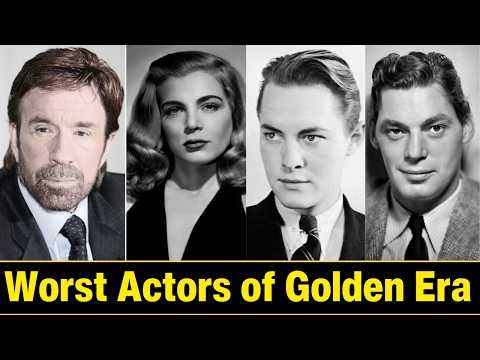
Imagine achieving fame not for your talent, but despite it. In Hollywood’s Golden Age, the spotlight didn’t always shine on the most skilled thespians. From the wooden expressions of Chuck Norris to the one-dimensional action roles of Charles Bronson, these actors found ways to charm audiences even if critics weren’t impressed. Their stories reveal a fascinating truth: sometimes, star power has little to do with acting ability.
Ever wondered how someone like Johnny Weissmuller became a household name despite his limited acting skills? Or how Ed Wood, often called the worst director of all time, became a legend? Stay with us as we unveil the fascinating stories of 24 actors whose fame defied their acting abilities.
Take Edward D. Wood Jr., a case study in cinematic infamy. Unlike traditional actors who gained recognition through skill, Wood became legendary precisely because of his extraordinary lack of conventional talent. In films like Plan 9 from Outer Space (1959), his acting and directing were so remarkably poor that they transcended typical criticism. His performances were stiff, unconvincing, and devoid of nuanced emotional expression. He seemed oblivious to fundamental acting techniques like natural dialogue delivery or meaningful character development.
Wood’s acting style could be described as comically mechanical. He moved with an awkward, almost robotic presence that seemed detached from any genuine human emotion. His line deliveries were frequently monotone, lacking any subtlety or understanding of dramatic subtext. When he appeared on screen, audiences were more likely to be bewildered than emotionally engaged. What truly set Wood apart was his remarkable persistence. Despite consistent critical and commercial failure, he continued making films with an infectious enthusiasm that was both admirable and perplexing.
Then there’s Steve Reeves, who embodied the transition from traditional actors to physically impressive screen presences in the 1950s and early 1960s. The Italian film industry’s sword-and-sandal epics, known as Hercules movies in English, were perfectly suited to his physical attributes. Films like Hercules and Hercules Unchained capitalized on his impressive muscular build, creating a new archetype of heroic masculinity that was more about visual spectacle than nuanced performance.
Reeves’s style could be described as monumentally statuesque. He moved with the precision of a bodybuilder, each movement calculated, muscles perfectly positioned. However, this physical mastery came at the expense of emotional depth. His line deliveries were often stiff and declarative, lacking the subtlety that method actors like Marlon Brando were introducing to cinema. Interestingly, Reeves was acutely aware of his limitations. He never pretended to be a dramatic actor; instead, he embraced roles that highlighted his physical capabilities. This self-awareness was rare in an era where actors often aspired to be considered serious dramatic performers.
George Brent’s career is a classic example of how sheer quantity doesn’t always equate to quality. Appearing in over 100 films, he was a reliable leading man during Hollywood’s Golden Age, often cast alongside major stars like Bette Davis and Barbara Stanwyck. Despite his prolific output, Brent never earned any significant acting awards, and critics frequently dismissed his performances as unremarkable. Bosley Crowther of the New York Times once described him as “adequate but uninspiring,” and this sentiment followed him throughout his career.
Brent’s reserved, gentlemanly persona worked well for romantic dramas but lacked the emotional depth or versatility needed for standout performances. While his co-stars often received acclaim, Brent was labeled as the dependable straight man whose primary job was to support the narrative rather than steal the show. Still, audiences of the time appreciated his charm and steady presence, even if he rarely dazzled. His career poses an intriguing question: can consistency and reliability alone define stardom, even when critical acclaim is absent?
Vera Ralston was a prime example of how nepotism could dramatically influence Hollywood casting during the mid-20th century. Her entry into Hollywood was not through traditional acting merit but through her close relationship with Herbert J. Yates, the powerful head of Republic Pictures. Yates, who was romantically involved with Ralston and later became her husband, consistently cast her in leading roles despite widespread criticism of her acting abilities. This nepotistic approach effectively shielded her from the usual professional scrutiny that most actors faced.
Her performances were systematically panned by critics who frequently described her acting as wooden, emotionally disconnected, and painfully unconvincing. Unlike other actors who might improve with experience, Ralston seemed immune to professional growth, consistently delivering performances that were considered amateurish and lacking any genuine dramatic depth. She became a textbook example of an actor whose presence in films was more a result of personal connections than artistic talent. Throughout her career, which spanned approximately 25 films, Ralston never received any significant acting awards or critical acclaim.
David Carradine’s career is a testament to the complex nature of Hollywood stardom. Born into a family of actors, he appeared in over 100 films and numerous television series. Despite his extensive filmography, Carradine never received major acting awards, and his performances often garnered mixed reviews. He gained widespread recognition for his role as Kwai Chang Caine in the 1970s television series Kung Fu. The show was a commercial success, but critics were divided on his portrayal. Some praised his unique screen presence, while others found his acting lacking in depth. In a 1973 New York Times review, John J. O’Connor noted that Carradine’s performance “had a peculiar serenity” but questioned whether this translated into compelling acting.
Carradine’s work ranged from cult classics like Death Race 2000 (1975) to mainstream successes such as Quentin Tarantino’s Kill Bill series (2003–2004). Tarantino cast him as the titular Bill, a role that revitalized his career. The director admired Carradine’s iconic presence and believed he brought a mythic quality to the character. However, some critics felt that his performance was overshadowed by the film’s stylized violence and ensemble cast. Despite his prolific output, Carradine’s acting was often criticized for being inconsistent, oscillating between captivating and lackluster.
Rory Calhoun is a classic example of how Hollywood in the 1950s and 1960s valued looks over acting talent. Born Francis Timothy McCown in 1922, Calhoun became famous for his rugged, handsome image, often playing Western heroes. While he looked the part, his acting was often criticized for being stiff and lacking emotion. He relied more on his good looks and strong presence than on bringing depth to his characters. In those days, the Hollywood studio system focused on creating marketable stars, and Calhoun fit the mold perfectly. Studios like 20th Century Fox and Universal International cast him in roles where he mainly had to look tough, stand tall, and deliver lines without much dramatic effort.
His breakout roles came in Westerns and adventure films where his masculine charm drew in audiences, especially women. Critics often pointed out that Calhoun’s performances lacked the emotional depth of actors like Montgomery Clift or James Dean. In movies like Way of a Gaucho (1952) and Apache Territory (1958), he played similar characters: tough, good-looking heroes with little variation. While this wasn’t entirely his fault, as studios typecast him to sell tickets, it meant he never got the chance to show much range. Still, audiences loved him, and he became a reliable star, even if critics weren’t impressed.
Buster Crabbe, the original king of action-packed serials like Flash Gordon and Buck Rogers, was born on February 7, 1908. His career spanned over 75 films. While his athleticism and Olympic gold medals in swimming helped him transition to Hollywood, his acting often fell short of critical acclaim. Crabbe’s performances were frequently described as flat and one-dimensional, with critics highlighting his inability to convey deeper emotions or dramatic complexity. His lines were often delivered in a stiff and mechanical manner, making it clear that his strength lay more in physical roles than in acting finesse.
A review in the Hollywood Reporter once remarked that Crabbe was “perfect for the role of a serial hero but not much else.” Directors cast him for his ability to handle stunts and action scenes, often bypassing any need for nuanced acting. He was typecast in roles that emphasized his physical abilities rather than his range as a performer. Crabbe’s career became a symbol of how physicality could overshadow traditional acting skills, but his limitations as an actor were apparent to both critics and peers in the industry.
Joan Bennett, born on February 27, 1910, was a glamorous star of Hollywood’s Golden Age with a career spanning over 75 films. Recognized for her roles in classics like The Woman in the Window and Scarlet Street, she even earned a Venice Film Festival honorary award in 1947. However, beneath her beauty and screen presence, critics often found her performances lacking the emotional depth expected of a leading lady. While Bennett excelled in roles requiring elegance and sophistication, she struggled when tasked with more emotionally demanding parts.
Critics frequently pointed out that her delivery could feel mechanical, and her characters often seemed distant or disconnected. A review in the New York Times once noted that her performance in Scarlet Street relied more on her charm than her ability to fully embody the complexity of the role. Directors admired her professionalism, but she was sometimes viewed as a performer who played it safe, avoiding the risks that might elevate a performance. Even her co-stars occasionally overshadowed her in scenes requiring intense emotional engagement. Though undeniably glamorous and competent, Joan Bennett’s acting career faced recurring critiques for its perceived lack of depth and dynamic range.
Victor Mature was a Hollywood star who never took himself too seriously. In fact, he famously quipped, “I’m no actor, and I’ve got 64 films to prove it.” With over 70 movies to his name, Mature became a box office draw in the 1940s and 1950s thanks to his striking looks and larger-than-life presence. Best known for roles in epics like Samson and Delilah (1949) and The Robe (1953), he often portrayed strong, silent types that suited his physicality more than his acting range.
Critics, however, were less forgiving. His performances were frequently labeled as wooden, with limited emotional depth. Bosley Crowther of the New York Times described his acting in The Robe as “lacking in conviction,” and other reviews often highlighted how his good looks overshadowed his ability to deliver a compelling performance. The term “beefcake actor” was often used to describe Mature, implying he was cast for his physique rather than his talent. Despite the criticism, Mature enjoyed a long career and cultivated a loyal fan base. His self-deprecating humor and undeniable charm helped him navigate an industry where image often mattered more than skill.
As we’ve seen, these actors found fame despite their critics, proving that star quality is a complex alchemy of charisma, timing, and sometimes sheer luck. But their stories are just the beginning. From the smoldering glances of Troy Donahue to the athletic prowess of Johnny Weissmuller, there are many more whose journeys to stardom defied conventional wisdom. Stay tuned as we continue to explore the fascinating lives of Hollywood’s most unlikely icons.
What unites these unlikely icons is a simple truth: audiences didn’t demand perfection—they craved presence. Charm, physique, and sheer persistence often outshone dramatic craft. Weissmuller’s Tarzan, Norris’s stoic heroes, and Wood’s baffling epics all carved a permanent place in pop culture, proving that fame is not a meritocracy of talent but a strange and wonderful accident of timing and connection.
Their legacies endure precisely because of their limitations, not despite them. They remind us that cinema is as much about spectacle and personality as it is about performance. So the next time a critic sneers at wooden acting, remember: the audience may be watching something else entirely—and loving every minute.
Which of these unlikely stars is your guilty pleasure? Share your favorite “so bad it’s good” Hollywood icon in the comments below!
Report this article
Select a reason for reporting:






