Marcus Williams had spent years staring into the past, but nothing had ever stared back quite like this. The antique shop in Charleston was a tomb of forgotten things—old wood, mothballs, and the weight of history pressing down on every dusty shelf. He had been browsing for over an hour, his trained eye scanning estate sale items for images that told stories beyond their surfaces. Then he saw it: a small daguerreotype in a tarnished silver frame, half-hidden behind a stack of Depression glass.
Three children, probably eight to ten years old, sat together on an ornate garden bench. Two white children—a boy and a girl with blonde ringlets—flanked a black child in the center. All three wore expensive clothing. The white boy in a tailored suit with a bow tie, the girl in an elaborate dress with lace trim, the black child in equally fine clothes: a pressed white shirt, dark vest, and trousers that matched the white boy’s. They were smiling—genuine smiles, not the rigid formality typical of 1850s photography. Their bodies were close, comfortable. The white girl had her hand resting on the black child’s shoulder. The white boy leaned in slightly, as if they’d been laughing just before the photographer captured the moment.
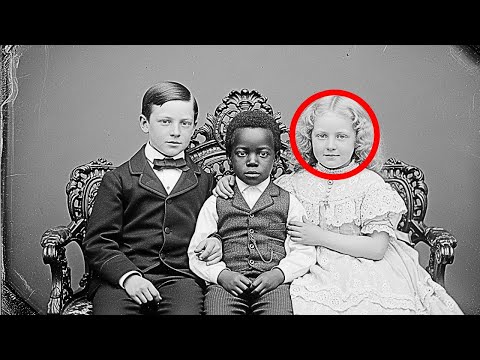
At first glance, it appeared to be a touching testament to childhood friendship, transcending the racial barriers of antebellum South Carolina. The kind of image that suggested innocence, that perhaps children of that era saw beyond the prejudices of their parents. But Marcus had learned never to accept such images at face value. He picked up the frame, studying it under the shop’s dim lighting. The photograph was dated on the back in faded ink: Summer 1854, Charleston. A photographer’s stamp read Whitmore Studios.
Marcus examined each child’s face carefully. The white children looked relaxed, happy. But the black child’s smile—Marcus noticed—didn’t quite reach his eyes. There was something else there, something harder to define. Weariness, perhaps. Or fear masked by the performance of happiness. And then Marcus saw it. The black child’s sleeves had ridden up slightly on both arms. Around each wrist, barely visible in the photograph’s sepia tones, were marks. Discolored bands of skin that suggested long-term abrasion.
Marcus had seen similar marks in other historical photographs and documents. They were the unmistakable evidence of shackles worn for extended periods. His hands began to shake. This wasn’t a photograph of three friends playing together. This was something far darker—a carefully staged image that documented a horror even as it tried to present an illusion of harmony and care.
He purchased the photograph for thirty dollars and walked directly to his car. Sitting in the parking lot, he examined the image again under better light, using his phone’s camera to zoom in on details. The marks on the wrists were definite. And now that he was looking more carefully, he noticed other things. The black child sat slightly forward on the bench, as if ready to stand at a moment’s notice. His posture, despite the smile, was deferential. And his clothing, while expensive, was slightly too large—handed down perhaps, or purchased without careful fitting.
This child was enslaved. Marcus was certain of it. Dressed in fine clothes and posed with his enslavers’ children as if they were equals, but marked by the chains that defined his actual status. Marcus needed to know who these children were, what had happened to them, and why someone had staged this particular photograph. He started his car and headed back to his office in Montgomery, Alabama, already planning the research that would consume the next months of his life.
Back at the Equal Justice Initiative’s research center, Marcus set up the daguerreotype under high-intensity lights and photographed it from every angle. The digital images revealed details invisible in casual viewing. The marks on the black child’s wrists were even more apparent under magnification—bands of lighter skin approximately an inch wide on each wrist, with subtle scarring visible along the edges. Marcus had documented similar injuries in his research. Enslaved children who were shackled—whether as punishment, to prevent escape, or simply as a demonstration of power—developed these characteristic marks. The skin would lighten where metal pressed constantly against flesh, and scar tissue would form where the shackles rubbed during movement or struggle.
He began with the photographer’s mark. Whitmore Studios, Charleston, 1854. Historical directories showed that Edward Whitmore had operated a successful photography business in Charleston from 1851 to 1863, catering to wealthy families who could afford the expensive daguerreotype process. Whitmore had advertised “family portraits of distinction” and “children’s likenesses captured with artistic sensitivity.” Marcus found dozens of examples of Whitmore’s work in archives and museum collections. The photographer had a distinctive style: outdoor settings when possible, natural poses, attention to clothing and background details that signaled his subjects’ wealth and status. Many of his portraits included enslaved servants in the background, positioned to demonstrate the family’s prosperity.
But this photograph was different. The enslaved child wasn’t in the background. He was centered, positioned between the white children, dressed as finely as they were. This wasn’t about displaying wealth through the number of servants. This was something else.
Marcus contacted colleagues at the Charleston Museum and the South Carolina Historical Society, sending them high-resolution images of the photograph. Within two days, he had a response from Dr. Patricia Green, a historian specializing in antebellum Charleston families. “I believe I’ve identified the white children,” Patricia’s email began. “The clothing style and the Whitmore Studios connection led me to prominent Charleston families from 1854. I found a matching photograph in our collection—a formal family portrait taken the same year showing the Hartwell family. Colonel James Hartwell, his wife Eleanor, and their two children, William and Charlotte. The children in your photograph match William and Charlotte Hartwell perfectly.”
Marcus felt his pulse quicken. The Hartwell family—he knew that name. Colonel James Hartwell had been one of Charleston’s wealthiest plantation owners, with properties totaling over 2,000 acres and, according to the 1850 census slave schedule, ownership of 187 enslaved people. “But here’s what’s interesting,” Patricia’s email continued. “I found a reference to this specific photograph in Eleanor Hartwell’s diary, which was donated to our archives in the 1920s. She mentions commissioning Whitmore to photograph the children at play with their little companion.” She doesn’t name the black child, but she refers to him as “always with them” and notes that William and Charlotte were “quite attached to the boy.” There’s something unsettling about the casual way she discusses this, as if it’s completely normal for her children to play with an enslaved child while that child wore shackles.
Marcus requested copies of Eleanor Hartwell’s complete diary. When the scanned pages arrived, he spent two days reading through entries from 1852 to 1856, searching for any mention of the black child in the photograph. Eleanor wrote about her children frequently—their lessons, their health, their social development—and she mentioned the boy in dozens of entries, always without using his name. Eleanor Hartwell’s diary painted a disturbing picture of how enslaved children existed in the lives of wealthy white families: simultaneously present and invisible, valued and utterly disposable.
Marcus compiled every reference to the boy who appeared in the photograph with William and Charlotte.
March 1853. William has become quite attached to the boy from the quarters. James says it’s natural for children to play together and the boy is well behaved and clean. I’ve instructed Mammy to ensure he’s properly dressed when he comes to the house.
July 1853. Charlotte insists the boy join her lessons. I’ve allowed it, though of course he cannot learn to read or write. That would be illegal and dangerous. But he sits quietly while she practices her letters, and his presence seems to motivate her studiousness.
December 1853. The boy attempted to run away last week. James was quite disappointed. We’d treated him well, allowed him privileges unusual for his station. James had him punished appropriately and fitted with restraints to prevent future incidents. The children were upset by the sight of it, so I’ve explained that discipline, while unpleasant, is necessary for the boy’s own good and for the safety of our family.
Marcus felt sick reading these entries. The restraints Eleanor mentioned so casually were the shackles that had left marks on the child’s wrists—marks still visible in the photograph taken six months later.
January 1854. The boy has adjusted to his restraints. He no longer struggles against them and has resumed his usual cheerful manner with the children. William asked why the boy must wear chains when he and Charlotte do not. I’ve explained that different rules apply to different people and that the boy’s restraints are like a parent’s loving guidance—uncomfortable perhaps, but necessary for proper development.
Marcus stopped reading, his hands clenched into fists. The psychological manipulation was staggering—teaching the enslaved child that his shackles were a form of care, teaching the white children that some people deserved chains while others deserved freedom based solely on the color of their skin. But Eleanor never once wrote the enslaved child’s name. In dozens of diary entries spanning years, he was always “the boy” or “their little companion.” This erasure was deliberate. Enslaved people weren’t individuals with names and identities. They were property, described by function rather than personhood.
Marcus needed to find the child’s name. He requested the Hartwell plantation records from the South Carolina Department of Archives and History. Plantation ledgers often listed enslaved people by name, age, and assigned work. If the child had been part of the Hartwell holdings, there would be a record. The ledgers arrived as digital scans—heavy leather-bound books filled with meticulous handwriting documenting the buying, selling, births, deaths, and labor assignments of human beings treated as livestock. Marcus forced himself to read through the dehumanizing language, searching for any child who might match the boy in the photograph.
In the 1854 ledger, under “House Servants – Children,” he found an entry that made his breath catch. Samuel, male, approximately 9 years, assigned to children’s companion and light house duties. Mother: Rose, deceased 1852. Father: unknown. Note: flight risk – secured as of December 1853. Samuel. The boy finally had a name.
Marcus traced Samuel’s presence in the Hartwell records backward and forward from 1854. The documentation was sparse but devastating. Born around 1845, Samuel’s mother Rose died of “fever” in 1852—a term that covered everything from cholera to exhaustion to violence. After her death, seven-year-old Samuel was assigned to the main house, his companionship a form of labor, his existence structured around serving white children barely older than himself.
The December 1853 ledger entry confirmed the diary’s account: “Samuel apprehended two miles from property attempting flight. 15 lashes administered. Fitted with wrist restraints to prevent future attempts.” Fifteen lashes. Samuel had been eight years old. The restraints remained for at least eighteen months—long enough to leave the permanent scarring visible in the photograph.
In October 1856, the final entry appeared: “Samuel sold to Mr. Thomas Crawford, plantation owner from Mississippi, for $650.” Eleven years old, sold away from his mother’s grave, sent alone into the historical void that swallowed millions of enslaved people.
But Samuel’s story didn’t end there. Three days after Marcus’s exhibition opened in Montgomery, an email arrived from Grace Morrison in Jackson, Mississippi: “I think I’m descended from the boy in your photograph.” Her great-great-great-grandfather was Samuel Rose—named for his mother—who lived until 1923, who told his children about the chains, who insisted on displaying his wrist scars in every photograph taken of him. “He said white people had stolen his childhood twice,” Grace explained. “Once by enslaving him, and again by forcing him to pretend enslavement was acceptable.”
At a memorial service in Charleston, on land that had once belonged to the Hartwells, Grace stood before two hundred people and spoke her ancestor’s name. A black granite marker now reads: “Enslaved as a child on this land. Shackled. Sold. But not broken.” The photograph that was created to hide the truth had become, through careful attention and persistent voices, testimony to that truth.
Marcus stood beside Grace, watching visitors study the image. “Do you think he would be satisfied?” he asked quietly. She considered the question carefully. “I think he’d want people to understand that remembering isn’t enough. These histories aren’t just past—they created systems that persist today.”
Samuel Rose had reached across 170 years through silver and glass. His scars, visible to anyone who looked closely enough, had finally told their story. And that story had changed everything.
But the work is far from over—thousands of photographs remain unexamined, millions of names still erased. When you look at an old family photograph, whose stories might be hiding in plain sight?
Report this article
Select a reason for reporting:






