Dr. James Mitchell had examined thousands of photographs in his 20-year career as a curator at the Atlanta History Center. But on that September morning in 2021, one image made him pause. It was a simple family portrait from 1904, donated in an unclaimed estate sale box from rural Georgia. At first glance, it was typical: a Black family posed formally outside a modest wooden house, dressed in their finest, capturing a moment of pride and dignity.
Then James placed the photograph under his magnifying lamp. As he examined the elderly man seated on the left—presumably the grandfather—his breath stopped. The old man’s hands rested on his knees, clearly visible in sharp detail. Even through the sepia tone, James could see distinctive scarring: raised, deliberate patterns across the backs of both hands and wrists. Branding marks and shackle scars. The permanent evidence of enslavement.
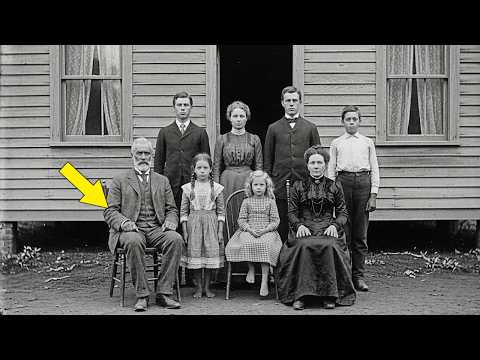
But it was more than the scars that disturbed him. It was their visibility, their prominence. The old man had positioned his hands deliberately, palms down, displayed for the camera. Between his thumb and forefinger, James could barely make out a small piece of metal, intentionally shown. This wasn’t an accidental capture of trauma. This was intentional documentation.
The photograph had been taken 39 years after slavery ended. Yet this grandfather had chosen to display his scars and hold what appeared to be a fragment of his chains. James felt a chill run through him. “What were you trying to tell us?” he whispered to the image.
James spent the following week working obsessively with the photograph, using advanced imaging technology to extract every possible detail. What emerged under digital enhancement was both horrifying and undeniable. The scars formed distinct patterns: circular indentations consistent with iron shackles worn over extended periods, and on the back of the right hand, a brand mark consisting of two letters burned into flesh decades earlier. The piece of metal held between the grandfather’s fingers proved most significant—a curved fragment of iron, deliberately broken from a larger shackle or chain.
James called his colleague, Dr. Patricia Holmes, who specialized in African-American material culture. Patricia studied the enhanced images in silence, her expression growing more somber with each detail. “That’s a shackle fragment,” she confirmed quietly. “He’s holding physical evidence of his own enslavement.” She paused, then looked at the full portrait again. “Look at the composition. The eldest grandchild stands directly behind him, hand on his shoulder. The mother isn’t looking at the camera—she’s looking at him. This entire photograph centers on him and his story.”
James nodded, his suspicions confirmed. “The positioning is too deliberate. He wanted this documented. But why in 1904? That’s nearly four decades after emancipation. Why would he choose to display his trauma so long afterward?”
Patricia leaned back thoughtfully. “Because people were already forgetting. By 1904, a new generation had been born who never knew slavery directly. Southern states were passing Jim Crow laws and rewriting history to minimize slavery’s horrors. Maybe this grandfather wanted to create irrefutable evidence—not just stories his grandchildren might doubt, but physical proof they could see with their own eyes.”
“A counternarrative,” James said slowly, understanding dawning. “While white society romanticized the old South, this man was saying, ‘Look at my hands. Look at what your romantic past actually did.'”
They spent hours examining every detail: the family’s clothing showing care and pride despite modest means, the well-maintained house in the background, the children’s healthy appearance. This was a family that had built something after emancipation despite everything working against them.
“We need to identify them,” James said finally. “This photograph deserves names, not just ‘anonymous Black family.’ These were real people with histories that matter.”
Patricia nodded. “Start with location. ‘Outside Savannah’ probably means Liberty County or Bryan County. Check property records for Black landowners from 1900 to 1905. Cross-reference with census data and contact local historical societies. Someone might recognize this house or family.”
As Patricia left for the evening, James began creating his research plan: county records, census data, church registries, land deeds, Freedmen’s Bureau records. Somewhere in Georgia’s archives, these people had names and stories. He looked once more at the grandfather’s face in the photograph—the direct gaze, the set jaw, the hands deliberately displayed. This man had survived unspeakable brutality and wanted his truth preserved. “I’ll find out who you are,” James promised quietly. “I’ll make sure your story is told.”
The Coastal Georgia Historical Society occupied a renovated building in Savannah’s historic district, its research room filled with ledgers and documents chronicling the region’s complicated past. James arrived early Monday morning, armed with detailed photographs and determination. The head archivist, Margaret Reynolds, studied the image with immediate recognition.
“I’ve seen similar portraits from that era—Black families who could afford it hired photographers to document their existence as free people. Acts of resistance, proving they were families, not property. But I’ve never seen one where slavery scars are displayed so prominently.”
She led James to a research table and began pulling census records. “If this was taken outside Savannah in 1904, we should start with the 1900 census for Liberty and Bryan counties. Black landowners would be listed with occupations and household members.”
They worked through the morning methodically. The 1900 census for Liberty County showed dozens of Black families farming small plots purchased after emancipation. Many listings included elderly parents or grandparents born during slavery times. One entry made James’s pulse quicken.
Samuel Freeman, age 68, born Georgia 1832, farmer. Household includes Martha Freeman, age 62, wife; Thomas Freeman, age 38, son; Rachel Freeman, age 35, daughter-in-law; grandchildren Isaac, age 14, Ruth, age 11, Joseph, age 8, Mary, age 6. The ages and family structure matched perfectly.
“Can we cross-reference with property records?” James asked, barely containing his excitement. Margaret pulled another ledger. “Here—1897. Samuel Freeman purchased 15 acres in Liberty County for $50. Before that, he appears as a tenant farmer from 1868 through 1896.”
“Twenty-eight years to save $50,” James said quietly, the enormity hitting him. “That’s less than $2 annually.”
“Formerly enslaved people faced impossible barriers,” Margaret explained. “They started with nothing, worked for minimal wages, faced discrimination from banks and white landowners. Samuel Freeman’s land purchase represents decades of sacrifice.”
James photographed the records carefully. “Is there any way to determine where Samuel was enslaved before emancipation? If we can identify the enslaver, we might find additional documentation.”
Margaret’s expression grew somber. “The 1860 slave schedule lists enslaved people only by age, gender, and owner’s name—not their own names. But we can try working backward.” She retrieved another thick ledger—Freedmen’s Bureau registrations from after the Civil War.
They found him in a registry dated July 1865. Samuel, age 33, formerly enslaved by Colonel James Hartwell, Hickory Hill Plantation, Liberty County, registered as Samuel Freeman—chosen surname. Wife Martha, age 27, son Thomas, age three.
James stared at the entry, overwhelmed. This was him—the man in the photograph, fifty-five years earlier, choosing his own surname for the first time. Freeman. Not his enslaver’s name, but a declaration of his new status.
“Hickory Hill Plantation,” Margaret said, pulling another file. “Colonel James Hartwell was one of Liberty County’s largest slaveholders. His plantation records survived the war and were donated here in 1923. If you want to understand what Samuel endured, those records will tell you. But I warn you—they’re not easy reading.”
James took a deep breath. “Samuel displayed those scars deliberately. He wanted people to know what happened. I owe him the truth, no matter how difficult.”
The Hartwell Plantation records filled twelve archive boxes, meticulously organized by decade and document type. James started with the overseer’s journals from the 1850s, knowing that enslaved men in their twenties would have been assigned the hardest physical labor. The journals were clinical and cold, recording human beings as inventory and labor units—but certain entries made James’s hands shake as he read them.
March 1854: Samuel, aged 22, received 15 lashes for alleged insolence to Overseer Brown. Branded on right hand with HH mark to prevent future escape attempts. Returned to fieldwork after 3 days.
The HH mark—Hickory Hill—matched the brand visible on Samuel’s hand in the 1904 photograph. This confirmed the identification beyond doubt. The man in the photograph was Samuel Freeman, branded at twenty-two for daring to resist his overseer’s treatment.
James continued reading, finding more references to Samuel that painted a picture of continuous resistance despite brutal consequences. August 1855: Samuel attempted escape, captured after 2 days, shackled continuously for 6 months as punishment and warning to others.
Six months in chains. James thought of the circular scars visible on Samuel’s wrists in the photograph, understanding now how they had been created. The shackles hadn’t been temporary restraints, but prolonged torture, wearing away flesh and leaving permanent marks.
December 1857: Samuel’s wife, Martha, gave birth to a son, Thomas. Value of plantation increased by estimated $500. The casual reduction of a human birth to monetary calculation made James feel physically sick. Thomas—the middle-aged man in the photograph standing protectively behind his father—had been literally born into slavery, valued only as future property.
April 1859: Samuel caught teaching other enslaved people to read, punished with 20 lashes and additional shackling. Overseer recommends sale as Samuel continues to be difficult and rebellious. January 1860: Colonel Hartwell declined the overseer’s recommendation to sell Samuel, stating that Samuel is too valuable as a skilled blacksmith, and that breaking his spirit is a matter of principle.
James leaned back, overwhelmed by the systematic cruelty documented so matter-of-factly. Samuel had been branded, repeatedly shackled, whipped for trying to escape—and for teaching others to read. Yet he had continued resisting in every way available to him. What also emerged from these brutal records was evidence of Samuel’s extraordinary courage and humanity.
The war years brought different entries. In 1862, the overseer noted that several enslaved people had disappeared during the night, likely fleeing to Union lines. Samuel’s name wasn’t among them—probably because leaving would have meant abandoning Martha and young Thomas. The final relevant entry came from April 1865.
April 18th, 1865: All enslaved people informed of their freedom by Colonel Hartwell. Samuel and approximately 40 others left the plantation immediately. Samuel took tools from the blacksmith shop, claiming them as compensation for 33 years of unpaid labor. Colonel Hartwell, too ill and defeated to prevent it.
James smiled despite the heaviness in his chest. Samuel had walked away not empty-handed, but carrying the tools of his trade—skills he would use to support his family as a free man. It was a final act of resistance, taking what was rightfully his. He found one more crucial document: a plantation inventory from 1860, listing Samuel, blacksmith, age 28, branded HH on right hand, valued at $800. The brand wasn’t just punishment. It was ownership marking—literally marking Samuel as property the way livestock were branded.
With Samuel Freeman’s identity confirmed and his enslavement documented, James shifted his research to what happened after emancipation. The Freedmen’s Bureau records for Liberty County showed Samuel had sought help immediately in July 1865, trying to locate his mother and sister who had been sold away from Hickory Hill Plantation in 1850. The registration noted his skills as a blacksmith and his urgent need for employment and housing.
Bureau records showed Samuel found work quickly, contracting with various landowners to perform blacksmith services. The contracts specified wages of approximately $5 monthly, plus housing. After 33 years of unpaid labor, Samuel was finally earning compensation for his skilled work. James found Samuel’s name in church registries at the First African Baptist Church of Hinesville, established in 1866 by formerly enslaved people. The church’s meticulous records showed Samuel and Martha as founding members, their children baptized there.
Property tax records told the story of Samuel’s slow but steady accumulation of wealth. From 1868 through 1896, he paid annual taxes as a tenant farmer. In 1897, the records shifted: Samuel became a landowner, taxed on 15 acres and a dwelling house valued at $75. James found the actual land deed, handwritten in careful script. Liberty County, Georgia, March 15, 1897. For the sum of $50, John Richardson hereby conveys to Samuel Freeman, Freedman, 15 acres in the fourth district. Samuel had signed with an X—indicating he couldn’t write his own name despite his ability to read.
The county records included something else that moved James deeply: a handwritten receipt dated April 1897, showing that Thomas Freeman had contributed $15 toward his father’s land purchase. Thomas, who had been born in slavery and valued as property, had helped his father buy land. The family had worked together to achieve what had been impossible during slavery—ownership, stability, and a legacy to pass down.
Census records tracked the family’s progress. The 1870 census showed Samuel as a laborer in rented quarters. By 1880, he was listed as a farmer with personal property valued at $100. The 1900 census showed Samuel as a landowner and farmer with four generations living on his property. But what happened between 1900 and 1904 that prompted the photograph?
James searched through local newspaper archives. In the Savannah Tribune, a Black-owned newspaper, he found a brief notice from May 1904. The Freeman family of Liberty County celebrated the 65th birthday of Mr. Samuel Freeman with a gathering of family and community members. Mr. Freeman, who survived 33 years of enslavement on Hickory Hill Plantation, spoke about the importance of remembering the past while building the future. A family portrait was commissioned to mark the occasion.
There it was—the explanation. Samuel’s 65th birthday meant he had lived as many years in freedom as he had in slavery. The photograph was commissioned deliberately as both memorial and teaching tool, documenting his survival and triumph. Samuel hadn’t just survived. He had thrived. And at 65, he decided to create a permanent record of both his suffering and his victory.
James realized he needed to understand who had taken the photograph. Research into photographers operating in the Savannah area in 1904 revealed that most white photographers refused to photograph Black families. But James found a business directory listing James E. Washington, photographer, colored clientele welcome, studio on West Broad Street, Savannah. Further research revealed that Washington was a Black photographer who had learned the trade as an assistant before opening his own business in 1899.
The Georgia Historical Society held a small collection of Washington’s business records. James discovered a ledger book recording appointments and commissions from 1903 to 1906. The entry for June 15th, 1904 read: Freeman family, Liberty County. Family portrait commission. Travel to location, full family including elders, special request for outdoor setting and clear detail of hands. Fee $3.50.
The notation—special request for clear detail of hands—confirmed what James had suspected. Samuel had specifically asked the photographer to ensure his scarred hands would be clearly visible. This wasn’t accidental documentation. It was deliberate evidence creation. James found additional notes in Washington’s personal journal. The entry for June 1904 read: Photographed the Freeman family today. The elder, Mr. Samuel Freeman, asked me to ensure his hands would be clearly visible in the portrait. When I inquired why, he showed me the brand marks and shackle scars from his enslavement. He said, ‘Young people need to see what slavery really was, not the lies white folks are telling.’ He held a piece of metal chain while I worked. Said it was from the shackles he wore for months as punishment for trying to escape. This was the most powerful portrait I have ever taken. I pray it survives to tell his truth.
Washington had understood the significance of what he was documenting. He had been a collaborator in Samuel’s effort to create historical evidence, ensuring the technical quality would preserve the details Samuel wanted recorded. James found more in Washington’s collection—prints of other photographs showing other elderly, formerly enslaved people. One showed an old woman with a scarred back visible through a deliberately open dress. Another showed a man holding rusted slave collar fragments. Washington had been systematically documenting slavery survivors and their evidence, creating a visual archive of testimony.
A letter in Washington’s files dated July 1904, written in another hand for Samuel Freeman, read: Mr. Washington, please accept my thanks for the fine portrait you made of my family. The clarity is excellent, and my hands show just as I requested. I have ordered additional prints to give to my children and to the church for their records. Your work preserves what must not be forgotten. Samuel Freeman.
James found records showing Washington had printed six copies: one for Samuel, one for each of his four children, and one donated to the First African Baptist Church. He contacted the church, which still operated in Liberty County. Reverend David Patterson confirmed, “Yes, we have historical photographs in our archive, including several from the early 1900s showing formerly enslaved congregation members. Would you like to visit?”
James drove to Liberty County the following week. The church maintained an archive in a climate-controlled room, and there on the wall hung another print of the Freeman family portrait with a brass plate beneath reading: Elder Samuel Freeman and family, 1904. Survivor of Hickory Hill Plantation.
James spent the next month tracking down living descendants. His search led him to Jacksonville, Florida, where Ruth Freeman’s descendants had settled. Angela Brisco, Ruth’s great-granddaughter, agreed to meet James at her home. She was a retired teacher in her early seventies, and when James showed her the enhanced photograph, tears immediately filled her eyes.
“I grew up hearing about this photograph,” Angela said softly. “My grandmother Ruth used to show us her copy and tell us about her grandfather Samuel. She’d point to his hands and say, ‘This is what they did to us, and this is why we must never forget.'”
She led James to her living room, where a framed copy of the photograph hung prominently on the wall, surrounded by other family photographs. “Ruth was only 11 in this photograph,” Angela explained, pointing to the girl on the right side of the image. “But she remembered that day clearly. She told us that Grandfather Samuel gathered the whole family and explained why he wanted the photograph taken. He said white people were already lying about slavery, trying to make it sound like it wasn’t that bad, and he wanted his grandchildren to have proof of what really happened.”
Angela brought out a box of family papers passed down through generations. Among them was a handwritten account by Ruth, written in the 1950s as part of a church history project. My grandfather, Samuel Freeman, was born into slavery in 1832. He was branded like an animal and kept in chains for resisting. When freedom came, he taught himself to read despite never having formal schooling. He worked for 30 years to save enough money to buy land for our family. On his 65th birthday, he gathered us for a portrait. He deliberately showed his scarred hands and held a piece of his old chains. He wanted us to never forget what slavery really was and to be proud that he survived it with dignity. Grandfather Samuel died in 1912 at age 80. He lived to see three of his grandchildren graduate from high school, something that would have been impossible during slavery. That was his victory.
James photographed Ruth’s account carefully, moved by the direct testimony. “Did Ruth pass down other stories about Samuel?” he asked. “Many,” Angela replied. “She told us he kept the rest of his shackles buried under the house he built on his land. She said he never threw them away because they were evidence, proof of what he survived. She also told us how he helped other formerly enslaved people in the community, using his blacksmith skills to make tools and repair equipment, often for little or no payment for those who couldn’t afford it.”
Angela showed James more photographs documenting the family’s continuation: Thomas Freeman in the 1920s, elderly but still farming the family land; Isaac Freeman in front of the school where he taught for forty years; the original family homestead photographed in the 1930s—a simple wooden house, but sturdy and well-maintained. “The land stayed in the family until 1965,” Angela explained. “By then, most of the younger generation had moved to cities for better opportunities. Thomas’s grandson eventually sold it to a developer. I’ve always regretted that our family land is gone, but the photographs and documents remain. That’s our real inheritance—the stories and the proof of what our ancestors survived and accomplished.”
She pulled out a wooden box worn smooth with age. “This belonged to Samuel. It contains some of his personal items that Ruth saved and passed down.” Inside were a leather-bound Bible with Samuel’s name inscribed, a few hand-forged tools bearing marks of Samuel’s blacksmithing work, and wrapped in cloth, several pieces of rusted iron chain. James’s hands trembled as he carefully unwrapped the chain fragments. These were the actual shackles Samuel had worn—the same chains visible in the photograph.
James compiled his research into a comprehensive presentation for the Atlanta History Center, scheduled for February 2022 during Black History Month. The night before the exhibition opened, James gave a preview presentation to historians, educators, and community members. The room was packed, with many standing in the back. Angela Brisco had traveled from Jacksonville to attend, bringing several family members with her.
James began by displaying the original photograph on the screen. “When I first saw this image nine months ago, I thought it was a typical family portrait from the early 1900s. But something made me look closer.” He then showed the enhanced images of Samuel’s hands—the brand marks clearly visible, the chain fragment held between his fingers. The audience’s collective reaction—gasps and sharp intakes of breath—confirmed they understood what they were seeing.
“This is Samuel Freeman,” James continued, showing Samuel’s Freedmen’s Bureau registration. “Born into slavery in 1832, enslaved for 33 years on Hickory Hill Plantation in Liberty County, Georgia. Branded at age 22 for attempting to escape. Shackled for months as punishment for teaching others to read. He survived brutality that should have broken him, but instead he resisted continuously.”
He walked the audience through Samuel’s life after emancipation—his work as a blacksmith, his slow accumulation of savings over 28 years, his land purchase in 1897, his role as community elder and church leader. “But what makes this photograph extraordinary,” James said, “is that Samuel chose to document his trauma deliberately. At age 65, knowing his generation was aging and that history was being rewritten to minimize slavery’s horrors, he commissioned this family portrait with specific instructions to the photographer. ‘Make sure my hands are clearly visible.’ He held a fragment of his own chains while the photograph was taken. He wanted to create evidence that could not be denied—visual proof of slavery’s brutality that would survive long after he was gone.”
James showed the documents he had found: the plantation overseer’s journals describing Samuel’s punishments, the Freedmen’s Bureau records, the land deed, photographer James Washington’s notes, Ruth Freeman’s written account, and finally, Angela Brisco’s family archives—including the shackles themselves. “Samuel Freeman understood something crucial,” James concluded. “He understood that those in power would try to control historical narratives. He understood that without evidence, future generations might be told lies about what slavery really was. So he created evidence—permanent, visual, undeniable evidence. This photograph is an act of resistance, a teaching tool, and a memorial. Samuel didn’t just survive slavery. He made sure we would never be able to forget or romanticize what he survived.”
The room remained silent for a moment. Then Angela Brisco stood, and the audience turned toward her. “My name is Angela Brisco, and I am Samuel Freeman’s great-great-granddaughter,” she said, her voice steady but emotional. “I want to thank Dr. Mitchell for his research and for honoring my ancestor’s courage. Everything he discovered confirms what our family has always known and preserved. Grandfather Samuel wanted his truth told, and now, more than a century later, it finally will be.”
The audience erupted in applause. Several people wiped away tears. The weight of Samuel’s story—his suffering and his triumph, his foresight and his courage—filled the room like a presence. After the presentation, dozens of people approached James and Angela, sharing their own family stories of ancestors who had survived slavery, expressing gratitude that Samuel’s story was being told truthfully and completely. One elderly woman, introduced as Mrs. Dorothy Hayes, told them, “My grandfather was also enslaved in Liberty County. He never spoke about it much, but he had similar scars. I wish we had photographs like this to preserve his story.”
When the exhibition opened the following day, the response exceeded anything James had anticipated. Within the first week, thousands of people visited the Atlanta History Center to see Samuel Freeman’s photograph and learn his story. The image of the elderly man with branded hands holding his own chains became instantly recognizable, shared across social media platforms and featured in news articles nationwide. Major news organizations picked up the story. The New York Times ran a front-page feature with the headline “A Portrait of Resistance: How One Man Documented Slavery’s Brutality for Future Generations.” National Public Radio interviewed James, Angela, and Reverend Patterson from the First African Baptist Church. The photograph went viral on social media, where millions of people saw it and learned what they were actually looking at.
The responses varied dramatically. Many expressed gratitude for the historical revelation and admiration for Samuel’s courage. Teachers contacted the history center requesting educational materials about Samuel’s story for their classrooms. Historians praised James’s research and called for similar investigations into other photographs that might contain hidden evidence of slavery’s brutality. But other responses were defensive and hostile. Some descendants of former slave-owning families accused James of attacking Southern heritage and dredging up old grievances. Anonymous emails claimed he was exaggerating Samuel’s suffering or that slavery wasn’t as bad as he made it sound. Several people argued that focusing on slavery’s horrors was divisive and prevented racial healing.
James addressed these criticisms directly during a live interview on CNN. “This isn’t about attacking anyone’s ancestors,” he said firmly. “It’s about telling the truth about American history. Samuel Freeman was a real human being who was branded, chained, and brutally punished for decades. Those are documented historical facts, not opinions. And if people are more concerned about protecting their ancestors’ reputations than acknowledging the suffering of enslaved people, they need to examine their priorities.”
The interviewer asked, “What do you say to people who argue we should move past slavery and stop dwelling on the past?” James’s response was measured but passionate. “Samuel Freeman didn’t create this photograph to dwell on the past. He created it because he understood that those in power would try to erase or minimize what happened to him. And he was right. By 1904—just forty years after slavery ended—people were already romanticizing the Old South and claiming slavery wasn’t that brutal. Samuel said, ‘Look at my hands. Look at this chain. This is the truth.’ We owe it to him and millions of others who suffered to honor that truth, not bury it for convenience.”
Educational institutions began incorporating Samuel’s story into their curricula. The College Board added his photograph to the AP US History curriculum as an example of how formerly enslaved people documented and resisted the Lost Cause mythology. Several universities invited James to speak about his research methods and the importance of examining historical photographs with careful attention to detail.
Angela Brisco became a frequent speaker at schools and community events, bringing her great-great-grandfather’s story to life through family memories and preserved artifacts. She often brought the actual chain fragments to presentations, allowing people to hold them and understand their weight in reality. “When students hold these chains,” Angela explained during one presentation, “they stop seeing slavery as an abstract historical concept. They understand it was real people—people like my grandfather Samuel, who wore these. It makes history immediate and personal.”
The First African Baptist Church in Liberty County created a permanent exhibition featuring Samuel’s story alongside other formerly enslaved congregation members’ histories. Reverend Patterson explained, “Our church has always understood the importance of preserving these stories. Elder Freeman wanted them remembered, and now they are.”
Museums across the country requested to display copies of the photograph as part of exhibitions on slavery, Reconstruction, and African-American history. Each display included the complete context James had uncovered: the plantation records, the Freedmen’s Bureau registration, the land deed, the photographer’s notes, and Ruth Freeman’s testimony. The photograph that had sat forgotten in an estate sale box became one of the most important historical images of its era, teaching millions of people about slavery’s reality and one man’s determination to ensure the truth survived.
Two years after James’s research was published, the impact of Samuel Freeman’s story continued to resonate and expand. What began as one historian’s curiosity about an old photograph had become a movement to identify and honor other formerly enslaved people who had deliberately documented their survival. Inspired by Samuel’s photograph, historians across the country began re-examining historical collections with new attention to detail. Several discovered similar images—elderly formerly enslaved people photographed with visible scars or holding artifacts from their enslavement, creating deliberate evidence that historians had previously overlooked or misunderstood.
In Charleston, South Carolina, a researcher found an 1898 photograph of an elderly woman with her back partially visible, showing whipping scars. In Mississippi, another historian discovered a portrait of a man holding broken shackles. In Louisiana, a photograph emerged showing an entire family of formerly enslaved people, each displaying different forms of scarring. Each discovery led to comprehensive research documenting these individuals’ lives and ensuring their stories were told. The Library of Congress created a dedicated online archive called “Bearing Witness: Formerly Enslaved People Who Documented Their Survival,” featuring Samuel Freeman’s photograph prominently alongside dozens of others. The archive included enhanced images, historical documentation, and educational resources for teachers and students.
James Mitchell received numerous awards for his research, including recognition from the Organization of American Historians and the Association for the Study of African-American Life and History. But he consistently emphasized that the credit belonged to Samuel Freeman. “I simply uncovered what Samuel wanted us to find,” James said during an acceptance speech. “He did the difficult work of surviving slavery, building a life in freedom, and having the courage and foresight to document his experience. All I did was honor his wishes by telling his story truthfully.”
Angela Brisco continued her educational work, traveling to schools and community centers across the country. She had written a book titled My Grandfather’s Chains: The Samuel Freeman Story, which became required reading in many high school history classes. The book combined historical documentation with family memories, creating a comprehensive and deeply personal account.
In Liberty County, Georgia, the community raised funds to purchase and preserve the land where Samuel Freeman’s house had stood. Although the original structure no longer existed, they created a memorial park featuring a reproduction of the 1904 photograph, explanatory plaques telling Samuel’s story, and a small museum housing artifacts related to formerly enslaved people in the county. The dedication ceremony for the memorial park took place on June 15th, 2024—exactly 120 years after the photograph was taken. More than a thousand people attended, including Freeman family descendants from across the country, local residents, historians, educators, and government officials.
Reverend Patterson led a prayer of remembrance. Angela Brisco spoke about her great-great-grandfather’s courage and legacy. James Mitchell discussed the importance of preserving difficult histories. But the most powerful moment came when Angela unveiled the central monument: a bronze statue of Samuel Freeman seated as he appeared in the photograph, hands resting on his knees, scars clearly visible, holding a fragment of chain. The statue’s base bore an inscription composed by Freeman family descendants: Samuel Freeman, 1832–1912. Born into slavery, branded, chained, and brutally punished for resisting. Survived with dignity and courage, purchased land, and built a legacy in freedom. At age 65, he created this photograph to ensure future generations would know the truth about slavery. We remember. We honor. We continue.
As the ceremony concluded, elementary school students from Liberty County sang freedom songs, their young voices filling the air with hope and determination. Many were descendants of formerly enslaved people, carrying forward the legacy of resistance and survival that Samuel and others had embodied. James stood beside Angela, watching the children sing. “Samuel wanted to be remembered,” he said quietly. “He wanted his suffering acknowledged and his strength celebrated. Mission accomplished.”
Angela nodded, tears streaming down her face. “He’s not just remembered. He’s teaching new generations. Every child who sees that photograph, who learns his story, who understands what slavery really was and how people survived it, is fulfilling his purpose. Grandfather Samuel created evidence that could never be destroyed or denied. And now that evidence is changing how we understand our history.”
That evening, as visitors walked through the memorial park, examining the exhibits and reading Samuel’s story, the bronze statue stood watch—hands displayed, chains held, truth preserved. Samuel Freeman’s gaze, captured in bronze as it had been in the 1904 photograph, looked forward across the decades with determination and quiet defiance, ensuring that his testimony would endure for generations yet to come.
The photograph had been forgotten in a box for decades, but Samuel Freeman’s foresight ensured it would not remain forgotten. His truth—deliberately documented and carefully preserved—had survived to teach millions of people what he had endured, what he had overcome, and why remembering honestly matters more than comfortable myths. In archives and museums and classrooms and homes and conversations and commemorations, Samuel Freeman’s story lived on exactly as he had intended when he sat for that photograph in the summer of 1904—displaying his scarred hands and holding his chains, creating evidence that could not be denied, ensuring his truth would outlive those who tried to silence it. His legacy was not just survival, but testimony; not just memory, but action; not just resistance, but victory. Samuel Freeman had wanted to be remembered, and now he would never be forgotten.
What forgotten photograph or family story in your own history might be waiting to be uncovered—and what truth could it be trying to tell?
Report this article
Select a reason for reporting:






