In 1783, eleven ships set sail carrying over 1,400 people toward a land most had never heard of—a place so remote and unknown that the only map Arthur Phillip had of its coastline was drawn by a botanist during a brief stop 18 years earlier. They came by sea, not on passenger ships or military vessels built for comfort, but crammed into dark, foul-smelling holds of converted merchant ships, chained below the waterline for weeks on end, crossing three oceans and 24,000 kilometers with no guarantee of survival.
Why would the most powerful empire on Earth ship its criminals to the edge of the known world? The answer didn’t start in Australia—it started in America. For 60 years, Britain solved its prison crisis by transporting convicted men and women across the Atlantic to work on plantations in Virginia and Maryland. It was brutal, but it worked, keeping London’s streets quiet. Then in 1783, the United States declared independence and immediately refused to accept any more British convicts. That pipeline stopped overnight.
What followed was a slow-motion catastrophe. The Industrial Revolution was pulling thousands of desperate people from farms into overcrowded cities. Unemployment soared. Poverty deepened. Petty crime exploded. Under Britain’s notorious criminal code, 222 offenses carried the death penalty—including stealing goods worth just five shillings. But judges increasingly refused to hang people for stealing bread. They jailed them instead. And the prisons ran out of space within years.
The government’s response was to use “hulks”—old warships stripped of their masts and moored along the Thames, converted into floating prisons. On some ships, nearly 300 convicts were packed into a hold just 65 meters long. Disease spread with terrifying speed. Over 30% of prisoners died before they could be moved anywhere. The stench reached the riverbanks. Public outrage grew louder. Parliament had no answer until someone pointed to a map and found an empty coastline on the other side of the world.
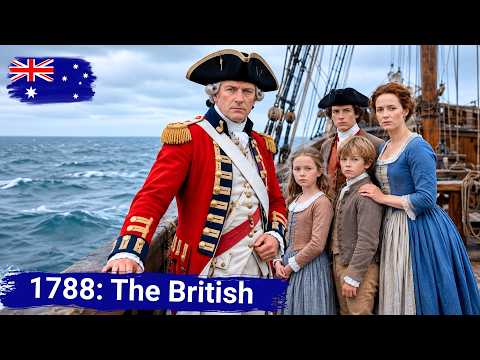
A fleet of 11 ships gathered at Portsmouth Harbor. On September 1, 1786, an advertisement appeared in a London newspaper seeking ships for hire. The British government needed vessels—not for war, not for trade, but for the largest forced migration in the empire’s history. Within weeks, a contract worth £54,000 was awarded to ship broker William Richards. The mission: load Britain’s convicts onto 11 ships and sail them 24,000 kilometers to a place called Botany Bay.
No one aboard would have a say in the matter. The man chosen to lead this operation was Captain Arthur Phillip of the Royal Navy. He was 48 years old, experienced in naval warfare and colonial administration, described by a former mentor as a man known for diplomacy and a relentless pursuit of perfection. He would need every quality he possessed. The logistical planning of moving over 1,400 people across three oceans with food, livestock, tools, seeds, medicines, and weapons was a challenge never before attempted on this scale.
The fleet that assembled in Portsmouth during the early months of 1787 was a study in contradiction. Two Royal Navy warships, HMS Sirius and HMS Supply, would serve as armed escorts. Six converted merchant ships—Alexander, Charlotte, Friendship, Lady Penrhyn, Prince of Wales, and Scarborough—would carry the convicts. Three supply ships—Borrowdale, Fishburn, and Golden Grove—were loaded with two years’ worth of provisions, agricultural tools, canvas tents, livestock, and enough gunpowder to defend a colony from scratch. The total cost of the operation was £84,000—equivalent to nearly 20 million Australian dollars today.
Aboard were 736 convicted men and women, 211 Royal Marines and their families, and nearly 300 officers and crew. The youngest convict was 11-year-old chimney sweep John Hudson, sentenced to seven years’ transportation when he was just nine. The oldest was 68. Most had never set foot on a ship in their lives.
On May 13, 1787, crowds gathered along Portsmouth’s waterfront to witness something no one had ever seen before. Eleven ships loaded with over 1,400 souls raised anchor and moved slowly toward the English Channel. Flags fluttered in the spring breeze. Shouts of command echoed across the water. And for the 750 men and women crammed below the decks of the transport ships, the coast of England disappeared behind them—likely forever.
They were not hardened criminals by any modern measure. 80% had been convicted of theft—stealing clothes, food, coins, or small goods. Many had committed their crimes out of desperation, displaced by the same Industrial Revolution that built the empire’s wealth. John Hudson, the 11-year-old, had been convicted of breaking and entering at age nine. Nancy Yates, convicted at York Assizes in 1785 for robbery, gave birth to a son aboard the Lady Penrhyn on November 17, 1787, in the middle of the ocean, somewhere between Rio de Janeiro and Cape Town.
Conditions were unlike anything most passengers had ever experienced. Convicts were confined below decks in spaces so cramped it was often impossible to stand upright. The air was thick with the smell of unwashed bodies, bilge water, and sickness. Rats and bedbugs moved freely through the holds. Marines stood guard at the hatchways. Punishments for insubordination included up to 150 lashes administered on deck before the assembled crew.
Captain Phillip ordered daily cleaning of the decks, insisted convicts be brought up for air when weather permitted, and placed a naval surgeon on each ship. His reasoning was practical: sick convicts arriving in Australia would be useless for building a colony. His insistence saved many lives. Of the 750 convicts who sailed, only 48 died during the eight-month voyage—a mortality rate remarkably low by the standards of the age.
Three oceans were crossed in 252 days. The route Phillip chose for the First Fleet was not a straight line. It couldn’t be. A direct southern route from England to Australia would have meant fighting headwinds across the Indian Ocean for months. Instead, Phillip plotted a course that first curved southwest across the Atlantic, then east beneath the Cape of Good Hope, and finally northeast toward the Australian coast—a route designed to use the planet’s wind systems rather than fight them.
The first stop was Tenerife in the Canary Islands, reached on June 3, 1787, three weeks after leaving Portsmouth. Fresh water, vegetables, and meat were loaded aboard. Ten days later, the fleet crossed the equator and pushed into the South Atlantic. The heat below decks became suffocating. Tropical rainstorms lashed the ships for days, forcing convicts to stay below with no way to dry their wet clothes. Water was rationed at three pints per person per day.
On August 5, the fleet reached Rio de Janeiro and remained for a month. The ships were cleaned, hulls inspected for damage, and Phillip purchased large quantities of food—including coffee, rice, and tropical fruits to combat early signs of scurvy. Female convicts whose clothing had been destroyed by lice received replacements sewn from rice sacks.
From Rio, the fleet crossed back east across the South Atlantic to Cape Town, arriving on October 13—the last stop before the unknown. From Cape Town, Phillip transferred from the flagship Sirius to the faster Supply to take the four fastest ships ahead and prepare Botany Bay before the rest of the fleet arrived. They never succeeded.
Supply reached Botany Bay on January 18, 1788. The slower ships followed within two days. The entire fleet had crossed three oceans without losing a single ship—a great logistical achievement in maritime history. But Botany Bay proved useless. Phillip sailed north.
When the First Fleet finally dropped anchor in Botany Bay on January 18, 1788, the relief must have been immense. After 252 days at sea, across three oceans and four ports in both hemispheres, they had arrived. The voyage was over. But within 72 hours, it became clear the destination was wrong.
Captain James Cook had visited Botany Bay in 1770 and described it in glowing terms: fertile soil, sheltered water, abundant fresh water, land suitable for settlement. What Phillip found was nothing like that description. The bay was wide and exposed to the ocean. The water was too shallow for ships to anchor near the shore. The soil was sandy and poor, and the fresh water Cook described was merely a small stream running through swampy ground. Building a colony here wasn’t impossible—it was a guarantee of failure.
To make matters worse, on the morning of January 24, two large French ships appeared outside the bay: L’Astrolabe and La Boussole, part of a scientific expedition led by Jean-François de La Pérouse. The French had sailed from Europe expecting to find a thriving British colony at Botany Bay where they could resupply. Instead, they found a newly arrived British fleet of convict ships, clearly unprepared. The French were better provisioned. The British knew it.
Phillip didn’t panic. On January 21, he had already taken a small group north in longboats to explore another harbor Cook had mentioned briefly but never explored: Port Jackson. What he found there changed everything.
A deep, sheltered harbor extending kilometers inland. A small stream of fresh water flowing into a protected cove, with water close enough to shore for ships to dock and unload directly. Phillip moved the entire fleet north within days. Sydney Cove offered fresh water and protection.
On January 25, 1788, the eleven ships of the First Fleet sailed through the entrance of Port Jackson and entered what would become Sydney Harbor. Arthur Phillip had already seen it. He had explored it four days earlier in a longboat with a small survey party, navigating the deep channels and examining the coves that indented the northern and southern shores. What he encountered left him lost for words. He later wrote that Port Jackson was, without exception, the finest harbor in the world, where a thousand ships of the line could ride at anchor in perfect safety.
The site Phillip chose for settlement was a small cove on the southern shore fed by a stream of fresh water descending from the heights. He named it Sydney Cove after Thomas Townshend, Lord Sydney, the British Home Secretary who had authorized the expedition. That stream, later known as the Tank Stream, became the lifeline of the colony. Every building, every tent, every garden in the early years of settlement was built near that water source.
The morning after the fleet anchored, sailors from HMS Sirius came ashore with marines and a group of male convicts. They were equipped with axes and saws. Work began clearing the ground immediately. Trees were felled, ground leveled, and spaces cleared for tents and supply stores. The governor’s portable house was erected on the eastern bank of the Tank Stream. Marine officers were positioned to the west. Female convicts remained aboard the Lady Penrhyn for another 12 days, not disembarking until February 6.
On February 7, Arthur Phillip formally proclaimed the colony of New South Wales. Within weeks, two realities collided on the shores of that harbor: the desperate effort to build something from nothing, and the growing realization that the land was already owned by someone else entirely.
The British flag was raised on January 26. The day of January 26, 1788, began before sunrise. Marines were roused from their hammocks. Convicts were assembled on the decks of the transport ships. Arthur Phillip dressed in his naval uniform, climbed into a longboat, and was rowed to the shore of Sydney Cove with a small group of officers. They brought with them one thing specifically for this moment: a Union Jack, folded and carried 24,000 kilometers from Portsmouth.
On the shore, in a clearing convicts had begun hacking from the bush just one day earlier, Phillip’s party assembled. The flag was raised. A volley of gunfire was fired into the air. Officers raised their glasses in a toast to King George III and the new colony of New South Wales. It was a ceremony that lasted perhaps 20 minutes. There were no crowds, no dignitaries, no speeches prepared for historical greatness. There were bushes, mosquitoes, unfamiliar January heat, and the sound of the distant harbor.
What made that morning complicated—and what historians have debated for two centuries since—was what happened at the same time on the other side of the cove. The Cadigal people, the traditional custodians of the land around Sydney Cove, had watched the fleet’s arrival. They had observed the survey parties, the longboats, the tree-felling. The Eora people, the broader language group of the Sydney region, had lived on and managed this land for over 50,000 years. No treaty was signed that morning. No negotiation took place. The British simply declared possession.
That date, January 26, is celebrated today as Australia Day. It is a national celebration and, at the same time, one of the most contested dates in Australian public life, carrying vastly different meanings depending on whose history is remembered.
The convicts cleared the land while the specter of starvation threatened everyone. Within weeks of landing at Sydney Cove, the scale of the problem became undeniable. The colony of New South Wales was founded on paper, but building an actual settlement from virgin bush with a labor force of convicts—most petty criminals from London’s streets—without experienced farmers, with rotting seeds, unfamiliar soil, and an alien climate was something else entirely.
The sandy ground around the cove was nearly useless for growing grain. The seeds brought from England had been poorly stored during the eight-month voyage, and many failed to germinate. Livestock—seven horses, 29 sheep, 74 pigs, six rabbits, and seven cattle—were landed and soon began wandering into the bush. Tools broke. Naval officers refused to supervise convict labor, considering it beneath their rank, and the convicts themselves, most of whom had never held a farming tool in their lives, worked reluctantly and without skill.
Arthur Phillip made a decision that earned him enemies among the officers but may have saved the entire colony: he ordered food rations distributed equally among convicts and free settlers alike. No one received more because of rank. No one starved because of status. The British officers were furious. The convicts were quietly fed.
Phillip also singled out a convict named James Ruse, transported for theft, who had grown up on a farm in Cornwall. Ruse was given a small plot of land at Rose Hill near present-day Parramatta and told to prove he could support himself. By 1791, Ruse had succeeded. He received the first land grant in the colony’s history.
HMS Sirius was dispatched to Cape Town in October 1788 to obtain emergency supplies, completing a circumnavigation of the globe to return in time to prevent mass starvation. The colony was hours away from collapse.
The Eora people watched the end of their world. When the eleven ships of the First Fleet sailed through the entrance of Port Jackson on January 25, 1788, they were not entering an empty land. The harbor and surrounding area were home to the Eora people, a network of clans who had lived on and managed this land for over 50,000 years. The Cadigal people occupied the land around Sydney Cove itself. The Wangal people lived to the west along the Parramatta River. The Bediagal people held the lands inland. Each clan had its own territory, its own ceremonial grounds, its own knowledge of how to sustain life from the harbor, the bush, and the seasons.
The first encounters between the settlers and the Eora were cautious but not immediately violent. Arthur Phillip had explicit instructions from the British government to establish friendly relations with the Aboriginal people. He tried to follow them, but the pressures of a colony running out of supplies, clearing land, and expanding outward made conflict inevitable within months.
The most devastating blow was invisible. Smallpox, a disease completely unknown to the Eora, swept through the Sydney region in 1789, just one year after the fleet’s arrival. The death toll was catastrophic. Entire families were wiped from existence. The warrior Pemulwuy of the Bediagal clan survived and became the most determined military opponent the colony faced, leading raids on farms, settlements, and military outposts along the Parramatta, Hawkesbury, and George Rivers throughout the 1790s. He was shot and severely wounded in 1797 and finally killed in 1802.
Phillip himself was speared in the shoulder at Manly in 1790 during a meeting with Eora men—an encounter historians still debate. He recovered and continued as governor, returning to England in 1792, taking with him two Eora men: Bennelong, who later returned to Australia, and Yemmerrawanne, who died in England in 1793.
One colony became the foundation of Australia. The colony Arthur Phillip proclaimed at Sydney Cove on February 7, 1788, was by every measure a failure waiting to happen. It had no reliable food source, no experienced farmers, hostile relations with the land’s owners, seeds that wouldn’t grow, broken tools, and a workforce of London thieves expected to build a city from virgin bush. Within two years, food rations were cut to near-starvation levels. Within three years, the flagship HMS Sirius was wrecked off Norfolk Island. Phillip himself, his health broken, returned to England by 1792.
Yet it survived—not because of grand imperial planning, but because of improvisation, stubbornness, and the hard, brutal work of people who had no other choice. Convicts whose sentences expired chose to stay rather than bear the cost of returning to England. They established businesses, cleared farms, and raised families on land that had belonged to others for 50,000 years.
Free settlers began arriving in large numbers from 1793 onward, bringing capital, skills, and ambition. By 1850, the population of eastern Australia had grown to 330,000 European settlers. The wool industry had transformed the economy. The gold rush that began in 1851 would transform it again. And on January 1, 1901, six separate colonies—New South Wales, Victoria, Queensland, South Australia, Western Australia, and Tasmania—united to form a single nation.
Between 1788 and 1868, the British government transported a total of 165,000 convicts to Australia. Most served their sentences and stayed. Many rose to positions of prominence. The attitude toward convict ancestry, once a source of deep shame, shifted through the twentieth century and into the present day. It is now widely regarded as a badge of distinction—a link to the most unusual founding story of any nation on Earth.
The nation that emerged from that harbor was never one thing. It was convict and guard, settler and dispossessed, immigrant and Indigenous, layered over each other like sediment. By 1901, the six colonies had become a federation—but the Eora had never signed anything away.
Today the continent holds 26 million people from every corner of the earth, speaking over 300 languages. Yet the oldest continuous culture on the planet still lives within it, still fights for recognition of that January morning’s other truth.
Australia Day is celebrated with barbecues and citizenship ceremonies, and mourned as Invasion Day by many of the descendants of those who watched the flag rise. Both stories are true. Both are Australia.
So here is the question the history leaves us: when a nation is built on a beginning that means triumph to some and catastrophe to others—can it ever truly celebrate a single day, or must it learn to hold both truths at once?
Report this article
Select a reason for reporting:






