The jungle was silent—too silent. Sergeant First Class Logan wiped the sweat from his brow, his eyes scanning the dense canopy for any sign of movement. Behind him, five men waited, their breathing controlled, their fingers resting lightly on the triggers of their CAR-15s. They were a Recon Team from the 5th Special Forces Group, Airborne—the best of the best. And they were deep in enemy territory, where a single misstep meant death.
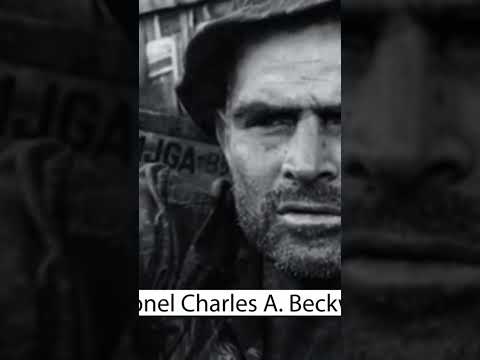
It was 1965, and the United States military had just launched a top-secret initiative: Project Delta. Their mission: gather intelligence, disrupt enemy operations, and prove that small, elite teams could achieve what entire battalions could not. At the helm was Colonel Charles Beckwith, a legendary figure whose name alone inspired both fear and respect. Beckwith had handpicked these men, trained them to operate behind enemy lines for weeks at a time, and now they were about to embark on a mission that would test every ounce of their training.
Logan signaled for his team to halt. He’d heard something—a faint rustle, a snapped twig. “Charlie’s out there,” he whispered. The team melted into the underbrush, their camouflage blending perfectly with the shadows. This was their world now: a world of stealth, of split-second decisions, of survival against impossible odds.
But this story isn’t just about the missions—it’s about the men who fought them. Men like Logan, a farm boy from Iowa who’d volunteered for the Army to escape a dead-end life. Men like Sergeant Rodriguez, a Cuban refugee who’d joined to prove his loyalty to his new country. And men like Lieutenant Miller, a West Point graduate whose idealism hadn’t yet been shattered by the realities of war.
They were a team, forged in the crucible of Fort Bragg’s brutal training, bound by a code that transcended rank or background. “We don’t leave anyone behind,” Beckwith had told them on the first day. “And we don’t fail.” Easy words to say in the safety of a briefing room. Harder to live by when the bullets started flying.
As Logan’s team moved deeper into the jungle, the tension was palpable. Every step could trigger a booby trap, every shadow could hide an ambush. They were hunting for intelligence—a North Vietnamese supply route rumored to be nearby. But the jungle had other plans. A sudden downpour turned the ground to mud, slowing their progress and muffling their senses. “Stay sharp,” Logan muttered, his voice barely audible over the rain.
Then came the first sign: a set of fresh footprints, leading off the trail. Logan’s heart raced. They were close. He signaled for the team to follow, and they slipped into the dense foliage, their movements silent as ghosts. What they found next would change everything—a hidden cache of weapons, maps, and documents, guarded by a squad of Viet Cong soldiers.
The odds were against them: six men against twelve, with no backup and no way to call for help. But that’s what Project Delta was all about—impossible missions, executed with precision and courage. Logan took a deep breath, chambered a round, and gave the signal. “Let’s go.”
The jungle erupted in chaos. Bullets tore through leaves, grenades shook the earth, and for a moment, it was pure adrenaline and instinct. Logan’s team fought with a ferocity that stunned the enemy, their training taking over as they moved and fired as one. But the Viet Cong were not easily beaten, and the fight was far from over.
As the smoke cleared, Logan realized they had achieved the objective—but at a cost. One of his men was down, and the enemy was regrouping. The mission was a success, but the jungle always demanded its price. With the documents secured and the wounded soldier carried between them, the team vanished into the rain, leaving behind a trail of destruction and a mystery that would haunt them for years.
This was just the beginning. Project Delta would go on to conduct countless missions, each one pushing the boundaries of what was possible. But for Logan and his team, this first operation would forever define them—a brotherhood forged in blood and fire, in the heart of a war that would test them to their limits.
They humped through the monsoon mud for two days before the extraction chopper finally found them, and by then the wounded man—Sergeant First Class Kowalski, a bear of a man from Chicago—was running a fever that turned his eyes glassy and his words to nonsense. Logan kept him talking anyway, because silence in the jungle felt like a grave.
Back at the forward operating base, Colonel Beckwith was waiting. He didn’t ask about the wounded first, or the enemy body count. “The documents,” he said, and Logan handed them over without a word. Beckwith spread the maps across the table, his finger tracing a network of trails and river crossings. “This isn’t a supply route,” he said quietly. “It’s a staging area. They’re massing for something big.”
The room went cold. Lieutenant Miller leaned in, his West Point polish now cracked with exhaustion. “How big?” Beckwith looked up. “Big enough that if we don’t stop it, half the province falls by spring.”
What Beckwith didn’t say—what he couldn’t say in front of the whole team—was that Washington had already decided the answer wasn’t another battalion sweep. It was another Delta mission. A deeper one. One that would take them across the border into Laos, where the rules of engagement dissolved into rumor and deniability.
Logan found Beckwith alone that night, staring at a map by lamplight. “Sir, Kowalski’s going to make it, but he’s done. We’re down a man.” Beckwith nodded slowly. “Then you’ll take a new one. Name’s Specialist Four Nguyen—Kit Carson scout, speaks the language, knows the trails better than any of us.”
Logan stiffened. “A scout? Sir, my men won’t—” “Your men will follow orders,” Beckwith cut in, his voice flat as a blade. “And so will you. He’s been vetted. He’s one of ours now.”
The introduction was exactly as ugly as Logan expected. Rodriguez wouldn’t look at the new man. Miller offered a stiff handshake. Nguyen took it all without a flicker, his eyes calm and unreadable, and Logan couldn’t decide if that was discipline or something colder.
They spent three days prepping—zeroing weapons, studying aerial photos, memorizing the route. Nguyen corrected the map twice, pointing out a ford that had shifted with the rains and a ridgeline the photos had missed entirely. “You’ve been there?” Logan asked. “I was born there,” Nguyen said. “Before it was theirs.”
On the fourth night, they slipped across the border in total darkness, the jungle swallowing them whole. Somewhere ahead lay the staging area, the enemy, and a mission that officially never happened. Logan checked his compass, then looked back at his men—five shadows and one stranger—and gave the signal to move.
The border crossing had gone smooth—too smooth, Logan thought, and that made his shoulder blades itch. They’d waded a shallow river, Nguyen leading them through a gap in the vegetation that no aerial photo could have revealed, and now they crouched in a bamboo thicket while the scout listened to the night the way other men listened to music.
“Two patrols,” Nguyen whispered at last. “Twenty minutes apart. If we move now, we cross the trail in their blind spot.” Logan nodded, and they moved—six men threading through the dark like a single animal, every step placed with the care of a man walking on broken glass.
By dawn they’d found the staging area, and it stole the breath from Logan’s lungs. It wasn’t a camp. It was a city in the jungle—bunkers dug into the hillside, trucks concealed under cut foliage, and hundreds of men moving with the orderliness of an army that had been there for months. Miller raised his binoculars and his hands were shaking. “That’s a regiment,” he breathed. “At least.”
Rodriguez was already counting out loud, his voice tight. “Anti-aircraft guns. Fuel dumps. That’s not a staging area, that’s a goddamn fortress.” Logan pulled them back into the tree line before anyone could be seen, his mind racing. Beckwith had been right. Half the province—maybe more.
The plan they built over the next two hours was simple and terrible: split into three pairs, plant the marking devices on the fuel dumps and the main bunker, then exfiltrate to the extraction point before the bombers came. “If we’re not at the LZ by zero-three-hundred, the birds fly without us,” Logan said. Nobody argued. Nobody ever argued with that rule.
Nguyen and Rodriguez took the eastern fuel dump. Miller and the radioman took the bunker. Logan took the western dump with the team’s machine gunner, a quiet Kentuckian named Dawes. They crawled through elephant grass for four hundred meters, the sun climbing and the heat pressing down like a hand, and Logan kept his eyes fixed on the gap between the trucks where the sentries paced.
They were ten meters from the fuel drums when Dawes froze. Logan followed his gaze—a tripwire, thin as spider silk, strung knee-high between two stakes. Dawes looked back at him, and Logan mouthed the word: careful. Dawes lifted his boot, stepped over—
And a dog barked somewhere behind them.
The sentry’s shout split the morning. Logan didn’t think; he fired, and the world came apart. “Go loud! Go loud!” he screamed into the radio, and Dawes was already on the drums, slapping the marking device against the metal as bullets chewed the dirt around them.
Across the compound, the eastern dump went up in a bloom of orange fire—Rodriguez and Nguyen had made it. The alarm sirens started, and men poured from the bunkers like ants from a kicked nest. Logan grabbed Dawes by the collar and dragged him into the smoke, and they ran, the whole jungle screaming behind them.
They ran for what felt like hours, lungs burning, legs churning through vines and mud, the jungle tearing at their fatigues like it wanted to keep them. Miller’s voice crackled over the radio—“Bunker’s marked, we’re moving!”—and Logan answered with a breathless grunt, shoving Dawes ahead of him through a wall of bamboo.
The LZ was a bomb crater in a clearing, marked only by the smell of wet earth. Rodriguez came crashing out of the tree line first, dragging Nguyen, whose left sleeve was soaked black. “He took a round covering me,” Rodriguez shouted, and there was something new in his voice—guilt, maybe, or respect. Logan didn’t have time to name it.
Miller arrived last, the radioman stumbling behind him. The sky was still dark, but the horizon was already growling. “Where’s the bird?” Dawes yelled. Logan checked his watch: zero-two-fifty. “Ten minutes,” he said, and then the whole jungle lit up as the first fuel dump cooked off—a fireball that turned night into noon.
The chopper came in hot, skids brushing the crater’s edge, and they threw themselves aboard with the enemy already firing from the tree line. Nguyen slumped against the bulkhead, bleeding but conscious, and Rodriguez pressed a compress to the wound without being asked.
Back at the base, Beckwith read the after-action report in silence. When he finished, he looked at Logan and said the only thing that mattered: “You brought all six home.” Logan thought about the tripwire, the dog, the stranger who’d taken a bullet for a man who wouldn’t look at him. “Yes, sir,” he said. “That’s the mission.”
Project Delta would run for years, and men would come and go, but that first deep mission into Laos became the story they told the new guys—the one about the jungle city, the six shadows, and the scout who earned his place in blood. Some brotherhoods are forged in training. Others are forged in fire.
And some are forged the moment a man steps over a tripwire and the whole world starts shooting—do you think Rodriguez ever looked Nguyen in the eye after that night, or did it take another mission to make them brothers?
Report this article
Select a reason for reporting:






