Kontum Province, Vietnam, January 1968. The sun had not yet risen, and the forward operating base sat at the jungle’s edge like a held breath. Three recon teams had gone into those hills in eight weeks. None returned with anything useful. One never returned at all. The men at this base weren’t ordinary soldiers—they were MACV-SOG, a unit so secret most of the U.S. military had never heard its full name. They ran small teams across borders that officially didn’t exist, onto trails Washington would never admit knowing about. Their job: go where no one was supposed to go, see what no one was supposed to see, and come back alive. They were the best-trained soldiers in the world. And they had a problem they couldn’t fix.
Teams were going quiet. Not in firefights—no radio calls, no sounds, no explanation. Four and five men, trained and armed and careful, walking into the jungle and disappearing. The radio stopped. The extraction helicopters found nothing. The jungle took them and gave nothing back.
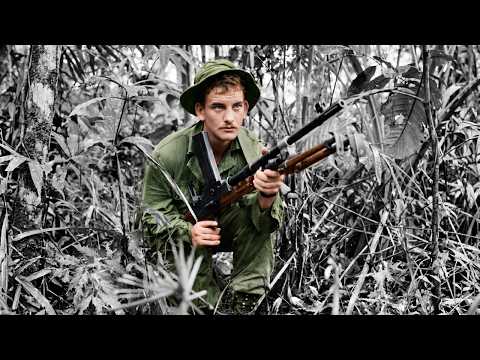
The NVA had learned. They had trackers of their own—men who could read a boot print pressed into mud, a hand that pushed a branch, the faint shape of a knee in the soil. They were finding the teams early and calling in forces fast enough to make escape nearly impossible. It wasn’t a failure of courage or training. It was a failure of camouflage in the deepest sense: the teams were invisible to the eye, but loud to the ground. And the ground was talking to the wrong people.
A request went up the chain. MACV-SOG needed someone who could read terrain the way the enemy did. Someone who could move without leaving the signs the NVA trackers had learned to find. The Australians had that person.
The Australian Army Training Team Vietnam had been in-country since 1962—longer than almost any other foreign force. They said yes. They would send someone. A temporary loan. He would work with the SOG teams for a defined period, pass along what he could, then go back to his own people.
He arrived before most of the base was awake. No ceremony, no briefing room full of officers. He came in on a vehicle with his kit, a scout by the terms of his attachment, and he moved the way men move when they are not performing anything for anyone. Quietly. Without wasted steps. He set his gear down and looked at the base the way a man looks at a place he is trying to understand rather than impress. Then he looked at the tree line. He looked at it for a long time. Not with fear. Not with the alert scanning of new men trying to look like they belong. He looked at it the way you look at something you’ve been looking at your whole life in different places, different light, different stakes, but always the same thing underneath. Green, quiet, full of information if you knew how to ask.
One of the American sergeants walked over and told him they had a mission coming. Told him the area, the team size, the basic shape of what they’d be doing. The Australian listened. He asked one question.
“When do we go out?”
That was all. No speech, no introduction of himself and his credentials, no reassurance offered in either direction. Just the question that mattered. The sergeant looked at him for a moment and then told him, “Two days.” The Australian nodded and went to find somewhere to sleep.
Nobody at that base knew yet what the next few weeks would produce. Nobody knew what this man was about to show them in the jungle, or what they would say about him when it was over, or what they would do when the Australians finally asked for him back. They would find out soon enough.
To understand what that Australian brought to Kontum, you have to go back—not to Vietnam. Back further. Back to a different jungle in a different decade, where the men who would eventually train him were learning something no classroom could teach and no manual had yet written down.
Malaya, 1950s. The British were fighting a communist insurgency deep in some of the thickest jungle on Earth. The enemy didn’t wear uniforms. They didn’t hold ground. They moved through the trees like water, and when standard infantry tactics failed—as they always did in that terrain—a different kind of soldier had to be invented. Small teams, long patrols, men who could live in the jungle for weeks, read it like a language, and move through it without announcing themselves to everything that lived there. The British called it deep jungle warfare. What it really was was patience turned into a skill—the ability to slow down so completely that the jungle accepted you as part of itself.
Australia sent soldiers to Malaya. They watched. They learned. Then they went home and built something of their own.
The Australian Special Air Service Regiment was formed in 1957, shaped by Australian experience and Australian terrain. From the beginning, it was a small force. It was never meant to be large. What it was meant to be was precise. The SASR trained for long-range reconnaissance, for operating in denied territory without support, for the kind of mission where the margin between success and death was measured in noise and footprints.
In the early 1960s, that training was tested in Borneo, during the Indonesia-Malaysia Confrontation. The jungle there was as dense as anything in Southeast Asia. The operations were quiet by necessity, small by design, and the men who came home from Borneo were different from the men who had gone. They had refined something. They had turned theory into muscle memory. Australian teams moving through that jungle were so quiet and moved so deliberately that accounts from the period describe Indonesian forces passing within meters of concealed Australian soldiers without detecting their presence. The jungle, as far as the enemy was concerned, was empty.
That was not accident. That was years of deliberate work paying off in the only way that mattered. They had learned to move like they belonged there. That was the thing they eventually brought to Vietnam.
Tracking was at the center of all of it. A tracker reads the ground the way a detective reads a crime scene—except the crime scene is moving and so is the criminal. A bent stem. A boot print too deep on one side. Moss scraped off a rock face at knee height. A spider web broken at chest level where a man pushed through in a hurry. Each one alone means almost nothing. Together, read fast in bad light with someone possibly watching you read, they tell you exactly how many people passed, which way they went, how long ago they left, and whether they knew you were coming. The Australians had spent a decade learning to read that language under real conditions with real stakes. By the time this man arrived at Kontum, it was not a skill he performed. It was how he thought.
The Australian Army Training Team Vietnam had been in the country since July 1962, making it one of the earliest foreign forces of the war and one of the last to leave, not pulling out until 1972. At its peak, the AATTV had around 200 soldiers in-country at any one time. For a unit that small, the footprint it left was enormous. AATTV members were awarded more decorations per person than almost any other unit in Australian military history. Two Victoria Crosses, multiple Distinguished Conduct Medals, a string of American commendations from officers who had worked alongside them and wanted it on record that what they had seen was not ordinary.
The men the AATTV sent were not advisers in the way that word usually sounds. They didn’t sit behind desks and review training schedules. They went out. Many were attached directly to South Vietnamese units, living with them, patrolling with them, doing exactly what those units did, and sharing every risk. Some ended up attached to American units, including, by the later years of the war, elements of MACV-SOG.
SOG itself was something the Australian had heard of before he arrived. But hearing of it and understanding it were different things. MACV-SOG—Military Assistance Command, Vietnam Studies and Observations Group—was the name built to sound like nothing important. It was one of the most classified operations of the entire war. Its recon teams, usually called Spike teams or recon teams depending on the period, ran four to six men into territory that the United States officially denied operating in. Laos, Cambodia, the Ho Chi Minh Trail. They went in light, without the kind of firepower that would let them fight their way out of anything serious, because the entire point was to never be found. Observe, report, extract. The teams were a mix of American Special Forces soldiers and local fighters—usually Montagnard tribesmen—who knew the terrain and had their own reasons for fighting.
What they were not, by 1968, was invisible enough. The NVA had spent years watching American patterns. They had learned the insertion corridors, the likely observation points, the signs that a foreign-trained soldier left in jungle he had not grown up in. The gap between what SOG needed and what its teams could currently provide was specific and serious. It was not a gap in courage or firepower or tactical knowledge. It was a gap in the oldest skill in warfare: reading the ground, and moving without being read back.
The man who had just arrived at Kontum had been reading terrain like this since before most of his new teammates had finished school. He was exactly what they needed, and in two days they would find out if they were right.
They went out before first light. Four men—the Australian and three Americans—moving in single file with five to ten meters between each. Nobody spoke. Sound in that jungle didn’t stay where you put it. The men who had survived long enough to know that didn’t need reminding.
The target was a ridgeline fourteen kilometers northwest, a suspected NVA staging corridor. Three previous teams had tried. One was compromised within six hours. One extracted early. One pulled back before establishing an observation point. Fourteen kilometers doesn’t sound far. In that terrain, it was a full day of deliberate, exhausting movement.
The team leader noticed it within the first hour. The Australian would pause where nothing visible had changed, look at a patch of soil for two or three seconds, then alter course—sometimes a degree or two, sometimes more. When the team leader looked back at those spots, he started to see it. Compression on a leaf that hadn’t fully risen. A drag mark with edges still sharp. A broken stem still white at the break. The Australian was reading a story in the soil the Americans had walked past without seeing the first word.
By mid-morning he had changed the route four times. Each change took them away from where the signs said people had been—and away from the corridors previous SOG teams had used. That was the point. The NVA trackers had learned to watch the predictable lines. The Australian was finding the unpredictable ones.
At roughly eleven, he stopped. Closed fist. The team froze. He crouched slowly and studied the dark soil between the roots of a large tree. Then he turned and held up three fingers. Pointed ahead and slightly right. Touched his ear. Three people, ahead and right. Listen.
For thirty seconds, the team heard nothing. Then, under the nothing, something. Not movement. Not voices. The sound a person makes when they are trying not to make sound—which is different from actual silence in a way that takes a long time to learn to hear. They were not the hunters anymore.
The team leader looked at the Australian. The Australian was already looking at him. His face was calm in a way that was not the calm of someone unafraid. It was the calm of someone who had already started solving the problem while everyone else was still realizing there was one. He pointed left and began to move.
They moved left for forty minutes without stopping. The Australian led. That wasn’t how it had started that morning—the team leader had been at the front when they inserted, as team leaders are. But somewhere in the first hours, the order had quietly shifted itself. Nobody announced it. Nobody needed to. Trust in small teams doesn’t come from rank. It comes from being right when being wrong gets people killed.
He wasn’t running from the NVA element. He was moving around it in a long curve, keeping them in low ground along a creek drainage. The water was too loud to use as a corridor, but the vegetation along its banks screened them, and the soft earth near the water spread prints badly, making them harder to read as human. He wasn’t just moving them away from danger. He was moving them in a way that left the least possible trace behind.
By early afternoon they reached an alternative observation point—a rocky shelf on the backside of the ridgeline, never used before. The Australian had found it by reading drainage patterns and vegetation density during the approach, working out where a flat surface was likely to exist before he could see it. They set up in two pairs, ate nothing that smelled, and watched the valley floor for three hours.
What they saw was enough. Movement on a trail below. Recently occupied rest positions. Supply activity that confirmed the valley was exactly what intelligence had suspected. They extracted the following morning before dawn—clean, undetected, with what they had been sent to collect. That had not happened in this area of operations for two months.
Back at the base, the debrief ran longer than usual. Not because of complications—because the team leader had things he wanted on the record correctly. He described the route changes and what each had avoided. He described the NVA detection and the specific signs read to identify it. Then he wrote something that didn’t belong in a mission report in the technical sense, but that he put in anyway. He wrote that the patrol’s success was directly traceable to the tracking and movement skills of the attached Australian soldier. That without those skills, based on the patterns of previous compromised operations in the same area, the team would likely have walked into the NVA element rather than around it. He did not use the word lucky. He used the word preventable, and he used it with purpose.
Within a week there was a second patrol. It nearly went wrong on the second day when the Australian stopped the team cold for eleven minutes in a creek drainage while something passed unseen forty meters to their north. They never found out what it was. They came back with the intelligence they had been sent for. Then a third patrol. Then a fourth. Each one returned complete. Each one brought back what three months of previous attempts had failed to produce.
The base commander sent a request up through command. Not a suggestion—a request. Specific language, specific justification, specific duration. He wanted the Australian’s attachment extended. He wanted to keep him. The paperwork moved through channels, each layer adding its own thinking. The AATTV commanding officer read it, read the operational reports attached, and sat with it. Pulling one man from his expected rotation wasn’t simply a personnel decision. It was a question about what the AATTV’s commitments meant and who decided when they were renegotiated. There was also the quieter question of what it meant for the man himself. SOG operated with the ability to deny that any of it ever happened. When a SOG team crossed a border the United States officially denied crossing, the men on that team were, in a formal sense, nowhere. If something went wrong, the acknowledgement was not coming.
The extension was eventually approved. The precise duration and conditions stayed inside the classified record for years. What mattered operationally was that the Australian stayed. He went out again, and again. One team sergeant—a man with four prior SOG rotations and a record that made his assessments carry weight—said that in all his time running recon, he had never worked with anyone who moved the way the Australian moved. Not faster, not louder or quieter in any obvious way. He moved, the sergeant said, like he understood an agreement the jungle had with people who paid attention to it.
Another American said something simpler. He said that twice during a single mission, the Australian had stopped the team and changed direction based on things the rest of them could not see. Both times, when they got far enough away to look back at where they had been heading, they found signs that people had been there very recently. He said he had gone home that night and tried to work out what he had missed. He could find one of the two things. The other one he never did find.
The Australian himself didn’t talk much about any of this. That wasn’t a personality trait in the unusual sense. It was how men from that tradition operated. The SASR culture, built across Malaya and Borneo, didn’t produce people who explained themselves at length. You did the work. The work spoke. What he did say, in the quiet conversations between patrols, was that SOG was unlike anything he had operated in before. Not in the quality of the soldiers—the Americans were serious men and he had no question about that. What was different was the weight of the silence around it. He was operating in a space where his own government knew roughly where he was and had no way to say so publicly if it became necessary. He had thought about that before the first patrol and decided it was acceptable. He had thought about it again after several more and reached the same conclusion. But it was a different kind of weight, and he did not pretend otherwise.
The Americans noticed that about him, too, in the way they noticed everything about a man you depended on in that kind of terrain. He was not reckless. He was not loud about his own calm. He carried his particular weight the same way he carried his kit—without adjusting his posture to show anyone he was carrying it. That was something the SOG operators recognized. They had their own version of it. And finding it in someone from the outside, from a different army with a different flag, sitting in the same dark at the same forward operating base before the same kind of dawn, was not a small thing. It did not need to be said. In that company, the fact that nobody said it was the compliment.
His rotation eventually ended the way it had begun. Quietly. A vehicle, a kit bag, a flight. The base at Kontum eventually became something else, and the men on it became other men in other places, the way all of it eventually does. He went back to the regiment that had trained him and sent him and waited for him. What he found when he returned was that they already knew. Not the specific details, which were classified and would remain so for years, but the shape of it. The SASR was small enough that reputation moved fast inside it, and the assessment that had come back through the channels—in the measured, unsparing language of American special operations officers who did not waste words—had reached the men whose job it was to know what it said. He did not need to explain himself. He was home.
The Americans who had served alongside him carried what they had learned in a more practical direction. At least three of the SOG operators who had patrolled with the Australian took the specific techniques he had shown them and began working them into how they trained and moved. Not as a formal program—as something passed between men who trusted each other, the way most genuinely useful military knowledge travels. One of them said, years later, that he had spent the rest of his career trying to teach other soldiers to see what the Australian had shown him, and that he had never fully succeeded, and that the failure had taught him more about the depth of that skill than any success would have.
Some of the men from those patrols did not come home. SOG’s casualty rate across the operational period was severe enough that the odds were always against any individual making it through a full rotation untouched. The ones who did not make it back were not forgotten by the ones who did. In that particular community, you do not forget the people you trusted your life to in the dark. The Australian had been one of those people. For the Americans who survived, that was a specific kind of permanent.
The war ended. Not cleanly, not quickly, not in the way that anyone who had fought in it would have chosen. Saigon fell in April 1975, seven years after the patrols in Kontum Province, and the country that so many men from so many nations had bled across became something different from what any of them had been told they were fighting to protect. The bases closed. The files were sealed. The men came home to countries that were, in different ways and for different reasons, not ready to talk about what they had done or what it had cost.
Australia was not kind to its Vietnam veterans in those years. That is a plain fact, and it does not need dressing up. The men of the AATTV came home to a country that had turned against the war before the war had finished. There were no parades for most of them. There were, for some, protests. Men who had spent years in the jungle doing serious and dangerous work at the request of their government came back to find that the same government was not particularly interested in saying so loudly. The AATTV would not receive its welcome home march until 1987—fifteen years after the last of its soldiers left Vietnam. Fifteen years is a long time to wait to be acknowledged. Most of the men waited without saying much about the waiting, which was consistent with who they were, and which made the silence around them that much harder to justify.
The SASR kept moving. That is what institutions do when they are built correctly. What the men brought back with them was not written down anywhere officially. It moved through the regiment the way real knowledge always moves in small organizations—not in manuals or formal updates, but in what experienced soldiers showed the men coming up behind them. The regiment that deployed to Afghanistan in 2001 was not the same regiment that had sent men to Vietnam four decades earlier, but it carried something forward from that period the way a river carries things from its source. You cannot always see what is being carried. You can sometimes see where it ends up.
The tracking doctrine did not disappear. It changed shape. The technology around it shifted in ways that no one in Kontum Province in 1968 could have imagined. Surveillance systems, drone reconnaissance, signals intelligence—all of it changed the battlefield. None of it replaced the need for men who could move through denied territory without being found. Who could read the terrain and move in ways that left the least possible trace. That need is older than any technology, and it has outlasted every prediction about being replaced.
What the Americans took home was not just a technique. It was a question they had not expected to be asking. The question was this: what does a military actually need to be? Not how big, not how well funded. What does it need to be at the level of the individual soldier in the moment when technology has no answer and firepower has no target and the only thing between a team of four men and the jungle silence is one person who learned to read the ground before most of his teammates had finished school. The Americans who came home from those patrols spent the rest of their careers inside that question. Some of them found better answers than others. None of them forgot who first made them ask it.
He went home with no ceremony, which was how he would have wanted it and how the SASR would have handled it regardless. His file went back into the system. His rotation continued. At some point, the details of what he had done became part of the classified record that the regiment held for years before any of it reached the public. What did not wait for declassification was the assessment. It had already moved through the channels that military institutions use to pass important information quietly. By the time he walked back through the gates of the regiment, the men whose job it was to understand what had happened in Kontum already knew. Not the specifics—the shape of it, the verdict. He did not need to explain himself and the regiment did not need him to. That is what it looks like when an institution and the people it built understand each other completely.
What the Americans said about him mattered. Not because it needed an outside voice to prove what he was, but because it was true. And true things said plainly by people who do not say things they do not mean are their own kind of record. They did not want to give him back. They said so in writing, in the specific language of men who understood that what they were documenting was not routine. They were right about that. It was not routine. A boy who learns to read the ground grows into a man who keeps four other men alive in a jungle on the other side of the world. The Americans who came home because of him put it in writing. That is what it looks like when a small country builds something right and sends it somewhere that matters.
So here is the question that remains, decades later, for anyone who has followed this story this far: if the measure of a military is not its size or its budget but what one of its soldiers can do in the dark when everything depends on him—what does it say that the world’s largest army had to borrow that from a nation of just twelve million people? What do you think that Australian carried home that never made it into any file? Tell us in the comments.
Report this article
Select a reason for reporting:






