On a July afternoon in 1917, a maid entered the bathroom of a Louisville mansion and found the richest woman in America unconscious in the bathtub, fighting for her life. Her name was Mary Lily. She had inherited $100 million from a Standard Oil magnate, and within months her pearls—valued at half a million dollars—had vanished. Her body was later exhumed at night under heavy guard, and the autopsy file was sealed forever.
She was not the only one. There was the streetcar baron who built a palace on Park Avenue for his mistress, then died broke in a hotel room. And the railroad heir who kept a second family reachable only by yacht, while his siblings dragged his fortune into court. Three of the Gilded Age’s greatest fortunes, each drained from within by love.
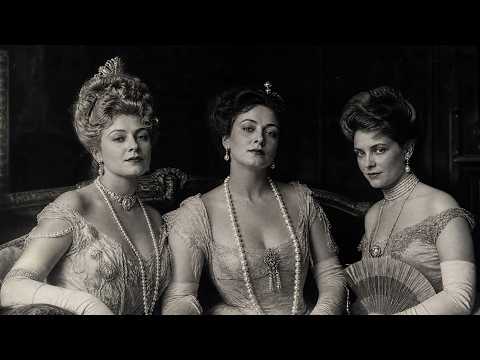
Where does $100 million go when its owner is gone? If you’ve ever wondered how the marble palaces of the Gilded Age emptied so quickly, stay with me. Subscribe, and over the next two hours, I’ll show you three fortunes and three women into whose hands the money flowed before it ran out.
Chapter One: The Fortune as a Crackable Vessel. They built their wealth to last a thousand years—out of marble, railroad steel, and oil profits—and not one of them survived its owner. That’s the strange thing about Gilded Age fortunes. We look at the surviving palaces, the ballrooms modeled on Versailles, the private galleries hung with Rembrandts, and we assume the wealth behind them was as solid as stone.
It wasn’t. Great wealth in those years was not a closed vessel. It looked like marble. It was closer to water, held in shape only by the will of the man who gathered it. And the moment that will weakened—the moment a crack opened in the side of the vessel—everything began to leak away quietly.
This film is about three vast fortunes, not lost to market crashes or to reckless sons gambling it away, though there were plenty of those. They were drained by something deeper and harder to predict. All three were depleted by love—or something like it—by an affair, a mistress, a secret family. In each case, a man who owned a colossal fortune turned it toward a woman his society refused to accept. He spent on her, built for her, signed for her. And in each case, the dynasty that was supposed to inherit was left with a fraction, a scandal, or nothing at all.
The three affairs did not destroy these families the same way. That’s why we take them in order, from the least severe to the most. The first fortune, Henry Flagler’s oil money, survived intact but simply left the family entirely, pulled out by a marriage and a mysterious death, and reattached to other names. The second, Charles Yerkes’s streetcar fortune, didn’t just leave—it evaporated. Within ten years of his death, there was nothing left to inherit. The palaces were sold, the paintings scattered among strangers. The third, the Gould railroad fortune, did something worse. It turned the family on itself until brothers and sisters were suing each other in court over what remained, the crack running right through the middle of the bloodline.
Consider for a moment the scale of what we’re watching vanish. Flagler died with a fortune of about $100 million—a sum his house museum today estimates at over $12 billion in modern value. Yerkes, at his peak, controlled companies with securities valued at over $100 million, though much of that paper, as we’ll see, was actually worthless. And Jay Gould, whose family inherited the third fortune, left $72 million in 1892—roughly $2.5 billion today. These were not comfortable inheritances. They were among the largest private accumulations of money the world had ever seen, and every one of them disappeared within a single generation of the family that made it—in two of the three cases, almost completely.
There’s a strange thread connecting all three cases, and it’s better to face it honestly from the start rather than pretend these are simple financial case studies. There’s a wife who spoke to a Ouija board and was declared insane. There’s a body pulled from a grave at midnight. There’s an heir who entered a pharaoh’s tomb and came home to die. Wherever the record turns strange, this film will turn with it. And each time it does, it will give you the clear explanation alongside the horror, then leave the judgment where historians have left it—open.
These were human beings first, and money was always second. So we’ll enter each one through the person at its center, and let the marble and the millions flow behind him. But let’s begin with the man who, by unanimous agreement, had the sharpest financial mind of his age—and who used it to do something no smart man should ever have done. He bought a law.
His partner, John D. Rockefeller, was once asked whether the grand design of Standard Oil was his own idea. He said no. He said, “I wish I had the brains to think of it.” Henry Flagler was the one who thought of it. Hold onto that line. We’ll need it again at the end, when we see what all those brains could not do—keep a vast fortune from leaking out through the one crack its owner opened himself.
Chapter Two: The Oil Baron and the Wife He Buried Alive. Henry Flagler had the brain that built Standard Oil, and a wife whose mind was collapsing in a curtained room he paid handsomely to keep closed. To understand how a man like that ends up buying a divorce law, you have to see first how far he rose, and how the rising never softened him.
Born in 1830 in a small upstate New York town, the son of a poor Protestant minister, he left school at fourteen. There was nothing in his beginnings to suggest the empire that followed. What he had was patience, a gift for cold arithmetic in a bargain, and a well-timed marriage. Around 1850, he met a young man named John Rockefeller while working in the grain trade in Ohio. The partnership might never have become an empire without family money. His half-brother invested $100,000 in Rockefeller’s refinery on one condition: that Flagler be brought in as a partner. So Flagler entered the oil business on another man’s capital rather than his own.
Once inside, he proved to be the architect. It was Flagler who devised the strategies that turned the oil company into a monopoly. The secret rebates extracted from the railroads, the merger mechanisms that swallowed every competitor. By 1870, the company was known as Standard Oil, and Flagler was one of the richest men of his age. Rockefeller himself deferred the credit without hesitation, and his tribute is the pivot of this film. When asked whether the grand design was his, Rockefeller said no. He said he wished he had the brains to think of it, and that the brains belonged to Henry Flagler.
By the end of his life, Flagler’s personal fortune was about $100 million—a sum the museum that now holds his home estimates at over $12 billion in today’s value. In short, he had more money and cunning than almost anyone alive. But one shouldn’t underestimate what he did with that fortune, because an ordinary man might be forgiven for the disaster that followed. Flagler chose every step of it with his eyes open.
His first wife was named Mary Harkness, a relative of the family that brought him into oil. She was, by all accounts, a devoted and frail woman. When she contracted tuberculosis, a doctor suggested a warm winter in Florida. That suggestion, offered to a dying woman, would one day change the face of an entire coast. Flagler fell in love with the place, and poured a fortune into it—railroads, grand hotels—making him the father of modern Florida. Mary Harkness did not live to see much of it; she died of her illness in 1881.
Two years later, at fifty-three, Flagler married again. Her name was Ida Alice Shourds, and she had been one of Mary Harkness’s nurses. A former actress, vivacious and clever, for a time she was a celebrated hostess, her dinner parties in Florida drawing old New York families like the Astors and the Vanderbilts. Then, gradually, something in Ida Alice began to come apart. It started with the usual cruelties of a marriage. She spoke openly in company about her husband’s infidelities, but it didn’t stay ordinary. She became absorbed in a Ouija board, consulting it for hours, taking its answers as instructions. In the strange context of that era, it seemed as though supernatural forces were creeping into a rich woman’s parlor. So the gossip ran.
The real explanation is sadder, and probably true. Ida Alice suffered from a genuine mental illness, a delusional disorder that the medicine of the time could not diagnose, though it failed to cure it. A sensational legend persisted for a century—that she believed the Tsar of Russia was in love with her, that he would marry her after Flagler died, that she once threatened her husband with a pair of scissors. But the most careful study of her case found no trace of the Tsar. So we leave those details where they belong, in the murk between fact and fiction.
What is documented is harsher than any legend. In the autumn of 1895, two alienists—the term then used for psychiatrists—examined her and recommended immediate transfer to an asylum. One doctor diagnosed her with incurable delusional insanity. She was moved, first to a private institution costing $1,000 a month, then to another, then another for the rest of her life. In 1899, a New York court declared her legally incompetent and placed her personal affairs and money under a committee. Among the hidden cruelties of this arrangement, the man appointed to protect her interests was Flagler’s own divorce lawyer.
Here is the scale of what this confinement meant. She remained isolated for over 35 years. By one recurring count, she spent more than 12,700 days in complete seclusion, and she did not die until 1930, long after the man who had put her there. The cost of her care exceeded a quarter of a million dollars a year, drawn from an income set aside for her of over $400,000 a year. Compare that to the wages of an ordinary family at the time, and the accounts of her imprisonment are obscene. It cost a fortune every year just to keep the first wife, considered an inconvenience, comfortable and out of sight. And all of it was hidden. The public was told only that Mrs. Flagler was suffering from ill health. Her name vanished from the society pages as if wiped away with a soft cloth.
The wife was still alive. She had been buried alive in comfort behind a curtain her husband could keep drawn, and would keep drawn for the rest of their lives. And while that curtain was drawn, Henry Flagler had fallen in love with another woman. By 1899, the year his wife was declared insane, he had given a young woman from North Carolina more than a million dollars in jewelry. Her name was Mary Lily Kenan, and there was only one obstacle between Flagler and his third marriage. His second wife was still alive, and no law in Florida allowed a man to divorce a woman for the crime of losing her mind. So he set about changing the law.
Flagler’s story ends where it began: with a vessel that could not hold. The fortune survived, but the family did not. His oil millions flowed through Mary Lily and out of the Flagler name entirely—into a Southern university, a Kentucky newspaper empire, and the pockets of the man who may have hastened her death. The pearls vanished, the grave was violated, the autopsy sealed. What remained was marble and silence.
Yerkes’s streetcar empire simply evaporated. Within a decade of his death in a rented hotel room, his palaces were demolished, his Rembrandts scattered, his golden piano sold at auction. Emily Grigsby took what was left to England and reinvented herself as a legend, living fifty-nine years longer than the man who built her a palace no one would visit.
And the Goulds? Jay Gould bound his children to a single trust, hoping to keep the bloodline strong. Instead, he built a machine for mutual destruction. The railroad empire slid into bankruptcy, and the siblings dragged each other into court, shredding the fortune into ten bitter pieces. The marble palace became a convent school.
So where did the money go? It went where love led it—through the cracks the men themselves opened. Three fortunes, three vessels, and the same water on the floor at the end of each. The lesson is not that money is fragile, but that will is. And no will, however iron, can hold what the heart insists on giving away.
Which of these three stories unsettled you most: the widow who died in the bathtub, the baron who died broke in a hotel, or the heir whose family sued his own fortune? Tell me in the comments—and subscribe for more hidden histories behind the marble.
Report this article
Select a reason for reporting:






