Most nations have a founding myth—a story of heroism and unity. Mexico’s is stranger, bloodier, and far more tragic. Because Mexico didn’t just fight for independence. It crowned an emperor, then killed him. Four decades later, it imported another emperor from Europe—and killed him, too. The families caught in between didn’t vanish. Their descendants scattered across continents, from a language professor in America to a stockbroker in Australia. And one former empress spent 60 years locked in a Belgian castle, slowly losing her mind, whispering the name of a country she would never see again.
This is the story of what happened to Mexico’s royal family after the empire fell—one of the most heartbreaking and overlooked sagas in the Western Hemisphere.
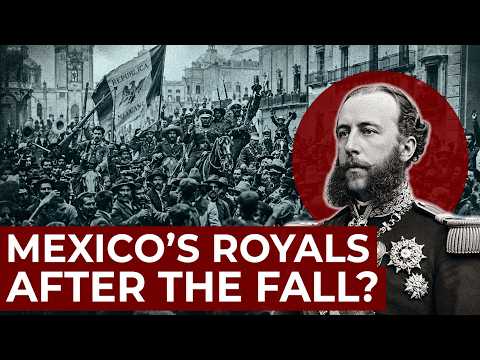
To understand the aftermath, we must first understand how the empire began. In the early 1800s, Mexico was not a country but a colony: New Spain. For three centuries, Spain ruled with an iron fist, extracting silver and funneling wealth to Madrid. A rigid hierarchy kept the vast majority in poverty while a tiny elite lived in splendor. Then, in 1808, Napoleon invaded Spain, deposed King Ferdinand VII, and placed his brother Joseph on the throne. The legitimacy of colonial rule was thrown into question overnight.
In 1810, a parish priest named Miguel Hidalgo rang his church bell and issued the Grito de Dolores—a cry for rebellion. The Mexican War of Independence had begun. But it would take more than a decade of brutal fighting before Mexico broke free. And the man who ultimately delivered independence was one of history’s most contradictory figures: Agustín de Iturbide.
Born in 1783 into a wealthy Creole family, Iturbide was no revolutionary. For the first decade of the war, he fought for the Spanish crown, crushing rebel forces with brilliance and ruthlessness. He even captured and executed José María Morelos, one of the independence movement’s greatest leaders. But by 1820, a liberal revolt in Spain threatened the privileges of Mexico’s conservative elite. Suddenly, independence looked like the only way to preserve the social order they depended on.
So Iturbide made his great pivot. In 1821, he allied with rebel commander Vicente Guerrero and together they crafted the Plan de Iguala—promising independence, Catholic supremacy, and equality between Creoles and peninsulares. Leading the Army of the Three Guarantees, Iturbide marched into Mexico City on September 27, 1821. Mexico was free. But free to do what?
The Plan de Iguala had envisioned a European prince as constitutional monarch. When no royal accepted, Iturbide’s supporters took matters into their own hands. On the night of May 18, 1822, soldiers marched through the streets chanting his name, demanding he be crowned emperor. Whether orchestrated or spontaneous, the result was clear: on July 21, 1822, Agustín de Iturbide was crowned Agustín I, Constitutional Emperor of Mexico.
The coronation was lavish—the cathedral packed, the regalia magnificent. But beneath the spectacle, the empire was already rotting. The treasury was empty, the military restless, and the Republican faction in Congress despised the very idea of a monarchy on American soil. Iturbide responded by dissolving Congress, imprisoning opponents, and ruling by decree. Within ten months, a young general named Antonio López de Santa Anna—yes, the same Santa Anna of Alamo fame—declared against him. Others followed. By March 1823, the emperor was finished.
He was forced to abdicate. Congress offered him a pension of 25,000 pesos per year if he left the country and never returned. He accepted. On May 11, 1823, the former emperor boarded a British ship with his wife, children, and a handful of servants, sailing for Italy. They settled near Livorno, in Tuscany, where he rented a small country house and began writing his memoirs. But exile was no paradise. Spain pressured Tuscany to expel him, forcing the family to move again—this time to England.
It was in England that things took a fateful turn. Iturbide began receiving letters from supporters in Mexico, claiming the country was descending into chaos, that a Spanish invasion was imminent, and that the people cried out for his return. What they didn’t tell him—or what he chose to ignore—was that Congress had declared him a traitor and an outlaw. A decree stated that if he ever set foot on Mexican soil again, he would be executed on sight. Believing himself the savior his country needed, Iturbide took his two oldest sons and sailed for Mexico in May 1824.
He landed at Soto la Marina on July 14. At first, locals seemed to welcome him. But within hours, soldiers arrived. General Felipe de la Garza arrested him and escorted him to the village of Padilla. A hasty trial was held. The outcome was never in doubt. Iturbide was sentenced to death.
On July 19, 1824, barely five days after setting foot in Mexico, the former emperor stood before a firing squad. According to witnesses, his last words were: “Mexicans, I die with honor, not as a traitor. Do not leave the stain on my children and my legacy. I am not a traitor.” Three bullets struck him. One was fatal. Agustín de Iturbide, the man who had delivered Mexico its independence, was dead at 40.
They buried him in a simple grave in Padilla—a town that would eventually be submerged beneath a reservoir. Nearly a decade later, his remains were exhumed and brought back to Mexico City with full honors. But what happened to his family? What happened to the wife, the children, the extended dynasty that had briefly worn the crown of the largest nation in North America?
This is where the story becomes truly extraordinary.
Iturbide’s wife, Ana María Huarte, was left a widow in a foreign land with a houseful of young children and virtually no resources. The Mexican government had promised her husband a pension during his exile, but after his execution, those payments became unreliable at best. The family scattered. Some stayed in the United States. Others drifted between Europe and Latin America, living in a genteel poverty far removed from the imperial splendor they had once known.
Iturbide had fathered at least ten children, and their fates varied wildly. His eldest son, Agustín Jerónimo, had been designated crown prince and given the title Prince Imperial during the brief months of the empire. After his father’s execution, he lived in exile, moving between the United States and Mexico, never able to reclaim the position that had been promised to him. He died in 1866, having spent most of his adult life as a man without a country.
His second son, Ángel María de Iturbide, would play a far more dramatic role in the family’s later history. Ángel eventually settled in the United States, in the Georgetown neighborhood of Washington, DC, where he attended Georgetown University and married an American woman named Alice Green. Alice was no ordinary American. She was the granddaughter of Uriah Forrest, a general in the American Revolutionary War and a former congressman, and the great-granddaughter of George Plater, the governor of Maryland. Through Alice, the bloodline of Mexico’s first imperial family became intertwined with the bloodline of America’s founding generation.
But the most dramatic chapter in the Iturbide family’s post-imperial saga was yet to come. Because four decades after the first empire collapsed, Mexico would get a second emperor. And this time, the Iturbide name would be dragged back onto the stage of history in the most unexpected way imaginable.
By the late 1850s, Mexico was tearing itself apart. The War of the Reform, a brutal civil conflict between liberal reformers and conservative defenders of the old order, had left the country exhausted and bankrupt. When the liberal side, led by Benito Juárez—a Zapotec indigenous lawyer from Oaxaca who had risen to become president—took power in 1861, he was forced to suspend payments on Mexico’s foreign debts. This gave three European powers—Britain, Spain, and France—the pretext they needed to intervene.
Britain and Spain eventually negotiated and withdrew. But Napoleon III, the emperor of France, had much grander ambitions. He saw Mexico as a golden opportunity to establish a French-backed empire in the Americas—a Catholic counterweight to the increasingly powerful and Protestant United States. The timing seemed perfect. The United States was consumed by its own civil war and in no position to enforce the Monroe Doctrine.
In the winter of 1861, French forces stormed the port of Veracruz and began pushing inland. They suffered a famous setback on May 5, 1862, when Mexican forces under General Ignacio Zaragoza defeated them at the Battle of Puebla—the origin of the Cinco de Mayo holiday. But it was only a temporary victory. French reinforcements arrived, and by June 1863, Mexico City had fallen to the invaders.
Now Napoleon III needed a figurehead—a European prince willing to sit on the Mexican throne and lend an air of legitimacy to what was in reality a military occupation. His choice fell on Archduke Ferdinand Maximilian of Habsburg, the younger brother of Emperor Franz Joseph of Austria. Maximilian was 31 years old, tall, blonde, idealistic, and utterly naive about the realities of Mexican politics.
When the Mexican delegation arrived at his castle of Miramar overlooking the Adriatic Sea and offered him the crown, Maximilian was intrigued. His wife, Princess Charlotte of Belgium—known in Mexico as Carlota—was even more enthusiastic. Charlotte was the daughter of King Leopold I of Belgium, a woman of fierce intelligence and burning ambition who had chafed under the limitations placed on royal women. The prospect of becoming an empress, of actually ruling a country, consumed her. She urged Maximilian to accept.
And so, on April 10, 1864, Maximilian formally accepted the crown. He and Carlota sailed for Mexico, arriving at Veracruz on May 28. From the very beginning, the signs were ominous. The port was sweltering, disease-ridden, and virtually deserted. The expected cheering crowds had not materialized. As the imperial couple made their way inland toward Mexico City, they discovered that their so-called empire was really just a patchwork of territory held together by French bayonets. Outside the areas controlled by French troops, Juárez’s republican government continued to function, and guerrilla resistance was constant.
But Maximilian pressed on—and here is where the story of the Iturbide family re-enters the picture in the most surprising way.
Maximilian and Carlota were unable to have children. The exact reasons remain a subject of historical speculation, but the fact was undeniable: they had no heir, and for a monarchy, no heir means no future. Maximilian knew he needed to solve this problem, and he devised a solution that was both politically shrewd and deeply cruel.
He turned to the Iturbide family. Specifically, he turned to Ángel María de Iturbide—the second son of the first emperor—who was living in Mexico City with his American wife Alice and their young son, also named Agustín. The child, Agustín de Iturbide y Green, was born on April 2, 1863, in Mexico City. He was a toddler, barely two years old, when Maximilian approached the family with a proposition.
He wanted to adopt the boy and raise him as his own heir.
The logic from Maximilian’s perspective was straightforward. By adopting the grandson of Mexico’s first emperor, he could link his own Austrian-imposed monarchy to the indigenous tradition of Mexican imperialism. It would give his regime a veneer of Mexican legitimacy that it desperately lacked.
Ángel María agreed with enthusiasm. His wife Alice did not. By most accounts, Alice was reluctant—even anguished—at the prospect of handing over her only son to a foreign monarch. But the pressure was immense. The family was offered a pension and the promise that young Agustín would be raised as a prince. In the end, Alice relented.
On September 16, 1865, Maximilian issued an imperial decree granting the title of Prince of Iturbide, with the style of Highness, to both young Agustín and his sixteen-year-old cousin, Salvador de Iturbide y Marzán. The two boys were ranked immediately after the reigning family in the order of precedence. Maximilian appeared to be grooming young Agustín as a potential heir to the throne.
But even this arrangement was more complicated than it appeared.
Privately, Maximilian had reservations about the Iturbide family. He believed they were not of sufficiently royal blood to truly inherit a European-style monarchy. The adoption was, in many ways, a temporary political maneuver—a way to buy legitimacy. And while Maximilian hoped for a more permanent solution, that permanent solution never came.
Because Maximilian’s empire was already dying.
By 1866, the situation had become desperate. The American Civil War had ended, and the reunited United States was now openly hostile to the French presence in Mexico. Washington began supplying Juárez’s forces with weapons and diplomatic support and pressured Napoleon III to withdraw his troops. Facing the growing threat of a confrontation with Prussia in Europe, Napoleon agreed. He told Maximilian that France would pull its army out of Mexico.
Carlota was frantic. She sailed for Europe in a last-ditch effort to save the empire, going first to Paris to beg Napoleon for help and then to Rome to plead with Pope Pius IX. Neither man could—or would—help her. And it was during this desperate mission that something broke inside Carlota’s mind.
She began exhibiting signs of severe mental illness—paranoia, delusions, an irrational fear that she was being poisoned. During her audience with the Pope, she reportedly refused to eat or drink anything that hadn’t been prepared in her presence. She dipped her fingers into a cup of hot chocolate and licked them because she was starving but terrified of being poisoned. She refused to leave the Vatican, becoming the first and only woman to sleep overnight in the papal apartments.
Her brother, Philip, Count of Flanders, eventually came to collect her. Carlota was taken back to Miramar Castle and placed under the care of doctors who diagnosed her with what they described as persecution mania. She would never recover.
For the next 60 years, Carlota lived in seclusion—first at Miramar, then at the Château of Bouchout near Brussels. Dynasties fell, republics rose, airplanes took flight, the First World War came and went. Through it all, the former empress sat in her castle, lost in a world that no longer existed.
Her nurses discovered that the only thing that could calm her during her most agitated moments was the sound of La Paloma, a popular Mexican song. Even in the depths of her madness, Mexico still lived somewhere inside her. Carlota died on January 19, 1927, at the age of 86—outliving her husband by exactly 60 years.
And what of Maximilian? He refused to abandon Mexico even after the French withdrawal. With a dwindling force of conservative loyalists, he retreated to Querétaro in early 1867. The Republican forces under General Mariano Escobedo laid siege. On May 15, Querétaro fell. Maximilian was captured on the Cerro de las Campanas—the Hill of the Bells.
Benito Juárez was in no mood for mercy. Despite appeals from heads of state across Europe, Juárez ordered a military trial. The verdict was death. On the morning of June 19, 1867, Maximilian stood before a firing squad. “I forgive everyone, and I ask everyone to forgive me. May my blood, which is about to be shed, be for the good of the country. Long live Mexico. Long live independence.” The soldiers fired. The Second Mexican Empire was over.
Now, with both emperors dead and Carlota locked away, what happened to the family caught in between? When it became clear that Maximilian’s regime was collapsing, the emperor sent young Agustín de Iturbide y Green—the toddler he had adopted—to Havana, Cuba, to be reunited with his biological parents. Alice Green finally had her son back.
The family eventually returned to the United States, settling in Washington, DC, where Ángel María took a position at the Mexican embassy. Ángel died in 1872, leaving Alice to raise young Agustín on her own at Rosedale, the Georgetown estate built by her great-grandfather, General Uriah Forrest.
And so, the grandson of Mexico’s first emperor and the adopted heir of Mexico’s second emperor grew up not in a palace, but in a comfortable American house in Georgetown. He attended Georgetown University, where he later became a professor of Spanish and French. He harbored dreams of restoring the monarchy, returning to Mexico during the dictatorship of Porfirio Díaz. But Díaz, who had fought against Maximilian, had no interest in sharing power with a pretender to a throne that no longer existed. When Agustín began criticizing the regime, Díaz had him expelled around 1890.
The last prince of Mexico returned to Georgetown. He married twice but had no children. He died of tuberculosis on March 3, 1925, in Washington, DC, at the age of 61. With his death, the direct male line of the adopted imperial princes went silent.
But the broader Iturbide family did not disappear. Young Agustín’s cousin, Salvador de Iturbide y Marzán—the other boy granted the title of Prince of Iturbide by Maximilian—lived a long life, dying in 1921. Through his descendants, the family line continued. Salvador’s granddaughter, María Josefa Sofía de Iturbide, eventually became head of the House of Iturbide. She married an Austrian count named Baron von Götzen. Through their descendants, the lineage continued into the 20th century and beyond—though through the female line rather than the male one.
Today, the current head of the Imperial House of Mexico is a man named Maximiliano von Götzen-Iturbide. Born in 1944, his story is almost comically far removed from the drama and bloodshed of his ancestors. After the Second World War, the family settled in South America. Maximiliano’s father died in 1956 in Caracas, Venezuela. His mother remarried, and the family eventually moved to Australia. Maximiliano was educated at a preparatory school in England. He worked as a stockbroker. He has real estate interests in Morelia and Guadalajara. Around 2010, he retired to Spain.
As a direct descendant of Emperor Agustín, Maximiliano is technically the rightful head of Mexico’s former imperial house. But he does not pursue any claim to the throne. He does not use his Mexican royal title. He has stated publicly that his only political interest is the legacy and reputation of his ancestor Agustín de Iturbide, the liberator of Mexico.
Maximiliano has two children. His son, Fernando Leopoldo—known casually as Freddy—was born in 1992. His daughter, Emanuela Isabella, was born in 1997. Fernando holds the historical titles of Imperial Prince of Mexico and Count von Götzen. But these titles carry no legal recognition whatsoever in modern Mexico. They are historical curiosities, relics of a world that vanished more than a century and a half ago.
And yet, there are people in Mexico who care about these things. There’s a small but persistent monarchist movement that keeps one eye on the Iturbide descendants, particularly on the young and photogenic Fernando. They maintain websites and social media accounts. They argue that Mexico would be better served by a constitutional monarchy than by the republic it has had for the past two centuries. They point to corruption, instability, drug violence, and ask whether a different form of government might produce different results. Whether this is a serious political movement or merely a historical hobby is debatable. But the fact that it exists at all tells you something about the enduring power of the monarchical idea—even in a country that has violently rejected it twice.
What makes the story of Mexico’s royal family so compelling is not just the drama—though the drama is considerable. It is the way the story illuminates larger questions about power, legitimacy, and identity that Mexico is still grappling with today. Mexico has had two empires, dozens of revolutions, a 71-year one-party state, and a transition to multi-party democracy that is still a work in progress. The country’s relationship with its own history is deeply complicated.
Iturbide is simultaneously celebrated as the father of Mexican independence and condemned as a power-hungry tyrant who dissolved Congress and tried to make himself king. Maximilian is both the foreign interloper who violated Mexican sovereignty and the well-meaning idealist who tried to implement liberal reforms that angered his own conservative supporters. And then there is Carlota. Poor, brilliant, ambitious Carlota. A woman who believed she could be an empress, who worked tirelessly to improve agricultural conditions and indigenous affairs, who wrote passionately about the failures of previous Mexican governments to serve their own people—and who was rewarded for all of it with 60 years of madness in a Belgian castle. Her nurses said that toward the end, the only thing that could soothe her was the sound of a Mexican melody. The country had broken her, but she could never let it go.
The Iturbide Palace itself still stands in the heart of Mexico City on Madero Street. It is no longer a royal residence. Today, it functions as a cultural center, housing exhibitions on Mexican art and history. Tourists walk through its grand halls, take photographs of its ornate facade, and most of them have no idea that the building was once home to the man who freed Mexico from Spain—and then lost everything.
The story of Mexico’s royal family is, in many ways, the story of Mexico itself. A country that has always been caught between competing visions of what it should be. Indigenous or European, monarchist or republican, conservative or liberal, traditional or modern. Every generation has fought over these questions, and every generation has paid a price for the answers. The Iturbide family paid more than most. They went from the heights of imperial power to exile, execution, poverty, and obscurity in the space of a single generation. Their descendants were scattered across four continents. Their titles became meaningless. Their palaces became museums. But the family survived—through wars and revolutions, through exile and adoption, through madness and tragedy, through the slow erosion of relevance that comes with the passage of time.
The descendants of Mexico’s royal house are still here. A stockbroker in Spain. A young man called Freddy with a title that exists only in history books. A castle in Belgium where an empress once sat alone, humming La Paloma to herself in the dark.
There is a final irony worth sitting with. When Agustín de Iturbide stood before the firing squad in 1824, his last words were a plea: “Do not leave this stain on my children and my legacy.” He was asking Mexico to remember him as a patriot, not a traitor. And for a long time, Mexico chose traitor. It took 14 years for his remains to be brought back to the capital with honors. It took even longer for his role in independence to be officially acknowledged. Today, Iturbide occupies a strange and uncomfortable place in Mexico’s national memory. He is not ignored exactly, but he is not celebrated the way Hidalgo or Morelos or Juárez are celebrated. His name is inscribed in gold letters in the Mexican Congress alongside the other heroes of independence. But his legacy is forever complicated by the fact that he tried to make himself king.
And that, perhaps, is the most Mexican thing about this entire story. A hero who was also a villain. A liberator who was also a tyrant. A family that was given everything and then had it all taken away. A country that still has not quite decided what to make of its own past.
So here’s my question for you: If Mexico’s royal family still existed today with any real power, would the country be better off—or would it just be another chapter in the same tragic cycle? Let me know your thoughts in the comments below.
Report this article
Select a reason for reporting:






