Dr. Sarah Chen held her breath as the daguerreotype slid under the microscope. The image was haunting: a young Black girl, no older than twelve, standing rigid beside a wealthy white man in front of a columned mansion. New Orleans, 1858. But it was the girl’s eyes that made Sarah’s heart race—not blank or defeated like so many enslaved faces from that era, but burning with intention. Purpose.
As Sarah adjusted the magnification to examine the girl’s coarse cotton dress, something caught her eye. Along the left sleeve, barely visible even at 40x, were tiny marks. At first she thought they were stains—but as she tilted the light, the marks resolved into letters and numbers, stitched with thread so fine it was nearly invisible. Coordinates. Latitude and longitude, painstakingly embroidered into the sleeve of a child who had no voice, no rights, no recorded name.
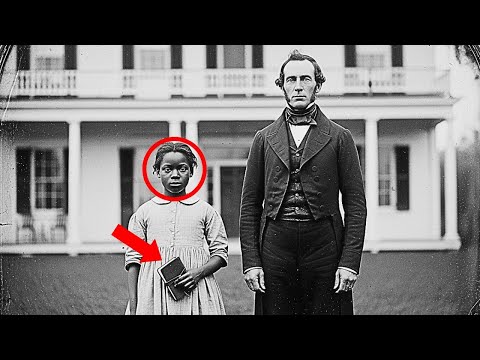
Sarah’s hands trembled as she reached for her camera. She had restored hundreds of nineteenth-century photographs, but she had never seen anything like this. The girl had left a message hidden in plain sight for 166 years.
By morning, Sarah had barely slept. She had cross-referenced the coordinates with historical maps of Louisiana. They pointed to a location roughly thirty miles northwest of New Orleans—dense swamp land in 1858, now part of a protected wildlife preserve near Lake Pontchartrain.
At the lab, she presented her findings to Dr. Marcus Williams, the department head. He was a meticulous man in his sixties who did not embrace wild theories lightly. “Show me,” he said simply, settling behind the microscope. After several minutes of adjusting magnification and light angles, he sat back. “The thread is period-appropriate. Cotton, not synthetic. The stitching technique is consistent with mid-nineteenth-century needlework.” He paused, cleaning his glasses—a nervous habit Sarah recognized. “But the precision required to create numbers this small, this accurately, with the tools available to an enslaved child—it should be impossible.”
Sarah pulled up her research file. The man in the photograph was Nathaniel Duchamp, owner of Bel Rive Plantation. He had died in 1859, just a year after the photograph was taken. The girl was listed in the donation papers only as “enslaved child, unidentified.”
Marcus stared at the girl’s face. “She wanted someone to find this. The question is why.”
Sarah made the three-hour drive to the Louisiana State Archives in Baton Rouge. The archivist, Mrs. Beatrice Tibido, had prepared several boxes of materials. “Bel Rive was prosperous until Duchamp’s death,” she explained. “After that, the property changed hands multiple times. Most of the plantation records were lost in a fire in 1891.” Sarah’s heart sank. “Most, but not all,” Mrs. Tibido added, placing a leather-bound journal on the table. “Duchamp’s personal diary. No one’s paid much attention to it.”
Sarah opened the journal carefully. Most entries were mundane—weather, sugar prices, social visits. Then, dated August 3rd, 1858, just two weeks before the daguerreotype’s date stamp, she found something different: “The girl saw. I’m certain of it. She was in the barn when I returned with the documents. Her eyes too intelligent, too aware. I cannot risk her speaking, though who would believe a slave child. Still, I watch her. She works in the house now, where I can see her always.”
Sarah’s pulse quickened. The next relevant entry was August 17th, 1858—the date on the daguerreotype: “Had our portrait made today as planned. The photographer from New Orleans came at dawn. I stood with the girl deliberately. Let there be record of her presence here should questions arise later. Though I have been careful, one can never be too cautious. The matter is buried and shall remain so.”
Mrs. Tibido appeared at Sarah’s shoulder. “What matter?” she whispered. “I don’t know,” Sarah said, “but I think this girl tried to tell us.”
Back in Washington, Sarah assembled a small team. Marcus brought in Dr. James Foster, a historian specializing in antebellum Louisiana, and Detective Robert Chen—Sarah’s brother—who had taken leave from the DC Metropolitan Police. They gathered in the conservation lab’s conference room, the daguerreotype projected on a large screen. The girl’s face, magnified ten feet tall, seemed to watch them.
“I’ve been through every newspaper archive from New Orleans in 1858 and 1859,” James said, spreading printouts across the table. “There was a significant unsolved crime during that period. On July 28th, 1858, a federal marshal named Thomas Beaumont disappeared while investigating illegal slave-trading operations in the Louisiana bayous.”
Robert leaned forward. “Illegal? Slavery was legal.”
“The international slave trade had been banned since 1808,” James explained. “But smuggling continued, especially through Louisiana’s waterways. Beaumont had been building a case against several prominent planters, including—” he paused significantly, “—Nathaniel Duchamp.”
Sarah felt the pieces clicking into place. “Duchamp killed him.”
“There’s no proof,” James cautioned. “Beaumont simply vanished. His investigation died with him. But look at this.” He pulled out another clipping dated March 1859. Duchamp himself had died less than a year later. The death certificate listed cause as sudden illness, but rumors persisted—some said guilt drove him mad, others suggested poison, that perhaps someone on his plantation had taken justice into their own hands.
Marcus studied the timeline on the whiteboard. “So we have July 28th, Beaumont disappears. August 3rd, Duchamp writes that the girl saw something. August 17th, the daguerreotype is made with coordinates hidden in her clothing. March 1859, Duchamp dies mysteriously.”
“The coordinates,” Robert said. “They have to point to where Duchamp hid the evidence of Beaumont’s murder.”
Sarah pulled up a modern satellite map. The coordinates landed in dense wetland thick with cypress—now protected federal land. “After 166 years, is there any chance something could still be there?”
“Depends on what it is,” Robert said. “Documents in a sealed container buried above the waterline? Maybe. But we’re talking about finding something the size of a briefcase in thirty square miles of swamp.”
“She gave us exact coordinates,” Sarah said, looking back at the girl’s face on the screen. “She risked everything to leave that message. We have to try.”
Three weeks later, Sarah stood at the edge of Lake Pontchartrain watching dawn break over the water. The expedition had required permits from the National Park Service, cooperation from local law enforcement, and the expertise of Dr. Raymond Arsenault, a forensic archaeologist from Tulane who specialized in wetland excavation.
They loaded two flat-bottom boats with ground-penetrating radar, metal detectors, excavation tools, and documentation cameras. “The coordinates put us about forty minutes north,” Raymond explained, studying a GPS unit. “The good news is the land elevation there is slightly higher—probably a natural levee even in 1858. The bad news is 166 years of sediment accumulation and vegetation growth.”
The boats pushed into the maze of waterways, passing beneath canopies of Spanish moss and cypress. The modern world fell away quickly, replaced by something ancient and watchful. Sarah imagined the girl—still unnamed in any record they had found—making the same journey in reverse, perhaps hidden in a small boat, carrying a terrible secret.
“There,” Raymond called, checking his GPS. They had reached a small island barely thirty feet across, thick with palmetto and wild grapevine. “This is it. Ground-penetrating radar first—we dig only if we get a clear signal.”
Sarah watched the radar screen as layers of soil, root systems, and ghostly shadows of buried cypress stumps scrolled past. Then, in the northeast quadrant, something different—a geometric anomaly roughly rectangular, buried about four feet down. “Got something,” Raymond said quietly. “Man-made. Metal and possibly wood, substantially decayed.”
They began to dig carefully, documenting every layer. The Louisiana heat was oppressive, humidity thick enough to swim through. Two hours in, one of Raymond’s students called out—her trowel had struck something solid. Raymond knelt beside her, brushing away soil with his fingers. Metal appeared, heavily corroded but intact. The edge of a box.
Sarah’s heart hammered as they excavated around it. The container was roughly two feet long, made of iron, with remnants of a wax seal around its seam. It had been buried deliberately, carefully, by someone who wanted it both hidden and preserved.
“Let’s get it to the surface,” Raymond said. “We open it at the lab.”
The conservation lab at Tulane was equipped for exactly this kind of delicate work. The iron box sat on an examination table, still caked with 166 years of swamp soil, while Raymond’s team prepared to open it under controlled conditions. Sarah stood beside Marcus behind a glass partition, with Robert and James crowding close to the monitors showing multiple camera angles of the box.
Raymond worked slowly, using specialized tools to pry at the corroded seam. The wax seal had long since deteriorated, but it had done its job—the interior appeared relatively dry. After twenty careful minutes, the lid separated with a grinding sound.
Inside, wrapped in oilcloth that had mostly disintegrated, were papers. Raymond lifted them with trembling hands and placed them on an examination tray. Despite the moisture and pressure, the documents were remarkably preserved. The first was a letter written in formal script on official United States government stationery.
James read it aloud through the intercom: “From the desk of Federal Marshal Thomas Beaumont, July 25th, 1858. To be delivered to the district attorney in New Orleans upon my return. I have gathered sufficient evidence to prosecute Nathaniel Duchamp of Bel Rive Plantation for violations of the Act prohibiting importation of slaves. Enclosed are bills of sale for seventeen African captives smuggled through Barataria Bay in June of this year, as well as correspondence between Duchamp and Captain Henri Mercier of the vessel Nightingale documenting payment of three thousand dollars for said captives.”
The team fell silent. This was it—the evidence that had disappeared with Beaumont.
“There’s more,” Raymond said, carefully separating the remaining documents: bills of sale, a ledger showing payments, and finally, at the bottom of the box, a small leather-bound notebook. Sarah’s breath caught. “That’s the same notebook in the daguerreotype. The girl is holding it.”
Raymond opened it carefully. The pages were filled with columns of numbers, dates, and initials. “It’s a smuggling record,” he said. “Duchamp’s own accounting of his illegal operations. Dates, prices, sources. If Beaumont had presented this in court, Duchamp would have been ruined.”
“Imprisoned, possibly hanged,” Marcus finished.
Robert leaned against the glass. “So Duchamp killed Beaumont, took his evidence, and buried it where no one would ever find it. But the girl saw him. She knew what he’d done—and somehow, impossibly, she left us a way to find the truth.”
James was studying the daguerreotype again, now displayed beside the opened box. “Look at how Duchamp positioned her in the photograph. She’s holding his notebook—the evidence of his crimes—literally in her hands. He thought he was showing his control over her, showing that even if she knew, she was powerless.”
“But she wasn’t,” Sarah said softly. “She found a way.”
With the truth of Duchamp’s crime confirmed, Sarah became obsessed with identifying the girl. She returned to Bel Rive’s surviving records with new urgency, searching for any enslaved child between ages ten and fourteen present at the plantation in August 1858. Mrs. Tibido became an essential partner, and together they cross-referenced plantation inventories, tax records, and church baptism registers from nearby parishes.
Finally, in a water-damaged ledger from 1857, they found an entry that made Sarah’s hands shake: “Purchased from the estate of Widow Mercier, one girl child, age approximately eleven years, skilled in needlework and housework. Price: four hundred dollars. Name given as Delphine Mercier.”
Sarah breathed the surname aloud—the same as the ship captain in Beaumont’s evidence. Mrs. Tibido was already pulling another file. “The Mercier family were prominent in New Orleans. Henri Mercier was a merchant captain, but his mother, Widow Katherine Mercier, ran a dressmaking business that—” she looked up, eyes wide, “—employed enslaved seamstresses known for extraordinarily fine work.”
The pieces fell into perfect alignment. Delphine had been trained in needlework precise enough to create the microscopic embroidery they’d found. When Widow Mercier died and her property was sold, Delphine had been purchased by Duchamp—whose illegal smuggling operation involved the widow’s son.
“Delphine would have known the Mercier family’s business,” Sarah said, thinking aloud. “She would have seen documents, overheard conversations. When she arrived at Bel Rive and saw Duchamp with Beaumont’s evidence—evidence that mentioned Captain Mercier—she understood what it meant.”
“An eleven-year-old child understood federal law and smuggling operations?” Mrs. Tibido said skeptically.
“She’d lived her entire life watching and listening,” Sarah replied. “Enslaved people were expected to be invisible, which meant they saw everything.”
Marcus, who had driven to Baton Rouge to join the research, added another document to their growing file. “I found Duchamp’s will. When he died in March 1859, his property was liquidated to pay debts—including his slaves. There’s a record of an auction on April 15th, 1859.”
Sarah scanned the list of names. There: “Delphine, age approximately twelve, sold to a buyer listed only as J. Morrison, New Orleans.” The trail went cold after that. “Morrison could be anyone,” Mrs. Tibido said. “It’s one of the most common names in Louisiana.”
But Sarah felt closer to Delphine than ever. The girl who had risked everything to expose a murderer, who had hidden coordinates in thread so fine it was nearly invisible, who had been photographed holding the very evidence of the crimes she witnessed. “We need to find what happened to her after the sale,” Sarah said. “She deserves to have her full story told.”
The search led Sarah to the New Orleans Public Library’s Louisiana Division, where she spent three days scrolling through microfilm. She found seven J. Morrisons in 1859—but only one, Jonathan Morrison, a schoolteacher, had been a documented abolitionist. “Abolitionists didn’t buy slaves,” Robert said. “Unless they were buying people to free them,” Sarah countered.
In a basement archive on Dauphine Street, she found it: notarized manumission papers dated May 2nd, 1859, freeing one female child named Delphine. Attached was Morrison’s letter: “At the auction, she approached me directly and spoke words that still haunt me: ‘I know where the truth is buried.’”
Sarah traced Delphine to Philadelphia, where she became a teacher, married, and raised four children. She lived until 1921.
Six months later, twelve descendants gathered before the daguerreotype at the Smithsonian. A five-year-old boy tugged Sarah’s sleeve. “Why did she hide the numbers in her dress?”
“Because sometimes, when you can’t speak the truth out loud, you have to find another way to tell it,” Sarah said.
Delphine’s message had finally been heard—and the truth she risked everything to preserve would never be buried again.
What would you have done, at eleven years old, with a secret that could topple a powerful man?
Report this article
Select a reason for reporting:






