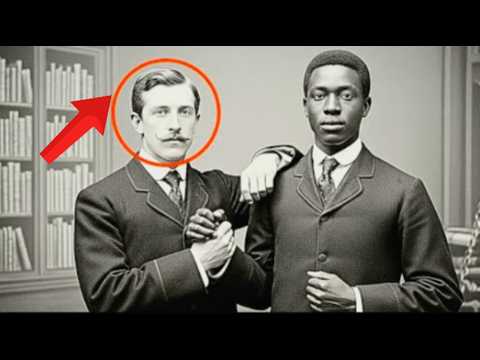
James Rivera had seen thousands of historical photographs pass through his hands at the National Museum of African American History and Culture in Washington, D.C. Each one carried a story, but none had ever made him stop and stare quite like this. It was a humid September morning in 2024 when he opened a box from an estate auction in Richmond, Virginia. The donation came from the belongings of Dorothy Hayes, a 97-year-old woman who had died without heirs. Inside, wrapped in layers of tissue paper, was a studio portrait mounted on thick cardboard. The photographer’s mark read “Anderson & Sons Photography, Richmond, Virginia, 1889.”
Two young men stood side by side, dressed in matching dark suits with high white collars and patterned ties. The man on the left was white, about 22 or 23, with light hair and a faint mustache. The man on the right was Black, the same age, with a strong jaw and intelligent eyes. What struck James most was their pose: the white man’s hand rested on the Black man’s shoulder, and the Black man’s hand gripped his friend’s forearm. It was an unmistakable gesture of friendship—perhaps even brotherhood. For a photograph taken in Virginia in 1889, just 24 years after the Civil War and in the heart of Jim Crow segregation, this was extraordinary.
But as James examined the image more closely with a magnifying glass, he began to notice details that didn’t fit the story of a simple friendship. The white man’s fingers weren’t resting gently—they were gripping tightly, knuckles whitened from the pressure. The Black man’s smile, which seemed genuine at first glance, didn’t quite reach his eyes. His other hand, the one not holding his friend’s arm, was clenched into a fist at his side. And in the bottom right corner of the painted backdrop, partially obscured by a small table, hung a chain—heavy links that seemed out of place in a scene meant to convey education and refinement.
James turned the photograph over. On the back, in faded brown ink, someone had written in a hurried, emotional scrawl: “Thomas and Marcus. Last photo before departure. May God forgive us for what we have done. September 14, 1889.” He read the words three times. Last photo before departure. Were they going somewhere together? Or separating? And that phrase—May God forgive us for what we have done. Not what we are about to do, or what we will do, but what we have done. Something had already happened when this photograph was taken. Something that required divine forgiveness.
James photographed the image from multiple angles, capturing every detail, then opened his laptop and began searching. He had to find out who Thomas and Marcus were, why they stood together in this photograph in 1889 Virginia, and what dark secret lay hidden beneath the surface of their apparent friendship. He spent the rest of the day looking for any record of a Thomas and Marcus from Richmond in 1889. Without surnames, the search was difficult—both names were common in that era. He started with the photographer’s mark: Anderson & Sons Studio. City directories from the 1880s showed that Anderson & Sons operated a studio on Broad Street from 1885 to 1893, advertising themselves as specialists in luxury portraits for prominent families. The focus on prominent families suggested they served Richmond’s white elite, making the photograph of a mixed-race pair even more unusual.
James examined the photograph again under different lighting, searching for any other clues he might have missed. The suits the men wore were expensive, tailored, not off-the-rack. The fabric appeared to be fine wool, appropriate for a formal portrait. Their shoes, visible at the bottom of the frame, were polished leather. Everything about their appearance suggested wealth and status, yet something about the Black man’s posture puzzled James. Despite the expensive clothes and confident stance, there was a slight tension in his shoulders, a wariness in his expression that spoke of someone who had learned to be careful, to watch and wait. James had seen similar expressions in photographs of freedmen from the Reconstruction era—people who had gained legal freedom but still navigated a world designed to limit them.
He decided to try a different approach. If these were prominent families, there might be records in the Richmond historical archives—property records, court documents, newspaper mentions. He reached out to his colleague, Dr. Patricia Okoye, who taught African American history at Howard University and had extensive connections with archives throughout Virginia. She called him back within two hours. “You’ve got my attention,” she said. “Can you send me high-resolution images of the photograph? I want to take a look myself.” James emailed her the images, and they agreed to meet the next day at the Virginia Library in Richmond, where Patricia had already booked time to search property records and newspaper archives from the 1880s and 1890s.
That evening, James couldn’t stop thinking about the photograph. He had handled thousands of historical images, but something about this one felt different. The inscription, May God forgive us, suggested guilt, complicity, perhaps even crime. And that chain in the background—partially hidden but undeniably there. Had the photographer included it deliberately, or was it part of a standard studio backdrop, a detail that only acquired sinister meaning in the context of who was being photographed?
He pulled up census records from 1890, searching for any Thomas and Marcus listed in the same household in Richmond or the surrounding counties. The 1890 census had been largely destroyed by fire, but fragments remained. After two hours of searching, he found an entry that made his pulse quicken. In Henrico County, just outside Richmond, the 1880 census listed a Thomas Whitmore, age 13, living with his parents, William and Elizabeth Whitmore. William’s occupation was listed as a large farmer—a term used for wealthy planters, often former slaveholders. The household included several individuals listed as servants, and among them was a boy named Marcus, age 13, with no surname given. His race was recorded as “colored.”
James sat back in his chair, his mind racing. In 1880, 15 years after the abolition of slavery, census records still often listed Black workers without full names or with first names only—a holdover from the era of slavery when enslaved people had no legal surnames. If this was the same Marcus in the photograph, he would have been about 22 or 23 in 1889, matching the apparent age of the man in the image. And Thomas Whitmore was the same age, having grown up in the same household as Marcus.
James searched for more information about the Whitmore family. William Whitmore appeared in multiple records—property deeds, tax records, and mentions in Richmond newspapers related to agricultural societies. The family owned a large plantation called “Oakwood,” about 15 miles outside Richmond before the war. After the war, they retained the property, though records showed its size had shrunk. What had happened to Marcus? Had he stayed with the Whitmore family after emancipation? And if so, under what circumstances? The Thirteenth Amendment had ended slavery in 1865, but James knew that many former slaves remained with their former masters, bound by economic necessity, exploitative labor contracts, or outright intimidation.
He needed to see the property records, the labor contracts, any legal documents related to the Whitmore family. He needed to understand the relationship between Thomas and Marcus. Were they truly friends, as the photograph suggested, or was something darker lurking beneath the surface of their apparent friendship? James looked at the photograph one more time before closing his laptop. Two young men in matching clothes, their hands on each other in gestures of connection. But the tension in Marcus’s grip, the too-tight clasp of Thomas’s hand, and the chain in the background all whispered of a story far removed from simple friendship. Tomorrow, in Richmond, he would begin to uncover the truth.
James read the first page of Marcus Freeman’s congressional testimony, delivered on March 6, 1902, before a committee investigating peonage and convict leasing. The language was formal, but the pain beneath it was unmistakable. “I was born into slavery on the Whitmore plantation in Henrico County, Virginia, in 1852,” Marcus began. “My mother was a cook in the big house. My father was sold away when I was five years old. I never saw him again.” James paused, the weight of those words settling over him. He continued reading.
Marcus described how, after emancipation, he had no choice but to stay on at Oakwood. “I was thirteen years old, with no family and nowhere to go. Mr. Whitmore offered me a contract—food, shelter, and five dollars a month. I signed it with an X because I couldn’t read or write.” The contract, Marcus testified, was renewed year after year. Each time, he was told he owed more money for clothes, tools, or medical care. “I tried to leave once, in 1875. The sheriff brought me back and I was fined for breach of contract. After that, I didn’t try again.”
James’s jaw tightened. He had read about such cases, but hearing it in Marcus’s own words—even transcribed through a clerk’s pen—made it visceral. The testimony went on to describe the brutal conditions: twelve-hour workdays, inadequate food, and the ever-present threat of violence. “Mr. Whitmore had a whip he used on those who disobeyed. I saw him use it on a man named Henry who tried to run. Henry never walked right again.”
But then Marcus’s testimony shifted. He spoke of Thomas, the planter’s son. “Thomas and I grew up together. We played in the fields and fished in the creek. When we were boys, I didn’t understand why his house was bigger than mine, why his mother wore silk while mine wore rags. But as we got older, Thomas began to see it too.” James leaned forward. This was the heart of the story.
“In 1889, Thomas came to me and said he had found proof of what his father was doing. He said he was going to take it to a lawyer and testify against his own father. He asked me to stand with him.” Marcus paused in his testimony—the transcript noted a long silence—and then continued. “I was afraid. But Thomas said he would protect me. He said he had a plan.”
James’s mind raced. The photograph was taken on September 14, 1889. The lawsuit was filed on September 10. Thomas died on October 2. “What was the plan?” James muttered to himself, scrolling through the pages. The answer came on page twelve.
Marcus testified that Thomas had arranged for him to leave Virginia. “Thomas gave me money and a letter of introduction to a lawyer in Philadelphia. He said I should go north and never come back. He said he would handle his father.” But Marcus had been caught. “Two days before I was supposed to leave, Mr. Whitmore’s men found me on the road. They brought me back to Oakwood and locked me in the barn.” James’s stomach clenched. “That was the night Thomas came to see me. He said we had to take one last photograph together—for proof, he said. Proof of what his father had done. But also proof of our friendship.”
The photograph. The chains in the background. The forced smiles. The tight grips. It all made sense now. “Thomas told me to grip his arm hard, to look serious. He said the photograph would be evidence if anything happened to him.” Marcus’s voice, even in the dry transcript, seemed to tremble. “The next day, I was to be moved to another property. But Thomas came for me in the night. He had a horse and a gun. He said we were leaving together.”
James read the next line and felt the blood drain from his face. “We were ambushed on the road. Mr. Whitmore and two of his men were waiting. Thomas told me to run. I heard a shot. I kept running. I never saw Thomas again.” Marcus had made it to Philadelphia, where he built a new life. But he had carried the guilt of Thomas’s death with him for thirteen years. “I don’t know if Thomas died because of me. But I know he died trying to free me. That is why I am here today. So that his death will not be forgotten.”
James sat back, his heart pounding. He had found the truth, but it was only the beginning. He needed to find out what had happened to Marcus after 1902, and whether the Freeman family still existed. He picked up his phone and called Patricia. “I found him,” he said. “And I think I know what happened to Thomas.”
Patricia was silent for a moment. “James, I’ve been doing some searching of my own. I found a record of a Marcus Freeman who died in Philadelphia in 1938. He was 86 years old. And he had a daughter named Dorothy.” James’s breath caught. “Dorothy?” he repeated. “Yes. Dorothy Freeman Hayes.” The donor. The woman whose estate had contained the photograph. “She was Marcus’s granddaughter,” Patricia said. “She never married, never had children. But she kept his things. All of them.”
James looked at the photograph again. Thomas and Marcus. Two young men, bound by friendship and tragedy, their story buried for over a century. Now, finally, it was coming to light. But there was more to uncover. “Patricia,” he said slowly, “we need to find out what happened to William Whitmore. Did he ever face justice?” The answer, he suspected, would be as painful as the rest of the story.
Patricia’s voice was grim. “William Whitmore was never charged. He sold Oakwood in pieces, lost his fortune, and died in 1912—but the Freeman settlement stayed pending in his estate until the end.” James closed his eyes. Justice deferred, then buried.
He returned to the photograph one last time. Thomas’s hand on Marcus’s shoulder. The chain in the corner. “May God forgive us for what we have done.” The words no longer felt like confession. They felt like a plea from a young man who knew he might not survive the truth.
James placed the portrait in a new display case, a small card beside it. It would bear both names: Thomas Whitmore and Marcus Freeman. Friends. Witnesses. Survivors.
Dorothy Hayes had kept their secret for 97 years. Now the museum would keep it forever.
What would you have done in Thomas’s place—betray your own family to save a friend?
Report this article
Select a reason for reporting:






