Sarah Chen’s hands trembled as she adjusted the magnifying glass over the fragile daguerreotype. The 1863 portrait of the Whitmore family looked perfect—a wealthy Richmond household frozen in Victorian elegance. But the fifth figure, a young Black woman holding a silver tea service, stood too close, her smile too knowing.
Sarah’s breath caught. That smile wasn’t servitude. It was certainty.
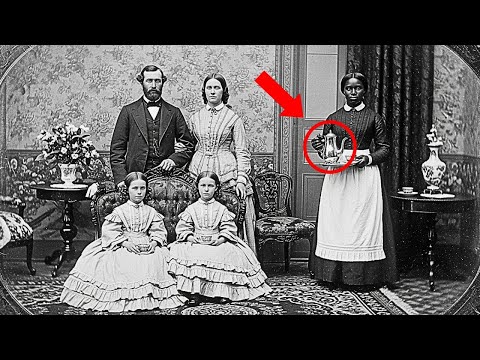
The inscription on the back read: “The Whitmore family, April 14th, 1863. Final portrait.” Final. The word clawed at her. Within a week, Sarah would learn the Whitmores were dead—poisoned the very next day—and the servant, Grace, had vanished.
Sarah, a forensic historian obsessed with Civil War photography, had seen hundreds of images of enslaved people positioned as props. But Grace was different. Her eyes held a flicker of something Sarah couldn’t name—not fear, not resignation. Something disturbingly like satisfaction.
She dug into newspaper archives. April 15th, 1863: “Entire family perishes, poisoning suspected.” Richard Whitmore, his wife Constance, and their daughters, Emma and Charlotte, found in agony. Arsenic. A reward for Grace’s capture: $500, dead or alive.
But no one asked why. “Ungrateful slave murders benevolent family. Case closed.” The words sickened Sarah.
She called Dr. Marcus Webb, a colleague at Howard University. Three days later, his voice was tight with anger. “Grace wasn’t born into slavery. She was kidnapped—free, literate, from Pennsylvania. Her father tried to buy her freedom for eight years.”
Sarah’s stomach turned. Grace Morrison. Kidnapped at eighteen, sold south, listed in a probate inventory as property worth $1,200. Her father, James, had traveled to Richmond with $2,000—a fortune—only to be laughed at and threatened. Richard Whitmore refused to sell.
Then Marcus added the detail that changed everything: “As punishment, Whitmore planned to sell Grace to a South Carolina plantation. She had four days between her father’s visit and the portrait.”
Four days to decide between a slow death in the fields or taking control. Sarah stared at the daguerreotype again. Grace’s hands, gripping the tea service, looked steady. The poison was already in the pot.
She wasn’t holding a prop. She was holding a weapon.
Sarah needed to know how Grace had done it—and how she had escaped. The answer lay in the ledgers of Pean’s Apothecary, preserved by the Virginia Historical Society. On March 28th, 1863, two weeks before the portrait, Constance Whitmore had purchased white arsenic powder “for rat infestation.” The murder weapon was already in the house, bought by the victim herself.
Deeper in the records, Sarah found a pattern: six arsenic purchases between 1861 and 1863, along with laudanum, morphine, and mercury tonics. Dr. Rebecca Torres, a toxicologist at Mass General, confirmed it immediately. “Constance was either poisoning herself in small doses or genuinely addicted. Either way, Grace had access to everything she needed.”
Arsenic had a faintly sweet, metallic taste—easily masked by strong tea and cream. A single teaspoon could kill a family. The poisoner would have to serve it, then wait, remaining in the house as the victims convulsed and died. That took extraordinary nerve.
But what finally broke Grace’s eight years of endurance? Sarah found the answer in a letter from James Morrison to the Pennsylvania Abolition Society, dated April 10th, 1863. “Mr. Whitmore laughed at my offer, called me an impostor, and threatened arrest. Worse—as punishment, Grace will be sold to a South Carolina plantation within the month, where her improper aspirations will be corrected through fieldwork. I have failed her.”
Four days later, the Whitmores commissioned a family portrait. They posed in their finest clothes, brought out their best china, and insisted Grace stand prominently to display their household’s refinement. She held the tea service and smiled that small, knowing smile—because she had already poisoned them.
They thought they were documenting their prosperity. She knew they were documenting their deaths.
Sarah’s hands shook as she set down the letter. Then she turned to the slave narrative collections at the Library of Congress, searching for any trace of what happened after. Among thousands of 1930s interviews, she found one from Clara Washington, age 94, enslaved in Richmond during the war. “I knew a woman once who poisoned the whole family that kept her. She was educated, kidnapped from up north. One day she just decided she’d had enough. I helped her.”
The interviewer had noted that Clara became emotional and asked that names not be recorded. Clara had lived three houses from the Whitmores on Grace Street. The proximity and timeline matched perfectly.
Clara had hidden Grace in an attic for two days while authorities searched the neighborhood. Then, with help from Richmond’s Underground Railroad network—still operating despite the war—Grace was smuggled out in a vegetable cart, moving by night through a chain of safe houses. By late April 1863, she had reached Union lines near Fredericksburg.
A register from a contraband camp in Alexandria, dated May 1863, listed: Grace M., female, age 26, from Richmond, literate, assigned to teaching duties for camp children. She had survived. She had reclaimed her family name.
Sarah leaned back, exhausted. But one question remained—what happened to Grace after the war? Did she reunite with her father? Did the ghosts of Emma and Charlotte Whitmore ever haunt her? She picked up her coat and reached for her keys. Philadelphia was only a train ride away.
The Mother Bethel AME Church archives smelled of old paper and lemon polish. Sarah sat in a narrow room with a volunteer archivist, a woman named Delia who handled the fragile ledgers like they were scripture. Membership records from 1865, ink faded to sepia, listed: Grace Morrison, returned from Virginia, reunited with father James Morrison, joined congregation August 1865.
She had made it home.
After ten years—eight in bondage, two in flight and hiding—Grace had crossed back into freedom and into her father’s arms. Sarah pictured the reunion, the barber shop on Lombard Street, the neighbors gathering. She had to stop and press her palm against her eyes.
But the records didn’t end there. Delia brought out a second box, marriage and burial notices, school subscriptions, committee minutes. In 1867, Grace Morrison married Samuel Peters, a teacher and activist. Three children followed. She worked as a seamstress, then as a teacher in the Freedmen’s schools, her literacy—once a crime in Virginia—now a gift she gave away by the hundreds.
Sarah found the 1875 clipping in the Christian Recorder: a speech Grace gave at a women’s rights convention in Philadelphia. She read it twice, then a third time, her throat tightening.
“I was stolen from freedom and thrust into bondage. I endured eight years of captivity, subjected to cruelties I will not detail here. I was denied my humanity, my family, my very identity. When every legal avenue to freedom was blocked, when those who claimed Christian virtue showed none, I took my fate into my own hands.
I will not apologize for my survival. I will not regret the actions that returned me to my rightful life.”
The article noted that the audience rose in a standing ovation. Sarah sat very still in the quiet archive, the words ringing in the empty room. She never named the Whitmores. She never needed to.
Delia found one more thing—a photograph tucked into a family scrapbook donated by a descendant in 1987. Philadelphia, 1890. Grace at fifty-three, gray-haired and strong-featured, surrounded by children and grandchildren on a sunlit porch. Her expression was serene in a way the 1863 daguerreotype had never been. The knowing smile was gone, replaced by something softer. Peace, Sarah thought. Or something close to it.
Grace died in 1908, age seventy-one. The obituary called her a beloved teacher, devoted mother, and tireless advocate. It mentioned her kidnapping and enslavement. It made no reference to Richmond, to arsenic, to the four bodies found in a parlor on Grace Street.
Sarah closed the scrapbook. Outside, Philadelphia hummed with afternoon traffic, and she thought about the question she could never answer: did Emma and Charlotte haunt her? Could a woman build a life of purpose on ground that terrible? Grace’s own words were the only answer she would ever get.
She gathered her notes. In three weeks she would stand before an auditorium at Georgetown and try to explain the inexplicable. But first, there was one more stop. Delia had mentioned a name in the burial records—a granddaughter, still living, somewhere in Germantown.
Sarah stepped into the sunlight and flagged a cab. The story wasn’t finished. It was waiting for her.
The house in Germantown was a narrow brick rowhouse with geraniums in the window and a hand-painted sign by the door: Peters Family Archives — By Appointment. The woman who answered was in her eighties, tall and straight-backed, with Grace’s same watchful eyes. “You’re the historian from Boston,” she said. “I’ve been expecting you since I heard about the Georgetown lecture.” Her name was Eleanor Peters Dawson.
They sat in a parlor crowded with framed photographs. Eleanor poured tea—Sarah noticed her own hands hesitate before lifting the cup, and Eleanor noticed too. “My great-grandmother killed four people with a teapot,” she said evenly. “I’ve had a lifetime to make peace with that. You have an afternoon.”
On the mantel stood the 1890 photograph Sarah had seen in the scrapbook, and beside it, a small velvet box. Eleanor opened it. Inside lay a tarnished silver teaspoon, its bowl worn thin from decades of use. “Grace’s. She willed it to her daughter with one instruction: never let it be polished.”
Sarah stared at the spoon that had measured out a family’s death and then a lifetime of Sunday teas. “Why keep it at all?” she asked. Eleanor smiled, and for an instant the 1863 daguerreotype looked back at her. “Because forgetting is how they win twice.”
Eleanor brought out a final document—a letter Grace wrote in 1901, never sent, found in her Bible. In it, Grace confessed that she had not slept a full night since Richmond, and that she had prayed for the Whitmore daughters every evening of her life. “I do not ask forgiveness,” she wrote. “I ask only that they be remembered as children, and I as a woman who was given no other road.”
Sarah returned to Boston and finished the exhibit labels. The daguerreotype went to the Smithsonian with both truths engraved beside it: the family who died and the woman who survived. On opening day, she stood before the case and thought of a teaspoon, unpolished, keeping its tarnish like a scar that refused to fade.
History, she had learned, does not offer clean hands—only the choice of which truths we are brave enough to hold at once.
So here is the question she left with every visitor who lingered before Grace’s smile: if freedom could only be taken and never given, what would you have done with the teapot? Tell us in the comments.
Report this article
Select a reason for reporting:






