James Rivera had handled thousands of historical photographs in his five years as curator at the National Museum of African American History and Culture in Washington, D.C. But on a humid September morning in 2024, a leather-bound album from a Richmond estate auction made him pause. Inside, protected by tissue paper, was a studio portrait mounted on thick cardstock. The photographer’s mark read: Anderson & Sons Photography, Richmond, Virginia, 1889.
Two young men stood side by side in matching dark suits, high white collars, and patterned ties. The backdrop was a painted library with shelves of books. The man on the left was white, about twenty-two, with light hair and a faint mustache. The man on the right was Black, same age, with a strong jaw and intelligent eyes. Their pose was striking: the white man’s hand rested on the Black man’s shoulder, and the Black man’s hand gripped his friend’s forearm. For an 1889 photograph in Virginia—just 24 years after the Civil War, during the rise of Jim Crow—this was extraordinary.
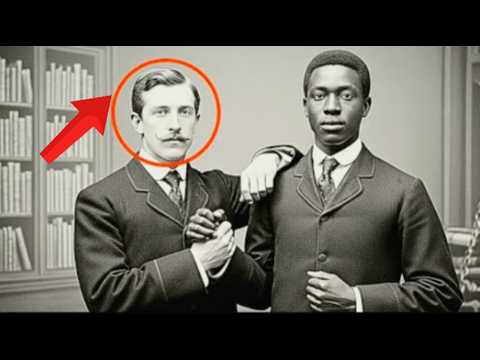
James pulled out his loupe and examined the image more closely. That’s when he noticed details that didn’t fit a simple friendship. The white man’s fingers weren’t resting lightly—they were gripping hard, knuckles whitened from pressure. The Black man’s smile, which seemed genuine at first glance, didn’t quite reach his eyes. His other hand, the one not holding his friend’s arm, was clenched into a fist at his side.
James moved the loupe across the background. In the lower right corner, partially obscured by a small table, something hung on the wall. A chain. Heavy links painted into the backdrop. Why would a photography studio include a chain in a setting meant to convey education and refinement?
He turned the photo over. On the yellowed backing board, someone had written in faded brown ink: “Thomas and Marcus. Last photograph before departure. May God forgive us for what we have done. September 14, 1889.”
James read the inscription three times. May God forgive us for what we have done. Not what we are about to do. What we have done. Something had already happened when this photograph was taken. Something that required divine forgiveness.
He spent the rest of the day searching for any record of Thomas and Marcus from Richmond in 1889. Without surnames, the search was difficult—both names were common. He started with the photographer’s mark. City directories showed that Anderson & Sons operated a studio on Broad Street from 1885 to 1893, advertising as specialists in luxury portraits for prominent families. That focus on elite families suggested they served Richmond’s white aristocracy, making a mixed-race portrait even more unusual.
James examined the photo again under different lighting. The suits were expensive, tailored, not off-the-rack. The fabric appeared to be fine wool, appropriate for a formal portrait. Their shoes, visible at the bottom of the frame, were polished leather. Everything about their appearance suggested wealth and status. But something in the Black man’s posture puzzled James. Despite the expensive clothes and confident stance, there was a slight tension in his shoulders, a wariness in his expression that spoke of someone who had learned to be careful, to watch and wait.
He called his colleague, Dr. Patricia Okoye, who taught African American history at Howard University and had extensive connections with archives across Virginia. She called back within two hours.
“You’ve got my attention,” she said. “Send me high-resolution images. I want to look at this myself.”
They agreed to meet the next day at the Library of Virginia in Richmond, where Patricia had already booked time to search land records and newspaper archives from the 1880s and 1890s.
That evening, James couldn’t stop thinking about the photograph. He’d handled thousands of historical images, but something about this one felt different. The inscription, “May God forgive us,” suggested guilt, complicity, perhaps even crime. And that chain in the background—hidden partially, but undeniably present. Had the photographer included it deliberately, or was it part of a standard studio backdrop, a detail that only acquired sinister meaning in the context of who was being photographed?
He pulled up census records from 1890, searching for any Thomas and Marcus listed in the same household in Richmond or surrounding counties. The 1890 census had been largely destroyed by fire, but fragments remained. After two hours of searching, he found an entry that made his pulse quicken.
In Henrico County, just outside Richmond, the 1880 census listed a Thomas Whitmore, age 13, living with his parents, William and Elizabeth Whitmore. William’s occupation was listed as a large farmer—a term used for wealthy planters, often former slaveholders. The household included several individuals listed as servants, and among them was a boy named Marcus, age 13, with no surname given. His race was recorded as “colored.”
James leaned back in his chair, his mind racing. In 1880, fifteen years after emancipation, census records still often listed Black workers without full names or with first names only—a holdover from slavery when enslaved people had no legal surnames. If this was the same Marcus in the photograph, he would have been about 22 or 23 in 1889, matching the apparent age of the man in the image. Thomas Whitmore would have been the same age, having grown up in the same household as Marcus.
James searched for more information about the Whitmore family. William Whitmore appeared in multiple records—property deeds, tax records, and mentions in Richmond newspapers regarding agricultural societies. The family had owned a large plantation called Oakwood, about 15 miles outside Richmond, before the war. After the war, they retained the property, though records showed its size had shrunk.
What had happened to Marcus? Had he stayed with the Whitmore family after emancipation? And if so, under what circumstances? The Thirteenth Amendment had ended slavery in 1865, but James knew that many former slaves remained with their former masters, bound by economic necessity, exploitative labor contracts, or outright intimidation. He needed to see the property records, the labor contracts, any legal documents related to the Whitmore family. He needed to understand the relationship between Thomas and Marcus—were they truly friends, as the photograph suggested, or was something darker lurking beneath the surface of their posed camaraderie?
James looked at the photograph one more time before closing his laptop. Two young men in matching clothes, their hands on each other in gestures of connection. But the tension in Marcus’s grip, the too-firm press of Thomas’s hand, and that chain in the background all whispered of a story far more complex than simple friendship. Tomorrow, in Richmond, he would begin to uncover the truth.
Phần tiếp theo của câu chuyện:
James đọc lướt qua 15 trang sh testimony, nhưng dừng lại ở trang thứ tư. Marcus đã kể cho ủy ban nghe về đêm tháng 9 năm 1889, khi Thomas lén mang cho anh ta một bộ quần áo và một con dao nhỏ. “Thomas nói với tôi rằng cha anh ấy đã biết hết mọi chuyện,” Marcus khai trước ủy ban. “Anh ấy nói rằng tôi phải đi ngay trong đêm, trước khi cha anh ấy kịp gọi cảnh sát. Thomas đã đưa cho tôi một lá thư gửi cho một người bạn ở Philadelphia, và một ít tiền. Anh ấy nói rằng anh ấy sẽ giải quyết mọi chuyện với cha mình.”
James cảm thấy lạnh sống lưng. Thomas đã ở lại để đối mặt với cha mình, trong khi Marcus chạy trốn. Và chưa đầy ba tuần sau, Thomas chết trong một “tai nạn săn bắn.”
Anh đọc tiếp. Marcus khai rằng anh ta chạy bộ suốt đêm đến một trạm xe lửa nhỏ ở Hanover County, nơi anh ta bắt chuyến tàu đầu tiên đến Washington, rồi đổi tàu đến Philadelphia. Anh ta không bao giờ quay lại Virginia. “Tôi không biết chuyện gì đã xảy ra với Thomas cho đến nhiều năm sau,” Marcus nói với ủy ban. “Khi tôi nghe tin anh ấy chết, tôi biết đó không phải là tai nạn. Tôi biết cha anh ấy đã giết anh ấy. Nhưng tôi là một người da đen ở Philadelphia, và ông ta là một người da trắng giàu có ở Virginia. Tôi biết mình không thể làm gì được.”
James dừng lại, tay run nhẹ. Marcus đã sống với nỗi đau đó suốt hơn một thập kỷ. Anh ta đã xây dựng một cuộc sống mới, nhưng không bao giờ quên người bạn đã hy sinh mạng sống để cứu mình.
Anh tiếp tục đọc phần còn lại của lời khai. Marcus đã cung cấp cho ủy ban tên của những người khác từng bị giam giữ tại Oakwood—những người mà anh ta biết đã bị buộc phải ký hợp đồng lao động khống chế. Anh ta cũng đưa ra một chi tiết mà James chưa từng thấy trong bất kỳ hồ sơ tòa án nào: “William Whitmore đã đốt tất cả các giấy tờ trong văn phòng của mình sau khi Thomas chết,” Marcus khai. “Một người hầu cũ của chúng tôi, tên là Silas, đã chứng kiến ông ta đốt cả một thùng giấy tờ trong lò sưởi. Silas nói rằng ông ta đã khóc khi làm điều đó, nhưng không phải vì đau buồn—mà vì tức giận.”
James ghi chú lại tên Silas. Đây là một nhân chứng mới, một người có thể đã thấy điều gì đó. Anh quay lại tìm kiếm trong các bản ghi của mình về bất kỳ ai tên Silas ở Henrico County trong những năm 1880.
Patricia gọi điện thoại cho anh vào lúc đó. “James, tôi vừa tìm thấy một thứ,” cô nói, giọng căng thẳng. “Trong hồ sơ của tòa án quận Henrico, có một bản khai chứng từ từ năm 1890 mà chúng ta đã bỏ sót. Đó là một bản tuyên thệ của một người tên là Silas Freeman—có vẻ như là anh trai của Marcus—trong một vụ kiện dân sự mà Marcus đệ trình chống lại William Whitmore từ Philadelphia.”
James nín thở. “Marcus đã kiện William Whitmore?”
“Đúng vậy. Và Silas đã làm chứng rằng anh ta đã chứng kiến William Whitmore đe dọa Thomas trong tuần trước khi Thomas chết. Ông ta nói rằng ông ta sẽ ‘chôn vùi’ Thomas nếu cậu ta tiếp tục ‘làm hỏng công việc kinh doanh của gia đình.’ Và Silas cũng khai rằng ông ta đã thấy William Whitmore cầm một khẩu súng trường vào đêm Thomas chết—không phải khẩu súng săn của Thomas.”
James cảm thấy tim mình đập mạnh. “Vậy là có bằng chứng. Có nhân chứng.”
“Có bằng chứng, nhưng không có công lý,” Patricia nói. “Vụ kiện đã bị đình chỉ vào năm 1891. Không có lý do được đưa ra trong hồ sơ. Có thể William Whitmore đã trả tiền cho ai đó, hoặc đe dọa ai đó. Nhưng Silas Freeman đã biến mất khỏi hồ sơ sau năm 1891. Tôi không biết chuyện gì đã xảy ra với anh ta.”
James nhìn chằm chằm vào màn hình. Anh đã có câu trả lời cho câu hỏi lớn nhất: Thomas đã bị giết bởi cha mình, và Marcus đã cố gắng tìm công lý nhưng thất bại. Nhưng vẫn còn một câu hỏi chưa được trả lời: Điều gì đã xảy ra với Marcus Freeman sau năm 1902? Anh ta đã sống một cuộc đời dài và thịnh vượng, hay số phận của anh ta cũng bi thảm như Thomas?
James dug deeper into Philadelphia records. The 1910 census showed Marcus Freeman, widowed, living with his daughter’s family. His occupation: carpenter, still. But the trail ended there.
Then Patricia found a death certificate. Marcus Freeman died in 1918, at age 52, of pneumonia. His daughter, Sarah, had provided the information. Under father’s name, she wrote: “Marcus Freeman. Born in Virginia. A free man.”
James sat back, the weight of the story settling over him. Thomas died for Marcus’s freedom. Marcus lived for decades, built a life, raised a family—but never forgot.
He looked at the photograph again. The chain in the background, the forced smiles, the inscription. “May God forgive us for what we have done.” Thomas had written that. He knew the cost.
James closed the file. The truth was out. But was it enough? What would you have done, if you were Thomas?
Report this article
Select a reason for reporting:






