In 1990, the quiet beaches of the Persian Gulf erupted into war. Saddam Hussein’s invasion of Kuwait triggered a massive coalition buildup, with over half a million Iraqi troops entrenched behind Soviet-made armor—5,000 tanks strong. The U.S. Air Force had a weapon built specifically to shred those tanks: the A-10 Thunderbolt II. Yet, in a move that stunned battlefield commanders, the general in charge of air operations nearly left it behind.
General Horner, commander of air operations, was summoned by General Schwarzkopf to review the aircraft roster before the attack. Among the 1,900 planes slated for action, not a single A-10 was listed. “Where are my A-10s?” Schwarzkopf demanded. Horner replied, “We have F-16s specially armed; they’ll do the job.” Schwarzkopf shot back, “I don’t want to hear any of your Air Force political crap. Give me my A-10s.”
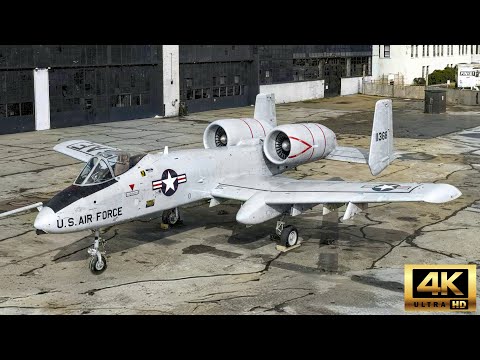
The A-10, already 20 years old, went on to destroy 4,000 tactical targets—more than all other aircraft combined. Why had the Air Force been so reluctant to bring the Warthog to war? What made them resist this tank-killing machine so fiercely? The answer lies in a decades-long battle within the Air Force itself.
To understand the A-10’s secret, we must go back to its origins. In the early days, the Air Force was a branch of the Army, and close air support—the dirty job of protecting ground troops—was seen as a necessary evil. Many Air Force generals despised it, preferring the glamour of strategic bombing. They believed bombers alone could win wars, a fallacy that persisted despite evidence to the contrary.
During World War II, the P-47 Thunderbolt accidentally became a legendary close-support aircraft. Its massive radial engine served as a shield, and its sturdy build brought pilots home riddled with holes. The P-47 set the standard for future support missions. But after the war, the Air Force doubled down on bombers and nuclear weapons, ignoring the lessons of Korea and Vietnam.
In Korea, jet fighters proved too fast for effective ground support, and old prop-driven planes like the A-1 Skyraider took on the dangerous role. The Air Force remained blind to the need for a dedicated support aircraft. Vietnam exposed the same gap, forcing the Navy’s A-1 into service again. Meanwhile, a young colonel named Avery Kay, haunted by a broken promise to provide close support, began a secret campaign to build the ultimate support plane.
Kay’s plan was audacious: create a cheap, deadly aircraft to kill the Army’s expensive Cheyenne helicopter program and force the Air Force to honor its commitment. With allies like Pierre Sprey and a team of rebel analysts, the A-X program was born. They demanded a plane that could loiter over the battlefield, carry massive firepower, and survive heavy ground fire. The result was the A-10, built around a devastating 30mm cannon and a titanium bathtub for the pilot.
But even as the A-10 took shape, the Air Force tried to kill it. They pitted it against the A-7 in a rigged competition, but the A-10’s superiority was undeniable. Production began, yet the attacks continued. The Air Force culture, rooted in strategic bombing, couldn’t accept a plane designed for the gritty job of supporting soldiers. The battle for the A-10 was just beginning.
By the time the first A-10s rolled off the assembly line in 1975, the Air Force had already launched a new wave of attacks. One general proposed handing the entire fleet over to the Army, arguing that if the Army wanted close air support so badly, they could own the planes. The Army, caught off guard, declined—they had no pilots trained for fixed-wing combat. The ploy failed, but it revealed the depth of the Air Force’s disdain.
Undeterred, the Air Force next tried to force the A-10 into a fly-off against the A-7, a plane that was slower, less armored, and completely unsuited for the close-support role. The test was so lopsided that even the most skeptical generals couldn’t pretend the A-7 was a viable alternative. The A-10 won every category—survivability, loiter time, weapons delivery, and low-speed handling.
Still, the Air Force’s budget warriors found new ways to undermine the program. They slashed production numbers year after year, hoping to strangle the A-10 quietly. By the time Ronald Reagan took office, the planned buy had been cut from over 700 to just a few hundred. Then came the budget showdown between Caspar Weinberger and Stockman, which nearly killed the program outright.
But something unexpected happened. The pilots who flew the A-10—many of whom had been assigned to it as a punishment—fell in love with the plane. They discovered that the Warthog was not just a weapons platform; it was a lifeline for soldiers on the ground. In the deserts of Kuwait and the mountains of Afghanistan, the A-10 would prove its worth in ways no PowerPoint briefing could capture.
When Saddam Hussein invaded Kuwait in 1990, the A-10 finally got its chance. General Schwarzkopf’s insistence on including the Warthog in the air campaign was a turning point. The A-10 destroyed more Iraqi tanks than any other coalition aircraft, and its pilots returned home with stories of soldiers on the ground weeping with relief at the sound of its cannon.
Yet even after Desert Storm, the Air Force resumed its campaign to retire the A-10. Each budget cycle brought new proposals to phase out the fleet, replace it with F-16s or F-35s, or simply let it wither through neglect. The pattern was predictable: the Air Force would announce a retirement plan, Congress would push back, and the A-10 would survive—barely.
In 2003, during the invasion of Iraq, the A-10 was again held back from the initial assault. But as the insurgency grew and American troops found themselves fighting in urban streets and mountain valleys, the Warthog was rushed back into service. By 2007, the Air Force was forced to admit that no other aircraft could do what the A-10 did: loiter for hours, deliver precise firepower, and terrify the enemy simply by showing up.
Today, the A-10 remains a symbol of the enduring conflict between what the Air Force wants to be and what the soldiers on the ground need it to be. It is a plane born of bureaucratic warfare, saved by rebellious officers and stubborn pilots, and proven in every conflict since its first flight. The Warthog’s story is not just about engineering—it is about a culture that has spent decades trying to kill the very weapon that keeps its soldiers alive.
The A-10’s saga is far from over. In the corridors of the Pentagon, the fight continues with the same intensity as the 1970s. Every few years, a new proposal emerges to retire the Warthog, each time dressed in the language of modernization and efficiency. And every time, the soldiers, the pilots, and the American public push back.
The latest battle centers on the F-35, the trillion-dollar stealth fighter that was supposed to do everything. “The F-35 will replace the A-10,” the generals declare, pointing to its advanced sensors and precision weapons. But the pilots who have flown both know the truth: the F-35 cannot loiter for hours at 250 knots, cannot absorb a 23mm hit and keep flying, and cannot dive into a valley to strafe an enemy position just 50 meters from friendly troops.
In 2016, the Air Force announced yet another plan to retire the entire A-10 fleet by 2022. Congress, responding to fierce lobbying from ground troops and veterans, blocked the move. The following year, the Air Force tried again. Again, Congress refused. It was a bizarre spectacle: the most powerful air force in history, fighting its own Congress to get rid of its most beloved attack aircraft.
Why this obsession? The answer lies deep in the Air Force’s DNA. The service was born from the conviction that strategic bombing—striking the enemy’s heartland from high altitude—could win wars alone. Close air support, by contrast, is messy, dangerous, and tied to the Army’s fortunes. It requires pilots to fly low and slow through enemy fire, to coordinate with ground troops in the chaos of battle, and to accept that their survival depends on armor and redundancy rather than speed and stealth.
But the A-10’s defenders have learned to fight back. In recent years, a new generation of pilots and maintainers has taken up the cause. They have formed advocacy groups, testified before Congress, and used social media to tell the Warthog’s story. They point to the plane’s unmatched record in Afghanistan, Iraq, and Syria—where its mere presence has broken enemy attacks and saved countless lives.
They also highlight the A-10’s remarkable upgradeability. The current fleet, with new wings, digital cockpits, and advanced targeting pods, is more capable than ever. The plane that was built to kill Soviet tanks now hunts insurgents on motorcycles and destroys ISIS convoys with precision-guided munitions. “It’s the only aircraft in the inventory that can do everything from close air support to combat search and rescue,” one pilot explains. “And it does it cheaper than anything else.”
The debate has also exposed a deeper truth about the American way of war. The military’s obsession with high-tech, multi-role platforms has driven costs to unsustainable levels. A single F-35 costs over $100 million; an A-10 costs a fraction of that. The F-35 requires enormous logistics and maintenance; the A-10 can operate from austere forward bases with a small crew. In an era of constrained budgets and endless small wars, the Warthog’s simplicity is its greatest strength.
Yet the Air Force leadership remains unmoved. In 2020, General Charles Brown, the Chief of Staff, stated that the A-10 would eventually be retired, calling it a “single-mission” aircraft. The comment infuriated supporters, who noted that the F-35, with its myriad of roles, has yet to prove it can perform any of them as well as the A-10 performs its one mission.
The fight has even spilled into the realm of doctrine. Some strategists argue that the future of close air support lies in drones and standoff weapons. But veterans of the A-10 community counter that no drone can replicate the human connection between a pilot overhead and a soldier on the ground. “When you hear that cannon, you know someone up there cares,” one Army sergeant said. “A drone doesn’t give you that feeling.”
As the sun sets over another dusty forward operating base, an A-10 crew chief runs through the pre-flight checks. The Warthog is older than most of the pilots who fly it, but it is ready. In the distance, a radio crackles with a call for help. The pilot straps in, the canopy closes, and the engines spool up with their distinctive whine. Once again, the A-10 will do what it was built to do—fly into harm’s way and bring the soldiers home.
The Warthog’s future remains uncertain, but its legacy is secure. Every soldier who has watched an A-10 dive through smoke to save their convoy knows the truth: some things are worth fighting for, even if the generals disagree.
As long as there are troops in harm’s way, the question will echo: When the call comes in, who will answer—the trillion-dollar stealth fighter, or the battered old Warthog that never quits?
What do you think—should the A-10 keep flying, or is it finally time to let the Warthog retire? Share your thoughts below.
Report this article
Select a reason for reporting:






