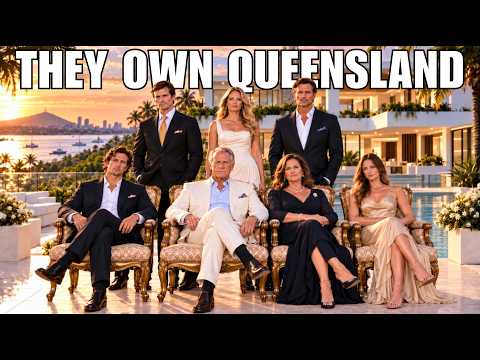
One family sits on roughly 1.75 million hectares of Queensland cattle country. Another turned 2,860 hectares of unwanted bushland into an entire city. And at number one, a billionaire whose companies hold more than 10,000 square kilometers of coal tenements. These are the richest families that own Queensland—and what they actually control across the state is hard to wrap your head around.
The fortunes didn’t arrive overnight. They were built slowly, often invisibly, by people who understood the value of what lay beneath the surface—or what could be built on top of it—long before anyone else did.
Take Chris Wallin. In the 1980s, he was a principal geologist with the Queensland Department of Mines, mapping coal reserves in the Bowen Basin. He spent years studying the ground underneath the mines before he ever owned one. Then, in 1989, he left government work and founded QCoal, targeting exploration tenements larger operators had overlooked.
Wallin’s advantage was simple: he knew what he was looking at. Over time, those licenses turned into operating mines. The Northern Hub now produces roughly 6 million tons of coal a year. Byerwen, west of Glenden, can produce up to 10 million tons of hard coking coal annually. By 2026, his fortune was estimated at roughly 1.84 billion Australian dollars.
Yet Forbes reported that Wallin spent roughly three decades living in the same house in The Gap, a suburban pocket of Brisbane. No sprawling estate was required. The money was already sitting underground.
Then there’s Maha Sinnathamby. In 1992, he and his business partner Bob Sharpless bought 2,860 hectares of bushland between Brisbane and Ipswich—land almost nobody wanted. Planning problems had made development difficult, and the site had spent years looking like an enormous piece of land with very little going for it.
Sinnathamby saw a city. Born in Malaysia, he had studied civil engineering at the University of New South Wales, driving taxis at night to pay his way. By the early 1980s, he had built a personal fortune of around 7 million Australian dollars. Then it collapsed. He later described himself as a negative millionaire.
Springfield was his comeback. He and Sharpless paid around 7.9 million Australian dollars for the land. But they didn’t just bet on Brisbane expanding west—they built the reasons for people to move there: housing, education, health care, employment, a shopping center, a university campus, a rail connection. By 2017, the Queensland government described Greater Springfield as Australia’s largest master-planned city, valued at around 85 billion Australian dollars. By 2026, more than 55,000 people lived there, and Sinnathamby’s wealth was estimated at just over 2 billion.
He didn’t simply buy property. He bought unwanted bushland and spent three decades giving people reasons to live on it.
The next family spread across Queensland cattle country on a scale that’s difficult to see even on a map. Trevor Lee started his working life as a jackaroo. Today, his family controls one of the largest vertically integrated beef operations in Australia—roughly 1.75 million hectares of Queensland grazing country.
The Lees moved into cattle in the 1960s and bought Brindley Park near Roma in 1968, developing one of Australia’s early commercial feedlots. But they didn’t stop at raising cattle. They kept adding more of the supply chain: grazing properties, feedlot capacity, and eventually meat processing. Today, Australian Country Choice can breed and background as many as 300,000 cattle a year, with feedlot capacity for more than 56,000 head.
An animal can move from family-controlled grazing country into the company’s feedlots, then into Cannon Hill for processing, packaging, and distribution. That’s the real money machine. The Lees participate at several stages of the same journey—influencing cattle through genetics, controlling how they’re finished, and capturing more value when the animal becomes a finished food product. For the financial year ending in 2023, revenue was in the range of 600 to 700 million Australian dollars. By 2026, Trevor Lee’s fortune was estimated at around 2.2 billion.
He started as a jackaroo. His family built much of the road from the paddock to the packet.
And the families further up this list made their fortunes from things even less appetizing—or far more controversial. The rubbish Queensland throws away every day. The ground beneath shopping centers. And at number one, the coal tenements of the Galilee Basin.
Consider the Richards family, whose trucks you’ve almost certainly seen without ever reading the name on the door. Joseph John Richards started the business in 1932 after winning a sanitary collection contract in Murwillumbah. His children joined, the company became J.J. Richards and Sons, and Queensland became central to the story in 1962 when it won the domestic waste collection contract for Toowoomba—a contract it still services more than sixty years later.
But the family did more than add trucks. They changed how the trucks worked. Waste collection was brutally labor-intensive, so J.J. Richards developed front-loading equipment for industrial bins and later automated side-loading systems. By the late 1980s, the company was trialing an automated side-loader in Redlands. A driver could operate a mechanical arm from inside the cab, letting one truck service more homes with fewer manual steps. That single change reshaped the economics of suburban rubbish collection.
Behind the trucks sat the infrastructure that determined what happened after collection: a major materials recovery facility at Stapylton between Brisbane and the Gold Coast, then transfer stations and other resource recovery operations. That network supported long-term council contracts—more than 21 million Australian dollars from Scenic Rim in 2021, about 42 million from Gladstone in 2026. Today J.J. Richards employs more than 2,800 people and operates over 1,700 vehicles across Australia, New Zealand, and the United States. By 2026, the family’s fortune was estimated at around 2.21 billion.
People wheel a bin to the curb, a truck arrives, the rubbish is gone. What they never see is the engineering, contracts, and infrastructure behind that simple moment.
Then there’s Bob Ell, who began not as a property billionaire but as a carpenter. In 1976 he founded Leda and moved into property development. By the late 1980s the company was making large bets on Queensland suburban growth—developing Morayfield Shopping Centre, then Logan Hyperdome, which became one of the largest single-story shopping centers in Australia.
Ell wasn’t simply building shops. He was identifying where population growth was heading, securing large sites, and putting housing and retail in front of it. Leda later developed more than 500 lots at Robina and around 1,200 homes at Pimpama as the northern Gold Coast expanded. Crucially, the company didn’t sell everything it developed. Forbes reported that Leda still owns three shopping centers in Queensland while maintaining major residential land interests across Queensland and New South Wales.
That’s the Leda money machine: develop some assets and sell them, hold others while population and roads increase their value, then recycle capital into the next piece of land. In 2023, Leda paid 177 million Australian dollars for a 161-hectare site at Coomera—reported as the largest residential land sale in Gold Coast history, with potential for a master-planned community of more than 4,000 homes. By 2026, Bob Ell’s fortune was estimated at around 2.88 billion.
A carpenter started buying and developing property. Decades later, parts of Southeast Queensland grew around it.
The next family began with something even more ordinary—furniture. But the really valuable part eventually turned out to be the property underneath the shops.
John Van Lieshout started at the bottom of a furniture shop in Fortitude Valley, quite literally. As a junior at Royal Art Furniture, his first jobs included cleaning windows and toilets before he worked his way into dispatch and sales. On weekends, he and a workmate bought used furniture, repaired it, and sold it from a garage. Then, in 1969, Van Lieshout and his wife Linda took the 2,000 Australian dollars they had saved for a house deposit and put it into a furniture shop at Coopers Plains. That eventually became Super A-Mart.
The business nearly failed more than once—the Brisbane floods of 1974 almost wiped them out—but they kept going. By 1984, Super A-Mart had grown to six stores, and from there the model expanded rapidly: large-format shops, simple pricing, and high volumes aimed at ordinary households. Eventually it reached 21 stores across Queensland and northern New South Wales, capturing more than a fifth of its market.
From the outside, that looks like the source of the fortune. Build a huge furniture retailer, sell it, get rich. That’s only half the story. In 2006, Van Lieshout sold Super A-Mart for around 500 million Australian dollars—but he kept ownership of the freehold property underneath a number of the stores. According to Van Lieshout, those buildings were worth roughly as much again as the business he had just sold.
That changes everything. The furniture generated the cash. The property became the longer-term machine. The retailer could change hands; the buildings did not have to. Today, JVL Investment Group says it owns and manages more than 1 billion Australian dollars of property, including shopping centers, large-format retail, and commercial assets across Queensland. Major retailers occupy those buildings and pay rent. Van Lieshout no longer needs to sell you a lounge suite to make money from the places where Queenslanders shop. By 2026, his fortune was estimated at around 3.24 billion.
What people remember is Super A-Mart. What made the wealth endure was what Van Lieshout refused to sell with it. He sold the furniture business. He kept the ground beneath the shops.
And the family at number two took that idea of controlling the asset underneath an industry even further. Instead of shopping centers, their fortune sits beneath some of Queensland’s biggest coal operations. Sam Chong, a Malaysian-born mining engineer, moved to Australia in the early 1970s and helped build Jellinbah Group—a private company that owns 70% of both the Jellinbah mine near Bluff and Lake Vermont near Dysart.
Together, those two mines have production capacity of roughly 15 million tons of coal a year, most of it metallurgical coal used to make steel. Then Anglo American decided to sell its stake. The price was 1.6 billion Australian dollars. Zashvin, the Chong family’s private vehicle, bought it.
That transaction lifted the family to roughly two-thirds of the company; a later sale to Marubeni left Zashvin with 60%. The Chongs don’t need to own every ton of coal in the Bowen Basin. They control the majority of a private company that itself holds 70% of two major mines. In 2025, Lake Vermont received a three-year mining contract extension worth around 2.3 billion Australian dollars. Across both operations, roughly 1,300 people are employed, most in regional Queensland. By 2026, Sam Chong’s wealth was estimated at roughly 3.5 billion.
Most people see the coal trains leaving central Queensland. What they don’t see is the ownership structure behind the mines. The Chong family does.
And the family at number one operates on an entirely different scale. Clive Palmer was already a multimillionaire before mining made him one of Australia’s richest men—his first fortune came from Queensland property. He entered property in 1974, working around the Gold Coast, and later said that by his late 20s he controlled assets worth roughly 40 million Australian dollars.
Then, in 1984, he created Mineralogy and moved into resources, acquiring rights over enormous iron ore deposits in Western Australia. At Sino Iron, Chinese state-owned CITIC supplied much of the capital to build the massive Pilbara project on Mineralogy’s tenements—and in 2006 paid Palmer and Mineralogy a combined 415 million US dollars upfront, plus royalties linked to the iron ore produced.
That changed the economics completely. Another company could spend billions building the mine while Mineralogy retained contractual rights connected to the resource underneath it. In 2017, Mineralogy won a claim worth roughly 150 million US dollars over unpaid royalties. By 2026, Palmer’s fortune was estimated at around 19.56 billion Australian dollars—a completely different financial league from every other family in this ranking.
But the royalty machine sits largely in Western Australia. His Queensland footprint is different. Through Waratah Coal, Palmer’s interests include more than 10,000 square kilometers of coal tenements in the Galilee Basin, with more than 7 billion tons of coal resources and around 1.1 billion tons of reserves. These are largely proposed developments and exploration positions, not operating mines—and that fits the Palmer model exactly. Property before the suburb grows around it. Mineral rights before the mine is developed. Coal tenements before the infrastructure arrives.
So the progression is remarkable. Roughly 40 million in property assets while still in his 20s. Hundreds of millions flowing through the Sino Iron agreement. A fortune now approaching 20 billion. And more than 10,000 square kilometers of coal tenements across one of Queensland’s major resource regions. Clive Palmer did not become this rich simply by digging minerals out of the ground. He became this rich by understanding the value of owning the rights to what was underneath it.
Look at what almost every one of these families has in common. A government geologist who learned the Bowen Basin from the ground up. A Malaysian-born engineer who looked at unwanted bushland and saw a city. A jackaroo whose family built a beef operation stretching across roughly 1.75 million hectares. A waste business built from council collections. A carpenter betting on Southeast Queensland property. A furniture salesman who sold the shops but kept the ground beneath them. A mining engineer’s family that took majority control of the company behind two major coal mines. And at the top, a man who turned property and mineral rights into a fortune worth nearly 20 billion.
None of these fortunes arrived at that scale overnight. That is the pattern running through Queensland. The biggest money often came from understanding land, infrastructure, or resources before everyone else understood what they could become.
So which one surprised you most—the family that helped build an entire city, the cattle empire stretching across Queensland, or the billionaire whose companies hold more than 10,000 square kilometers of Galilee Basin coal tenements? Drop it in the comments and tell us which part of Australia we should break down next.
Report this article
Select a reason for reporting:






