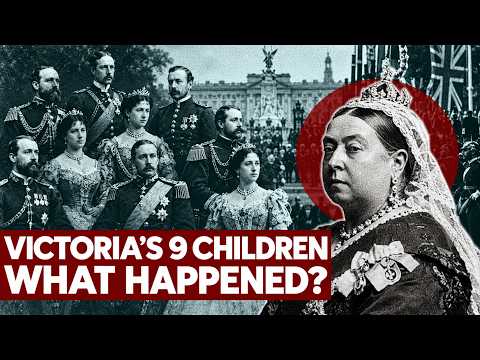
On January 22, 1901, a single woman died in a quiet room at Osborne House, and with her passing, an era ended. Queen Victoria had ruled the largest empire the world had ever seen for 63 years, but her most enduring legacy wasn’t the crown—it was the nine children she left behind. Five daughters, four sons, all of whom survived into adulthood, a rarity in the 19th century. But survival came at a cost. Victoria didn’t just give her children titles and palaces; she passed down a hidden genetic mutation that would ripple through Europe’s royal houses for generations, earning it the grim nickname “the royal disease.”
As her coffin was lowered into the ground, her children stood together one last time—a fragile alliance of blood and duty. But the bonds that held them were already fraying, pulled apart by ambition, grief, and the cruel hand of fate. What happened to them after their mother’s death is a story of triumph and tragedy, of thrones won and lives lost, of a family that shaped the modern world in ways we are still reckoning with today.
The eldest, Vicky, had dreamed of a liberal Germany. Instead, she watched her son, Kaiser Wilhelm II, steer the nation toward war. Her husband’s reign lasted just 99 days before throat cancer took him, and Wilhelm seized the throne, sidelining his own mother. Vicky died just seven months after Victoria, her dreams shattered, her body ravaged by cancer.
Bertie, the heir who was never supposed to be king, proved everyone wrong. After decades of being told he was unworthy, he became Edward VII, a surprisingly effective monarch whose charm earned him the nickname “The Uncle of Europe.” But his reign was short—just nine years—and the Great War that followed would tear apart the family he had tried to unite.
Alice, the gentle daughter, kissed her sick child and paid with her life. Her son’s hemophilia drew Rasputin into the Russian court, destabilizing the monarchy. Her daughter, Alexandra, would die in a basement in Yekaterinburg, executed with her family by Bolshevik revolutionaries. Alice’s legacy was written in blood—both the blood she couldn’t stop and the blood that was spilled in the name of revolution.
Alfred, Victoria’s favorite son, died just six months after her, broken by his own son’s suicide. Helena, the dutiful daughter, outlived them all by decades, channeling her grief into charitable work. Louise, the rebel, defied convention and lived to 91, the longest-lived of them all.
Arthur, the golden child, became a field marshal and governor general of Canada, witnessing both World Wars. Leopold, the hemophiliac, died at 30 from a simple fall on a staircase—a fall that would have been survivable for anyone else. And Beatrice, the youngest, spent 30 years burning her mother’s private journals, taking the Queen’s most intimate secrets to her grave.
Nine children. Nine extraordinary lives. And through them, the DNA of one woman reshaped the modern world. But the story doesn’t end there. The wars their descendants started, the thrones their grandchildren sat upon, and the genetic curse that haunted them for generations—all of it traces back to a single woman on a throne. And the most fascinating part? The full extent of Victoria’s legacy is still being unraveled today.
To understand the full weight of that legacy, you have to look beyond the nine children themselves and into the generation that followed—the grandchildren who would inherit both the glory and the curse. Victoria and Albert had 42 grandchildren between them. Forty-two. They sat on thrones in Britain, Germany, Russia, Greece, Romania, Norway, Sweden, and Spain. They were baptized in gold fonts and raised in marble palaces, and yet so many of them were marked from birth by forces they could neither see nor control.
Consider the cousins who ruled Europe in 1914. King George V of Britain, Kaiser Wilhelm II of Germany, and Tsar Nicholas II of Russia were all grandsons of Queen Victoria. They had played together as children at family weddings and funerals. They had exchanged letters, hunting invitations, and birthday telegrams. And then, in the summer of 1914, they led their nations into a war that would kill seventeen million people and topple four empires.
What makes this story so haunting is that Victoria’s strategy of peace through marriage did not fail by accident. It failed because she assumed blood was thicker than politics—and it wasn’t. Wilhelm’s resentment of his English mother, his desperate need to prove himself, his fascination with military might—these were personal wounds that became national policy. Nicholas’s devotion to his hemophiliac son, and the hold Rasputin had over his family because of it, weakened a dynasty already teetering on the edge. George, meanwhile, watched his cousins fall and quietly changed his family name from Saxe-Coburg-Gotha to Windsor in 1917, desperate to distance the British monarchy from its German roots.
The hemophilia gene, meanwhile, kept threading its way through the bloodlines. Alexandra of Russia passed it to Alexei. Victoria Eugenie of Spain passed it to two of her sons. Alice of Albany, Leopold’s daughter, passed it to her son Rupert, who died in a car accident in 1928 when the bleeding could not be stopped. By the mid-twentieth century, the disease had faded from the royal houses—not because it was cured, but because the carriers had fewer children, and the gene had fewer chances to spread.
But the story of Victoria’s children is not just a story of catastrophe. It is also a story of quiet endurance. Helena, the daughter her mother called plain and difficult, outlived nearly all of them and spent her widowhood building hospitals and nursing schools. Louise, the rebel sculptor, lived to ninety-one and never stopped fighting for women’s education. Arthur, the golden son, served Canada through the darkest years of the First World War and lived long enough to see the world remade again by the second.
And then there was Beatrice, the youngest, the one Victoria had tried so hard to keep forever. After her mother’s death, she did not fade quietly into the background. She became a formidable figure in her own right, a woman who had spent decades at the very center of power and who understood the machinery of monarchy better than almost anyone alive. When she burned Victoria’s original journals, she wasn’t just destroying paper—she was curating a legend. What she chose to preserve, and what she chose to consign to the flames, shaped how the world would remember her mother for a century.
But the grandchildren—the forty-two of them—carried the story forward in directions Victoria could never have imagined. Some of them died in ways so brutal they still feel impossible. Others lived long enough to see the world their grandmother had built collapse entirely, and then rebuild itself into something unrecognizable.
Take, for instance, the fate of Victoria’s Hessian grandchildren. Alice’s surviving daughters did not simply vanish into obscurity after their mother’s death. Elizabeth, the one who had escaped the diphtheria, became a nun after her husband’s assassination, founding a convent in Moscow and devoting herself to the poor. She was, by all accounts, radiant with a kind of serene faith that unsettled even the Bolsheviks who came to arrest her. When they threw her down the mine shaft in Alapayevsk, she reportedly tore a piece of her own veil to bandage a wounded fellow prisoner’s head as they fell. The singing that echoed from that pit for hours afterward was said to include her voice.
Her sister Irene, meanwhile, had married her own first cousin, Prince Henry of Prussia—Wilhelm’s brother—and passed the hemophilia gene to two of her sons. One died at four years old from a fall. The other survived to adulthood but lived a life shadowed by the disease. Irene herself, who was said to be gentle and kind, never fully escaped the guilt of what she had unknowingly transmitted.
And then there was the most unlikely survivor of all: Victoria’s granddaughter, Princess Alice of Albany, Leopold’s daughter. She had lost her father before she was born, lost her brother to the disease that ran in her blood, and lost her son Rupert to a car accident in 1928 when his blood refused to clot. And yet Alice lived on and on, through two world wars, through the fall of empires, through the rise and fall of the Third Reich. She died in 1981 at the age of ninety-seven—the last surviving grandchild of Queen Victoria, a living relic of an age that had long since passed into myth.
By the time she died, the world Victoria had built was gone. The German Empire was a republic. The Russian Empire was a memory. The Austro-Hungarian Empire had been carved into pieces. The British Empire itself had dissolved into a Commonwealth of nations. And the royal families of Europe, once so intertwined that a single marriage could shift the balance of power, had become constitutional figureheads—symbols rather than rulers.
The hemophilia gene, too, had run its course. It still exists in the world, of course, no longer confined to royal bloodlines, but the specific mutation Victoria carried has largely disappeared from the families she founded. Modern medicine can treat it now. What was once a death sentence is now a manageable condition. The curse that killed Frittie and Leopold and Alexei is, in most of the world, no longer a curse at all.
But the deeper legacy—the one Victoria never intended—remains. She believed that family bonds could prevent war. She believed that if her descendants sat on enough thrones, they would find a way to keep the peace. Instead, they proved that blood ties are no match for ambition, fear, and the terrible momentum of history. The First World War was, in a very real sense, a family quarrel that killed millions.
And yet, there is something else in the story, something quieter. Look at Helena building hospitals. Look at Louise sculpting statues and fighting for women’s education. Look at Beatrice, burning her mother’s secrets but preserving her legacy. Look at Alice of Albany, living nearly a century, carrying the memory of a world that no longer existed. These were not just pawns in a dynastic game. They were people—complicated, flawed, and often surprisingly brave.
Victoria herself, in her final years, seemed to sense that the world she had built was slipping away. She had outlived three of her own children. She had watched her empire grow to encompass a quarter of the globe. She had seen her grandchildren marry into every major royal house in Europe. And she had seen the first cracks appear in the edifice she had spent her life constructing.
She died at Osborne House on a January afternoon, with her son Bertie and her grandson Wilhelm at her bedside—the future king and the future kaiser, standing on opposite sides of a bed that would soon become a battlefield. She never knew what was coming.
What she left behind was not a united Europe, but a map of fault lines. Her nine children had done exactly what she asked of them—married, multiplied, and spread across the continent—and in doing so, they planted the seeds of the deadliest war in human history.
But here is the thing about legacies: they are never just one thing. Victoria’s bloodline gave the world a war, yes, but it also gave the world nurses and sculptors and diplomats and survivors. It gave the world a queen who outlived her empire and a princess who died singing hymns in a mine shaft.
And it gave us a question we are still answering today: When we build a family, are we building a peace—or a powder keg?
Victoria thought she knew the answer. History proved her wrong. And yet, a century later, we are still marrying across borders, still believing that love can hold back the darkness, still writing the next chapter of her story.
So here is my question for you: if you could ask Queen Victoria one thing about her children—about the lives she shaped and the world she broke—what would it be? Drop it in the comments below. I read every single one.
Report this article
Select a reason for reporting:






