Erwin Rommel was not a man who paid compliments to defeated enemies. Yet in April 1941, watching a column of Australian prisoners march past him outside Tobruk, he wrote of “immensely big and powerful men who without question represented an elite formation of the British Empire, a fact that was also evident in battle.” He was not admiring them. He was measuring a problem—the way an engineer records the thickness of a wall he cannot knock down.
Fifteen months later, deep inside Egypt, Rommel mentioned those same men again. This time he dropped any interest in their height. He wrote only that his army had run into “the Australians, whom we knew only too well from the time of the Tobruk siege.” Only too well. The phrase carries the weight of a man who has learned to dread a name.
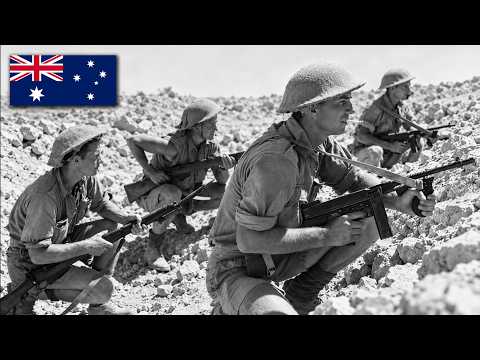
Most of us learn a tidy version of the desert war. Rommel, the desert fox, fast and daring. Montgomery, slow and careful. Tanks sweeping across the sand to a famous British victory at El Alamein. In that version, the Australians flicker past for a moment—a few photographs of men in slouch hats, a nickname borrowed from enemy propaganda. The German record does not match that version.
It shows a general who kept having to stop what he was doing and turn toward one division of volunteers from the other side of the world. At Tobruk in 1941. At a low hill called Tel el Eisa in July 1942. On the coast road at El Alamein that October. In those two years, Rommel beat one British army after another. So why did a single Australian division keep pulling his best units toward it? Why did it keep turning up in his own pages as something he had to worry about?
The answer comes in three pieces. Each piece is something the Australians took from him. He never got any of them back.
February 1941. Rommel lands in Libya with orders to hold the line for the Italians. He does not hold it. Within weeks, his columns are racing east across Cyrenaica and the British are falling back toward Egypt. One place stands in his way. Tobruk. A small port with a harbor, a perimeter of old Italian posts, and anti-tank ditches cut into rock. Whoever holds Tobruk can land supplies by sea. While it stays in British hands, an army driving on Egypt has an enemy fortress sitting behind it.
The men ordered into Tobruk belong mostly to the 9th Australian Division. The division was formed only in late 1940. Many of its soldiers have never fired a shot in anger. Their commander has. Leslie Morshead was born in Ballarat, Victoria, on 18 September 1889. He started out as a school teacher. On 25 April 1915, he went ashore at Anzac Cove, Gallipoli, with the 2nd Battalion. On the Western Front, he commanded the 33rd Battalion through Messines, Passchendaele, Villers-Bretonneux, and Amiens. Between the wars, he worked for a shipping line, the Orient Steam Navigation Company, and rose to passenger manager. In April 1941, he is 51 years old. His soldiers call him Ming the Merciless after the villain of the Flash Gordon serials. The nickname comes from a habit. When he is thinking hard, Morshead narrows his eyes and slowly strokes his chin. He does that a great deal in Tobruk.
The siege of the port begins on 10 April 1941. Morshead gathers his staff and gives them a line that will travel through the garrison. “There will be no Dunkirk here. If we should have to get out, we shall fight our way out. There is to be no surrender and no retreat.”
Inside the perimeter waits a corporal of the 2/17th Battalion named John Hurst Edmondson. Everyone calls him Jack. He was born in Wagga Wagga, New South Wales, on 8 October 1914, and grew up on a farm near Liverpool. His parents are Joseph and Maud. He is 26, 1,400 kilometers of desert and a different war away.
There is another man the Australians have never heard of. Captain Alfred Seebohm commands a German radio intercept company. In March 1941, his advanced platoon sets up at Sirt on the Libyan coast. Seebohm himself arrives on 24 April with the rest of the unit—more than 300 men, receivers, direction finders, cipher specialists. They do not fight. They listen. On 2 May 1941, the company sends its first radio situation report. In mid-May, it detects a British offensive before it starts. On 14 June, it warns that another, called Battleaxe, is imminent. British operators chatter on open channels, and Seebohm’s men write everything down. Keep his name in mind. His story and the Australians will meet on a hill in Egypt, and when they do, it will explain more about Rommel’s worry than any casualty list.
And one more man. Percy Gratwick was born in Katanning, Western Australia, on 19 October 1902. He left school at 16. He carried messages at Parliament House. He worked as a blacksmith, then a drover, then a prospector. He enlisted in a war that belonged mostly to younger men, and joined the 2/48th Battalion from South Australia. His war has not started yet. When it does, it will last one night.
13 April 1941, Tobruk. The first German probe comes in near the El Adem Road on the southern edge of the perimeter. Tanks of the 5th Panzer Regiment feel for a weak spot. Artillery and anti-tank guns drive them off. Darkness falls. Shortly before midnight, German infantry cut through the wire near post R33. They come in numbers. Machine guns, mortars, light field guns. They dig in inside the perimeter, ready to hold a gap open for the tanks at dawn.
Lieutenant F.A. Mackell decides they cannot be left there until morning. He takes Corporal Edmondson and five privates—seven men. They fix bayonets. They run at the German position under heavy fire. Edmondson is hit in the neck. He keeps running. He is hit in the stomach. He keeps running. He kills one German with the bayonet. Then he sees Mackell on the ground fighting off one man who has grabbed his legs while another comes at him from behind. Edmondson goes to him. He kills both. The German post breaks. The survivors scatter into the dark. Edmondson walks back to the post on his own feet. Then he lies down.
Before dawn, the main blow arrives. German tanks push through the gap in the wire heading north toward the harbor. They run straight into the British guns behind the line. Field artillery firing over open sights. Anti-tank guns at close range. The tanks turn and go back the way they came. The infantry following them are caught in the open. The German 8th Machine Gun Battalion loses about three quarters of its men. Its commander, Lieutenant Colonel Gustav Ponath, is among the dead. For the garrison, the figures are 26 killed and 64 wounded.
At the post, as the light comes up, Jack Edmondson is dying. Machine gun fire sweeps the ground and his mates cannot carry him out on a stretcher. Private Athol Dalziel tries anyway. Edmondson stops him. According to the account preserved by the Australian War Memorial, his last words were these: “No, Athol. Thanks all the same for trying. I know hospitals are no good to me now. Give my love to the folks, old boy, and good luck.” He dies as day breaks on Easter Monday, 14 April 1941. He will become the first Australian of the Second World War to be awarded the Victoria Cross.
Rommel does not give up after one night. He spends the next two weeks bringing up more troops, and the garrison spends them digging, wiring, and sending patrols out into the dark. Morshead does not want his men waiting in holes. A phrase attributed to him sums up the order: “We’re not here to take it. We’re here to give it.” Night after night, small parties go out through the wire to raid German and Italian positions and come back before light.
In Berlin, the Army High Command grows uneasy. It sends a senior staff officer, Major General Friedrich Paulus, to see what Rommel is doing with his divisions. Paulus is in Africa when the second blow falls. 30 April 1941. Evening. Rommel attacks the southwestern corner of the perimeter near a low rise called Ras el Medauar. This time he uses two divisions, the 5th Light and the 15th Panzer. The attack bites deep. German and Italian troops break into the perimeter on a front of about three miles and push some two miles inside. Then the Australians counterattack again and again. By 4 May, the line has stopped moving. The bulge in the perimeter stays, a salient that both sides will hold for months, but the harbor is out of reach. The bill for Rommel’s side is roughly 650 German and 500 Italian casualties.
Paulus has seen enough. Before leaving, he orders that no further attacks be made on Tobruk unless the defenders begin evacuating the port. So the siege settles into something slower. Shelling in the day, patrols at night, water rationed, ships running in through the dark with supplies and running out with the wounded. Two destroyers lost, among them HMAS Waterhen. Three sloops lost, among them HMAS Parramatta. Twenty-one smaller vessels. From Germany, the English-language voice of Nazi radio, William Joyce, known as Lord Haw-Haw, mocks the garrison as rats caught in a trap. The garrison takes the word and keeps it. The rats of Tobruk.
Morshead studies the maps in his headquarters, squinting, hand at his chin. He knows the arithmetic. Every week the port holds is a week Rommel cannot safely drive into Egypt with a fortress at his back. From August 1941, most of the Australians are taken out by sea and replaced by British, Polish, and Czechoslovak troops. Relief from outside links up with the garrison on 27 November 1941, and the siege is fully lifted in December. Between 8 April and 25 October, the 9th Division and the units attached to it lose 749 killed, 1,996 wounded, and 604 taken prisoner.
That is the first thing the Australians took from Rommel. Time. Months of it, in the one year when time was most on his side.
Now the second. June 1942. The tide turns again, running hard toward Egypt. Tobruk falls on 21 June. Rommel chases the British back to El Alamein, a railway halt barely 100 kilometers from Alexandria. On 7 July, the 9th Australian Division arrives at the northern end of the line, by the sea. Rommel is looking east toward the Nile. On the coast in front of the Australians, on a low rise called Tel el Eisa, sits Captain Seebohm’s company, now Signals Intercept Company 621. For more than a year it has been Rommel’s ears.
10 July 1942, half past three in the morning. The guns open up behind the Australian 26th Brigade. Contemporary accounts call it the heaviest barrage yet seen in North Africa. The Italian Sabratha Division breaks. Men walk toward the Australians with their hands up. The Australians push toward the ridge north of the railway station, a feature on their maps called Trig 33. Seebohm is with his platoons that morning. His men fight with rifles and machine guns. It is not enough. Seebohm is wounded and dies soon afterward. Seventy-three men of the intercept platoons are captured—their receivers, their logbooks, their files.
The captured papers show the British exactly what the Germans had been reading. Call signs, careless habits, plain-language chatter. British signals security is overhauled. Rommel is furious. In a single morning he has lost his best source of intelligence. He reacts the way he reacted at Tobruk. He stops looking east and turns north. In his own account he names the cause: “Fierce fighting followed with the Australians whom we knew only too well from the time of the Tobruk siege.”
Then comes the third piece. 23 October 1942, ten to eight at night. Nearly a thousand guns open fire along the Alamein front. The 9th Division, about 17,000 men under Morshead, is at the northern end by the coast road. Its job is to grind into the German line. On the night of 25 October, the 2/48th Battalion attacks an artillery observation post called Point 29. Private Percy Gratwick, one week past his fortieth birthday, charges one machine-gun post, then a mortar crew, then a second machine-gun post. He is hit and falls. Behind him, his company takes the objective and 240 prisoners.
Rommel lands back in Africa and reads the reports. He concludes the main British blow is coming in the north, against the Australians. He orders his armor north. “It will be quite impossible for us to disengage from the enemy,” he writes. “There is no gasoline for such a maneuver. We have only one choice, and that is to fight to the end at Alamein.” On 2 November, the Germans stop attacking. That same day, further south, the British launch the final blow—and the divisions that might have stopped it are up north, around the Australians, with too little fuel to turn round.
4 November. Rommel orders a full retreat. Between 23 October and 5 November, the 9th Division loses 2,694 men—roughly a fifth of all the Eighth Army’s casualties, from a division that made up about a tenth of its strength. Horrocks calls the Australians the linchpin of the battle. Montgomery later admits he could not have won without them. The division sailed home in early 1943, its next war against Japan in the jungles of New Guinea.
So why is the Australian part of this story so faint in the version most of us know? Because the desert war is usually told from the top—two generals, two styles, one famous duel. Because the Australians left. And because the most famous name they carried was not even theirs. The record was kept by people who had no reason to flatter them: Rommel’s own pages, Seebohm’s captured files, Paulus’s order forbidding further assaults, the war diaries of a German battle group that attacked Thompson’s Post four times and failed four times.
Three times that division took from Rommel something he could not replace. At Tobruk, it took his time. At Tel el Eisa, it took his ears. At El Alamein, it took his reserves and his fuel. In 1941, Rommel was describing prisoners walking past him. By November 1942, he was describing the reason he had to retreat.
What do you think—should these names be taught in every school, or does the quiet record speak loudly enough on its own? Tell us in the comments.
Report this article
Select a reason for reporting:






