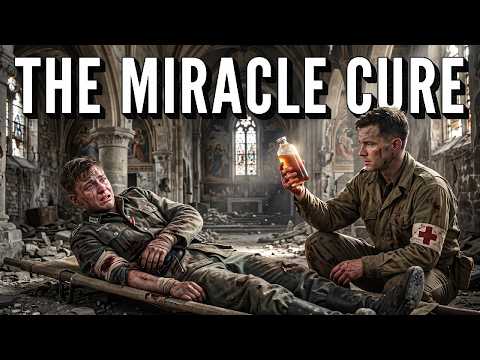
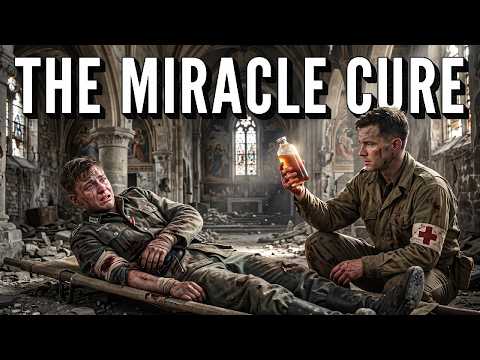
February 1945. The Hürtgen Forest has finally been cleared, and the Allies are pushing deep into the Rhineland. Inside a bombed-out village church, an American forward aid station operates at absolute maximum capacity. The air is thick with the smell of ether, copper blood, and boiling water. Two American medics carry a stretcher through the shattered oak doors. On the canvas lies a 19-year-old German infantryman. His right leg has been shredded by shrapnel. He is pale, sweating, and rapidly going into shock.
For the last three days, this boy’s commanders told him that the Americans were merciless gangsters who executed prisoners and left the wounded to rot in the mud. When his own German medics saw his leg, they gave him a paper bandage and left him behind. In the brutally pragmatic triage system of the collapsing Third Reich, a severely wounded man was a waste of resources. The boy is terrified. He begs in broken English to see a doctor, fully expecting to be dragged into an alley and shot, or simply pushed into a corner to bleed to death.
Instead, an American surgeon, his apron covered in blood, walks over. He doesn’t ask for the boy’s rank. He doesn’t ask for intelligence. He simply looks at the wound, barks an order to a nurse, and grabs a pair of shears.
Within seconds, the boy’s shredded uniform is cut away. A needle is slipped into his arm. A glass bottle of warm golden fluid—human blood plasma—is hoisted above his head. Another medic injects him with a massive dose of morphine. And then, the surgeon pulls out a small glass vial of a strange cloudy liquid the German boy has never seen before: penicillin.
As the pain instantly melts away and the warm plasma surges into his freezing veins, the German soldier stares up at the vaulted ceiling of the ruined church. He begins to weep. Not from the pain, but from the absolute world-shattering shock. His own empire had left him to die in the dirt. His enemy was currently spending a small fortune to save his life.
To understand the psychological devastation this caused among captured German troops, you must look at the deeply opposing medical philosophies of the Axis and the Allies. By the winter of 1944, the German Medical Corps was suffering from the same logistical starvation as the rest of the Wehrmacht. But it was also poisoned by the dark, underlying ideology of the state. The German system operated on a ruthless interpretation of survival of the fittest. Medical care was heavily prioritized for the slightly wounded—men who could be patched up and shoved right back into the meat grinder. If a soldier was catastrophically wounded, administering precious morphine or anesthesia to him was seen as a waste of materials on a lost cause.
Across the lines, the United States viewed military medicine through a radically different lens. To the Americans, saving a life was not just a moral imperative. It was the ultimate flex of logistical supremacy. The US military believed that if you drafted a young man from Kansas, you owed him the greatest medical care the industrial world could produce. They didn’t just build tanks. They mass-produced miracles.
For years, the German Ministry of Propaganda had painted the United States as a chaotic, soulless, capitalist machine. They assured their soldiers that an army of factory workers could never possess the deep, spiritual brotherhood of the German military. Because of this propaganda, the German high command assumed American medics would be cowards under fire, and American doctors would be overwhelmed by the carnage of modern war. They failed to realize that the United States had completely revolutionized battlefield survival.
The Americans pushed highly trained surgeons directly to the front lines. They standardized the mass collection, freezing, and shipping of blood plasma across the Atlantic Ocean. And most terrifyingly for the Germans, the Americans had weaponized the greatest medical breakthrough of the 20th century: penicillin. While German soldiers were dying by the thousands from simple mud-borne infections, their limbs amputated with wood saws and no anesthesia, American GIs were being injected with a miracle drug that stopped gangrene in its tracks.
When these two realities collided in the brutal winter of 1944 and 1945, the friction was absolute. German front-line units were disintegrating. Their supply lines were severed. A German soldier wounded in the snow knew that a bullet in the gut was a guaranteed agonizing death sentence. They watched their comrades die screaming in the mud because there was no morphine left. But when German soldiers were captured or overran American positions, they stumbled into a completely alien world of medical abundance. They saw American medics running directly into machine gun fire to drag wounded men to safety. They saw fleets of heated ambulances waiting behind the lines. For a starving, freezing German soldier suffering from infected wounds, capturing an American medical kit was like finding treasure. The syrettes of pure morphine and the sterile bandages were worth more than gold.
Inside the ruined church, the American surgeon works with terrifying speed. He is tying off arteries and packing the German boy’s shattered leg with sulfa powder. There are wounded American GIs in the room. Some are moaning in pain. The German boy, his mind clouded by morphine, looks at the American soldiers. He expects them to demand that the doctor stop treating the enemy. He expects them to drag him off the table.
Instead, an American infantryman with a bandaged head sitting on a nearby pew simply lights a Lucky Strike cigarette, walks over, and places it between the German boy’s lips. The psychological collapse is instantaneous. The German boy realizes that everything he has been taught about his own racial superiority and the cruelty of the Americans is a lie. He is looking at a glass bottle of blood plasma—plasma that was donated by an anonymous civilian in New York, shipped across a submarine-infested ocean, driven across a contested beachhead, and delivered to a ruined church in Germany, all so a frontline surgeon could pump it into the veins of an enemy soldier.
The infantryman doesn’t say a word. He just nods once, pats the boy’s shoulder with a grimy hand, and limps back to his pew. The German boy draws on the cigarette, and the smoke mixes with the ether in his lungs. He has not eaten in two days. He has not slept in four. And now, for the first time since the war began, someone has touched him without the intent to harm.
Beside him, a nurse with blood-caked hands is threading a fresh suture. She is maybe twenty-two. She catches him staring and offers a tired, crooked smile. “You’re gonna keep that leg, kid,” she says, as if she were telling him the weather. He doesn’t understand the words, but he understands the tone. It is the tone his mother used when he was small and feverish.
The surgeon steps back from the table, peels off his gloves, and drops them into a bucket. He says something to a medic and points at the boy’s leg. The medic nods and begins wrapping the wound in clean white gauze. Not the paper bandage his own corpsmen had slapped on him. Real gauze. Layers of it. The kind of dressing that costs money. The kind of dressing that assumes the leg is worth saving.
Outside, the artillery is still grumbling somewhere to the east. But inside the church, the rhythm is different. The medics move with a kind of practiced calm, like men who have done this a thousand times and expect to do it a thousand more. There is no shouting, no panic, no officers demanding to know the boy’s unit or his mission. Just the quiet clink of instruments, the hiss of a sterilizer, the low murmur of men comparing hometowns.
Then the boy notices something that makes his stomach turn over. In the corner, a young American soldier is dying. He has a wound in his chest, and the blood is bubbling at his lips with every breath. Two medics are working on him, but their hands are slowing. They know. The surgeon glances over, and something passes across his face—a flicker of grief, quickly buried. He turns back to the German boy and continues his work.
The boy understands, with a clarity that cuts through the morphine, that he has been placed in the same line as that dying American. The same triage. The same calculation. And in that calculation, he was not discarded. He was not ranked below the enemy. He was simply a wounded man, and the math said he could be saved.
A medic returns with a tin cup of hot coffee and holds it to the boy’s lips. It is bitter and sweet at the same time, and it burns his tongue. He drinks it all. The medic grins and says something the boy doesn’t catch, then points at the cigarette, now burned down to a stub. The boy takes one last drag and lets the medic pluck it from his fingers.
He thinks of his father, who told him the Americans were soft. He thinks of his sergeant, who said the enemy would shoot a wounded man as soon as look at him. He thinks of the paper bandage, and the mud, and the long cold hours of waiting to die.
And then he thinks of nothing at all, because the morphine has finally won. His eyes close. The last thing he sees is the nurse’s crooked smile, and the last thing he hears is the surgeon’s voice, calm and steady, moving on to the next table.
When he wakes, the church is quiet. Grey light filters through the shattered roof, and the artillery has moved east. His leg is still there—heavy, throbbing, but there. A blanket has been tucked around his shoulders, and someone has left a half-tin of cold peaches on the pew beside him.
He learns the war’s end the way the whole world did: in fragments, in rumor, in the sudden silence of guns. The Americans move him through a chain of field hospitals and then a POW camp in the Rhineland, where the barbed wire is loose and the guards are bored. He is fed three times a day. His dressing is changed every morning. No one asks him for his rank. No one asks him for intelligence.
In the camp, he meets other Germans—boys from the Volkssturm, veterans of the SS, a former tank driver from the Ruhr. They sit around a stove at night and argue about the Reich, about Hitler, about who knew what and when. But the argument always circles back to the same strange fact: the enemy had healed them. “They gave me penicillin,” one of them says, and the words hang in the air like a confession.
Years later, when the boy is an old man with a limp and a garden, he will tell his grandchildren about the church. He will tell them about the surgeon’s shears, the warm plasma, the cigarette placed between his lips by a man who had every reason to hate him. He will not tell them about the ideology, or the Führer, or the thousand small cruelties that led him to that stretcher. He will tell them only about the bottle of blood that came across an ocean to save a boy who had been taught to hate the people who sent it.
He will hold up his hand and say: “They did not defeat us with bombs. They defeated us with mercy. And that, my children, is the hardest weapon of all.”
But the old man is not the end of the story. The story is still being written, in every war, in every field hospital, in every choice between the paper bandage and the real gauze. So ask yourself: if you were the surgeon, would you have picked up the shears?
Report this article
Select a reason for reporting:






