The cold October morning light sliced through the tall windows of the Hartford historical archive, casting long shadows across Dr. Sarah Mitchell’s desk. At 42, she had spent two decades studying Victorian photographs, but her heart still raced as she opened a box marked 1868. Inside, wrapped in yellowed tissue, lay dozens of images—each a frozen moment of lives long gone. She picked up the first with gloved hands, feeling the weight of history. It was a family portrait: a stern father, a mother in a high-necked dress, two teenage boys, and a small boy seated in a velvet chair. Something about the seated child made her pause.
His posture was unnaturally rigid, his hands resting on his knees like a doll’s. And his eyes—they didn’t focus on anything. A chill ran down Sarah’s spine. She had seen that look before. She enlarged the image on her computer, her hands trembling. On a dark wooden table beside the boy, barely visible in the shadows, sat a small wooden horse and a folded letter. This wasn’t just a family photo. It was something darker.
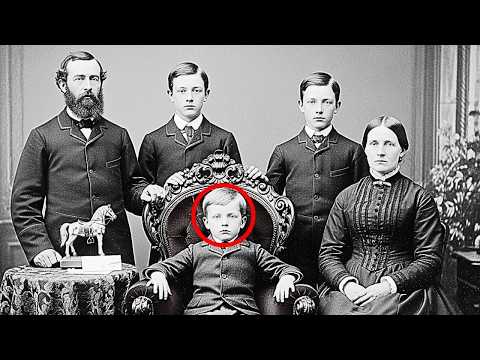
Sarah couldn’t shake the image during lunch. She sat in a café two blocks away, picking at her salad while staring at the digitized photo on her tablet. The waitress, a young redhead named Emma, asked if everything was okay. “Just distracted with work,” Sarah forced a smile. But under the natural light, the photo seemed even more disturbing. The seated boy’s skin had an unnatural pallor, and there was no sign of movement—something inevitable in children, even with the long exposures of 1868. But that boy was perfectly still.
She returned to the archive at 2 p.m., climbing the worn stone steps. Mrs. Dorothy Chen, the 70-year-old receptionist, looked up over her glasses. “Back quickly today.” “Found something interesting, Dorothy. I need access to Hartford death records between 1867 and 1869.” Dorothy smiled. “Ah, another one of your investigations. Section D, shelf six.” Sarah knew every corner of the archive. She walked quickly between tall shelves, the familiar smell of old paper filling her lungs. She pulled three leather-bound volumes and carried them to her table.
She opened Death Records, Hartford County, 1868. The yellowed pages contained hundreds of names in faded ink. Children—so many children. Infant mortality was devastatingly high. She stopped on the March page. Her finger froze. Thomas Williams, son of Jonathan and Elizabeth Williams. Born April 14, 1860. Died March 8, 1868. Cause: scarlet fever. Age: seven years and 11 months. Sarah’s stomach tightened. She picked up the photo again. The handwriting on the back read: Williams family, March 1868. Coincidence? Unlikely.
Below Thomas’s name was a smaller note: Memorial photograph commissioned. Photographer: Mr. Augustus Whitmore, Church Street. There it was—the confirmation. The next morning, Sarah woke before her alarm, the boy’s face haunting her dreams. She barely touched breakfast and was back at the archive by 8:30, carrying her laptop and camera. The morning assistant, Marcus, waved. “Starting early, Dr. Mitchell?” “I have an important investigation.” She needed Hartford business directories from the 1860s.
Business directories were gold mines. She found the 1868 volume and flipped to photographers. Whitmore, Augustus J. Photography and Portraits. Specialty in family and memorial portraits. Church Street, 45. Established 1862. The word memorial confirmed everything. She photographed the page and searched old newspapers. An 1867 advertisement in the Hartford Courant read: We preserve your most precious memories with dignity and respect. Special services available for families in mourning. Coded language for postmortem photography.
At 11 a.m., Sarah grabbed her coat and walked 15 minutes to Church Street, a narrow road lined with 19th-century brick buildings. Number 45 was now a café called The Roasted Bean. She entered, the aroma of coffee and warmth enveloping her. A young barista with lavender hair smiled. “What can I get you?” “A cappuccino, please. Can I ask a strange question? Do you know how long this café has been here?” “About 10 years, but the building is much older. The owner said it was some kind of studio before—photography, I think.” Sarah’s heart accelerated.
At 2:15, an elderly woman entered—short white hair, glasses on a chain, a green wool coat. The barista discreetly waved to Sarah. She approached. “Excuse me, ma’am. I’m Sarah Mitchell, a historian. I heard you know the history of this building.” The woman smiled. “I’m Patricia Holloway. My late husband was president of the local historical society. Please sit down.” Sarah explained her research. Patricia’s eyes shone with interest. “Augustus Whitmore. Of course I know that name. He was well known for his work with… the more difficult photographs.” “Photographs of the dead?” “Exactly.”
Sarah mentioned the Williams family. Patricia’s face changed—something moved in her expression. “Jonathan and Elizabeth Williams?” Sarah felt a shock. “Yes. Do you know them?” Patricia nodded slowly, her hands trembling as she picked up her teacup. “I know their story. It’s one of Hartford’s saddest.” She stirred her tea slowly. “The Williams family lived on Maple Street in a two-story white wooden house with blue shutters. My grandfather knew Jonathan. They worked together at a textile factory near the Connecticut River.”
Patricia paused, her eyes distant. “Jonathan was a good man, hardworking. He immigrated from England in 1855. He met Elizabeth here, a local girl from an Irish family. They married in 1856. They had three children: Robert, the eldest, then Michael, and lastly Thomas, born in 1860.” Sarah shivered at the name. “Thomas was special—a joyful child, curious, always asking questions. He loved horses, dreamed of working in a stable. Jonathan promised to buy him a real horse when he turned 10.” Patricia wiped her eyes. “He never reached 10.”
“Scarlet fever,” Sarah murmured. “Yes. It was in the winter of 1868, one of the harshest Hartford had ever seen. Thomas began feeling ill in late February. First a sore throat, then high fever, the red rash. Elizabeth cared for him day and night, but medicine was limited. He died at home on the morning of March 8th, just before dawn. He was only seven.” Patricia closed her eyes. “My grandfather said the funeral was on a terrible day—snow and strong wind. Jonathan carried the small coffin in his arms. Elizabeth didn’t stop crying.”
The café seemed to grow quieter. “But there’s more,” Patricia continued. “Elizabeth couldn’t accept that Thomas had gone. She insisted on a photograph. She wanted a postmortem photograph.” Sarah nodded. “Jonathan initially refused—he thought it was morbid. But Elizabeth begged. She said they had no photograph of Thomas. Photographs were expensive, and they had always postponed it. Now it was too late. This would be their only chance to have an image of their son, to prove he had existed.”
Patricia paused. “Jonathan gave in. Three days after the funeral, they went to Augustus Whitmore’s studio. They brought Thomas, dressed in his best Sunday clothes. They also brought Robert and Michael. Elizabeth insisted it be a complete family photograph—all together one last time.” Sarah’s throat tightened. “And the objects on the table?” “The wooden horse was Thomas’s favorite toy. Jonathan had carved it himself, working nights after his factory shift as a Christmas present. Thomas took it everywhere.”
“And the letter?” Sarah barely whispered. Patricia took a deep breath. “The letter was from Thomas. He had written it to Jonathan a few months before becoming ill. He was learning to write. It said: ‘Dear Papa, thank you for the horse. When I grow up, I will buy a real horse for you, too. With love, Tommy.'” Sarah felt hot tears streaming down her face. She didn’t try to stop them. “Elizabeth placed both objects on the table during the photograph,” Patricia said softly.
Sarah sat in silence, processing everything. “What happened after the photograph?” she finally asked. Patricia sighed deeply. “Elizabeth never recovered. She became a shadow of herself—stopped eating, stopped caring for the house, spent hours staring out the window as if expecting to see Thomas playing in the yard.” “Depression,” Sarah murmured. “Today we’d recognize it as complicated grief, severe depression. In those days they called it melancholia, and there was no real treatment.”
Patricia paused to drink more tea. “Robert and Michael suffered too. Robert, the eldest, was 15. He took on extra responsibilities, trying to be strong for his mother. But inside he was shattered. Michael was 12—he and Thomas were closer in age, played together constantly. After Thomas’s death, Michael became quiet, withdrawn. Once, my grandfather found him in the cemetery sitting beside Thomas’s grave, talking to him as if he were alive.” Sarah felt a tightness in her chest. The tragedy had radiated pain throughout the entire family.
“The photograph hung in the living room,” Patricia continued. “Elizabeth looked at it every day, sometimes for hours. She said it was her way of keeping Thomas alive. Jonathan began to worry—he thought the photograph was preventing her from moving forward. He suggested removing it once, but Elizabeth reacted with a fury no one imagined she still possessed. She screamed that he wanted to erase Thomas. Jonathan never mentioned it again.”
Outside, rain began to fall, soft drops beating against the café window. “Months passed. But in the Williams house, time seemed to have stopped in March. And then in November 1868, everything got worse.” Sarah leaned forward. “What happened?” Patricia’s hands tightened around her teacup. “Elizabeth began having visions—or at least that’s what she said. She claimed she saw Thomas in the house, playing with his wooden horse, running up the stairs. She talked to him, prepared food for him, left his chair at the table as if he would sit there. Jonathan was terrified. He called the family doctor, who diagnosed Elizabeth with severe hysteria and recommended rest and isolation.”
“Isolation?” Sarah’s voice carried horror. “In those days, it was a common treatment for women considered hysterical. Keep them in dark rooms, away from stimuli. Today we know it was cruel and ineffective. Jonathan didn’t want to do that to Elizabeth, but he was desperate. He converted the extra bedroom into a sort of infirmary. Elizabeth spent most of her time there, but my grandfather said she didn’t rest. She lay there staring at the ceiling, whispering Thomas’s name repeatedly.”
“How long was she like that?” “Weeks. And then in December, shortly before Christmas, Elizabeth disappeared.” Sarah felt her stomach freeze. “Disappeared? How?” “One morning, Jonathan woke up and she wasn’t in bed. Her shoes were gone, as was her shawl. It was December—there was snow on the ground, temperatures below freezing. Jonathan woke Robert and Michael, and the three went out searching. They scoured the neighborhood, asked neighbors, went to the cemetery.” Patricia paused, her eyes welling up.
“They found her three hours later in the cemetery, lying on Thomas’s grave. She was unconscious, freezing. Jonathan carried her back home, called the doctor. She survived, but something had changed irreversibly. She had tried to… die, probably. Or maybe she just wanted to be close to Thomas. We’ll never know for certain because Elizabeth never spoke again after that day.” The silence between them was heavy as lead. “She remained in a catatonic state for weeks. Jonathan hired a nurse to care for her at home, spending all the family savings. Robert and Michael did what they could, but the sadness in the house was suffocating.”
Sarah wiped tears silently. “And after? Did Elizabeth recover?” Patricia looked directly into Sarah’s eyes. “She recovered enough to function, but was never the same person. And the family? Well, the family eventually disintegrated in ways no one could have predicted.” The rain intensified outside, drumming against the café windows. Patricia glanced at the clock—past 4 p.m.—but showed no hurry to end the conversation. Sarah realized this story was important to Patricia too, a way of honoring memories long forgotten.
“When Elizabeth finally emerged from her catatonic state in January 1869, she had fundamentally changed. She spoke, ate, performed basic household tasks, but it was as if an essential part of her had died in that cemetery. She functioned mechanically.” Sarah nodded, recognizing symptoms of severe depression with dissociative features. “My grandfather described her as a porcelain doll that someone had forgotten to bring to life. She prepared breakfast but never ate. She washed clothes but left them wet in the basin. She looked at Jonathan and the boys without really seeing them.”
Patricia stirred her tea, cold for a long time now. “Jonathan tried to keep the family together, but it was like holding sand between his fingers. He worked extra shifts to pay medical bills. Robert, at 16, now worked full-time at a hardware store, barely attending school. Michael withdrew further into himself, spending hours alone in his room. The photograph remained on the living room wall. Elizabeth still looked at it, but now with a blank stare, as if looking through it rather than at it.”
“The house on Maple Street became known in the neighborhood as a place of sorrow. Children avoided walking past it. Women whispered about poor Elizabeth Williams at church.” Patricia took a breath, her voice trembling. “In the spring of 1869, Jonathan made a decision. He couldn’t continue like this. The family was drowning financially and emotionally. He had a cousin in Philadelphia who owned a small printing business and offered him a job—better pay, a fresh start, a chance to escape the memories that haunted every corner of Hartford.”
“They left. Jonathan wanted to, but Elizabeth refused. She said she couldn’t leave Thomas. She visited his grave every day, talked to him, brought flowers. The idea of moving to Philadelphia, of being hundreds of miles away from his burial site, was unbearable to her.” Sarah felt her heart break. “What did Jonathan do?” “He made an impossible choice. He took the job in Philadelphia and left Robert with him. Michael stayed in Hartford with Elizabeth, living with Elizabeth’s sister Margaret, who had recently been widowed. He split the family. He had no choice. They were destitute, drowning in debt. The Philadelphia job was their salvation. Jonathan sent money back every month for Elizabeth and Michael’s care. He visited when he could, but trips were expensive and time-consuming.”
Patricia’s voice grew softer. “The years that followed were difficult for everyone. Jonathan and Robert built a new life in Philadelphia. Robert eventually married a local girl and had children. Jonathan remarried in 1875 to a widow named Catherine who owned a boarding house. He never forgot Elizabeth or Thomas, but he chose survival over grief.” Sarah absorbed this, understanding the impossible position Jonathan had been in. “And Elizabeth and Michael in Hartford?”
“Elizabeth lived with her sister Margaret until her death in 1883. She was 47. The official cause was pneumonia, but my grandfather said she had simply given up living. She spent 15 years existing, not living. Margaret cared for her with devotion, but Elizabeth never truly came back from that December morning in the cemetery.” “Did she ever see Jonathan again?” “A few times. He visited perhaps once or twice a year. The visits were awkward, painful. They had become strangers bound by shared tragedy. Michael would later tell people that watching his parents sit in the same room, unable to truly speak to each other, was more painful than their separation.”
Patricia paused to wipe her eyes with a handkerchief. “Michael grew up essentially without parents. Margaret did her best, but she had her own struggles. Michael finished school, became an apprentice to a carpenter, and eventually opened his own small furniture shop. He married at 25 to a woman named Ann, and they had two daughters.” “Did he stay in Hartford?” “His whole life. He visited Thomas’s grave every week without fail, even as an old man. He kept the wooden horse that had been in the photograph. It sat on his mantel until the day he died in 1924. He never spoke much about his childhood, about Thomas, about the photograph. His daughters knew only fragments of the story.”
Sarah felt tears on her cheeks again. “And Robert in Philadelphia?” “Robert had a successful life in material terms. He became a manager at his uncle’s printing business, had four children, lived comfortably. But my grandfather, who knew Robert’s son, said Robert carried a sadness that never left him. He blamed himself for leaving Michael behind, for not being there when his mother needed him. He visited Hartford only twice after leaving—once for Elizabeth’s funeral in 1883 and once for Michael’s wedding in 1885.”
“Did the brothers remain close?” Patricia shook her head sadly. “They exchanged letters occasionally, but the distance—geographical and emotional—was too great. They had been torn apart by tragedy and circumstances, and they never truly found their way back to each other. When Robert died in 1911, Michael traveled to Philadelphia for the funeral. It was the last time the Williams brothers were together, and even then it was over Robert’s casket.”
The café had emptied considerably. Only a few customers remained, and the barista was quietly cleaning tables. “What happened to the photograph?” Sarah asked. Patricia smiled faintly. “That’s where the story comes full circle.” She leaned back, her expression distant yet peaceful. “When Elizabeth died in 1883, Margaret found the photograph still hanging in Elizabeth’s room. She had looked at it every single day for 15 years. Margaret couldn’t bear to throw it away—it felt like erasing Thomas’s existence entirely—so she kept it.”
Sarah listened intently, her historian’s mind already connecting the dots. “Margaret passed it to Michael when she died in 1891. Michael hung it in his furniture shop in a small back office where he did his bookkeeping. His wife Ann thought it was morbid having a postmortem photograph displayed like that, but she understood. Thomas was Michael’s brother, and that photograph was the only image of them all together.”
“Did Michael’s daughters know the truth?” “Eventually, when they were old enough, Michael told them the story—about Thomas, about the scarlet fever, about how their grandmother had loved Thomas so much that grief consumed her. The photograph became a family artifact, a reminder of love and loss intertwined.” Patricia took a sip of her tea, grimacing slightly. “Michael died in 1924. His daughter Ruth inherited the photograph. Ruth had always been fascinated by family history, and she preserved it carefully. She researched, found Thomas’s grave, had it maintained. When Ruth died in 1967, her son donated several family items to the Hartford Historical Society, including the photograph. He didn’t know its full significance—to him, it was just an old family picture. And that’s how it ended up in the archive.”
“Yes,” Sarah said softly. “It sat in storage for decades, just another artifact among thousands, until I found it yesterday.” They sat in silence for a moment. Sarah looked at the photograph on her tablet, seeing it now not just as a historical curiosity, but as a monument to love, grief, and the unbearable weight of loss. “The wooden horse and the letter,” Sarah said, “what happened to them?” “Michael kept both until he died. They were buried with him at his request in the same cemetery as Thomas. He wanted to return them to his brother in a way. Ruth told people that her father’s last words were about Thomas—that he hoped they would play together again the way they used to before the fever came.”
Sarah felt her throat tighten. “That’s beautiful and heartbreaking.” “That’s grief,” Patricia said simply. “It changes everyone it touches. Jonathan chose survival and built a new life. Elizabeth chose memory and was consumed by it. Robert carried guilt. Michael carried love and sadness in equal measure. There’s no right way to grieve, Sarah. There’s only survival in whatever form it takes.” Sarah nodded, understanding profoundly.
“Thank you for telling me this story, Patricia. I’ll make sure it’s properly documented—that the Williams family isn’t forgotten.” “That’s all we can do for the dead,” Patricia said, standing slowly. “Remember them. Tell their stories. Make sure they mattered.” They exchanged contact information, and Patricia left the café, disappearing into the rainy afternoon. Sarah remained seated, looking at the photograph on her screen. Five people frozen in time—two parents, three sons, one of them dead—all bound together by love and loss.
She would write the story. She would document it thoroughly, contextualize it within the broader history of Victorian mourning practices, examine the social and emotional landscape of 1868 Hartford. But more than that, she would honor the Williams family—Jonathan, Elizabeth, Robert, Michael, and especially Thomas, the seven-year-old boy whose death rippled through generations. Sarah saved her notes, packed her laptop, and walked out into the rain. Somewhere in Hartford, in the Old Grove Street Cemetery, Thomas Williams rested beside his brother Michael. The wooden horse and the letter finally returned to him after more than a century. And in the Hartford historical archive, their photograph waited—a silent testament to the family that loved, lost, and somehow, despite everything, endured.
Three weeks later, Sarah stood in the Old Grove Street Cemetery, the October wind tugging at her coat. She had found the grave at last—a modest stone, its letters softened by a century of rain: Thomas Williams, 1860–1868, Beloved Son. Beside it, a newer marker for Michael, who had waited fifty-six years to rejoin his brother.
She knelt and placed a small wooden horse—a careful replica she’d carved herself—against the headstone. It felt foolish and right all at once. “You mattered,” she whispered. “All of you did.”
That evening, Sarah typed the final line of her article and paused, her fingers hovering over the keys. Somewhere in Philadelphia, Robert’s descendants still carried a sadness they couldn’t name. Somewhere in Hartford, a photograph waited for the next pair of curious eyes.
She pressed save. The story was no longer hers alone.
Have you ever discovered a family secret hidden in an old photograph—and did you dare to uncover the truth behind it?
Report this article
Select a reason for reporting:






