On any given morning in 1865, somewhere along 363 miles of ditch water and limestone, 25,000 mules were walking. Each pair harnessed in tandem, connected to a canal boat by a length of Manila rope, pulling 30 tons of cargo at the speed of a man’s stride. And each pair was led by a boy. A boy between 8 and 14 years old, barefoot on a towpath, earning 50 cents a day to keep America’s freight moving from Albany to Buffalo and back again.
This is the story of the Erie Canal’s mule-powered freight system. Not the canal itself, not the governors and engineers who get the credit in the history books, not the politicians who shook hands at the ribbon cutting. This is about the animals and the children who actually made the thing work for 93 years, from 1825 to 1918. And what it cost them.
But to understand what those mules and those boys were doing on that towpath every morning, every afternoon, every night, for nine decades, you have to understand the problem they were solving. And the problem was simple. It was also, by every measure available at the time, impossible.
In 1800, the United States had a geography problem that threatened to split the young republic in half before it had even figured out what it was. The Appalachian Mountains ran like a stone wall from Maine to Georgia. Everything east of that wall was connected to the Atlantic Ocean, to Europe, to money, to markets. Everything west of it was connected to nothing but itself. A farmer in Ohio could grow enough wheat to feed a city. But the cost of getting a single barrel of that flour across the mountains to New York City was more than the flour itself was worth.
Overland freight by wagon ran about 32 cents per ton per mile on the best roads available. A ton of goods traveling from Buffalo to New York City, roughly 363 miles of rutted turnpike and mountain switchback, would cost over $100 in shipping alone. The goods themselves might be worth 80. Nobody ships at a loss. Not then, not now.
So, the wheat stayed in Ohio. The lumber stayed in Michigan. The iron stayed in Pennsylvania. And the coast, where the people and the ports and the money were, imported what it needed from Europe at European prices. The mountains were a wall, and for the first quarter century of the Republic, there was no door through them.
The canal was supposed to be that door. Governor DeWitt Clinton of New York staked his entire political reputation on digging a ditch across the full width of the state, connecting the Hudson River at Albany to Lake Erie at Buffalo. 363 miles of artificial waterway, 40 ft wide at the surface, 4 ft deep, carved through forest and swamp and solid rock, with 83 locks to raise and lower boats across the 600-ft elevation change between the Hudson Valley and the Great Lakes Basin.
When Clinton first proposed it to Thomas Jefferson, Jefferson called it little short of madness. And Jefferson had a point. The United States in 1817 had exactly zero professional civil engineers. It had no earth-moving equipment beyond the shovel, the pick, and the wheelbarrow. It had no precedent whatsoever for a public works project of this scale. The longest canal in America at that time was 27 miles. Clinton was proposing 363.
They dug it anyway. With shovels and axes and black powder, with Irish and German immigrants who cleared forest at the rate of 1 mile per month, and moved dirt by the wheelbarrow load, with local farmers who signed on during the seasons they were not planting. It took 8 years and $7 million and more than a thousand men who died of malaria in the Montezuma marshes, of blasting accidents in the limestone cuts near Lockport, of collapses and drownings and infections that had no name and no cure. The canal was built on their labor, and many of them are buried alongside it in graves that were never properly marked.
The Erie Canal opened on October 26th, 1825. Governor Clinton poured a barrel of Lake Erie water into the Atlantic Ocean at New York Harbor, and the newspapers up and down the coast celebrated what they called the wedding of the waters. Cannons fired in sequence along the canal route, each one triggered by the sound of the last. A chain of explosions stretching from Buffalo to Manhattan. It was the most ambitious public works project the young nation had ever attempted, and it was done.
But a canal with no boats is a ditch. And a canal boat with no power is a barge.
The boats were too heavy to pull against any current. The canal was too shallow and too narrow for sails to work reliably. Steam engines existed, and they were getting better every year. But a steam vessel on the Erie Canal created a wake that eroded the earthen banks, and the banks were the canal. Destroy the banks, and you destroy the waterway. The state of New York banned steam-powered vessels from the canal for most of its operating history.
So, the question became, what pulls the boats? Not horses. Horses were tried in the early years. They are faster than mules, and they look better in harness. But a horse on a towpath is a liability. Horses are prone to panic near water. Their hooves slip on wet clay. They overheat under sustained loads. They will eat themselves to death if you let them, gorging on oats until they colic and die. And a horse that has been pulling 30 tons for 4 hours does not have the patience to pull for two more. A horse quits when a horse decides to quit. And there is nothing a 14-year-old boy can do about it.
A mule is something else entirely. The mule is the offspring of a male donkey called a jack and a female horse called a mare. It inherits the size and muscle of the horse and the patience, the endurance, the sure-footedness, and the iron stubbornness of the donkey. A mule can pull more weight per pound of its own body mass than a horse. A mule can walk in mud and on narrow paths where a horse would stumble and fall. A mule will stop eating when it has had enough. A trait so unusual among working animals that it alone would justify the crossbreed. A mule’s hooves are harder and more compact than a horse’s, better suited to packed earth and wet clay. A mule can work in heat that would drop a horse.
For the specific, grinding, repetitive job of walking a towpath for 6 hours straight, hauling 30 tons of freight through still water at 3 to 4 mph, the mule was not just the best available option. It was the only animal that could do it and survive. And so the demand for canal mules created one of the largest organized animal labor forces in American history. By 1860, at the peak of canal operations, approximately 25,000 mules worked the Erie Canal. Not worked on. Worked. As in they were the engine. They were the power plant. Without them, the most important piece of infrastructure in the United States was a very long, very expensive puddle.
These mules were not pulled at random from farm lots or bought off auction blocks. They were bred for canal work, specifically and deliberately, by mule breeders in Missouri and Kentucky who understood exactly what the canal required and who had spent decades perfecting the crossbreeding that produced it.
Kentucky breeders crossed large draft mares, usually Percherons or Belgians standing 16 hands or better, with mammoth jack donkeys imported from Spain and France. The result was an animal that stood 14 to 15 hands high, weighed over 1,000 lb, and possessed a temperament that bordered on mechanical. Steady, unflappable, capable of walking the same pace for 6 hours without variation, without distraction, without protest.
The breeders called this trait being canal broke, and it took years of selective breeding and training to produce consistently. A canal mule was not born ready. It was engineered through generations of crossbreeding, then trained on towpaths near the breeding farms before being shipped east to the canal. The breeders in Missouri and Kentucky treated this the way any manufacturer treats a precision product. They knew the specs. They delivered to them.
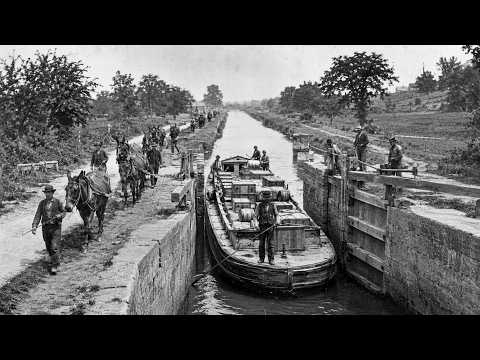
The mules worked in pairs, always, harnessed in tandem formation, with the lead mule in front and the wheel mule directly behind. A heavy manila rope, typically 250 ft long, connected the harness to the bow of the canal boat. The rope had to be long enough to allow the mules to walk the towpath on one side of the canal while the boat floated in the center of the channel. It had to be strong enough to handle the constant drag of 30 tons of water resistance without snapping. And it had to be flexible enough to be slackened and dropped into the water when another boat approached from the opposite direction.
This maneuver was called giving way. The boat traveling empty gave way to the boat traveling loaded, and the hoggee driving the empty boat’s mules had to slacken the rope, let it sink beneath the surface, and wait for the loaded boat to pass over it. Then he pulled the rope taut again and resumed walking. When both boats were loaded, the right of way disputes could turn violent. Fist fights on the towpath were common. Broken noses, split lips, the occasional cracked rib. These were considered a normal part of doing business on the canal.
The shift cycle was 6 hours on, 6 hours off. Every canal boat carried two pairs of mules. One pair worked the towpath while the second pair rested in a mule stable built into the forward section of the boat. The stable was cramped, dark, and close, smelling of hay and sweat, and the particular musk that clings to a mule after hours of work.
When the 6-hour shift ended, the hoggee stopped the working pair, unharnessed them, walked them onto the boat via a narrow gangplank, led the rested pair off the boat and onto the towpath, harnessed them to the tow rope, and resumed. The boat never stopped moving except at locks and loading docks. This meant the canal operated essentially around the clock, 7 days a week, from the April thaw to the November freeze.
Day and night, boats gliding through the water, the only sounds the groan of rope under tension, the rhythmic thud of mule hooves on packed earth, and the occasional shout of a boy somewhere ahead in the dark telling his team to keep walking.
That boy, those boys, we need to talk about them now because the mules could not walk the towpath without someone to lead them. They were called hoggees, a word that probably comes from a corruption of the phrase on the hog, meaning to ride the mule, though the true origin has been lost to time and nobody living can say for certain.
A hoggee was a boy, almost always between 8 and 14 years old, hired from immigrant families or from farming communities along the canal route. Irish families mostly, though German and Welsh families also sent their sons. The pay was 50 cents a day plus food. The food was whatever the boat captain’s wife cooked in the galley of the canal boat, which typically meant salt pork, cornbread, beans, and black coffee strong enough to strip paint.
The hoggees lived either on the canal boats themselves, sleeping in the cramped forward quarters alongside the off-duty mules, sharing the smell of animal sweat and hay and manure in a space no bigger than a closet, or in mule barns at canal stops along the route, where they would sleep on hay bales and wait for the next boat that needed a driver.
Fifty cents a day. In the 1840s and ’50s, a laborer on the New York docks earned a dollar to a dollar fifty. A hoggee earned half that for work that was longer, harder, and immeasurably more dangerous. But for a family with six or eight children and a father already working every hour God sent, that 50 cents mattered. It fed the younger ones. It kept the rent paid through winter. And all it cost was one boy walking a towpath, 6 hours at a stretch, 20 to 30 miles a day, alongside a pair of thousand-pound animals in the dark, in the rain, in the mud, on a path barely 4 ft wide with canal water on one side and a drainage ditch or a rock face on the other.
The hoggees were not supervised in any meaningful way. The boat captain was on the boat, 60 ft of water behind the mules. The hoggee was on the towpath, sometimes close enough to hear a shouted instruction, sometimes around a bend and out of sight entirely. If a mule balked, the boy handled it. If the rope fouled on a snag or a bridge piling, the boy cleared it.
These were eight-year-old children, maneuvered by government, making judgment calls about thousand-pound animals and 30-ton loads in conditions that would test a grown man’s nerve. The towpath itself was packed earth in dry weather, a surface worn smooth and hard by decades of hooves. In rain, it became ankle-deep mud that sucked at bare feet and hid the ruts that could turn an ankle.
The boys walked it barefoot more often than not. Their feet cracked and bled and calloused over and cracked again. Their hands blistered from the lead rope. The Manila hemp that connected mule to boat was a rough fiber and a single shift of holding it could strip the skin from a 12-year-old’s palm.
But the feet and the hands healed. The water did not forgive.
The Erie Canal was 4 ft deep along most of its route. That does not sound like enough water to kill a child. But a boy who falls into a canal at 3:00 in the morning, exhausted from his fifth hour on the towpath, tangled in 250 ft of wet Manila rope with a pair of mules still walking forward and a 30-ton boat still drifting on the current behind him, that boy is not swimming. He is being dragged.
The rope pulls tight across his chest or his legs. His wet wool clothing soaks through and doubles in weight within seconds. The water is black and cold and there is no lantern and no one on the towpath to see him go in. If the mules do not stop, and mules at 3:00 in the morning on a dark towpath do not stop unless a human voice commands them to stop, the boy goes under and he stays under.
The records are incomplete. They always are when the dead are poor and young and their families lack the standing to demand an accounting. But the best estimates from canal historians and from the archives of the Erie Canal Museum in Syracuse suggest that at peak operations, roughly one hoggee drowned per week during the canal season. One boy per week, April through November, year after year, for decades.
Some drowned in the canal channel itself. Some fell under mule hooves on the towpath and were kicked or dragged into the water. Some were crushed between the boat hull and the stone walls of lock chambers during coupling maneuvers. Some simply disappeared from the towpath between one canal stop and the next. Their absence noted only when the boat captain arrived at the dock and had to hire a replacement.
Most of them are buried in small cemeteries along the canal route in towns like Syracuse, Rome, Utica, and Lockport. Their graves are unmarked or marked with field stones that have long since weathered past reading. Some were buried by their families who came to claim the body if they could afford the trip. Some were buried by the canal towns where they washed up. Some were never recovered from the water at all.
I want to say their names. I cannot. The records do not hold them. What the records hold are incident reports filed by boat captains with the canal authority. Coroner’s notes from canal town physicians. Occasional mentions in weekly newspapers with circulations of a few hundred. A boy drowned near Syracuse. A boy trampled at Lockport. A boy fell between the boat and the lock wall at Cohoes. The names, when they appear at all, are first names only or last names misspelled by clerks who did not ask twice or simply the word boy followed by an estimated age.
This is the grief I carry when I walk the towpath. Not anger at the system. Not outrage at the captains or the parents or the state legislators who profited from the tolls. Grief. Simple grief for children who did the work that made the nation’s commerce possible and whose lives were not considered worth the cost of a proper headstone. They deserve to be remembered with dignity even when we cannot remember them by name.
If you have been with me this far into the story, I think you understand why I tell it. This channel exists to remember the people the history books left out. If that matters to you, subscribing is the simplest way to make sure these stories keep reaching the people who want to hear them.
But the canal did not stop for grief. The canal did not stop for anything except ice.
The lock system was both the engineering marvel and the daily grind that defined life on the water. 83 locks along the 363 mile route, each one a stone chamber designed to raise or lower the water level so a boat could pass between two stretches of canal at different elevations. The total elevation change between Albany and Buffalo was roughly 600 ft. And those 83 locks covered every foot of it. One chamber at a time.
For the mule teams, each lock meant uncoupling. The hoggee had to halt the mules at the lock approach, detach the 250 ft tow rope from the harness, walk the mules past the lock chamber on the towpath while the boat was floated in and the water level adjusted by the lock keeper. Then recouple the rope on the far side and resume walking. 83 times between Albany and Buffalo.
Each uncoupling and recoupling consumed 10 to 20 minutes depending on the lock, the condition of the rope, the weather, and whether the mules decided to cooperate or stand their ground. A full transit of the canal took roughly 6 days. 6 days of walking, uncoupling, waiting, recoupling, walking again. The repetition ground down the body. The labor never paused long enough to feel like rest.
The locks at Lockport were the most spectacular on the entire route and the most feared by the hoggees who had to manage their teams through them. Five locks in sequence, stacked like a stone staircase. Raising the canal 60 ft in less than a quarter mile. The water volume required to fill and empty each chamber was enormous. The noise of it, thousands of gallons pouring through wooden sluice gates, echoed off the limestone walls of the Niagara Escarpment and could be heard a mile away on a still morning.
For the hoggees, Lockport meant five consecutive uncouplings and recouplings in rapid succession, managing nervous mules through crowds of waiting boats, and the general shouting chaos of the busiest lock complex on the canal.
The mule barn at Lockport is still standing. It operates today as a museum, and I have stood inside it. You can still find the harness rings bolted into the barn rafters, where the mule teams were tied between shifts. The iron is rusted, but it holds firm when you grip it. The wood beams overhead are hand-hewn, marked with the flat strikes of a broad axe, cut from timbers more than 150 years ago. The stalls are narrow, barely wide enough for a mule to turn around in. The floor is stone, worn into shallow bowls by the weight of hooves standing in the same spot shift after shift, year after year.
When you stand in that barn and look up at those rings, when you wrap your hand around the iron and feel the cold of it even in summer, when you think about the 25,000 animals that were tied in barns like this one up and down 363 miles of canal, resting for 6 hours before walking another 20 miles through the dark, the scale of the operation settles on you like a physical weight.
By 1850, the system was moving 1 million tons of freight per year. 1 million tons. Through a ditch 40 ft wide and 4 ft deep, pulled by mules at walking pace, managed by children earning 50 cents a day, the canal had dropped freight costs from 32 cents per ton per mile by wagon to less than 2 cents per ton per mile by water. That single number reshaped the economic geography of the entire continent.
Ohio wheat reached New York City at a price that undercut European imports for the first time. Michigan timber flowed east to frame the houses and the factories of the growing seaboard cities. Pennsylvania iron traveled the canal to foundries in Albany and Troy, and was forged into the tools and machines of American industry. The tolls alone generated revenue that exceeded the entire federal budget of the United States in some years.
And because all of that freight emptied into the Hudson River and then into New York Harbor, the city sitting at the river’s mouth became the largest, richest, most commercially important port in the Western Hemisphere. New York City did not become New York City because of Wall Street or Ellis Island or manifest destiny. It became New York City because of a ditch and 25,000 mules and a generation of barefoot boys who walked beside them.
There was one of those boys who refused to stay forgotten. His name was Sam Patch and he was born around 1807 in the canal country of Western New York. He spent his childhood as a hoggee leading mule teams along the towpath the way 10,000 other boys did. The work was the same. The danger was the same. The 50 cents was the same.
But Sam Patch had something the other boys did not. He was fearless around water in a way that went past courage into something closer to compulsion. While other hoggees feared the canal and the dark water and the rope that could drag them under, Sam swam in the canal for sport. He dove from lock walls to amuse himself between shifts. He jumped from towpath bridges into the channel below, surfacing with a grin that made the other boys think he was either the bravest person they had ever met or the craziest.
As he grew older, Sam Patch left the canal and became something America had never quite seen before. A professional daredevil. He began jumping from factory dams in Pawtucket, Rhode Island, where he worked in a cotton mill after leaving the canal. He jumped from cliffs at Niagara Falls twice and survived both times. Crowds gathered by the thousands to watch the canal boy hurl himself through empty air and hit the water and come back up alive. He became famous. Not wealthy. Not respectable in the way that mattered to the newspapers, but famous. They called him the Yankee Leaper. He called himself Sam Patch, and he said it like it was the only title he needed.
In 1829, Sam announced that he would jump into the Genesee Falls at Rochester, New York. A drop of nearly a hundred feet into churning white water at the base of the falls. On November 6th, thousands of spectators lined the gorge. Sam Patch, the former hoggee, the canal boy who had walked the towpath barefoot and survived the rope and the mules and the dark water that killed so many others, climbed to the edge of the falls. He looked down, and he jumped.
He hit the water cleanly. He surfaced. The crowd roared. Sam Patch had beaten the Genesee Falls.
But Sam was not finished. He announced a second jump. Higher this time. On November 13th, 1829, Sam climbed to a platform built 125 feet above the Genesee River. The crowd was larger than before. The weather was colder. Witnesses later said that something went wrong halfway down. His body went limp. His arms, which had been pressed tight to his sides the way a practiced jumper holds them, suddenly flailed outward. He struck the water off balance and at an angle. He did not surface.
His body was not recovered until the following spring, when it was found frozen in the ice at a bend in the river several miles downstream. Sam Patch was 22 years old. He had spent roughly half his short life on the canal, walking the towpath, sleeping in mule barns, earning his 50 cents. And he had spent the other half trying to prove that the fearlessness the canal had hammered into him was worth something more than a day’s wages and a plate of beans.
He is buried in Charlotte, New York, near the mouth of the Genesee River where it empties into Lake Ontario. His grave marker reads, Sam Patch, famous jumper. It does not mention the Erie Canal. It does not mention the mules. It does not mention that he was a hoggee. But I mention it because that is where he learned to stop being afraid of water. And the water killed him anyway.
The system that shaped Sam Patch and that the water eventually took him from continued growing after his death. Through the 1830s, ’40s, and ’50s, the canal was enlarged twice to handle increasing traffic. The channel was widened to 70 ft and deepened to 7 ft, accommodating larger boats that could carry heavier loads. The mule teams grew in proportion. More animals bred on the farms of Missouri and Kentucky. More hoggees hired from the immigrant neighborhoods of canal towns. More rope. More freight. More of everything except safety or rest or recognition.
But the railroads were coming. And the railroads did not need mules or boys or towpaths.
The decline was not sudden. It was generational, the way the canal itself had been built. Through the 1860s and ’70s, railroad networks expanded across New York and the Midwest, connecting the same cities the canal connected, but doing it faster. The canal could not match speed. 3 to 4 mph is remarkably efficient when you are pulling 30 tons through water with no fuel cost beyond oats and hay, but it is agonizingly slow when a steam locomotive covers the same 363 miles in less than a day.
Shippers who valued speed chose rail. Shippers who valued low cost per ton chose the canal. For a generation, there was room for both. But as rail technology improved and freight rates dropped, the canal’s cost advantage narrowed and then disappeared.
Freight volumes on the Erie Canal peaked in the 1880s and then began a long, steady, irreversible decline. The mule teams shrank year by year. The hoggees aged out of the work and were not replaced by younger boys because the work was disappearing. The specialized canal mule, bred for decades in Missouri and Kentucky for towpath temperament and 6-hour endurance, gradually disappeared as a distinct type. The breeders shifted their stock toward general farm mules and urban draft animals because the market for canal mules no longer existed.
By the early 1900s, traffic on the old Erie Canal had dropped to a fraction of its peak. The state of New York began converting sections of the waterway into the New York State Barge Canal System, which used motorized vessels and did not require mule teams or towpaths at all.
The last mule-drawn boat on the Erie Canal completed its final trip in 1918, 93 years after Governor Clinton poured Lake Erie water into the Atlantic. 93 years of mules walking towpaths in tandem, 6 hours on, 6 hours off. 93 years of boys in the dark. Done.
But something survived the mules and the boats and the boys. A song.
In 1895, a songwriter named Thomas Allen composed a tune called Low Bridge, Everybody Down. Allen was not a canal man himself. He was a vaudeville and Tin Pan Alley composer working out of New York City. A man who made his living turning American life into music that other Americans would pay to hear. But Allen had grown up hearing stories about the Erie Canal, and he had enough ear for the real thing to capture something that the engineering reports and the freight statistics and the political speeches never could. He captured the rhythm of the work itself.
The low bridges that crossed the canal at dozens of points along the route were built cheap and built low, barely clearing the deck of a loaded canal boat. When a boat approached one of these bridges, the shout went up from whoever saw it first. Low bridge, everybody down. The hoggee ducked. The steersman ducked. Anyone standing on the deck of the boat got down fast or got knocked into the canal. It happened dozens of times a day, every day, for decades. The phrase became a reflex, a piece of language that belonged to the Erie Canal the way a bell belongs to a church steeple.
Allen turned that reflex into music. Slow music. Steady music. Music that moves at the pace of a mule walking a towpath, 3 miles per hour. Patient and unending.
My grandfather sang that song. He sang it the way it was meant to be sung. Not performed. Not presented. Just remembered. The way you remember something that happened to someone you loved. In a low voice, at an even pace, steady as hooves on packed earth.
I have walked the towpath at sunrise. Not the full 363 miles. But enough of it. Enough to feel the width of the path under my boots and understand why a barefoot boy could slip from it in the dark. Enough to see where the tow rope would have run from the mule harness to the bow of the boat, stretched taut over black water, humming with the tension of 30 tons. Enough to stand at a lock chamber and rest my hands on the stone walls and imagine the water rising around a wooden hull while a 12-year-old boy outside the chamber held two mules steady with a rope in his bleeding hands and waited for the lock keeper’s shout to recouple and start walking. Again.
I have stood inside the mule barn at Lockport and wrapped my hand around the harness rings and felt the rust come off on my skin. I have knelt on the stone floor and traced the shallow depressions where mule hooves wore the same stone down in the same spot, shift after shift, for decades. I have tried to imagine being 10 years old in that barn in November. In the dark before dawn. With the mules breathing heavy beside me and the smell of hay and sweat in the cold air, waiting for a boat captain I had never met to hire me for 50 cents and a plate of salt pork and beans.
I cannot fully imagine it. But I can stand in the place where it happened and hold still and let the weight of it press down until I feel something close to understanding.
25,000 mules at the peak. Tens of thousands of boys across 93 years of operation. 1 million tons of freight per year by 1850. 83 locks. 6 hours on, 6 hours off. 50 cents a day plus food. One boy per week who did not come home.
If you have stayed with this story from the first mule to the last, you understand something that most people will never take the time to learn. That the greatest infrastructure achievement of 19th century America was not run by its engineers or financed by its bankers or celebrated by its politicians. It was operated day after day, night after night, April through November for nearly a century, by mules and children. And it worked. It worked so completely that it built the most commercially important city in the Western Hemisphere and connected half a continent to the markets of the world. It worked so well that we forgot how it actually worked. We forgot the mules. We forgot the rope. We forgot the boys.
If this is the kind of history that matters to you, the kind that remembers the people at the bottom of the ledger and grieves the ones whose names the ledger never bothered to record, I would be grateful if you subscribe to this channel. Not for the numbers. For the work itself. There are more stories like this one waiting. They deserve to be told by someone willing to walk the ground and touch the iron and say the names that remain.
The towpath is quiet now. The canal in most places has been filled in, paved over, or converted into something modern and clean and entirely different from what it was. But in certain stretches, particularly between Syracuse and Rochester, the original path remains. The ground is packed hard in places where a century of hooves compressed the earth beyond what grass or weeds or even tree roots can fully reclaim.
In the early morning, when the light is flat and gray and the mist sits low on the old canal bed like a memory that will not lift, you can close your eyes and almost hear it. The creak of hemp rope under 30 tons of tension, the steady patient thud of hooves on clay, the voice of a boy somewhere ahead in the fog telling his mules to keep walking.
The rope is gone. The boats are gone. The boys are gone. The mules are gone. But the path is still there. Pressed into the earth by the weight of everything that once moved through this place. And if you walk it early enough in the morning before the joggers and the cyclists arrive, before the modern world presses itself back down over the old one, you can feel it under your feet. The compression of a hundred thousand hooves, the patience of animals who never complained, the silence of children who were never asked if they were afraid.
They only knew the next mile. And then the next. And then the next.
Low bridge, everybody down.
But here is the part that stays with me. The canal did not vanish because it failed. It vanished because it succeeded so completely that something faster could replace it. The mules did not stop walking because they were weak. They stopped because the world no longer needed them to walk. And the boys, the hoggees, the ones whose names we will never know, they did not stop because they chose to. They stopped because the towpath went silent, and there was no one left to shout the order to keep moving.
The last hoggee on the Erie Canal died an old man in some canal town, and nobody wrote down his name. He walked the path as a boy, slept in the barns, held the rope, feared the water, and outlived the world that made him. When he died, the canal was already a memory, a ditch with no boats, a path with no hooves. But somewhere in his last years, in the quiet of an evening, he must have heard it. The creak of the rope. The thud of the hooves. The voice of a boy ahead in the dark. And he must have remembered that he was once part of something that moved the world, even if the world never knew his name.
So when you walk the old towpath, and you feel the hard-packed earth under your feet, and you hear the wind in the trees and imagine it is the sound of rope and hooves and boys, remember this. The canal was built by men who died in the marshes. It was run by mules that were bred for the work. And it was led by children who were never asked if they were afraid. They only knew the next mile. And then the next. And then the next.
That is the story of the Erie Canal. Not the engineers. Not the governors. Not the politicians. The mules and the boys. And the path they walked into history.
What do you think? Should we remember the ones whose names were never written down, or is it enough to remember the canal itself? Let me know in the comments.
Report this article
Select a reason for reporting:






