January 3rd, 1945. The conference room at SHAEF headquarters in Versailles was a pressure cooker of egos and desperation. Outside, a bitter wind lashed the palace grounds, but inside, the real storm raged between Charles de Gaulle, Winston Churchill, and Dwight Eisenhower. The fate of Strasbourg—and the entire Western Alliance—hung by a thread.
Two days earlier, over 100,000 German soldiers had smashed into American lines in Alsace. The offensive caught Allied command reeling. They were still fighting the Battle of the Bulge in the Ardennes. Now, Hitler had opened a second front, and Eisenhower had ordered the abandonment of Strasbourg, a city French soldiers had bled to liberate just six weeks earlier. De Gaulle was furious. “If American forces withdraw, French forces will defend Strasbourg alone,” he threatened, vowing to pull his entire army out of Allied command.
Churchill understood what Eisenhower didn’t: this wasn’t about military logic. It was about 400,000 French civilians who would face Nazi reprisals, and a nation’s soul. After hours of argument, Eisenhower relented. Strasbourg would be defended. But none of it would have mattered if there had been no line to hold.
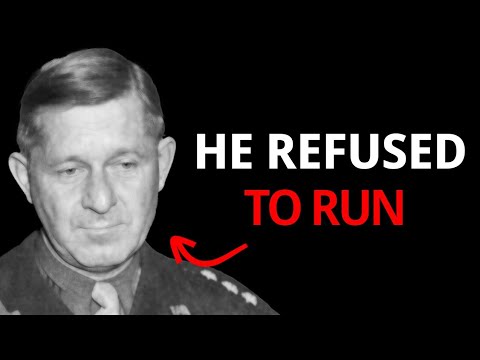
Because while Eisenhower panicked and de Gaulle threatened, one American general had already refused to retreat. His name was Jacob Devers, and he was the only general ready for Operation Nordwind.
December 16th, 1944. The same day German forces launched their massive offensive in the Ardennes, Jacob Devers was in his headquarters in Vittel, France, commanding the Sixth Army Group. His force held the southern end of the Allied line from the Vosges Mountains to the Swiss border. Devers had been fighting since August, racing 450 miles north in 30 days, liberating Marseille, Lyon, and Strasbourg. By November, he stood on the banks of the Rhine—the first Allied commander to reach it.
Devers wanted to cross. He had identified a crossing point at Rastatt, north of Strasbourg, where German defenses were thin. A quick thrust could establish a bridgehead and unhinge the entire German southern front. On November 24th, he laid out his plan to Eisenhower. “Cross the Rhine now while the Germans are disorganized,” he urged. Eisenhower said no. The Supreme Commander wanted a broad front approach, no single army group racing ahead. Devers was ordered to clear the west bank and eliminate the Colmar Pocket instead. He was furious but obeyed.
What Devers didn’t know was that his obedience would soon be tested in ways he never imagined. When the German Ardennes offensive hit, Eisenhower pulled divisions from every sector to reinforce the Bulge. Devers was ordered to stretch his already thin lines to cover Patton’s abandoned front. Suddenly, the 7th Army was responsible for 126 miles of front—some units holding sectors 20 miles wide, when doctrine said no more than 5. Devers knew what that meant: if the Germans attacked his exposed front, he would be in serious trouble.
On December 19th, Eisenhower summoned his commanders to Verdun. After the meeting, he pulled Devers aside. German forces were massing opposite the 7th Army. Another offensive was coming. Eisenhower’s solution: retreat. Pull back from exposed positions, shorten the lines, give up ground to create reserves. Be prepared to withdraw all the way to the Vosges Mountains. Devers argued against it—his men had fought hard for that ground, and abandoning Strasbourg would be a political catastrophe. Eisenhower didn’t care. He gave Devers a direct order: prepare contingency plans for withdrawal.
Devers flew back to his headquarters. He called in his commanders. He told them about the threat and Eisenhower’s orders. Then he did something remarkable. He decided to fight.
December 24th, 1944. Christmas Eve. While American soldiers in the Ardennes froze in foxholes, Devers’ intelligence officers delivered a warning. German radio traffic had spiked. Prisoner interrogations mentioned new units. An attack was imminent. Unlike other commanders who relied solely on SHAEF intelligence, Devers had developed his own network. His G-2 staff had tracked at least 17 German divisions massing for assault, including the 6th SS Mountain Division and the 21st Panzer Division. This was not a local counterattack. This was a major offensive.
On December 26th, SHAEF confirmed the attack would come within days. But Devers didn’t wait for permission. He ordered Patch to pull back exposed units to intermediate positions—not all the way to the Vosges, but to defensible terrain. He identified the Moder River as his main defensive line. He stripped units from quiet sectors to create mobile reserves. He ordered newly arriving divisions—the 42nd, 63rd, and 70th—to send their infantry regiments forward immediately, organizing them into ad hoc task forces. He was creating reserves that didn’t exist on paper, finding strength where SHAEF saw only weakness.
Most importantly, Devers refused to abandon Strasbourg. He shifted his lines so the French First Army would take responsibility for the city’s defense, freeing American units to face the German attack. It was a calculated gamble. He was technically complying with Eisenhower’s orders to prepare for withdrawal while actually positioning his forces to stand and fight. If the gamble failed, his career was over. If it succeeded, he might save the entire southern front.
New Year’s Eve, 1944. 11:00 p.m. In frozen foxholes across Alsace, American soldiers waited. General Patch had forbidden celebrations—he didn’t want Germans attacking hungover troops. The waiting ended at midnight. German artillery opened fire along an 80-mile front. Thousands of shells slammed into American positions. Nebelwerfer rockets lit up the night sky. Then came the infantry. Then came the tanks. Operation Nordwind had begun.
Three days earlier, at his headquarters at Adlerhorst, Hitler had addressed his commanders. “This attack has a very clear objective,” he told them. “Namely, the destruction of the enemy forces. It is a matter of destroying and exterminating the enemy forces wherever we find them.” Two German army groups attacked simultaneously. Army Group G, under General Johannes Blaskowitz, struck from the north through the low Vosges Mountains. Army Group Oberrhein, commanded by Heinrich Himmler himself, attacked from the Colmar Pocket in the south.
Himmler had no military experience. He had commanded concentration camps, not combat units. But Hitler trusted him, and Hitler had promised him a prize: that the swastika would fly over Strasbourg Cathedral by January 30th. The goal was not merely to recapture territory. It was to destroy the American Seventh Army entirely. Then a follow-up operation code-named Zahnarzt would strike into the rear of Patton’s Third Army. If successful, the entire Allied southern flank would collapse.
The initial assault hit Task Force Hudelson, a scratch force of cavalry squadrons and armored infantry holding the seam between XV Corps and VI Corps. The Germans infiltrated through fog and thick forests without artillery preparation. By morning, they had penetrated ten miles into American lines.
At Wingen-sur-Moder, the 6th SS Mountain Division—veterans of brutal fighting in Finland and Russia—slammed into the 45th Infantry Division. In savage close-quarters combat, the SS troops destroyed an entire battalion of the 157th Infantry Regiment. The town changed hands multiple times. At Bitche, four Volksgrenadier divisions pushed through the mountains, threatening to cut the vital road to Strasbourg.
By January 5th, the initial German assault had created dangerous salients throughout the American front. But it had not broken through. And now Devers’ preparations began to pay off. The mobile reserves he had created plugged gaps as they opened. The 45th Division bent but did not break at Wingen. The task forces he had formed from newly arrived divisions rushed to threatened sectors. American artillery, pre-positioned on commanding heights, hammered German columns on the narrow mountain roads. The Germans had expected the Americans to crumble. Instead, they found an enemy that fought back immediately.
January 7th, 1945. The Germans committed their exploitation force. The 21st Panzer Division and 25th Panzergrenadier Division, held in reserve for the breakthrough that never came, were thrown into battle anyway. They struck south from Wissembourg toward the villages of Hatten and Rittershoffen. What followed was one of the most brutal engagements of the entire Western Front.
For two weeks, German and American soldiers fought street by street, house by house, sometimes room by room. Tanks dueled at point-blank range. German Flammpanzers incinerated Maginot Line bunkers with American soldiers still inside. American tank destroyers stalked Panthers through rubble-choked streets. The 79th Infantry Division, veterans of Utah Beach, held Rittershoffen. The 14th Armored Division fought in Hatten. By day, the Americans held one end of each village. By night, the Germans held the other. The front line ran through kitchens and cellars.
Colonel Hans von Luck, commanding a regiment of the 21st Panzer Division, later wrote that the fighting at Rittershoffen was one of the hardest and most costly battles he ever experienced. And von Luck had fought at El Alamein. He had fought at Kursk. He had fought in Normandy. In the cellars beneath the fighting, 1,500 French civilians huddled in the darkness, praying for survival. When the battle finally ended, ninety percent of both villages had been destroyed. The burned-out hulks of 31 American Shermans, nine Stuart light tanks, and 51 German tanks and assault guns littered the streets and fields. Eighty-three civilians died in Hatten alone. But the Germans had not broken through.
January 15th, 1945. The situation had become desperate. The US VI Corps was now fighting on three sides. German forces had established a bridgehead across the Rhine at Gambsheim, just ten miles from Strasbourg. Another column was pushing through the Haguenau Forest. At SHAEF headquarters, Eisenhower was terrified. He saw his worst nightmare materializing. The Seventh Army was being encircled. If it collapsed, the Third Army’s flank would be exposed. The entire Allied position in Western Europe could unravel.
Eisenhower sent another message to Devers. “Pull back now. Fall behind the Vosges. Give up everything.” And once again, Devers refused. He knew something Eisenhower didn’t. He knew his men were holding. He knew the German attacks were losing momentum. He knew that every day the Seventh Army stood, more reinforcements arrived from the Ardennes, where the Bulge was finally collapsing.
Devers shifted his forces again. He pulled the battered 79th Infantry Division and 14th Armored Division out of Hatten and Rittershoffen and withdrew them to the Moder River. This was not the retreat Eisenhower wanted. It was a tactical adjustment that shortened the lines while maintaining a solid defensive position. The Moder River became the final stand.
Eisenhower, still demanding a full withdrawal, grew furious. He accused Devers of disloyalty. He threatened to relieve him. General Walter Bedell Smith, Eisenhower’s chief of staff, called Devers and delivered a blistering message. The Supreme Commander believed Devers was deliberately defying orders. Devers held his ground. He trusted his judgment. He trusted his soldiers. And he trusted Alexander Patch, who was fighting one of the great defensive battles of the war with almost no recognition.
January 25th, 1945. The 222nd Infantry Regiment of the 42nd Infantry Division stopped the final German assault at Haguenau, earning a Presidential Unit Citation. That same day, reinforcements from the Ardennes finally arrived. The 101st Airborne Division, fresh from Bastogne, moved into position along the Moder River. Hitler personally ordered Operation Nordwind halted. His last offensive in the west had failed.
Strasbourg remained in Allied hands. The Seventh Army had not been destroyed. The Third Army’s flank was secure. The Western Alliance held together. The cost was terrible: roughly 15,000 American casualties, over 23,000 German. But without Devers, the losses would have been catastrophic. Had Eisenhower’s withdrawal been executed, the Germans would have retaken Strasbourg and positioned themselves to strike Patton’s rear.
In March, Devers’ Sixth Army Group crossed the Rhine. On May 5th, 1945, he accepted the unconditional surrender of Army Group G. Yet history barely remembered Nordwind, and Eisenhower ranked Devers 24th of 38 generals. Marshall, however, understood—pushing through Devers’ promotion to full general, dated ahead of Bradley and Patton.
Devers later wrote: “You can kill a willing horse by overdoing what you require of him.” He was right. But he found a way to win anyway. When every instinct told his superiors to retreat, he trusted his soldiers to stand.
Was Jacob Devers the most underrated general of World War II? Share your thoughts below.
Report this article
Select a reason for reporting:






