In 1944, he was in the Gestapo in Rome. For every German soldier killed, ten Italians were to be executed. But children were killed. No, no boy of fourteen was killed. The words hung in the air, a chilling denial that would echo through decades. As the Third Reich crumbled in 1945 and the Nuremberg trials promised justice, a clandestine movement had already begun. Thousands of Nazi officers, scientists, and high-ranking officials were vanishing from Europe, armed with forged passports and safe-conduct documents issued by religious institutions, consulates, and sympathetic governments.
While Berlin reduced to rubble, the ports of Genoa and Barcelona became launch points to a new destination: Juan Domingo Perón’s Argentina. Fueled by anti-communist rhetoric and the collaboration of sectors of the Catholic Church, the Argentine government facilitated visas and documents on humanitarian grounds. Through these roots traveled Adolf Eichmann, the organizer of the deportation of millions of Jews; Erich Priebke, responsible for the Ardeatine Caves massacre; and Josef Mengele, the doctor of Auschwitz. They all entered with Red Cross passports and the approval of Argentine authorities.
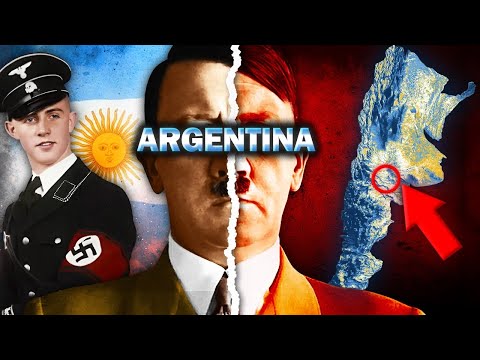
Between 1946 and 1950, more than 3,000 former members of the Third Reich were allowed into the country, blending into German communities, industries, and schools under new identities. This documentary reveals the political, diplomatic, and religious network that turned Argentina into the largest Nazi refuge after the war. It also unveils the “March Journey,” the Argentine SS officer who paved the way for the Nazi escape.
To understand how the secret network that allowed hundreds of Nazi officials to flee to South America was organized, one must focus on a pivotal figure: Carlos Fuldner. Born in Argentina, Fuldner was an officer in the Nazi SS. His arrival in Europe in the final months of the war and his subsequent return to Buenos Aires explained the origins of the structure that later facilitated the escape of men of the Third Reich.
Amid the collapse of Nazi power, Fuldner knew how to deal with the remnants of a regime seeking to secure a future outside Germany. In this turmoil, security offices became hotbeds of conspiracy and distrust. Ernst Kaltenbrunner, head of the RSHA, and Walter Schellenberg, responsible for foreign espionage, exchanged accusations of hiding money in Switzerland and Austria to ensure their survival. Forged documents proliferated, and SS officers forged civilian identities to evade their crimes.
In this chaotic climate, Fuldner stood out for his ability to build relationships and provide secret exits for those who could pay the price. Hence, his talent for deception found fertile ground. As a polyglot with a wide network in European trade, he realized the value of mobility and identity. His Argentine origin made him a natural intermediary between German agents and the support networks forming in Madrid. There, in Franco’s neutral capital, figures like the Belgian Pierre Daye and the Frenchman Charles Lesca, both with a collaborative past and ties to Nazi intelligence, shared refuge and contacts with diplomats aligned with the Axis.
Little by little, what began as a series of services turned into a system. From Spain to Buenos Aires, a carefully interwoven network extended. In the following years, this structure, encouraged by the political leanings of Juan Domingo Perón’s government and influential sectors of the Church, enabled the secret transfer of war criminals from Europe to South America. But it all began with that secret journey in March 1945 and a man who saw in the collapse of the Reich an opportunity to rise again.
This ability to rise again had deep roots. When Carlos Fuldner arrived in Madrid, he was no stranger to the world of deception or exile. Years earlier, he had tasted the bitterness of his own actions. Accused of fraud, desertion, and embezzlement within the Nazi SS, he was humiliatingly expelled and imprisoned. The death’s head ring he wore, symbol of his membership in the core of the SS, was melted down in a humiliation reserved for those deemed unworthy of the black uniform. However, that fall was not the end. After his release and partial exoneration, he tried in vain to regain his rank, and since then, he lived his life in hiding, moving between countries, names, and flags.
From that moment, his path became obscure. Post-war Allied reports barely managed to reconstruct his trajectory. He was known to have traveled through South America, worked as a translator in Franco’s Blue Division, and returned to Berlin several times. He also worked for “Sofindus,” the economic network that financed secret German operations in Spain. But even there, his character betrayed him. He was dismissed from his job on charges of embezzlement.
With the collapse of the Third Reich, Fuldner continued to move freely across the continent with suspicious ease, transporting money and documents, and according to some records, shipments of stolen artworks destined for the black market. This constant mobility kept him in the spotlight. His return to Madrid in late 1944 coincided with the last attempts by German intelligence to establish survival networks outside Europe. After regaining his rank and carrying both Argentine and German passports, Fuldner arrived on a special mission for Himmler’s secret intelligence service.
In the following weeks, he met with diplomats of the Reich and contacted his old acquaintances, the Belgian Pierre Daye and the French journalist Charles Lesca, both Nazi collaborators seeking refuge. The British later confirmed that he belonged to the Sicherheitsdienst (SD). Under the protection of Francoist aristocrats and his former comrades in the Blue Division, Fuldner hid in private residences and estates near El Escorial. The Spanish police pretended to search for him while he changed addresses, moving between Madrid and Catalonia. He even appeared in social circles, mingling with bullfighters and prominent figures of high society. Despite Allied pressure, he managed to remain free, cementing his reputation as a born survivor.
Amid this network of relationships, his real work began. He coordinated operations with other exiled agents, including Charles Lesca, a veteran propagandist, also born in Buenos Aires and closely linked to French Nazism. Lesca had fled Paris with forged documents and money provided by Berlin. From his residence in Madrid, he organized the first trips to South America, leveraging his connections with Argentine diplomats and with Perón himself, whom he had known since the 1930s. His network, supported by Francoist sectors and the Church, became the main escape route for men of the Reich. And Carlos Fuldner, as an efficient and ambitious manager, was at the heart of this mechanism.
With Perón’s victory in the February 1946 elections, the small circle of Nazi exiles in Madrid realized their moment had come. In cafes and secret apartments guarded by Franco sympathizers, there was open talk of an imminent evacuation operation to South America. Charles Lesca, who had become a central figure in the network, claimed to be in direct contact with the new Argentine president. He said he had met him in the 1930s during his trips to Buenos Aires, and that their relationship had continued through the Argentine embassy in Madrid. This alleged friendship, whether real or exaggerated, gave a decisive boost to the escape plans that had been secretly hatched for months.
During those meetings, Lesca exchanged secrets with the German spy Hans Sommer and the Francoist intelligence chief known as Pena. In meetings held between San Sebastián and Madrid, they discussed how to get the most implicated Nazi officers out of the country. One of the most urgent cases was that of General Eckart Krämer, responsible for transporting a convoy of artworks looted by Göring from France to Spain. After being betrayed, Krämer was hidden on a Spanish officer’s estate and later transferred to Argentina. Incidents like these demonstrated the effectiveness of a network supported by complicity within the army and police, who were warned of fugitives before any raids.
The plan was both precise and bold. According to Allied reports, between 150 and 200 Germans were to be transported from southern Spain, specifically from Cádiz, using forged passports and documents issued by Franco’s own authorities. The first trips began in the summer of 1946, coinciding with news of the arrival in Buenos Aires of priests and sailors who were actually former members of the SD and Gestapo. The first to test this route was another Argentine-German agent, Carlos Reuter, a purported banker with a background in German intelligence. He was arrested in Paris, then released thanks to his Argentine passport, and fled to Madrid, where Lesca entrusted him with the mission of opening the escape route. He left northern Spain from the city of Bilbao in early 1946 and arrived in Buenos Aires days before Perón’s victory. His smooth journey confirmed the feasibility of the operation on a large scale.
By mid-1946, Lesca decided to follow the same path. After bidding farewell to his associates in Madrid, he traveled to the Basque Country and from there set off for the Americas. Although briefly detained in Uruguay at France’s request, he managed to continue his journey and soon settled in Buenos Aires. There, from a modest apartment on Santa Fe Street, he continued his work under the protection of his old acquaintances in the Presidential Palace. Around him, the nucleus of a broader network began to form, a network soon to be led by Pierre Daye, the next architect of the Nazi exile operation on the southern continent.
When Pierre Daye stepped off the plane in Buenos Aires on May 21, 1947, he was concluding a journey that embodied a significant part of the secret history of the Nazi escape. This Belgian journalist, intellectual, and diplomat, who had met Hitler, Ribbentrop, and Pius XII, arrived at the Río de la Plata with an altered identity, sheltered by a regime prepared to grant asylum to the defeated Reich. But his journey was actually the culmination of a much broader operation, transforming a European collaborator into a key element in a network of exiles who wove ties between Madrid and Buenos Aires.
During the German occupation, Daye moved without scruples between Otto Abetz’s offices in Paris and the most anti-Semitic editorial rooms of the French press. At “Je suis partout,” surrounded by figures like Robert Brasillach and Lucien Rebatet, he observed how propaganda praising the persecution of Jews became official state policy. Between fiery articles and lavish dinners in fine restaurants, Daye found in that environment a mix of fascination and power, convinced he was part of a new European order.
But when the tide of war turned, that world began to crumble. In 1943, while serving as Minister of Sports in the collaborationist Belgian government, he traveled to Rome where he was received by Pope Pius XII. Daye sought to know which of the two totalitarian systems, Nazi or Soviet, the Church considered less harmful. He received no clear answers. The Vatican moved cautiously, avoiding definitions that might jeopardize its neutrality. For him, that ambiguity was proof that the fascist structure was beginning to crack.
When the Allies landed in Normandy, Daye realized that staying in Europe would be impossible. He had taken refuge in Madrid since 1944, joining the same circles that already included Charles Lesca, Carlos Fuldner, and Radogenia. In the salons of the Palace Hotel or at the tables of the Hawaii restaurant, former diplomats, propagandists, and Axis officers mingled, dreaming of rebuilding their careers across the Atlantic. Aware of his growing isolation, Daye began working as an intermediary for Belgians and Frenchmen pursued by justice, managing safe routes for them and communicating through Spanish authorities. This activity, unintentionally, made him another link in the future Argentine route.
As collaboration trials progressed in Brussels, his situation became unbearable. In December 1946, he was sentenced to death in absentia, stripped of his nationality, and subjected to international press scrutiny. From his room at the Victoria Hotel, he wrote in his diary about his feeling of gradually disappearing, friends drifting away, requests being rejected, and doors closing before him. Only a few Spanish intellectuals offered him refuge, including Eugenio d’Ors and the Marquis de las Marismas, who connected him with Argentine representatives close to Perón. Thanks to this network and the intervention of diplomat Raúl de Labougle, Daye finally obtained a visa on May 8, 1947. With a stateless passport and a new surname adapted to Spanish, he boarded a plane heading south. His journey stopped in Morocco, West Africa, and Montevideo before landing in Buenos Aires. There, Lesca and other Axis exiles, already settled under the protection of the new Peronist government, were waiting for him.
As he walked on the tarmac of Morón airport, Daye breathed in the warm southern winter air. He had escaped the grip of European justice, and without knowing it, he was about to become a fundamental element in a system that would shelter hundreds of Nazi fugitives in the coming years. Since his arrival, the network established by Fuldner and Lesca began to take its final shape. The real rescue operation had only just begun.
From Rome to Buenos Aires, the sacred network had saved the Nazis. But the paper trail was not entirely erased. In the archives, orange folders survived—fragile, damning. Priebke’s file, 211712/48, and Mengele’s, 211713/48, proved the same hand had processed them in 1948. The system was institutional, not myth.
Yet when researchers demanded access, doors closed. In 1996, a night fire behind the Immigration Office consumed Eichmann’s records, Mengele’s, and others. “The most sensitive files were burned,” a lawyer confessed. The state that had sheltered them now erased them.
Still, fragments remained in Bern, Brussels, and scattered police logs—enough to reconstruct the machinery of escape. Eichmann’s capture in 1960, Priebke’s confession in 1994, Mengele’s drowned corpse in 1979: each exposed the network’s reach.
But the archives that could condemn the architects—Fuldner, Freude, Hudal—were ash. The silence was deliberate.
If the state burned the evidence, can history still deliver justice—or does forgetting become the final refuge?
Report this article
Select a reason for reporting:






