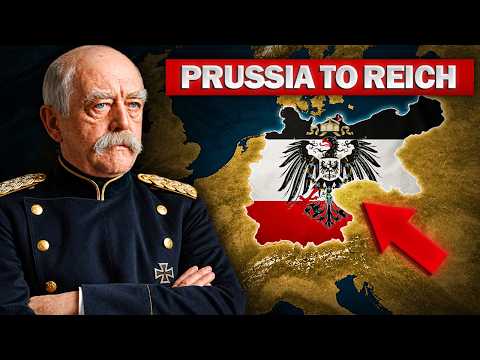
On January 18, 1871, in the Hall of Mirrors at the Palace of Versailles, a 73-year-old man stood before hundreds of German princes and generals. Snow fell outside, and the city was surrounded by occupying troops. The man was King William I of Prussia, and he was about to be proclaimed Emperor of a new German Empire. But the night before, he had wept. “Tomorrow, we will be burying Prussia,” he said. He was right—and he was wrong. That kingdom, born from the ashes of a crusade, had survived against half of Europe, risen from humiliation, and now it was dissolving into something larger that it had itself created: Germany. The consequences of that morning would echo through two world wars and beyond.
But to understand how Prussia came to dominate Germany, we must go back centuries, to a time when Prussia was not even a German state—it was a land of swamps and pine forests, inhabited by a Baltic people who spoke their own language and worshipped their own gods. Their name would be stolen, their culture erased, and their land would become the foundation of a military state unlike any Europe had ever seen.
The story begins with the Teutonic Knights, a military order of warrior monks who, in the 13th century, were invited to conquer the pagan Prussians. “The conquest lasted more than 50 years,” and it was brutal. Villages were burned, hostages executed, and those who survived were baptized, reduced to serfdom, and mixed with German settlers. By the early 18th century, the Prussian language was extinct. All that remained was the name.
Yet from that grim beginning, the Teutonic Order built something unprecedented: a state ruled by warrior monks, with a standing army and a centralized administration. That idea—a state organized around military discipline—would outlive the order by six centuries.
The turning point came in 1525, when the Grandmaster of the Teutonic Order, Albert of Brandenburg-Ansbach, converted to Lutheranism and secularized the order’s Prussian territory into the Duchy of Prussia. “He arrived as grandmaster of a religious order and rose as hereditary duke of a secular duchy,” the first state in the world to officially adopt the Protestant faith. But Prussia remained a vassal of Poland, a small and poor duchy on the fringes of Europe.
Then, in 1618, the Duchy of Prussia passed by inheritance to the Hohenzollern Electors of Brandenburg, a sandy territory around Berlin. Suddenly, a single dynasty controlled two separate lands—one inside the Holy Roman Empire, one outside it. It was an administrative oddity, but it would prove to be the seed of something far greater.
The Thirty Years’ War, which began that same year, devastated Brandenburg. “In some districts, the population fell by half or more. Fields reverted to forest. Wolves wandered into empty villages.” When Frederick William inherited this ruined territory in 1640, he was 20 years old. He had seen how the Dutch Republic survived through a professional army and efficient administration. He decided to build the same for Prussia.
What he created earned him the name “the Great Elector.” He established a standing army, paid for by regular taxes and a centralized bureaucracy. He negotiated with the Junkers, the land-owning nobility, offering them absolute power over their peasants in exchange for taxes. “In Brandenburg-Prussia, the state was beginning to organize itself around its army.”
In 1675, at the Battle of Fehrbellin, the Great Elector’s army defeated the Swedes, one of the great military powers of Europe. It was a modest battle in military terms, but it sent a clear message: a second-rate principality had just beaten a first-rate power. Prussia was no longer to be crossed.
When the Great Elector died in 1688, he left behind an army of 30,000 men and a state that commanded respect. His son, Frederick III, wanted more—he wanted a crown. In 1701, he got it, proclaiming himself “King in Prussia” (not “of Prussia,” because part of the territory still belonged to Poland). He placed the crown on his own head in Königsberg, and from that day he was Frederick I.
But it was his son, Frederick William I, who truly transformed Prussia. Known as the “Sergeant King,” he was obsessed with the army. He dismissed his father’s lavish court, sold off the silverware, and wore a plain blue colonel’s uniform every day. He poured money into the military, creating a standing army of 83,000 men—the third largest in Europe, in a kingdom of only 2.2 million people. “Where other states have an army, in Prussia, the army has a state,” the saying went.
He also created the canton system, which required peasants to serve as soldiers for part of the year, and he founded schools, centralized the administration, and left a full treasury. But he despised his son, the crown prince, who loved poetry, music, and philosophy. In 1730, the prince tried to flee to England with his friend, Lieutenant Hans Hermann von Katte. They were caught. The king ordered Katte beheaded and forced his son to watch. “Frederick cried out from the window begging forgiveness in French. Katte answered that there was nothing to forgive, that he died for him gladly.” The prince fainted before the sword fell.
That prince would become Frederick the Great. He never defied his father again. He learned to obey, to dissemble, and to wait. And when he became king in 1740, he would use his father’s army to change the map of Europe.
Within months of taking the throne, Frederick II proved that the philosopher prince was also a gambler. In December 1740, without a declaration of war, he marched his father’s immaculate army into Silesia, one of the richest provinces of the Habsburg monarchy. “Silesia was one of the richest provinces of the Habsburg monarchy, mines, looms, more than a million inhabitants,” and its young ruler, Maria Theresa, had just inherited a fragile empire. Frederick chose the exact moment of weakness.
The first great test came at Mollwitz in April 1741. Austrian cavalry swept away Frederick’s wing, and the king himself fled the field at a gallop, convinced the battle was lost. But his father’s infantry, trained for twenty-seven years, advanced in compact lines and fired at a rate the Austrians could not match. They won without him. “Mollwitz was my school,” Frederick later said. He never again abandoned a battlefield.
Two wars later, Silesia was Prussian. The kingdom had grown at a stroke in territory, population, and industry. But Maria Theresa never accepted the loss, and her chancellor, Count Kaunitz, spent the following decade preparing revenge. In 1756, Austria and France—enemies for two centuries—became allies, and Russia, Sweden, and Saxony joined them. Their declared goal was to reduce Prussia to what it had been before the Great Elector.
Frederick struck first, invading Saxony in August 1756. The Seven Years’ War had begun, and the year 1757 nearly finished him. He lost at Kolín, the Russians entered East Prussia, the Swedes landed in Pomerania, and a Franco-Imperial army advanced from the west. Near the village of Rossbach, some 41,000 allies tried to encircle his 22,000 men. Frederick let them march, then unleashed his hidden cannons and the cavalry of General Seydlitz into a column that had not even deployed. The fighting lasted less than ninety minutes. The allies lost between 8,000 and 10,000 men; the Prussians fewer than 600.
A month later, at Leuthen, Frederick faced 65,000 Austrians with 36,000 men. Under cover of morning fog, he marched the bulk of his army behind a line of low hills, leaving a visible force to convince the enemy the blow would come from the other side. When his columns appeared in successive echelons against the Austrian left flank, the line folded in on itself. By nightfall, the Austrians had lost some 22,000 men. On the frozen field, a soldier began to sing a Lutheran chorale, and thousands of voices followed him in the darkness. Germans would call it the chorale of Leuthen from then on.
Rossbach and Leuthen made Frederick a legend, but the war dragged on for five more years. At Kunersdorf in 1759, a Russo-Austrian army shattered his forces. Of some 50,000 men, by nightfall he could barely gather a few thousand. That night he wrote to his minister that he would not survive the ruin of his country and bade him farewell forever. He carried a dose of poison. His enemies did not press the victory home. Frederick called it the miracle of the House of Brandenburg.
Then, in January 1762, Empress Elizabeth of Russia died, and her successor, Peter III, admired Frederick almost to the point of devotion. He signed peace, returned everything conquered, and even offered troops to his idol. The coalition collapsed. At the Peace of Hubertusburg in February 1763, Silesia remained Prussian. Prussia had held out for seven years against Austria, France, Russia, Sweden, and a good part of the empire.
For the rest of his reign, Frederick devoted himself to rebuilding. He drained the marshes of the Oder, settled colonists, and in 1772, in the first partition of Poland, he took West Prussia—the strip that separated Brandenburg from East Prussia—and at last could call himself king of Prussia rather than merely king in Prussia. He wrote French better than German, composed sonatas for the flute, and debated philosophy with Voltaire at Sanssouci. Yet he ruled as an absolute monarch who consulted no one. He died in an armchair at Sanssouci in August 1786, asking to be buried on the terrace beside his dogs. His nephew did not carry out the wish. His final testament would take 205 years to be fulfilled.
Twenty years after Frederick’s death, his army was still marching exactly as he had left it. That was the problem. On October 14, 1806, Prussia fought Napoleon in two simultaneous battles, and the army that had withstood half of Europe disintegrated in a single afternoon. “At Jena, the emperor himself shattered a Prussian corps; at Auerstedt, Marshal Davout with 27,000 men defeated the main Prussian army, which outnumbered him two to one.” Fortresses surrendered without firing a shot. Napoleon visited Frederick’s tomb and told his generals that if that man were alive, they would not be standing there.
From that ruin, a group of reformers understood that the disaster had been structural. Baron vom Stein abolished personal serfdom. Scharnhorst and Gneisenau rebuilt the army, rotating recruits to circumvent the 42,000-man limit. Humboldt founded the University of Berlin. “Prussia survived because Tsar Alexander I wanted a buffer state between Russia and France.” In 1813, after Napoleon’s Grande Armée dissolved in the snows of Russia, Prussia rose again. At Leipzig, at Paris, and finally at Waterloo, Blücher’s army arrived on Napoleon’s flank and decided the battle.
At the Congress of Vienna, Prussia gained the Rhineland and Westphalia—a scattered burden that hid the coal of the Ruhr. In 1834, the Zollverein customs union came into force, and within two decades railways were stitching together a Germany that revolved around Prussia. In 1848, revolution swept Berlin, and the Frankfurt Parliament offered Frederick William IV a crown. He refused it as “an imaginary hoop baked from mud and clay that reeked of revolution.” A legitimate crown could only come from the princes by the grace of God.
Then came Bismarck. Appointed minister president in 1862, he delivered the sentence that would define him: “The great questions of the day will not be decided by speeches and majority resolutions, but by iron and blood.” He dragged Austria into war over Schleswig-Holstein, then turned on his partner. At Königgrätz in 1866, Moltke’s needle guns shattered the Austrian army in a single day. Austria was excluded from Germany, and Prussia annexed Hanover, Hesse-Kassel, Nassau, Frankfurt, and the duchies.
All that was needed was a war to bring the southern states to Berlin. In July 1870, the Ems telegram—edited by Bismarck to sound like a fanfare in answer to a challenge—did the trick. France declared war. At Sedan, Napoleon III surrendered his sword, and the Second Empire fell. On January 18, 1871, in the Hall of Mirrors, William I was proclaimed Emperor. “Tomorrow, we will be burying Prussia,” he had wept the night before. He was right—and he was wrong.
Bismarck governed the empire for nineteen years, weaving alliances to isolate France and creating the first national social security system in history. But William II dismissed him in 1890, and the alliances unraveled. In 1914, the Schlieffen Plan was set in motion. Four years later, the last king of Prussia crossed into the Netherlands on a special train. In 1947, the Allied Control Council abolished Prussia by decree. “The Prussian state, which from its earliest days had been a bearer of militarism and reaction in Germany, had ceased to exist in fact.” The name that the Teutonic Knights had taken from an exterminated people was left without a land once again.
In 1991, exactly 205 years after his death, Frederick the Great was buried again on the terrace of Sanssouci, beside his dogs, beneath a stone slab with no title and no inscription except his name. Today, visitors leave potatoes on it. A kingdom born from the ashes of a crusade, which rose from humiliation to dominate Europe, vanished—and yet its shadow still falls across the continent. Was Prussia a state that possessed an army, or an army that possessed a state? And when the name finally disappeared from the maps, did the idea truly die—or does it live on in the Germany of today?
Report this article
Select a reason for reporting:






