She was Elvis Presley’s only child, the sole heir to Graceland and the mythology that turned a dead rock star into an American religion. But on January 12, 2023, Lisa Marie Presley lay on the floor of her Calabasas home in cardiac arrest—just 48 hours after smiling on a red carpet beside her mother, celebrating a film about her father. The world saw a fairy tale. What they didn’t see was the private architecture of damage built over three generations, a legacy of love and loss that began in a military base in Germany and ended in a burial garden where the dead now outnumber the living.
This is the story of what Elvis Presley’s love actually cost the people closest to him—and how the name that made him a king became a curse for his daughter and grandson.
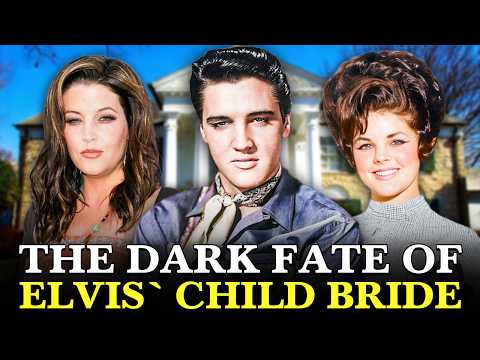
To understand how Lisa Marie ended up in that hospital, you have to go back more than 60 years to a party in Bad Nauheim, West Germany, and a girl who hadn’t yet turned 15. Elvis was 24, already a global sensation, stationed in the Army. Priscilla Beaulieu was a schoolgirl, the stepdaughter of an Air Force officer. What Elvis saw was possibility—not just beauty, but malleability. She was young enough to be shaped. He courted her with intensity, convinced her parents to let her move to Memphis at 17, and began molding her into the woman he wanted: choosing her clothes, her hair, her makeup. The heavy black liner and towering bouffant that became her signature? They were his taste, not hers.
They married in 1967 in a Las Vegas ceremony that lasted eight minutes—a press event as much as a wedding. Nine months later, Lisa Marie was born. The fairy tale seemed complete. But inside Graceland, a different reality was taking hold. Elvis was increasingly dependent on prescription drugs, his moods governing every room. Priscilla was trapped in a closed system where one person set every term. By 1971, she’d begun an affair with her karate instructor—the first autonomous choice she’d made since she was 14. When she told Elvis she was leaving in 1972, he was enraged. He wanted her, but on terms that left no room for her to become a separate human being.
The divorce was finalized in October 1973. Lisa Marie was four years old, and her family had just been divided into two addresses, two schedules, two versions of reality. She became a child of two worlds—her mother’s emerging independence and her father’s accelerating decline. By the mid-70s, Elvis was bloated, sedated, erratic. Lisa Marie visited him in a house where the most famous man in America was coming apart, surrounded by people who either couldn’t or wouldn’t stop it. She was learning that the people you love most are also the people most capable of disappearing while they are still in the room.
On August 16, 1977, Elvis’s heart stopped in the bathroom of Graceland. He was 42. Lisa Marie was nine. She was in the house when it happened. The father was gone—but what replaced him was something larger and less human: the legend. Eighty thousand people descended on Memphis. Graceland became a shrine. For a nine-year-old girl, the public grief was both validation and theft. He was no longer her father in any way that belonged to her alone. He was everyone’s Elvis.
In 1982, Priscilla made the decision that would define the family’s future: Graceland opened to the public as a tourist attraction. The house where Lisa Marie had been a child became a museum. The rooms where Elvis had lived and loved and fallen apart were roped off and narrated by tour guides. It saved the estate financially, but it meant Lisa Marie’s childhood home would never again simply be a home. It belonged to the dead.
Lisa Marie turned 25 in 1993 and inherited the estate—along with the job of stewarding a myth before she’d finished metabolizing what it meant to be his child. She tried to build a different life. In 1988, she married musician Danny Keough, a quiet man who was the opposite of Elvis in almost every way. They had two children: Riley, born in 1989, and Benjamin, born in 1992. For a while, it seemed like a departure from the pattern. But the marriage didn’t hold. They divorced in 1994, and Lisa Marie moved toward spectacle. Twenty days later, she married Michael Jackson.
The union of the King’s daughter and the King of Pop was met with global incredulity. But by her own accounts, Lisa Marie was genuinely drawn to Jackson—to his intensity, his isolation, his particular kind of damage that rhymed with her own. She had not stepped outside the logic of American myth. She had married deeper into it. The marriage lasted less than two years. Then came Nicolas Cage (108 days), then Michael Lockwood, with whom she had twin daughters in 2008. Four marriages, four attempts to build something that worked differently from the household she’d grown up in. Each time, the gravitational pull of the original pattern reasserted itself.
Meanwhile, her children were growing up inside the instability. Riley metabolized the family’s exposure by moving toward it—becoming an actress and filmmaker. Benjamin did not. He was quieter, more private, and he had inherited something more specific and more dangerous than a famous last name: he had inherited a face. From childhood, people remarked on how strongly he resembled his grandfather—the same jaw, the same eyes, the same quality of stillness. The world wanted to celebrate that resemblance. Benjamin seemed to want nothing to do with any of it.
By the summer of 2020, Benjamin was 27, living in Calabasas during a pandemic that had stripped away the ordinary social scaffolding of daily life. He was struggling—carrying the face of a grandfather he’d never met, the name of a family that couldn’t stop being famous, and whatever private pain no public source has the right to name. On July 12, 2020, a Sunday, Benjamin Keough took his own life. He was 27 years old.
Lisa Marie was destroyed. Priscilla later said Benjamin was the love of her daughter’s life—and that after his death, Lisa Marie did not want to be here anymore. She kept his body on dry ice for two months because she could not let him go. She and Riley got matching tattoos of Benjamin’s hand, the artist working in proximity to his preserved body. That detail is not sensationalism. It is the record of a grief so total that it overrode every norm.
For two and a half years, Lisa Marie endured without direction. She attended to her twins, Harper and Finley, who were 11 when their half-brother died. She continued to oversee the estate. She began working on a memoir, recording herself speaking into a device, trying to organize 54 years of experience into a shape that might be bearable. Then, on January 10, 2023, she attended the Golden Globe Awards, smiling beside her 87-year-old mother as a film about her father was celebrated. Two days later, she was dead.
The medical examiner ruled it natural—a small bowel obstruction, a complication from prior surgery. No drugs were involved in the immediate cause. But to those closest to her, the clinical explanation felt almost beside the point. The body gave out. The spirit, by Priscilla’s account, had wanted to give out since July 2020.
Lisa Marie was buried at Graceland in the meditation garden, beside her father and beside her son. The garden now holds three generations of Presleys who each, in their own way, could not escape the gravity of the name they shared. Grandfather, daughter, grandson—within feet of each other, in a garden tourists walk past every day, paying admission to stand in the presence of a grief that belongs to people they will never meet.
Riley Keough, now 36, became sole trustee of the estate. She finished her mother’s memoir. She is trying to turn inheritance into stewardship instead of repetition. Whether the pattern will break, whether the gravitational pull of the Presley story will eventually pull her into the same orbit that captured everyone before her—that is a question only time will answer. But the story of what Elvis Presley’s love cost his family is far from over.
But the story of what Elvis Presley’s love cost his family is far from over. Because the Presley pattern is not simply a psychological inheritance—it is written into the very ground of Graceland, into the meditation garden where the dead now outnumber the living, and into the legal and financial machinery that has kept the name alive for nearly half a century. To understand why the cycle repeats, you have to look at what the estate actually is: not just a house or a brand, but a system that requires its living heirs to serve as custodians of a dead man’s image. And that system has its own gravity, its own demands, its own way of consuming the people who inherit it.
When Elvis died in 1977, his estate was worth barely $5 million—after taxes, debts, and the cost of maintaining Graceland, it was nearly insolvent. It was Priscilla who saw the solution: open the house to the public. She turned a private home into a public shrine, and in doing so, she saved the family from financial ruin. But she also locked the Presleys into a permanent role: they would forever be the living caretakers of a dead legend. The house could never be sold. The name could never be retired. Every generation would inherit not just money, but a job—and a set of expectations that no one had chosen.
Lisa Marie understood this better than anyone. She was 25 when she took control of the estate, and for the next three decades, she was the public face of Elvis’s legacy. She attended the openings, approved the licensing deals, signed off on the films and the merchandise and the endless parade of tributes. She was not merely her father’s daughter. She was his brand manager, his myth-keeper, his living monument. And every time she tried to step away—into a marriage, into a new life, into some version of herself that wasn’t defined by him—the gravity of Graceland pulled her back.
That gravity is not metaphorical. It is financial, legal, and emotional all at once. The estate generates tens of millions of dollars a year, but it also carries enormous costs: maintenance on a 13.8-acre property, staff salaries, security, insurance, the constant upkeep of a museum that must remain pristine for the hundreds of thousands of visitors who arrive each year. The trust that owns Graceland is not a passive inheritance—it is a business that demands active management. And the person at the center of that business is always a Presley, always a family member, always someone whose identity is inseparable from the name.
For Riley Keough, that means something different than it did for her mother. Riley grew up in the shadow of Graceland but also outside it—split between her mother’s world of celebrity and her father Danny’s world of mattresses on the floor. She has said that she never felt entirely comfortable with the Presley mythology, that she resisted the idea of being defined by it. And yet, when her mother died, she stepped into the role. She became the trustee, the steward, the keeper of the garden. Not because she wanted to, but because there was no one else. Because the system requires a Presley at the center, and she was the last one standing.
That is the trap that has defined this family for three generations. The name is not just a legacy—it is a responsibility that cannot be refused. Elvis could not escape it, even in death. Priscilla could not escape it, even after divorce. Lisa Marie could not escape it, even when she tried to build a life elsewhere. And now Riley carries it, with her own daughter—a fourth generation—growing up inside the same gravitational field. The question is not whether the pattern will repeat. The question is whether anyone can break it without walking away from everything the family has built.
There is another dimension to this story that has never been fully explored: the role of the Memphis Mafia, the inner circle of friends and associates who surrounded Elvis for most of his adult life. These were the men who enabled him, protected him, and in many ways, isolated him from the outside world. They were his buffer against reality—and they were also the people who watched him deteriorate and did nothing to stop it. They were loyal to the king, not to the man. And that loyalty, however well-intentioned, contributed to the isolation that ultimately killed him.
After Elvis died, the Memphis Mafia scattered. Some wrote books, some gave interviews, some faded into obscurity. But their presence—and their absence—left a mark on the family. Lisa Marie grew up hearing stories about her father’s inner circle, about the men who were closer to him than his own family. She learned early that fame creates its own kind of family, one that is often more devoted to the image than to the person. And she learned that those same people can disappear when the image no longer serves them.
That lesson shaped her relationships for the rest of her life. She married men who were larger than life—Michael Jackson, Nicolas Cage—and then men who were not—Danny Keough, Michael Lockwood. She was searching for something she had never had: a relationship that was not mediated by fame, not organized around a central figure, not defined by the gravitational pull of a legend. But the pattern kept repeating. She kept choosing men who needed her to be something, rather than men who simply wanted her to be. And the men who did want her to be—Danny, in particular—were often the ones she left behind.
Danny Keough, the quiet man from her first marriage, stayed close to the family through everything—through her remarriages, through Benjamin’s death, through the final years. He was there in the hospital when she died. He had been the one who showed up reliably, without the mediation of fame or chemicals, and he was still showing up at the end. There is something almost unbearably sad in that: the man she left was the man who remained.
Riley, meanwhile, has spoken about the memoir and the estate with a calm that feels earned rather than inherited. She has said she wants to preserve Graceland, not expand it—to keep the house standing, to honor what it means without turning it into something louder. “My goal is to keep it as it is,” she said in one interview. It is the first time in three generations that someone has chosen restraint over reinvention.
Whether that restraint holds—whether the fourth generation will grow up free of the gravity that consumed the first three—is the only question that matters now. The garden still holds its three generations. The gates still open every morning. The name still means something to everyone who walks through them.
But maybe, for the first time, the people inside the house are finally learning to live there without being consumed by it. Or maybe the pattern is simply waiting for its next heir. What do you think—can a family ever truly escape a legacy like this, or is the pull of Graceland too strong to resist?
Report this article
Select a reason for reporting:






