Rebecca’s fingers trembled as she unfolded the brittle tissue paper, the musty scent of her grandmother’s attic filling her lungs. She had spent weeks sorting through decades of accumulated belongings in the old Salem house, but this leather portfolio, tucked inside a cedar chest, felt different. Something about the way it had been wrapped—so carefully, almost reverently—made her pause. Inside, a collection of formal portraits from the early 1900s stared back at her, their stern faces frozen in time. Most were typical: businessmen in dark suits, families arranged in stiff poses, brides in elaborate gowns. But one photograph, dated 1905, seized her attention and refused to let go.
It showed a couple in what appeared to be an expensive studio, the backdrop painted to resemble an elegant parlor. The man—Harold Whitman, according to the faded notation—was handsome and confident, his smile warm and genuine. Beside him, his wife Victoria was breathtaking, her Gibson Girl hair adorned with jewels, her dress a masterpiece of silk and lace. But her smile was wrong. It was too perfect, too practiced, a mask stretched over something cold and calculating. Rebecca, a graphic designer who restored historical images, had learned to read the stories hidden in old photographs. And this woman’s eyes held a predatory glint that made her blood run cold.
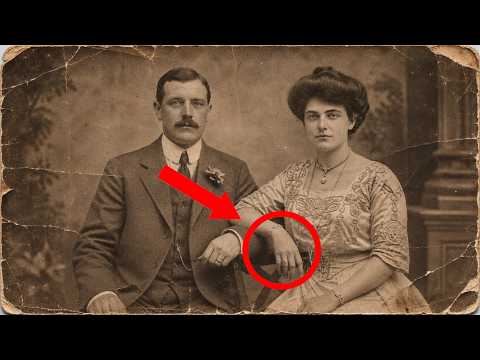
She carried the photograph to her kitchen, where better light might reveal more. As she scanned it at high resolution, the details sharpened—and the unease deepened. Victoria’s left hand rested elegantly on her lap, but her right hand, tucked slightly behind Harold’s chair, was clenched into a white-knuckled fist. A faint dark stain marred her sleeve, barely visible but unmistakable under magnification. It was as if she were restraining herself, hiding a violence that simmered beneath the surface. Rebecca zoomed in on Victoria’s face, and the asymmetry of her smile became glaring—a carefully constructed expression that didn’t reach her eyes. Those eyes, Rebecca realized, were not those of a loving wife. They were the eyes of a hunter.
Determined to uncover the truth, Rebecca plunged into research. Harold Whitman, she discovered, had been a wealthy Boston businessman who died just five months after the photograph was taken. The cause: sudden heart failure. But his physician had been baffled—Harold was in perfect health. Two weeks before his death, he had changed his will, leaving everything to Victoria. And Victoria, the charming widow from Philadelphia, had vanished soon after, liquidating his assets and disappearing without a trace.
The pattern was chilling. In Philadelphia, a textile manufacturer named Charles Morrison had died under eerily similar circumstances in 1904, six months after marrying a woman called Virginia Ashworth. In Chicago, a banker named Robert Patterson had succumbed to a sudden illness in 1903, shortly after wedding Victoria Ashby. Each time, a wealthy man, a whirlwind courtship, a hasty will change, and a convenient death. Each time, the bride disappeared with the fortune.
Rebecca’s hands shook as she pieced together the evidence. Victoria was no ordinary widow—she was a serial killer, one of America’s first female predators, operating with a sophistication that defied the era. She had forged identities, charmed her way into high society, and used poisons like arsenic and digitalis to mimic natural deaths. And she was still out there. The photograph in Rebecca’s hands was not just a portrait—it was a warning, a snapshot of evil hiding in plain sight.
But the story didn’t end there. Rebecca’s research led her to New York, where Victoria—now calling herself Violet Ashland—had nearly claimed another victim: Theodore Blackwood, a railroad heir. Only a private investigator’s suspicions had saved him, forcing Victoria to flee once more. The police had launched a multi-state manhunt, but Victoria had always stayed one step ahead. Until, in 1908, she was found dead in a San Francisco hotel room, poisoned with strychnine. Had she been silenced by her own criminal network? The truth, Rebecca realized, was even darker than she had imagined.
Rebecca closed the laptop and sat in the dim light of her kitchen, the photograph propped against the salt shaker like an accusation. She had spent three weeks chasing Victoria across a century, and now that the chase was over, she felt hollowed out rather than triumphant. Six confirmed victims. Possibly more. And a death that had never been officially solved.
She pulled the photograph toward her again and studied the woman’s clenched fist. Something still bothered her. The stain on the sleeve, the tension in the knuckles—those were details of a moment, a single afternoon in October 1905. But Rebecca had spent years restoring damaged images, and she knew that damage often told a second story, one layered on top of the first.
She flipped the photograph over. The notation was there, faded brown ink: Mr. and Mrs. Harold Whitman, Boston Studio, October 1905. But beneath it, almost invisible against the card stock, were faint indentations—the kind left when someone had written on a sheet of paper resting on top of the photograph. Rebecca had seen this before in her restoration work. Pressure marks. Ghost writing.
She carried the photograph back to her studio and placed it under a raking light, angling the beam until the indentations cast tiny shadows. Then she photographed them and inverted the contrast in her editing software. Slowly, letter by letter, the ghost writing emerged.
It was a single line, written in a hand that was not the same as the notation. The strokes were sharper, more hurried, the pen pressed hard enough to bite into the card.
“She knows about the child. God help me.”
Rebecca stared at the screen, her pulse loud in her ears. The child. No record she had found mentioned a child—not in Harold’s will, not in the society pages, not in any of the letters she had read. She checked the handwriting against samples she had saved from her research. It wasn’t Harold’s. It wasn’t Victoria’s either, judging by the few signatures she had located on forged documents.
It belonged to someone else entirely. Someone who had held this photograph, written on a paper laid across it, and pressed hard enough to leave a mark that survived a hundred and twenty years.
Rebecca thought of her grandmother, who had kept this portfolio wrapped in tissue paper and hidden in a cedar chest. Her grandmother had never spoken of the Whitmans. But the house had been in the family for four generations—which meant someone in Rebecca’s own line had been close enough to this photograph to write on it.
She went back to the cedar chest that night, flashlight in hand, and this time she searched the lining. Beneath the false bottom, folded small and brittle, was a second document: a birth certificate from Salem, dated June 1906. The mother’s name had been scraped away with a knife, but the father’s name was still legible.
Harold Whitman.
Rebecca sat back on her heels in the dark attic, the paper trembling in her fingers. Victoria had not simply murdered Harold and vanished. She had left something behind—something that someone in Rebecca’s family had spent a lifetime hiding.
Rebecca’s mind raced through the implications. A child born in June 1906—four months after Harold Whitman’s death. If Victoria had been pregnant when she married him, or shortly after, the child would have been the sole heir to the Whitman fortune. Yet Victoria had liquidated the estate and disappeared. Why leave a child behind? The answer, Rebecca suspected, was simple and brutal: a crying infant would have slowed her down, complicated her escapes, drawn attention she could not afford.
She examined the birth certificate more closely. The mother’s name had been scraped away, but the paper itself bore a faint watermark—the seal of the Salem town clerk’s office. Whoever had removed the name had done so after the certificate was issued, not before. Someone had wanted to erase Victoria’s identity from the record while preserving the child’s legitimacy.
Rebecca thought of her grandmother’s careful tissue paper, the cedar chest, the portfolio wrapped like a relic. Her family had not stumbled onto this secret. They had guarded it.
She spent the next two days cross-referencing Salem birth records with census data. The child’s name on the certificate was incomplete—only a first name remained, Margaret, followed by a surname that had been scratched out and overwritten with something else. Under ultraviolet light, Rebecca could just make out the original letters beneath the correction: Whitman, replaced by Whitmore.
The same surname as Victoria’s real identity. Margaret Whitmore.
Rebecca’s breath caught. The child had not been abandoned to strangers. She had been placed with family—Victoria’s own family, or someone posing as such. And that child had grown up, married, and become someone in Rebecca’s lineage. The blood in Rebecca’s veins carried the same blood as the woman in the photograph.
She pulled up the genealogy files she had compiled during her research and traced the line backward from her grandmother. There it was, buried in a branch she had never bothered to examine closely: a woman named Margaret Whitmore, born June 1906 in Salem, who had married a local shopkeeper in 1928 and lived a quiet, unremarkable life until her death in 1971. Her daughter—Rebecca’s grandmother—had inherited the house and, with it, the portfolio.
Rebecca sat very still. Victoria had left her daughter behind, but she had also left her money—or at least the means to a comfortable life. The shopkeeper husband, the Salem house, the cedar chest: all of it suggested a modest but secure inheritance. Victoria’s crimes had funded the quiet respectability of the family that had raised her child.
But that raised a darker question. If Margaret Whitmore had known the truth about her mother—and the scraped birth certificate suggested someone had tried to control that truth—had she passed that knowledge down? Rebecca’s grandmother had never mentioned Victoria, never hinted at a murderess in the family tree. Either the secret had died with Margaret, or it had been deliberately buried.
Rebecca returned to the portfolio. There was one more thing she had not examined: the portfolio’s inner lining. She ran her fingers along the seam and felt a slight bulge. With a letter opener, she slit the fabric and shook out a folded sheet of stationery, yellowed and creased.
The letter was addressed to My dearest Margaret and signed with a single initial: V.
The handwriting matched the forged documents Rebecca had studied in the archives. Victoria had written to her daughter. The letter was dated 1909—a year after Victoria’s supposed death in San Francisco.
Rebecca’s hands went cold. She read the letter twice before the words fully registered.
My dearest Margaret, it began. By the time you read this, you will believe me dead. That is as it must be. The men who hunted me are not finished, and as long as they believe I am gone, you are safe. I have left you what I could—the house, the money, the name that will protect you. Do not look for me. Do not speak my name. And whatever you do, never trust a man who asks too many questions about your past.
There was more—a paragraph about a woman named Mrs. Harlow in Salem who would care for the child, and a final line that made Rebecca’s skin prickle.
Remember: the world punishes women who take what they want. So take it quietly, and smile while you do.
Rebecca set the letter down. Victoria had not been killed by her criminal network in 1908. The strychnine death in San Francisco had been staged—a body identified by circumstantial evidence, a hotel room rented under a false name. Victoria had faked her own death and vanished, leaving behind a daughter and a fortune and a warning that had been passed down through four generations of women.
She looked at the photograph again, at Victoria’s clenched fist and predatory smile. The woman in the picture had not been stopped. She had simply chosen a different kind of disappearance.
And somewhere in the attic, or in the town records, or in the quiet Salem house itself, there might be evidence of what Victoria had done next.
Rebecca read the letter a third time, and this time she noticed something she had missed: the postmark. It was from Salem, dated 1909. Victoria had not vanished to Europe or the West. She had come back.
That night, Rebecca searched the house with new eyes. In the cellar, behind a loose brick near the furnace, she found a tin box containing a second photograph—an old woman in black, seated on a porch, her face half-turned from the camera. On the back, in the same sharp hand: V., Salem, 1921.
Victoria had lived out her final years in the very house Rebecca now owned, watching her daughter from the shadows, smiling while she did.
What would you do if you found a killer in your own bloodline?
Report this article
Select a reason for reporting:






