She was called “Püppi”—little doll—by the man who orchestrated the Holocaust. Heinrich Himmler, architect of the SS and chief of the Nazi concentration camp system, adored his only daughter, Gudrun. He phoned her daily, wrote weekly letters, and flew her to his offices just to see her smile. But behind this tender facade lay a monster whose affection would shape a woman incapable of remorse.
Born in 1929, Gudrun grew up in the lap of Nazi luxury, surrounded by the ideology of hate. Her father’s love was absolute, but so was his indoctrination. By age 12, she was already visiting Dachau—not as a horrified witness, but as a privileged guest. Her diary entry from that day reveals a chilling detachment: “We saw the pictures that the prisoners have painted. They were all very beautiful. In the end we had a very good lunch.” The suffering of thousands was invisible to her.
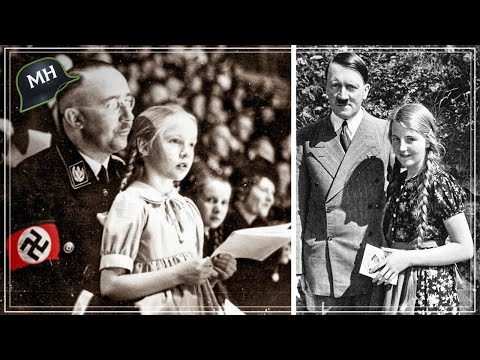
As the Third Reich crumbled, Gudrun’s world shattered. In May 1945, her father bit into a cyanide capsule, and she was left to face a world that despised her name. But she never renounced the ideology that had raised her. Instead, she clung to it, defending her father’s actions and denying his suicide. “I never talk about my job,” she later said. “I just do what I can, when I can.” Those words would echo through decades of secrecy and complicity.
After the war, Gudrun tried to fade into obscurity, working as a dressmaker and bookbinder. But her past was a shadow that never lifted. In 1961, she was hired by West German intelligence under an assumed name—a secretary in the spy agency run by former Nazis. Then, she found her true calling: Stille Hilfe, the “Silent Help” organization dedicated to aiding fugitive SS members. She became its public face and chief financier, revered as the “Nazi princess” and even called the “Mother Teresa of the national socialists.”
For decades, she helped war criminals escape to South America, providing money, contacts, and a veil of secrecy. When confronted by a journalist in 2015, she remained defiant, offering only a cryptic response. “I never talk about my job. I just do what I can, and when I can.” Until her death in 2018, she wore a silver brooch given by her father—four horses arranged in a swastika. The little doll had become a guardian of the darkest chapter in history.
But how did a child raised on love become a woman who aided murderers? And what secrets did she take to her grave? The story of Gudrun Himmler is a chilling reminder that evil can wear a familiar face—and that the past is never truly buried.
To understand Gudrun, one must first understand the Himmler household. Heinrich was a man of rigid order, obsessed with genealogy and racial purity, yet he doted on his “Püppi” with a sentimentality that bordered on the absurd. His letters to her, preserved in archives, are filled with affectionate drawings of flowers and animals, interspersed with casual mentions of his work—which included the expansion of Dachau and the construction of Auschwitz. He wrote to her about the “great task” of cleansing Germany, framing genocide as a noble duty. She absorbed it all without question.
Her mother, Margarete, was no innocent bystander. A nurse who had joined the Nazi Party early on, she managed the family estate at Gmund and entertained SS wives while their husbands oversaw mass murder. In this environment, Gudrun learned that compassion was weakness. She was taught to view Jews, Slavs, and Roma not as human beings but as “vermin” threatening the German race. The love she received from her father was conditional—dependent on her loyalty to the cause. And she never wavered.
When the war ended, Gudrun was sixteen—old enough to understand the magnitude of the defeat, yet too young to have committed any direct crimes. This technical innocence became her shield. During the Nuremberg trials, she and her mother were detained and interrogated, but no charges were filed. She walked free while survivors of her father’s camps were still dying of typhus and starvation. The injustice of it festered inside her, not as guilt, but as resentment.
In the post-war years, she found a new purpose. West Germany was full of former Nazis desperate to avoid prosecution, and Gudrun—with her father’s name and her inherited fortune—became their lifeline. Through Stille Hilfe, she helped figures like Klaus Barbie, the “Butcher of Lyon,” and Erich Priebke, a perpetrator of the Ardeatine massacre, escape justice. She arranged false papers, paid legal fees, and provided safe houses. The network was extensive, stretching from Munich to Buenos Aires.
Her home in Munich became a pilgrimage site for unrepentant Nazis. They gathered on her father’s birthday, raising glasses in his honor. Gudrun presided over these meetings like a high priestess, her swastika brooch gleaming on her lapel. To the outside world, she presented herself as a harmless old woman—a secretary, a dressmaker. But to the faithful, she was the keeper of the flame.
In the 1980s, as a new generation of German prosecutors began reopening war crimes cases, Gudrun’s activities drew scrutiny. Journalists staked out her house. Holocaust survivors confronted her on the street. She responded with icy silence, sometimes calling the police to report harassment. Once, when a reporter asked if she regretted anything, she replied, “My father was a great man. History will judge him fairly.”
But history had already judged him—and her. The Simon Wiesenthal Center listed her as a “notorious unrepentant Nazi,” and her name became synonymous with the banality of evil. Yet she never faced legal consequences. The German statute of limitations for aiding and abetting murder had expired, and her role in Stille Hilfe, while morally repugnant, was rarely prosecutable. She lived out her days in a modest apartment, surrounded by photographs of her father and letters from SS veterans.
But the question of how she financed this network remained a mystery for years. Investigators suspected that Gudrun had access to hidden SS funds—gold, artwork, and cash smuggled out of Germany before the fall. She never disclosed the source of her wealth, and no audit ever traced it fully. What is known is that Stille Hilfe operated with a budget far beyond the means of a retired secretary. She paid for lawyers, bribed officials, and arranged passages to South America with a efficiency that suggested deep pockets and deeper connections.
One of her most notorious clients was Anton Malloth, a guard at Theresienstadt known as the “Tyrant of the Small Fortress.” He had beaten prisoners to death with his bare hands. In 2001, Gudrun helped him evade extradition from Italy, paying for his legal defense and providing him with a comfortable apartment in Munich. When he died in 2002, she attended his funeral and laid a wreath with a ribbon reading “From your loyal friends.” The message was clear: the network was still watching, still honoring its own.
Her influence extended beyond Germany. In the 1990s, she traveled to Croatia and Argentina, meeting with former Ustaše and SS veterans. She was received like royalty—the daughter of the Reichsführer SS, the living symbol of a lost cause. In these circles, she was not a criminal but a martyr’s child, a woman who had suffered for her father’s ideals. They called her “Gudrun” with reverence, as if speaking her name might resurrect the dead.
But the world was changing. The fall of the Berlin Wall and the reunification of Germany brought a new generation of prosecutors who had no patience for the old guard. In 1998, the German government began investigating Stille Hilfe’s finances, and Gudrun was summoned for questioning. She arrived at the police station wearing her father’s brooch, smiling for the cameras. She answered every question with the same phrase: “I have nothing to say.” The investigation stalled, but the publicity was damaging. For the first time, her neighbors in Munich learned who lived among them.
Holocaust survivors began gathering outside her apartment building, holding signs that read “Nazi, go to hell.” One morning, someone painted a swastika on her door—not in homage, but as a mark of shame. Gudrun scrubbed it off herself, then called the police to report vandalism. When the officer asked if she had any idea who might have done it, she replied, “The same people who always hate us.” The “us” was telling. To her, the Nazis were still a tribe, still victims.
In her final years, she became increasingly isolated. Her husband, Wulf-Dieter Burwitz, died in 2002, and many of her old comrades had passed away or drifted into obscurity. She lived alone in a two-room apartment, surrounded by framed photographs of her father and a portrait of Hitler that hung above her bed. She gave interviews only rarely, and always on her terms—never answering questions about the Holocaust, only about her father’s “greatness.”
In 2015, a British journalist named David Charter managed to confront her outside her home. He asked if she felt any remorse for the families of the victims her network had helped evade justice. She stared at him for a long moment, then said, “You don’t understand. My father was a man of honor. Everything he did, he did for Germany.” When Charter pressed her on the camps, she turned away. “I have nothing more to say to you.” She walked inside and closed the door.
That closed door became the final image of Gudrun Himmler’s public life. She retreated into her Munich apartment, surrounded by relics of a fallen empire, and spoke to almost no one. Her health declined, but her convictions never softened. She died on May 24, 2018, at the age of 88, still wearing her father’s swastika brooch. Even in death, she remained the dutiful daughter of the Reichsführer SS.
Her funeral was a quiet affair, attended by a handful of aging neo-Nazis and Stille Hilfe loyalists. No representative of the German government was present, and no apology was ever offered. She was buried in a small ceremony, her gravestone bearing only her married name—a final attempt to hide from history.
But history does not forget. The Simon Wiesenthal Center condemned her legacy, and Holocaust survivors mourned not just their own suffering but the fact that one of the last living links to the Nazi elite had gone to her grave unrepentant. Her story serves as a warning: evil is not always monstrous in appearance. Sometimes it is a loving father, a privileged childhood, and a daughter who never learned to see the humanity in others.
Gudrun Himmler’s life was a testament to the power of indoctrination—and the terrible cost of loyalty without conscience. She chose to honor a murderer rather than confront the truth. And in doing so, she became a footnote in the very history she tried to rewrite.
What do you think? Can a person be held morally responsible for the crimes they enabled but never directly committed? Share your thoughts in the comments below.
Report this article
Select a reason for reporting:






