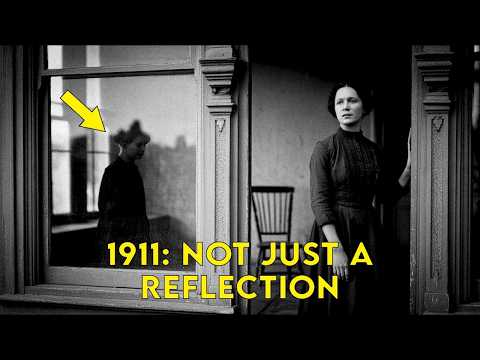
On a warm September afternoon in 1911, Catherine Blackwood stood proudly on the porch of her new home, smiling for a photograph that should have been a simple family keepsake. But when experts examined the image over a century later, they froze. In the window’s reflection, something impossible appeared—a room that shouldn’t exist, and a figure that would unravel a dark secret buried for decades.
This is the story of the Blackwood photograph, a mystery that has baffled historians and scientists alike. What was captured in that reflection? And why did it drive Catherine to madness?
In April 2019, antique dealer Rachel Hartley arrived at the Blackwood Estate in Millbrook, Connecticut. The last descendant of the once-prominent family had passed away, leaving behind a Victorian mansion filled with a century of accumulated history. Rachel specialized in vintage photographs and had built her reputation on finding hidden treasures in estate sales. The Blackwood sale had attracted dealers from across New England, all hoping to find something valuable among the dusty relics.
“Third floor is mostly photographs and personal effects,” the estate sale coordinator told her. “Haven’t had time to catalog everything up there properly.”
Rachel climbed the narrow servant staircase, her footsteps echoing in the empty house. The third floor had clearly been used as storage for generations. Boxes were stacked floor to ceiling, trunks lined the walls, and the musty smell of old paper filled the air. In a corner, she found what she was looking for: several boxes labeled “Family Photographs.”
She began sorting through them methodically. Formal portraits, vacation snapshots, holiday gatherings spanning decades. Then her fingers stopped on a photograph that seemed different from the others. It was larger than most, mounted on thick cardboard backing. The image showed a woman standing on a wrap-around porch, her hand resting on an ornate column. She wore the high-neck dress typical of the 1910s, her hair arranged in the Gibson Girl style. Behind her, the house’s windows reflected the afternoon light.
What caught Rachel’s attention wasn’t the woman or her clothing. It was the quality of the photograph itself. Despite its age, the image was remarkably clear, almost unnaturally sharp. Every detail was preserved: the texture of the woman’s dress, the grain of the porch’s wooden boards, even the delicate lacework of the curtains visible through the windows. On the back, in fading brown ink, someone had written: “Catherine Blackwood, September 15th, 1911, first day in our new home.”
Rachel held the photograph up to the window light and gasped. In the large window, directly behind Catherine, the reflection showed not the expected view of the yard and trees, but something else entirely. The reflection seemed to show the interior of a room, but not any room that should have been visible from that angle. She pulled out her jeweler’s loupe for a closer look. The reflected room appeared to be furnished differently than the rest of the house, with furniture styles that seemed older, more austere. And there was something else—a figure, barely visible, standing in the reflected room.
“Find something interesting?” Rachel jumped. A man in his sixties stood in the doorway, wearing a visitor’s badge that identified him as Professor James Morton from Yale.
“I’m sorry, I didn’t mean to startle you,” he said. “I study historical photography. That particular image you’re holding—may I?”
Rachel handed him the photograph. Professor Morton examined it carefully, his expression growing more intrigued by the second. “Extraordinary,” he murmured. “The plate clarity, the chemical composition visible in the tones. This was taken with a very specific type of camera—a Gandolfi, if I’m not mistaken. They were known for their exceptional glass plates.”
“What about the reflection?” Rachel asked.
Professor Morton studied the window area with her loupe. His face paled slightly. “That’s unusual. The angle of reflection is all wrong. Windows don’t reflect interiors from that perspective. They reflect what’s in front of them.”
They stood in silence, both staring at the impossible reflection. Finally, Professor Morton spoke again. “Would you consider letting me borrow this for analysis? I have colleagues at Yale who specialize in photographic anomalies. I’ll pay you a rental fee, of course, and return it within a week.”
Rachel hesitated. In her experience, truly mysterious photographs were rare and valuable, but the professor’s offer was generous, and she was curious about what modern analysis might reveal. “All right,” she agreed, “but I want to be involved in whatever you discover.”
Professor Morton smiled. “I wouldn’t have it any other way. In fact, I think you should know—this isn’t the first Blackwood photograph to show unusual properties. There were stories years ago about the family having a connection to unexplained incidents in Millbrook.”
As they carefully wrapped the photograph for transport, Rachel noticed something she’d missed before. In the lower corner of the image, barely visible unless you knew to look for it, was a small mark—like a handprint on the glass, but from the wrong side.
The drive back to New Haven was quiet, both of them lost in thought about what they’d found. Rachel couldn’t shake the feeling that in that reflected room, frozen in silver and time, something was terribly wrong. The figure in the reflection seemed to be watching, waiting, as if aware that after more than a century, someone had finally noticed it was there.
As they passed through the old mill towns of Connecticut, Rachel found herself wondering about Catherine Blackwood, standing proud on her porch in 1911, completely unaware of what the camera had captured behind her. Or had she known? The woman’s expression, which had seemed simply formal at first glance, now appeared to hold a hint of something else—tension perhaps, or fear. What had happened in that house? And what was that room that shouldn’t have been there, reflected in a window that should have shown only sky?
Yale’s digital imaging laboratory was a testament to how far photographic analysis had come since 1911. Professor Morton led Rachel through rooms filled with spectrometers, electron microscopes, and computers running advanced imaging software.
“My colleague, Dr. Sarah Chen, is our expert on early 20th-century photographic techniques,” Morton explained as they entered the main lab.
Dr. Chen, a woman in her 30s with intense dark eyes, was already examining the Blackwood photograph under a specialized scanner. “This is remarkable,” Dr. Chen said without looking up. “The silver halide patterns are consistent with 1911 processing, but the clarity is extraordinary. Whoever took this photograph was a master technician.”
She gestured them over to a monitor displaying a highly magnified version of the window reflection. “Now, this is where it gets interesting. See the reflection? The room shown here doesn’t match the interior layout of a typical 1911 colonial revival home like the Blackwood house.”
Rachel studied the screen. The reflected room appeared sparse, almost cell-like, with bare walls and a single wooden chair. The figure standing in the room was clearer at this magnification. A woman in a dark dress, her face turned away from the window.
“Could it be a double exposure?” Morton asked.
Dr. Chen shook her head. “I thought so at first, but look at this.” She pointed to the edges where the reflection met the window frame. “In a double exposure, you’d see overlap, transparency. This is a perfect reflection—just reflecting the wrong thing.”
If you’re enjoying this mystery so far, don’t forget to hit that like button and subscribe to the channel.
Dr. Chen pulled up architectural records on another screen. “I found the original blueprints for the Blackwood house. That window should reflect the front yard and the street beyond. The angle is all wrong for it to show any interior room, let alone one that doesn’t match the house’s layout.”
Rachel remembered something. “Professor Morton mentioned the Blackwoods had connections to unexplained incidents. What kind of incidents?”
Morton pulled out a folder he’d brought from his office. “I did some research after we left the estate. The Blackwood family was prominent in Millbrook from the 1870s onward. Catherine Blackwood, the woman in the photograph, was married to Theodore Blackwood, a successful industrialist. But there were stories.” He spread out newspaper clippings and documents. One headline from the Millbrook Gazette dated October 1911 read: “Strange Occurrences at Blackwood Residence: Neighbors Report Unusual Sights.” The article described how neighbors had reported seeing lights in the house when the family wasn’t home, and figures in windows that disappeared when approached. One witness claimed to have seen a woman in an upstairs window standing perfectly still for hours, even though Catherine Blackwood had been confirmed to be across town at the time.
“But here’s the truly strange part,” Morton continued. He pulled out a photograph from the 1890s showing the same house. “This is the Blackwood property 20 years before Catherine’s photograph. Look at the windows.”
Rachel and Dr. Chen leaned in. The house looked almost identical, but there was one major difference. Where the large window in Catherine’s photograph stood, there was only a solid wall.
“They added that window during renovations in 1910,” Morton explained. “Just a year before this photograph was taken.”
Dr. Chen had been running more tests while they talked. “I found something else. The light patterns in the reflection don’t match the time of day the main photograph was taken. Based on the shadows, Catherine’s portrait was taken around 3 p.m., but the light in the reflected room suggests early morning—maybe 6 or 7 a.m. Different times captured in the same image.”
Rachel felt a chill. “That’s impossible.”
“It should be,” Dr. Chen agreed. She pulled up another analysis. “But look at the spectral analysis of the reflected area. The chemical signature is slightly different, as if this part of the photograph was exposed to a different light source entirely.”
Morton was searching through historical records on his laptop. “Found something. In 1891, 20 years before Catherine’s photograph, there was a tragedy at the Blackwood house. A housemaid named Mary Sullivan died under mysterious circumstances. She was found in a locked room on the third floor, dead from unknown causes. The room was subsequently sealed off during renovations.”
Rachel looked at the reflected room in the photograph again. The sparse furnishing, the cell-like quality. “Could that be the sealed room? But how could it appear in a reflection of a window that didn’t exist when Mary Sullivan died?”
“There’s more,” Morton said quietly. “I found Mary Sullivan’s employment records. Look at her photograph.” He showed them a small, grainy image from an employment agency. Despite the poor quality, the resemblance was unmistakable. The figure in the window reflection looked exactly like Mary Sullivan.
Dr. Chen stood up abruptly. “I need to run one more test. This equipment can detect latent images. Sometimes old photographs contain visual information that’s not visible to the naked eye.”
She initiated a deep scan of the photograph. As the results appeared on screen, all three of them stepped back in shock. The scan revealed multiple latent images throughout the photograph, all centered around the window. Faint impressions of the same figure—Mary Sullivan—appeared in different positions, as if the photograph had captured her moving through the reflected room over a period of time, all compressed into a single image.
Leave a comment about what you think is happening in this photograph.
“This is scientifically impossible,” Dr. Chen breathed. “A photograph captures one moment. It can’t show movement over time like this.”
Morton was pale. “Unless we’re not looking at a normal photograph. There are theories about locations that act as recording devices—places where traumatic events leave impressions that can be captured under the right conditions.”
Rachel thought about Catherine Blackwood standing on her porch, having her picture taken on what should have been a happy day. Did Catherine know? When she posed for this photo, did she know what might appear?
They would need to dig deeper into the Blackwood family history, into the circumstances of Mary Sullivan’s death, and into the nature of that mysterious window that seemed to be a portal—not through space, but through time itself.
The Millbrook archives revealed the rest. Catherine’s diary grew frantic: “She stands in that horrible room, waiting. Last night I heard tapping on the glass from the inside.” Then the entries stopped. A newspaper clipping followed: “Mrs. Theodore Blackwood Suffers Nervous Collapse.”
Dr. Chen’s final scan showed Mary Sullivan moving through that sealed room—a pattern of escape attempts frozen in silver. “She’s been trying to tell her story for over a century,” Morton whispered.
Rachel stared at the photograph. Mary Sullivan stood eternal, a witness to her own murder. The truth was preserved, impossible to deny. But was it justice—or just a window that should never have been opened?
What do you think? Was Henry Pittman’s temporal lens real, or is there another explanation for the impossible reflection? Share your theories below.
Report this article
Select a reason for reporting:






