July 7th, 1944, Saipan. They prop a dying sergeant against a tree. He can’t walk, can’t be carried. Three to five thousand Japanese soldiers are pouring down a hillside in the largest banzai charge of the Pacific War. And his squad has to pull back through the dark. There’s nothing left to do for him, and everybody knows it. Someone puts a pistol in his hand. Eight rounds. That’s everything Thomas Baker has left in the world.
We’ll come back to that tree. But first, you need to understand the weapon they handed him—because every man who ever held this pistol had the same math: not enough bullets, not enough time, and no other option left.
The island of Samar, Philippines. October 1905. A prisoner named Antonio Caspi tries to escape and attacks American soldiers. They shoot him four times at close range with a .38 Colt revolver. Three rounds punch through his chest and perforate both lungs. A fourth passes through his hand into his forearm. Caspi keeps fighting. They finally stop him by cracking his skull with the steel butt plate of a Springfield carbine.
Colonel Laguar documented the case. Caspi was a Pulahan rebel on Samar, not a Moro from the south, but what happened to him was an exact preview of what was happening 600 miles away. In the southern Philippines, Moro warriors had undergone ritual purification, wrapped their limbs with leather tourniquets to slow blood loss, and charged American positions with swords. The .38 went through them without slowing them down.
Here’s why. A .38 bullet is .357 inches across. A .45 is .451. Under the rules of war, military bullets can’t expand. So the hole is exactly the size of the bullet going in. That difference—less than a tenth of an inch—was the difference between a man who kept charging and a man who dropped.
General Wood’s 1904 report was blunt: “The .45 caliber revolver stops a man in his tracks.”
Now, most people will tell you the M1911 was designed to fight the Moros. It wasn’t. The pistol didn’t reach the Philippines until mid-1913, after the last major engagement. The .45 revolvers fought the Moros. But the Moro experience created the .45 caliber requirement. The requirement created the cartridge, and the cartridge created the gun.
In 1904, Colonel John Thompson and Major Louis LaGarde ran the test that decided the caliber. Union Stockyards, Chicago—live cattle, horses, and human cadavers. Seven calibers. The conclusion: a bullet which will have the shock effect and stopping power at short ranges necessary for a military pistol should have a caliber not less than .45.
John Browning had been developing semi-automatic pistols for Colt since the 1890s. He scaled up his .38 ACP design to meet the .45 mandate. Six years of refinement. In the final trial, his pistol fired 6,000 rounds against the Savage. The Savage suffered 37 malfunctions. Browning’s Colt had zero. Adopted March 29th, 1911. $14.25.
And here’s a detail that ties the origin together. Colonel Thompson—the man who ran those cattle tests—chaired the board that approved the M1911. Then he retired and invented the Thompson submachine gun, chambered in the same .45 ACP.
Browning built the pistol with intentionally loose tolerances. The slide rattled. Engineers hated it. He wasn’t building a target pistol. He was building something for conditions that didn’t exist yet. Mud, ice, blood, sand. Remember that. Those loose tolerances are going to save lives in a place called Chosin.
The army had its pistol. What they didn’t know yet was what it would actually be used for.
October 8th, 1918. The Argonne Forest. Fog in the ravines. Machine gun fire echoing off wet limestone. Alvin York almost didn’t go to war. He was a conscientious objector from the Tennessee mountains—a Christian who believed killing was a sin. Filed for exemption twice. Denied both times.
Now he’s crouched in a ravine with seven survivors of a 17-man patrol. Six Americans killed, three wounded. German Maxims sweeping the ground above. And a German officer and five men have just leapt from a trench with bayonets fixed, 25 yards away and closing.
York’s Enfield rifle is nearly empty. Six men in the open. Bayonets 25 yards away. He’d grown up in the mountains of Pall Mall, Tennessee, hunting wild turkeys since before he could read. And turkey hunters know something most soldiers don’t: you shoot the rear bird first, so the front ones don’t see it fall and scatter.
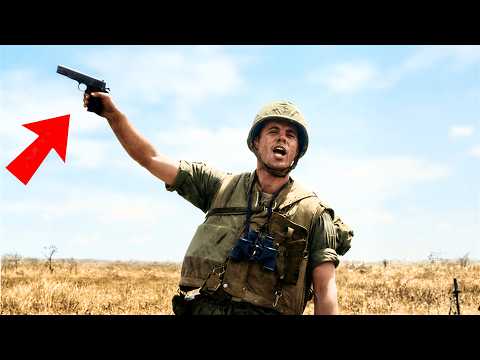
York pulled his M1911 and shot the last man first. Worked forward. Six rounds, six men down. The German commander surrendered. York and seven Americans marched 132 prisoners back to Allied lines—a pacifist from Tennessee with a pistol he never wanted to carry.
His Medal of Honor citation doesn’t mention the pistol. The story comes from his diary and from Private Percy Beardsley’s affidavit: “I saw Corporal York fire his pistol repeatedly. I saw Germans who had been hit fall down.”
A pattern was forming, one that would repeat for the next 60 years. Nobody planned to use this pistol. It was what happened when the plan was already dead.
In the first war, the M1911 was the backup—the thing you reached for when your rifle failed. In the next war, men would reach for it knowing they’d never reach for anything again.
Back to Saipan. Back to that tree.
Baker had refused evacuation. Told his squad he’d rather die than risk another man’s life carrying him out. So they left him with a pistol and the only goodbye anyone could manage in the middle of a banzai charge.
His Medal of Honor citation reads: “When last seen alive, Sergeant Baker was propped against a tree, pistol in hand, calmly facing the foe.” Later, they found his body in the same position, gun empty, with eight Japanese lying dead before him.
Same battle, Lieutenant Colonel William O’Brien fought with two Colt .45s until he died manning a machine gun. Both men received the Medal of Honor posthumously. That word defines the M1911 in World War II. At least 20 Medal of Honor actions involved this pistol. Twelve of those 20 men were killed. Sixty percent.
Drawing a sidearm in that kind of combat wasn’t offensive. It was the end of the line.
The country built 1.88 million of them for the war. Remington Rand, a typewriter company, built 900,000. Their previous best-known product had a backspace key.
If you’ve ever held a 1911, you know the weight. Two and a half pounds loaded. Pick up a hardcover book. That’s what Baker had in his hand against that tree.
A Marine Raider battalion’s after-action report from New Georgia, November 1943, summed up the M1911’s entire war in one line: “Held up very well, but used very little. Almost never needed. Completely reliable until it was the only thing left.”
And then the weather turned.
Korea. Chosin Reservoir. November 1950. Thirty-five below zero. Steel burned skin on contact. Morphine froze in the syrettes.
Remember Browning’s loose tolerances—the ones the engineers hated? Standard lubricants froze solid. Bolt actions locked so hard that Marines urinated on them to thaw the bolts. The M1 carbine’s reputation was destroyed at Chosin.
The M1911 survived. GIs stripped every drop of oil and ran it dry. The same sloppy fit that rattled in a clean room let ice pass through without seizing.
General S.L.A. Marshall noted more instances of the service pistol used with killing effect in Korea than in all his World War II studies combined. Chinese forces specialized in night infiltration. They appeared inside American foxholes. At that distance, you didn’t shoulder a rifle.
The gun survived the ice of Chosin. Months later, in the muddy hills of June 1951, it was the last line of defense for PFC Jack Hanson of the 31st Infantry. His squad had four wounded men who couldn’t move fast. Hanson volunteered to cover their withdrawal. Told them to go. Stayed on the gun.
When the counterattack retook the hill the next morning, they found a machine gun, ammunition expended. An M1911 in his right hand, slide locked back on an empty magazine. A machete in his left. Twenty-two enemy bodies in front of his foxhole.
He’d gone through every weapon he had, in order, until there was nothing left. Slide locked back. That’s how they kept finding it. Baker at Saipan. Hanson in Korea. The last round fired, the slide caught open, and the man behind it was already gone.
The next place it happened, the walls were close enough to touch.
Vietnam. The air smelled like turned earth and something worse. Somewhere beneath a jungle floor, the enemy was waiting.
Hundreds of Army tunnel rats volunteered for this duty over the course of the war. Under five-foot-five, slight build. The tunnels were three feet wide at best—red clay, hand-carved, sometimes dropping straight down into a second level that ran for miles. Air thick enough to taste: soil and sweat and something chemical that burned your throat.
No room to turn around. If you met someone coming the other way, one of you was going to die facing forward and the other was going to die crawling backward in the dark.
They went in with a flashlight, a knife, and a .45. Captain Herbert Thornton built the first tunnel-clearing teams in 1966. His assessment: “He had to have an inquisitive mind, a lot of guts, and a lot of real moxie, because you could blow yourself out of there in a heartbeat.”
The M1911 underground was power and punishment. A .45 round in a clay tube barely wider than your shoulders produced instant deafness and temporary blindness from the muzzle flash. The National Museum of the Army noted the .45 caliber round was too loud, the flash too bright. Three shots maximum before reloading. Any longer, and the VC rushes you.
Tunnel rat Harold Roper put it simply: “I felt more fear than I’ve ever come close to feeling before or since.” Three shots, then silence, then the sound of your own breathing—and the knowledge that whoever was down there with you had heard everything.
You couldn’t see. You couldn’t hear. The clay walls pressed against your shoulders, and the .45 in your hand was the only reason you were still alive. That was what the M1911 was in Vietnam. Not a weapon you wanted to fire—a weapon you couldn’t survive without.
In 1985, the Army retired the M1911 after 74 years. Fifteen rounds of 9mm replaced seven of .45. NATO standardization. The frames they replaced were 40 years old—the last ones built in 1945.
The .45 didn’t throw men backward. That’s not how physics works. If a bullet could knock the target down, the recoil would knock the shooter down too. What it did was make a hole 60% larger than a 9mm. In a world where military bullets can’t expand, that was the whole secret. That was enough.
But the gun wouldn’t die either. Marine Force Recon hand-built pistols from gutted World War II frames. In 2012, Colt won a contract for 12,000 M45A1s—the first new military-issue 1911 since 1945. Marines carried them until 2016, then switched to the Glock 19. Not for performance. Logistics.
Seventy-four years. Fifty-five Medal of Honor actions. 2.7 million built. A sergeant propped against a tree with eight rounds. A pacifist in a forest shooting the back man first. A private in a frozen foxhole with a machete in his other hand. A volunteer underground with three rounds before the dark closed in.
The M1911 was never designed to win a war. It was designed to keep one man alive for ten more seconds when the math said he was already dead.
Slide locked back. Magazine empty. That’s how they always found them.
So here’s the question I keep coming back to: in an age of drones and precision strikes, is there still a place for a weapon whose only job is to buy ten seconds when everything else has failed—or have we finally outgrown the men who needed it?
Report this article
Select a reason for reporting:






