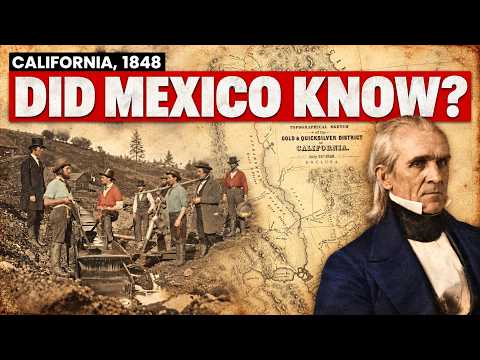
On January 24, 1848, a carpenter named James Marshall spotted something glinting in the tailrace of a sawmill on the American River. Nine days later, on February 2, Mexico signed a treaty selling California to the United States for $15 million. Within four years, California’s mines would produce $80 million in gold in a single year—more than five times the purchase price. The timing is so perfect it’s suspicious. Did Mexico know about the gold? The usual answer is no, it was pure coincidence. But that explanation ignores a crucial fact: Mexican miners had been pulling gold out of California’s soil since 1842. So was this a nine-day accident of fate? Or did both sides know more than the legend admits?
President James K. Polk himself told Congress that mines of precious metals were known to exist in California when the U.S. acquired it. The real question isn’t whether the negotiators had heard about Sutter’s Mill—they hadn’t. It’s whether anyone in Mexico knew California held gold at all. And for that, we have to go back to 1842, to a canyon near Los Angeles, where a man named Francisco Lopez made California’s first authenticated gold discovery.
Lopez was gathering wild onions near an oak tree when he found gold particles clinging to the roots. The romantic version says he napped under that tree, dreamed of gold, and woke to find it—but local historians say the dream doesn’t appear in early accounts. What’s certain is that Sonoran miners worked the placers, and in November 1842, rancher Abel Stearns sent about 20 ounces of California gold to the United States Mint in Philadelphia. Six years before Marshall’s discovery, gold was found in Mexican California, mined by Mexican citizens, and shipped to an American mint.
So Mexico’s people in California knew there was gold. What nobody knew was how much. The 1842 placers were a regional find, nothing like the riches waiting under the gravel of the Sierra Nevada. That distinction matters more than anything else in this story.
To understand why the gold didn’t decide the price, we have to understand why America wanted California in the first place. The answer wasn’t gold—it was the coast. In the 1840s, California was the far northern edge of Mexico, thinly populated and a long way from Mexico City. For President Polk, what mattered was the Pacific coast, including the port of San Diego.
Polk tried to buy it first. In late 1845, he sent Congressman John Slidell to Mexico with authority to offer $25 million for California alone. Mexico rejected the mission outright. Seen from Mexico City, this was an attempt to buy national territory that hadn’t been put up for sale. Polk had already moved troops into disputed land between the Nueces River and the Rio Grande. After clashes between Mexican and American soldiers, Congress declared war on May 13, 1846.
The war was costly. By September 1847, American forces held Mexico City itself. That’s the setting for the treaty—not a negotiation between equals over the market value of land, but a conversation held while one army occupied the other country’s capital. The man sent to have that conversation was about to disobey his own president.
Nicholas Trist was the chief clerk of the State Department. In April 1847, he was sent to Mexico to work on a peace settlement. Then Polk changed his mind and recalled him. Trist stayed anyway. In a letter dated December 4, 1847, he wrote, “The decision is altogether my own.” He had no official standing anymore. He kept negotiating.
On the other side of the table sat three Mexican commissioners who worked hard on articles protecting the property and citizenship of Mexicans living in the ceded lands. The American draft had authorized paying Mexico up to $20 million. Trist, on his own initiative, offered 15. He judged that figure likely to win acceptance among Americans who felt the country had already paid enough in blood and treasure.
On February 2, 1848, they signed. Mexico gave up about 55% of its territory—more than 525,000 square miles—covering present-day California, Nevada, Utah, most of Arizona and Colorado, New Mexico, and parts of Oklahoma, Kansas, and Wyoming. In return, the United States would pay $15 million: 3 million after ratification, and the remaining 12 million in annual installments with 6% interest.
That structure is worth slowing down on. Mexico wasn’t handed $15 million in a chest. It was handed 3 million and a promise. The treaty offered Mexico a choice: either the 12 million would sit in a fund earning interest for two years, or it would come in yearly payments. Mexico’s interim president chose the yearly payments because the government needed cash immediately. Think of a family selling the farm during a foreclosure—not because the price is fair, but because the bank’s at the door and payday is next week.
Polk was furious at Trist’s insubordination. But he sent the treaty to the Senate anyway. The Senate approved it with amendments on March 10, 1848, by more than two to one. Polk ratified it on March 16. The Senate struck out Article 10, which would have protected Mexican land grants. Hold on to that deletion, because it comes back later.
Then the treaty went back to Mexico. Mexico’s Congress approved it in May 1848, and the two governments exchanged ratifications in Querétaro on May 30. By that point, the gold had been found more than four months earlier. So here’s the sharpest version of our question: When Mexico’s legislators voted, had the news from Coloma reached them?
We looked hard for evidence either way, and we have to be honest about what we found. We found no record that California gold came up in Mexico’s ratification debates. We also found no proof that it didn’t. What the record does show is that the debate in Mexico was about other things: whether to accept the loss of half the country at all, and what would happen to the Mexicans living in the ceded lands. A sizable minority wanted to continue the fight. Benito Juárez, then governor of Oaxaca, opposed the treaty.
Now, here’s where we’re interpreting rather than reporting. Even if a ship had carried word of Sutter’s Mill to Mexico by May, it’s hard to see what Mexico could have done with it. Until the treaty was ratified, the war wasn’t over, and Mexico had already lost its capital. The choice in front of Mexico’s Congress wasn’t between $15 million and a higher price. It was between peace on these terms and more war. A rumor of gold wouldn’t have changed the size of the army.
The gold rush itself made the timing look worse. People from Hawaii, Oregon, Mexico, Chile, Peru, and China reached California in 1848 before most Americans on the East Coast even knew. Mexicans were among the first to grasp what had been found and come for it. But by then, the land was no longer Mexico’s.
The official confirmation came from Polk. On December 5, 1848, in his annual message to Congress, he told the country what California’s military commander had seen: about 4,000 persons engaged in collecting gold. And then Polk said the sentence that sits at the center of this whole story: “It was known that mines of the precious metals existed to a considerable extent in California at the time of its acquisition.” But he went on: “Recent discoveries render it probable that these mines are more extensive and valuable than was anticipated.”
Read those two lines together and you have the honest answer, in the words of the man who bought the land. Some mineral wealth was known. Its scale was not. Polk wasn’t claiming he’d outsmarted Mexico. One way to read it is that he was admitting the mines turned out bigger than anyone had expected.
So, if no one knew the size of the prize, who ended up with it? Follow the money and the answer is far more lopsided than $15 million suggests. A single good year in California’s mines was worth several times what the United States paid Mexico for the entire cession. In 1852, the peak year, California produced close to $80 million in gold. The United States was effectively on a gold standard, buying gold at $20.67 an ounce. Every ounce refined from a California riverbed was worth about $20 of American money. The gold rush was a positive monetary supply shock—the country suddenly had a lot more of the metal its money was based on.
You can see it in the coins. In 1849, Congress created a $1 gold coin and authorized the $20 gold double eagle. The flood of gold also upset the old balance between gold and silver. By 1851, the market ratio had shrunk to about 15.45 to 1, and it became profitable to melt down nearly all silver coins. Small change started vanishing. Congress responded with the Coinage Act of 1853, cutting the silver in smaller coins so they’d stay in circulation.
California’s gold didn’t even have a federal mint to go to at first. Private firms struck their own gold coins starting in the winter of 1848 to 1849. Congress authorized a branch mint in San Francisco, and President Millard Fillmore signed the law on July 3, 1852. Gold deposits began there in April 1854. The United States had bought a territory, and within six years its own mint there was taking in the gold.
And the $15 million? Here the story gets murky. Polk’s own message gives one uncomfortable detail: $769,650 in military contributions collected in Mexico—money the occupying army had raised inside the country—was applied to the first installment owed under the treaty. In other words, part of the first payment to Mexico came from money the American army had raised in Mexico.
But Mexican accounts tell a different story about what actually arrived. The UNAM Gaceta article states that the total paid to Mexico came to $6 million. La Crónica says sources put what the United States ultimately paid at about $6 million plus interest, that the later installments are poorly documented and often confused with a separate $10 million paid for the land Mexicans call La Mesilla, and that not all the money reached Mexico’s depleted treasury. We couldn’t settle this from the records we were able to read, so we’ll be clear: the treaty promised $15 million. American records show the installments being scheduled and arranged, and some Mexican accounts say far less reached Mexico. That gap is worth a historian’s full attention.
That separate $10 million, by the way, was the Gadsden Purchase. At the end of 1853, Mexico’s President Antonio López de Santa Anna signed a treaty to sell another stretch of land along the border—29,670 square miles for $10 million. The United States wanted it for a southern railroad route. Santa Anna refused to sell a larger part of Mexico but needed money to fund an army against ongoing rebellions. Once again, a Mexican government short of cash sold land, and its need for money shaped the deal.
So the winners are clear enough, but for every fortune made in California, someone else paid the cost. Start with the Californios, the roughly 6,500 people of Mexican descent who’d been living in California when the war began. Remember Article 10, the clause protecting Mexican land grants that the Senate struck out? Its absence mattered. The treaty did still protect property in other articles, and a follow-up protocol signed at Guadalupe gave further assurances. But according to PBS, those guarantees weren’t all they seemed once they reached American courts.
Then there were the Mexican miners. Between 10,000 and 20,000 Hispanic miners from Mexico and Chile came to the gold fields. In 1850, California passed a foreign miners license law charging $20 a month. It was applied to Mexican miners even when they were American citizens—including people who’d become citizens under the very treaty that had transferred the land. Mexican miners protested alongside other foreign miners, and white militias put the protests down. Californios who tried mining were driven out, some through violence and lynching.
Sit with the irony for a moment. Some of the first people to mine California gold, back when it was Mexico, were miners from Sonora. Less than a decade later, Mexican miners were being taxed as foreigners on land that had been part of Mexico only a few years before.
The heaviest cost fell on California’s native peoples. The mill at Coloma was built on Nisenan land. An estimated 150,000 Native Americans lived in California in 1848, speaking more than 100 languages. PBS’s American Experience estimates that about 120,000 native Californians died during the Gold Rush era from disease, starvation, and killing. The state of California itself took part. In 1851, the state’s first elected governor, Peter Burnett, told the legislature that a war of extermination will continue to be waged between the races until the Indian race becomes extinct. The state put bounties on native people. In 2019, Governor Gavin Newsom acknowledged the state’s role in what he called a genocide and apologized on California’s behalf.
Those numbers belong in any honest account of what the land was worth. The $15 million was a price paid by one government to another. The people who lived on the land—native, Californio, and Mexican—weren’t parties to the sale, and many of them paid in ways the treaty never priced.
Now, the other side of this story deserves a fair hearing, because there’s a serious case that the gold is a red herring. Defenders of the deal would put it like this: The United States didn’t fight for gold, and it didn’t know about the mother lode. Polk wanted the Pacific ports, and he’d been trying to buy them since 1845. Mexico’s hold on California was weak. On this reading, the treaty’s price reflected a war that had already been decided, not a hidden swindle. And the gold, when it came, was found and worked by people who poured in from around the world, not handed to Washington by Mexico.
Mexican historians answer that the framing itself is the problem. As the PBS history puts it, Mexican historians and politicians view this treaty as a bitter lesson in American aggression. The same history argues the treaty helped ensure Mexico would remain an underdeveloped country well into the 20th century. The American historian Peter Guardino sums up the whole outcome in one line: Mexico lost that war because it was poor. That line connects everything. A poor country loses a war, loses half its territory, sells it at a price it has little power to negotiate, takes the payments in installments because it needs cash, and then, five years later, sells more land because it needs money for its army. Meanwhile, the land it lost starts producing tens of millions of dollars a year. The treaty didn’t create that imbalance; it locked it in.
And on the moral question, the critics aren’t only in Mexico. Ulysses S. Grant, who fought in the war, later wrote that he regarded it as one of the most unjust ever waged by a stronger against a weaker nation. And yet the same country that fought that war produced the diplomat who defied his own president to end it and gave up his career doing it. Both of those things are true.
So, did Mexico know about the gold? Here’s where the evidence leaves us. Mexico’s own people in California knew there was gold in the province. Francisco López found it in 1842. Sonoran miners worked it, and some was shipped to Philadelphia. The American president admitted in 1848 that the existence of precious metals in California had been known when the United States acquired it. What nobody knew—not the Mexican commissioners, not Nicholas Trist, not Polk himself—was how much there was.
When the treaty was signed on February 2, 1848, the discovery at Sutter’s Mill was nine days old and neither government knew about it. And by the time Mexico ratified the treaty that May, we found no evidence that the news had reached its Congress or that it would have mattered if it had.
That’s the real twist. The price of California wasn’t set by what was under the ground. As we read the evidence, it was set above all by who held Mexico City. $15 million wasn’t an evaluation. It was a settlement signed while one army occupied the other country’s capital. The gold just made the gap impossible to ignore.
And that leaves a question we’d like to hear your take on. If Mexico’s government had known in February 1848 exactly what was in the Sierra Nevada, could it have done anything differently? Or does the price of land stop meaning anything once one side holds the other’s capital? Tell us in the comments.
So the ledger closes with a strange symmetry. Mexico sold a territory it could not defend, at a price it could not refuse, and watched the land outproduce the payment within a single year. The United States bought a coastline and got a gold field—and paid for it partly with money its own army had collected in Mexico.
Neither side was fooled. Both sides were constrained. The nine days were real, but they were never the point.
What remains is the harder question, the one no treaty article could settle: what a place is worth when the people living on it are never asked. The gold answered that for California’s native peoples in blood, not dollars.
If Mexico’s Congress had known in May 1848 what Polk would announce in December, would the vote have changed—or would the army at the capital have decided it anyway? What do you think?
Report this article
Select a reason for reporting:






