On the morning of October 29, 1945, a Royal Air Force officer walked across the grass at Farnborough, past a row that included a Messerschmitt Me 262 jet, an Arado Ar 234 jet bomber, and a Gloster Meteor whose paint was still wet. Wedged between them, looking almost apologetic in its faded gray-green camouflage, sat a muscular radial-engined fighter that should have been obsolete: a Focke-Wulf Fw 190.
By every metric that mattered in October 1945, the jet age had arrived. The Fw 190 was a piston-engined relic of a war just ended. Yet the RAF did not dismantle it, ignore it, or set it aside as a museum piece. At least five separate Fw 190s were shipped, flown, or trucked to England for live evaluation by the Royal Aircraft Establishment. Each carried a British serial number, a new coat of RAF markings, and a specific reason why someone in London wanted to study it in detail rather than melt it down for scrap.
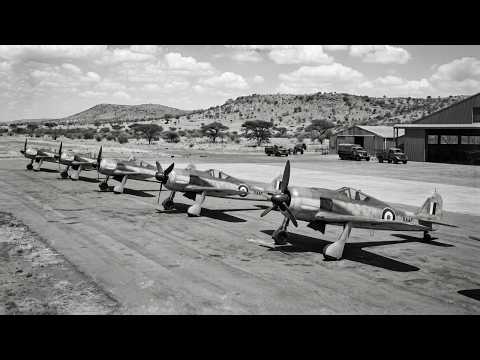
It made no sense on paper. Britain had already beaten the Fw 190 in the air, had captured one intact in 1942, and had two jet fighter programs of its own. Dragging five more German fighters across the North Sea in the summer of 1945 looked like a waste of dockyard space. But what it actually represented was one of the most methodical technical debriefings of an enemy air force in history.
The prevailing military thinking in the summer of 1945 was that the Fw 190’s time had passed. The fighter had first terrified RAF Fighter Command in September 1941 when it appeared over the English Channel and outclassed the Spitfire Mk V in almost every performance category except turning radius. At 2,000 feet, it was roughly 25 to 30 mph faster, and the gap widened at higher altitudes. Britain’s answer, the Spitfire Mk IX, had closed that gap by mid-1942. By 1945, both sides had moved well beyond piston-engined fighters.
Critics within the Air Ministry could make a reasonable case that the Fw 190 was a solved problem. Britain had captured its first intact example in June 1942, when Oberleutnant Armin Faber, disoriented after an air battle over Devon, mistook the Bristol Channel for the English Channel and landed his Fw 190 A-3 at RAF Pembrey in South Wales. That aircraft, serial 313, was dismantled, trucked to the Royal Aircraft Establishment at Farnborough, repainted as MP499, and flown 29 times between July 1942 and January 1943 in direct comparative trials against the new Spitfire IX.
Britain already had the performance numbers. It already had the tactics. Engineers had already climbed into the cockpit, measured control forces, and knew exactly how the aircraft flew. So the argument for stopping there was not unreasonable. The war was over. The aircraft was three years old, and the RAE’s resources were in high demand elsewhere: in jets, radar, and the rocket technology recovered from Peenemünde.
What that argument missed was the assumption that a fighter’s value to an evaluator ends the moment it stops being dangerous. The secret lay in what these five particular airframes represented, because none of them were standard fighters on standard combat duties. Each was brought from a different corner of the collapsing Luftwaffe structure, and each answered a question that the 1942 evaluation of Faber’s aircraft could never have answered.
The first, RAF serial AM111, was a Focke-Wulf Fw 190 F-8/R15, captured at Travemünde on the Baltic coast, where it had been used by the German Navy’s torpedo weapons testing establishment. It was flown directly to Farnborough on July 19, 1945. This was not a fighter at all in practical terms. It was a fighter-bomber converted to carry an aerial torpedo, part of Germany’s late-war efforts to adapt fast, low-flying aircraft to ship destruction. The Fleet Air Arm had spent years refining torpedo strike doctrine with Beauforts and Barracudas. The German attempt to do the same job with a modified single-seat fighter was a direct data point about an alternative approach the Royal Navy needed to understand.
The second and third, AM37 and AM40, came from Kastrup airfield near Copenhagen after the German surrender in Denmark. AM37 was an Fw 190 S-1, a rare two-seat trainer variant with a second cockpit cut into the fuselage behind the pilot. Evidence of how Germany, even in its final year, was still trying to build a structured conversion pipeline for pilots transitioning to its most advanced radial-engined fighter. AM40 was an Fw 190 F-8/U1, another ground-attack variant. Together, these two aircraft gave the RAE a picture of how Germany trained its pilots and then employed them in the fighter-bomber role, a role British Typhoon squadrons had themselves learned through costly trial and error over Normandy.
The fourth, AM75, was the strangest prize of the entire war. It was an Fw 190 A-8/R6, works number 73382, found at Tirstrup in Denmark, mounted atop a Junkers Ju 88 bomber as one of three complete Mistel combinations discovered at that airfield alone. The Mistel project was Germany’s attempt to build a remote-guided flying bomb. An old bomber packed with explosives, piloted by a fighter riding on top, steered toward the target and then released, with the fighter returning to base on its own. The gun ports on AM75’s Fw 190 half were faired over, and a bomb-release rack was fitted to its belly. A fighter turned into disposable guidance equipment. This was not a traditional air force. It was Germany’s answer to running out of trained bomber crews, and Britain wanted to understand exactly how the mechanism worked.
The fifth, a two-seat Fw 190 seized at Grove airfield in Denmark in May 1945, was personally ferried by Squadron Leader Eric “Winkle” Brown of the RAE. He was the same test pilot responsible for flying more captured German aircraft than any other Allied pilot in history. That aircraft went first to Farnborough and later to Brize Norton storage, and its components helped preserve the type for study long after the war ended.
In other words, what mattered was not whether the Fw 190 could still win a dogfight in 1945. It could not, and no one in the Air Ministry thought otherwise. What mattered was that these five aircraft represented five different German solutions to five different late-war German problems. How to sink ships without a dedicated torpedo bomber; how to train pilots faster than the front consumed them; how to turn obsolete airframes into weapons when experienced crews ran out; and how to keep an air force in naval and army roles while its doctrine was designed for air combat only.
That final point deserves closer attention, because it cut to the heart of why the RAE kept requesting these airframes when the war was already won. An air force designed for air combat only was being asked to fight a war on the ground and at sea, and it was doing so with borrowed aircraft. The Fw 190 F-8/U1 from Kastrup was not an experiment. It was a production compromise, a fighter pressed into a role its designers never intended, and Britain’s own Typhoon force had been forced into precisely the same corner.
The difference was that Britain had learned the hard way over Normandy, with rocket-firing Typhoons that arrived at the battlefield as an improvisation and stayed as a doctrine. Germany had arrived at the same improvisation from the opposite direction, and the RAE wanted to know whether the Luftwaffe’s version worked better, worse, or simply differently.
There was also a quieter, more pressing reason for the urgency in the autumn of 1945. Within months of VE Day, British planners were already turning their attention toward a new and uncertain adversary in the East. The Soviet Air Force flew lend-lease aircraft and captured German types, and its industrial base had not been bombed into rubble. Whatever the RAE learned about how a strained air force improvised under pressure in 1944 and 1945 might be needed again sooner than anyone wanted to admit.
The clearest proof of how seriously Britain took this material came not from the test flights but from what happened afterward. Rather than quietly filing the reports in drawers, the Air Ministry organized a public exhibition of captured enemy aircraft and British prototypes at Farnborough, open to the public in late October and early November 1945.
Visitors walked past rows that included a Junkers Ju 290, a Heinkel He 219 night fighter, a manned version of the V-1 flying bomb, a Dornier Do 335, and a Messerschmitt Me 262. And standing in line beside a Focke-Wulf Ta 152 was an Fw 190 A, displayed not as a defeated enemy weapon but as an engineering artifact worth studying openly.
The fact that the RAF chose to show these piston-engined relics alongside its own Meteor and Spiteful prototypes tells you how much the establishment actually valued them. Not as combat threats, but as reference points for design philosophy. A fighter that had been outclassed in the air was still being treated as a document worth reading.
The Fw 190 derived from the Mistel project, AM75, proves the point even more directly. Instead of being scrapped once its intelligence value was extracted, it survived intact and was eventually preserved, first through the Air Historical Branch collection and later displayed to the public, including a period on show at the Imperial War Museum in London. A weapon Britain never fired a single shot at in battle, built entirely as a component of a guided bomb, was considered historically and technically important enough to preserve whole for decades.
Compare that with MP499, the aircraft Faber had delivered in 1942. Once its performance envelope had been fully documented against the Spitfire IX, it was struck off charge in September 1943 and scrapped. The difference in treatment tells the entire story. A fighter Britain had already beaten in combat was expendable once its secrets were known. A fighter that represented an entirely new German answer to a manufacturing or doctrinal problem was worth keeping.
The two-seat trainer from Grove offers a second kind of proof: longevity. Brown’s team judged the type important enough that, decades later, restorers still use surviving components from wartime Fw 190 wrecks. An original BMW 801 engine recovered from a German museum and newly manufactured structural parts keep a single airworthy example intact for display in museums in both Britain and Germany.
An aircraft no one feared in combat by 1945 was still considered worth full physical preservation eighty years on. Not for what it could do in the air, but for what it represented: German industrial and tactical improvisation under pressure.
This was not sentiment, and it was not a failure to notice the war had ended. The RAE’s leaders and engineers were not clinging to an obsolete fighter out of nostalgia. They understood exactly how far the Fw 190 had fallen behind the front line. What they knew, and what a combat-only assessment misses, is that air force equipment tells you about industrial condition and command decisions more than any performance table ever could.
Germany did not build five identical fighters and send them to five identical squadrons. It built a torpedo variant because its dedicated naval strike aircraft were insufficient. It designed a two-seat trainer because the pilot pipeline was collapsing under losses. It converted airframes into guided-bomb components because trained bomber crews had run out. Each variant was a display of a strained war economy improvising its solutions through 1944 and 1945.
And each one told British planners how a modern industrial power behaves when its resources, manpower, and doctrine collapse at once. That kind of lesson does not come from watching an aircraft in a dogfight. It comes from taking it apart, flying it under controlled conditions, and asking not how fast it was, but why it existed.
Battles test not only machines against each other, but the entire system that built and supplied them. The surviving wreckage, studied carefully, keeps giving testimony long after the shooting stops.
British planners in the post-war months, facing a new and uncertain struggle with the Soviet Union only months after VE Day, understood that the next adversary’s aircraft might tell exactly the same story. They wanted those analytical habits entrenched before they were needed again.
What began as five battered airframes plucked from surrendered Danish and German airfields in 1945 became something like a case study in how a defeated air force functioned under pressure. Training shortcuts, weapons improvisation, industrial compromises, all legible in metal and rivets, not only in captured papers.
The RAF did not need the Fw 190 to win a war it had already won. It needed it to understand how the enemy lost that war in enough detail to recognize the same signs somewhere else someday.
So which of these five stories strikes you as the most revealing about how a collapsing air force actually fights: the torpedo fighter, the trainer, the Mistel component, or something else entirely? Let us know in the comments.
Report this article
Select a reason for reporting:






