The sky over Europe was a lethal chessboard, and the B-17 Flying Fortress was a pawn in a game it was never designed to win. As German FW-190s tore through bomber formations with cannons that could shred a bomber in four hits, the B-17’s defensive guns seemed almost primitive. But the real story isn’t just about guns—it’s about a fundamental philosophy that left stragglers doomed.
In the frozen altitudes, a lone B-17 limping out of formation was a death sentence. “On some missions, 50% of bomber losses were stragglers,” a 1945 tactical report revealed. Why? Because the B-17’s firepower, while impressive on paper, was never meant to fight alone.
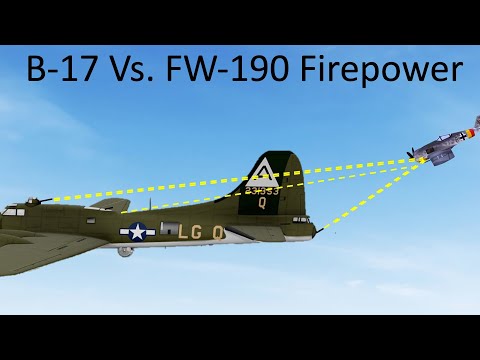
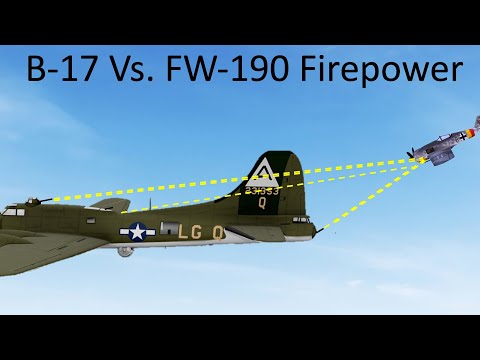
The FW-190, Germany’s main bomber interceptor, was a flying arsenal. Starting with four 7.92mm machine guns, it quickly evolved into a beast packing two 13mm machine guns and up to four 20mm autocannons—or even a 30mm cannon that could destroy a B-17 in just four strikes. “The MK 108 30mm autocannon was considered the best armament for anti-bomber attacks,” a 1947 survey noted. By war’s end, the FW-190’s firepower exceeded the B-17’s by a factor of 3.9.
Meanwhile, the B-17’s armament philosophy was radically different: “ideal minimum firepower,” not maximum. Bombers needed to carry bombs, not heavy guns. So while the B-17 added guns and better sights, it could never bring more than five .50-caliber machine guns to bear in any one direction. Against a single FW-190, that was suicide.
But the B-17 had one advantage: formation. Stacked in tight boxes, bombers created a wall of mutual firepower. A straggler, though, lost that protection. “To match the firepower of an FW-190, a straggling bomber would need 20 .50-caliber machine guns bearing in the fighter’s direction,” the analysis concluded. Twenty. The B-17 had five.
The FW-190 was a specialized bomber killer, and the B-17 was a bomber that relied on escorts and formation for survival. When those failed, the outcome was inevitable. The sky was unforgiving, and the FW-190 ruled it with fire and steel.
Yet the story of the FW-190’s dominance is not simply one of bigger guns bolted onto a bigger engine. It is a story of trade-offs, and the German fighter paid for its firepower in ways that are easy to overlook when staring at a chart of destructive coefficients.
Every autocannon added to the FW-190’s wings meant extra weight, extra drag, and a shift in the aircraft’s center of gravity. “Armaments need to be minimized due to their detrimental effect on bombing performance,” the 1945 survey warned of bombers—but the same physics punished fighters. The FW-190’s later variants, bristling with four 20mm cannons or even the monstrous 30mm MK 108, became sluggish in a dogfight against Allied escort fighters.
This was the cruel irony of the Luftwaffe’s bomber-interceptor program. The very upgrades that made the FW-190 lethal against a B-17 made it vulnerable to the P-51 Mustang and the P-47 Thunderbolt. A fighter optimized to shred a lumbering bomber at 25,000 feet could not turn with a nimble escort diving from above.
And so the German response was not to abandon the bomber killer, but to protect it. Formations of FW-190s were themselves escorted by lighter, faster fighters—a mirror image of the Allied bomber-escort doctrine. The hunter had become the hunted, and the hunter now needed its own shepherd.
On the American side, the B-17’s salvation came from two directions that had nothing to do with its guns. The first was the long-range escort, which the original analysis named as one of the two main factors in reducing bomber losses. The second was the tight combat box formation, which turned dozens of individual bombers into a single, bristling fortress of overlapping fields of fire.
“The best formation to defend against fighters is to stack the bombers one on top of each other,” a 1945 gunnery manual explained—though it admitted that bombs could not be released in that configuration. The compromise was the staggered box, which gave mutual coverage without sacrificing the bomb run.
But formations had a fatal weakness: they were rigid. A bomber that fell out of position—damaged by flak, engines failing, wounded crew—became a straggler. And the straggler was the FW-190’s favorite prey.
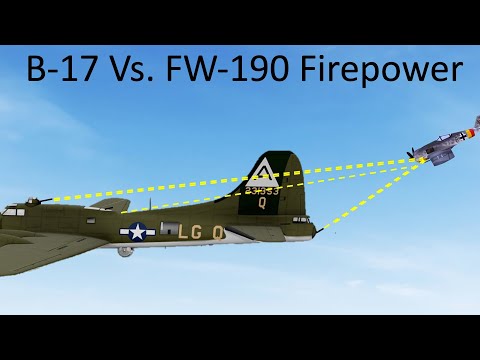
Here the numbers become brutally personal. A single B-17 at the edge of formation, with two tail guns, two upper turret guns, and a single radio room gun bearing on a 5 o’clock high attack, could muster a firepower value of just 60. The FW-190, at the peak of its armament evolution, brought 236 to the fight.
That is not a duel. That is an execution.
The German pilot knew it. He would approach from the rear quarter, where the bomber’s defensive coverage was thinnest, and fire a short, devastating burst with cannons that could tear a wing off in a single pass. “Each MK 108 autocannon firing a 30mm caliber projectile is capable of destroying 25% of the bomber per hit,” the analysis noted—around four strikes for complete destruction. Four strikes. A single second of trigger time.
The B-17 gunner, by contrast, was aiming at a small, fast, maneuvering target through a ring-and-bead sight, trying to track a fighter that was already breaking away. The 1945 report was blunt: “A bomber’s gunner’s target is small, fast, and maneuverable. This makes gun sight target tracking difficult.”
This asymmetry in tracking difficulty was not a minor tactical detail—it was the entire battle. The FW-190 pilot had the luxury of aiming at a target the size of a barn, flying straight and level, and holding his burst. The B-17 gunner had to lead a darting, closing fighter through a frozen gunsight while the airframe bucked and the temperature inside the turret dropped far below zero.
And yet, the bomber gunners were not helpless. Declassified 1945 statistics credited bomber gunners with 3,174 FW-190 claims out of 6,259 total—nearly half of all German fighters destroyed by defensive fire. No other German model fell to bomber guns in such numbers. The Flying Fortress, for all its defensive philosophy of “ideal minimum firepower,” still drew blood.
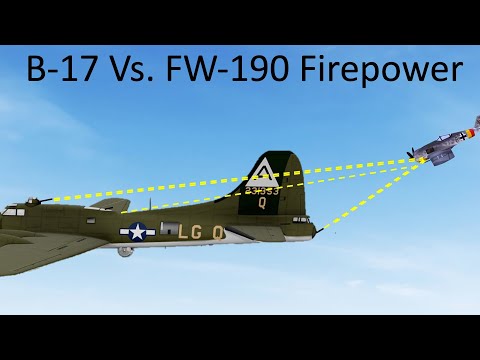
How? The answer lay in the geometry of the attack. When an FW-190 pressed its attack to close range—necessary to land killing hits with the MK 108, whose low muzzle velocity demanded a short firing window—it flew into the overlapping cones of fire from multiple bombers at once. A single Fortress threw five guns at the fighter; a combat box of eighteen threw ninety.
The German pilot who dove into that box was threading a needle of tracers, and the .50-caliber Browning, while lacking the explosive punch of a 30mm shell, had one advantage the German cannons did not: volume. Belted armor-piercing incendiary ammunition, loaded one hundred percent in late-war belts, could punch through the FW-190’s armor plating and set fuel lines alight.
“The largest armament effect was swapping out the ring-and-bead sights for reflector and compensating gun sights and the addition of 100% belted armor-piercing incendiary ammo,” the September 1945 technical service command report concluded. The bomber was not trying to out-gun the fighter. It was trying to make every one of its few shots count.
There was another factor the firepower charts could not capture: the human one. An FW-190 pilot attacking a formation had to hold his nerve through a wall of defensive fire, close to within a few hundred yards, and fire accurately before breaking away. Every pass through the box risked a face full of .50-caliber rounds. Many Luftwaffe pilots, veterans of the Eastern Front, described the American combat box as the most terrifying sight in the air war.
The bomber crews, meanwhile, flew with the knowledge that survival depended on discipline. Stay in formation, keep the guns trained, and never—never—fall behind. The straggler was not merely unlucky. He was the statistical majority of the dead.
So the duel between the B-17 and the FW-190 was never a fair fight, and it was never meant to be. It was a contest between two doctrines: the German doctrine of maximum destructive power concentrated in a single interceptor, and the American doctrine of mutual defense through numbers and formation. The charts favored the German fighter. The casualty figures, in the end, told a more complicated story.
By the final months of the war, the FW-190’s evolution had reached its apex with the R4M air-to-air rocket—a single hit could destroy a bomber outright. “A single R4M air-to-air rocket will destroy a bomber on one hit,” the analysis confirmed. Yet this ultimate weapon was born of desperation, fired in salvos from beyond cannon range by pilots who often never saw their targets fall.
The B-17, meanwhile, remained what it had always been: a bomber first, a gun platform second. Its .50-caliber Brownings never matched the FW-190’s destructive coefficient, but they did not need to. The bomber’s true weapon was the formation itself—eighteen aircraft flying as one, throwing ninety guns into a single killing zone.
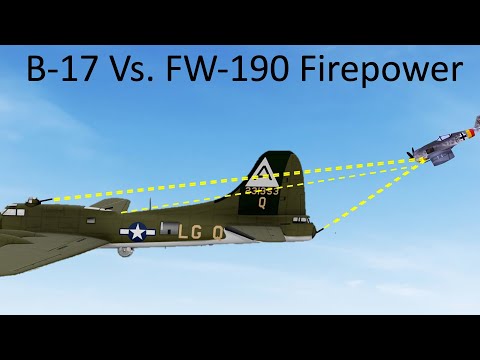
In the end, the firepower charts told only half the story. The FW-190 won every mathematical comparison, yet Germany lost the air war. The bomber that could never bring more than five guns to bear in any direction helped level a continent’s industry, while the fighter that out-gunned it by a factor of 3.9 ran out of fuel, pilots, and factories.
“To match the firepower of an FW-190, a straggling bomber would need 20 .50-caliber machine guns bearing in the fighter’s direction,” the report concluded. Twenty guns. The B-17 had five. But the B-17 never fought alone—and that, more than any cannon or rocket, was the difference between victory and defeat.
So which platform truly mustered more firepower: the B-17 or the FW-190? The charts say one thing. The wreckage of two air forces says another. What do you think—was the bomber’s mutual defense the real weapon, or was the German fighter’s raw destructive power simply wasted on a lost cause? Share your thoughts below.
Report this article
Select a reason for reporting:






