In the annals of World War II, few stories are as compelling as the rise and fall of the Luftwaffe. At its peak, it was a force that seemed unstoppable, a symbol of Nazi Germany’s technological prowess and military might. Yet, within a few short years, it was reduced to a shadow of its former self, overwhelmed by the combined air power of the Allies. How did this happen? What fatal mistakes did Nazi Germany make that led to the death of the Luftwaffe?
For decades, historians have debated the exact causes of the Luftwaffe’s decline. Some point to the failure to develop strategic bombers, others to the lack of coordination with the navy, and still others to the meddling of Hitler and Göring in aircraft production. But perhaps the most intriguing aspect of this story is the role of the Messerschmitt Me 262, the world’s first operational jet fighter. A technological marvel that could have changed the course of the war, it instead became a symbol of the regime’s hubris and inefficiency.
The story begins in 1933, when Adolf Hitler became Chancellor of Germany. Determined to restore Germany’s military strength, the Nazi regime quickly recognized the importance of a powerful air force. In 1935, the Luftwaffe was officially born, with Hermann Göring, a World War I fighter ace, at its helm. Göring, however, was not a man of technology. “This thing is a box with files, and I don’t like boxes with files,” he reportedly said, dismissing the importance of technological innovation. Instead, he believed that courage and bravery were all that mattered.
Despite Göring’s attitude, Germany had many advantages in building its air force. The country boasted a first-class aircraft industry, with companies like Messerschmitt, Dornier, Heinkel, Junkers, and Focke-Wulf. Brilliant engineers pushed the boundaries of aerodynamics, and a highly educated population could build aircraft on a massive scale. By 1938, production had risen to over 5,000 aircraft, and a year later, it exceeded 8,000. The Nazis were using new machines and technologies, but they employed them in service of an old way of war. They looked to their traditions and incorporated new technologies into them, rather than looking to the future.
Before the war, the Luftwaffe was impressive. It had the Me-109, a superior single-engine fighter; the Junkers 87 Stuka, a terrifying dive-bomber; and the Heinkel 111 and Dornier 17, two first-class medium bombers. Additionally, it had the largest transport fleet in the world, the Junkers 52, which would be the backbone of German offensives. But one crucial element was missing: a strategic bomber. The lack of a long-range bomber would haunt the Luftwaffe throughout the war.
In 1935, General Walther Wever recognized this gap and championed the construction of long-range bombers, which he called the “Ural bomber.” He believed that to defeat the Soviet Union, Germany needed to destroy its industry in the Ural Mountains. “Air power carries the war into the heart of the enemy country from the moment hostilities break out,” Wever wrote. He pushed for the Dornier 19 and Junkers 89, but neither matched the performance of the American B-17 Flying Fortress. Wever’s death in a plane crash in 1936 put an end to the program, and Göring canceled the projects.
Göring’s decision was not necessarily wrong. For Germany, building such aircraft required large amounts of rubber, metals, and fuel, all of which had to be imported at great cost. Of the 4,500 tons of aluminum needed monthly for aircraft production, only half was available during Wever’s time. The air force he envisioned was simply uneconomical. Instead, Germany focused on tactical air power, designed to defeat enemy armies in the first weeks of combat. This approach worked well in the early years of the war, but it would prove inadequate against the industrial might of the United States and the Soviet Union.
As the war progressed, the Luftwaffe’s failures became apparent. The lack of coordination with the Kriegsmarine, the German navy, was a major issue. Göring, who claimed “everything that flies belongs to me,” fought bitterly against any attempts by the navy to get its own air arm. When Admiral Dönitz went behind Göring’s back to Hitler to get Focke-Wulf 200 Condors for maritime patrol, Göring was furious and cut off all cooperation. This lack of cooperation would prove costly, as the Focke-Wulf 200, even in small numbers, demonstrated how effective a coordinated air-naval strategy could have been.
Another critical failure was the lack of maintenance and repair infrastructure. When an aircraft was damaged, it was sent back to Germany for repairs. In a short, tactical war against France, this system worked. But in a long war of attrition against the Soviet Union, it was a disaster. By 1941, less than 30% of Luftwaffe airfields were operational, a fact that was almost inconceivable given that Germany was fighting on two fronts.
The invasion of the Soviet Union in June 1941 was a catastrophic mistake for men like Göring, who had never fought on the Eastern Front in World War I. They underestimated Soviet will and industrial capacity. By relocating its factories beyond the Ural Mountains, the Soviet Union put them out of reach of German bombers. The ghosts of General Wever returned to haunt the Luftwaffe.
After the Japanese attack on Pearl Harbor, Germany declared war on the United States. This decision added another enemy with unparalleled production capacity. By 1944, the United States was producing over 96,000 aircraft annually, one every five minutes, more than double Germany’s output. The Luftwaffe was outmatched.
One of the Luftwaffe’s failures was its inability to rationalize procurement and production. Prototypes were built and abandoned, rebuilt and modified on Hitler’s orders, and abandoned again. This lack of planning and foresight can be attributed to Ernst Udet, a World War I ace appointed to manage Luftwaffe production in 1936. Udet knew nothing about technology, and his tenure was marked by disastrous decisions, such as ordering the Heinkel 177 to be converted into a dive-bomber, which led to numerous technical problems.
As the war turned against Germany, the Luftwaffe found itself increasingly on the defensive. The strategic bombing campaign by the Allies devastated German cities and industries. By 1944, Germany was outproduced in aircraft by more than four to one. The introduction of the Me 262 jet fighter, a revolutionary aircraft, came too late and in too few numbers to make a difference. Hitler’s insistence that the Me 262 be used as a bomber rather than a fighter further delayed its deployment.
The final nail in the coffin was the lack of trained pilots. By 1944, the average training time for German pilots had dropped to just over 100 hours, compared to over 300 hours for Allied pilots. With air superiority lost over Germany, the Luftwaffe was decimated. The once-proud air force was reduced to a mere shadow of its former self.
The death of the Luftwaffe was not due to a single mistake but a series of fatal decisions: the failure to develop strategic bombers, the lack of coordination with the navy, the meddling of Hitler and Göring, the mismanagement of production, and the failure to train enough pilots. These mistakes, compounded by the overwhelming industrial might of the Allies, sealed the fate of Nazi Germany’s air force. The story of the Luftwaffe is a cautionary tale of how arrogance, inefficiency, and hubris can bring down even the most powerful of institutions.
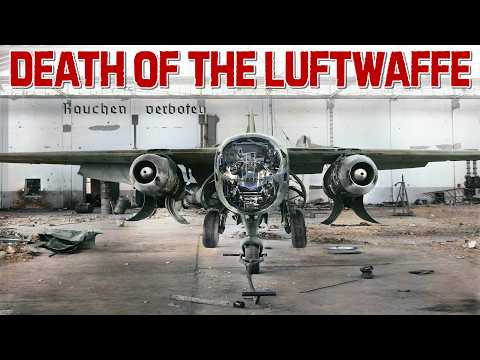
Yet even as the Allies closed the ring, the Luftwaffe’s engineers produced machines that hinted at what might have been. The Me 262 was not the only marvel. The Arado 234 jet bomber, the rocket-powered Me 163 Komet interceptor, and the Dornier 335 Arrow—the fastest piston-engine aircraft of the war—all emerged in the final months. These were aircraft that could have made a difference on both fronts, but they arrived too few and too late.
The Me 262 itself was a case study in wasted potential. Its swept-wing design, born from supersonic wind tunnel research, gave it a speed of 568 mph—a quantum leap over the Spitfire Mark XIV’s 446 mph. As one test pilot recalled, “When I first saw it, I realized this was an aircraft of a completely different appearance.” Its four 30mm cannons packed a devastating punch, designed to shred B-17 Flying Fortresses with a single burst.
But the jet had two fatal flaws. Its engines were incredibly fragile. “The German axial-flow jet engines had a scrap life of 25 hours,” one expert noted, “and by the end of the war, Adolf Galland told me his unit’s average engine life was just 12 and a half hours.” Throttle movements had to be handled with extreme care—too rapid an acceleration or deceleration could set the engine ablaze.
Worse still, no one had thought to install airbrakes. The Me 262 was so fast that when it dove on Allied bombers, the closing speed was immense. “You had two seconds before you had to break away,” a pilot explained. “You didn’t sight—you just pressed the button and hoped you were pointing in the right direction.” With four seconds, he added, a pilot could have aimed properly. That single omission cost the Luftwaffe dearly.
And yet, the Me 262’s story is not merely one of technical failure. It is a story of a regime that could not get out of its own way. Hitler’s insistence that the jet be used as a bomber—“even the smallest child can see that the 262 is a fighter, not a bomber,” Marshal Milch raged—delayed its deployment by months. By the time it entered service as a fighter-interceptor, the war was already lost.
The same pattern repeated across the Luftwaffe’s entire procurement system. The Heinkel 177, with its bizarre twin-engine arrangement and Udet’s mad demand that it be a dive-bomber, became known as the “dead racehorse.” The Messerschmitt 210 was ordered into mass production before it could even fly properly, forcing the conversion of many airframes into the Me 410. “Everything turns to dust in Udet’s hands,” one aircraft representative lamented.
Only one aircraft, the Focke-Wulf 190, proved truly successful during Udet’s tenure. It was, by all accounts, a superb fighter—versatile, rugged, and adaptable. As the war progressed, it was pressed into service as a fighter-bomber, a role in which it proved surprisingly effective against trains and convoys. From 1942 to the end of the war, the Focke-Wulf 190 remained at the top of the Luftwaffe’s fighter and fighter-bomber ranks.
But one successful design could not compensate for systemic failure. By 1944, Germany was outproduced in aircraft by more than four to one. The United States alone was building over 96,000 aircraft a year—one every five minutes. The Luftwaffe’s total production in 1941 had been just over 11,000 aircraft, a mere fraction of what was needed. The numbers told a grim story: Germany could not win a war of attrition against the industrial might of America and the Soviet Union.
The Luftwaffe’s collapse was not a single event but a cascade of fatal choices: no strategic bomber, no naval air arm, no rational production, no pilot pipeline. Each blunder compounded the last, until the once-mighty force was reduced to a handful of wonder-weapons flown by boys against overwhelming odds.
By 1945, the Me 262 and its kin were scattered across shattered airfields, their engines lasting barely twelve hours, their pilots barely trained. The Allies swept the skies unopposed. In the end, the Luftwaffe was not defeated in the air alone—it was strangled by hubris, mismanagement, and a regime that mistook courage for technology.
What if Wever had lived? What if Göring had shared power with the navy, or Udet had never touched production? History offers no second chances. But the lesson endures: no amount of engineering brilliance can save a force that refuses to learn, adapt, and let its experts lead.
So here is the question for you: was the Luftwaffe’s fate sealed by Hitler’s meddling and Göring’s ego, or by something deeper in the Nazi system itself? Share your thoughts below.
Report this article
Select a reason for reporting:






