Marcus Bennett had restored hundreds of 19th-century photographs, but the moment he slid the fragile portrait from its envelope, he knew this one was different. Two young boys, one white and one black, sat shoulder to shoulder in matching velvet-collared suits, their hands resting close together—a pose that would have been unthinkable in 1890 Charleston. As Marcus began the digital restoration, he noticed something chilling: the boys’ smallest fingers were interlinked, and behind the painted backdrop, a shadowy figure watched. This was no ordinary portrait. It was a crime scene.
Marcus’s breath caught as he enhanced the image further. The shadowy figure behind the backdrop—a woman, he realized—had a hand raised to her face. She was weeping. The studio stamp on the back read “Ellsworth Photography, 1890,” and a penciled inscription named the boys: Thomas and Samuel. Below that, in darker ink: “Before everything changed.”
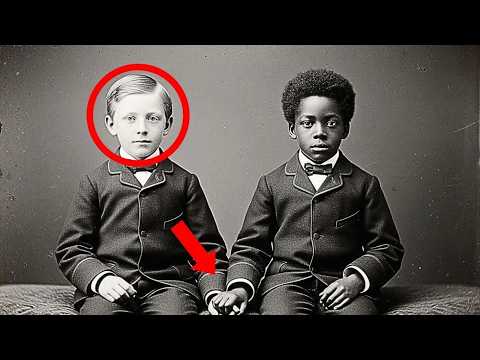
Within days, Marcus uncovered a newspaper article from April 1890. Arthur Ellsworth, the photographer, had faced outrage for treating black and white subjects with equal dignity. “A child is a child,” Ellsworth had defended, “and all deserve to be remembered.” The controversy destroyed his business. But it was a diary entry from Adelaide Whitmore that shattered Marcus: “The boy insisted that Samuel be included, dressed identically as his equal and friend. Mrs. H could not refuse him, though she knows the danger.”
Marcus traced the boys to the Harrison plantation. Thomas was the white owner’s son; Samuel, the black housekeeper’s son. Born the same year, raised side by side, they had forged a friendship that defied the Jim Crow South. But by June 1890, Adelaide’s diary recorded the unthinkable: “Ruth and Samuel are gone. The Colonel sent them away in the night.” Threats from white supremacists had made their friendship a target. Thomas locked himself in his room and refused to eat.
Decades later, Samuel—now a teacher and civil rights activist in Philadelphia—wrote a letter to Thomas. It was returned unopened, marked “correspondence from colored individuals will not be accepted.” Samuel kept it sealed for the rest of his life. Thomas never married. In a letter to Adelaide, his mother confessed: “He gave his heart to a friend when he was 8 years old, and that friend was taken from him. The world stole his capacity for love.”
Marcus sat back, tears stinging his eyes. The photograph was not just a relic—it was a memorial to a friendship destroyed by racism. But as he prepared to return the restored image, a new question surfaced: what had happened to Samuel’s copy of the portrait, the one his mother kept hidden in her Bible? And why had someone written “before everything changed” on the back—as if they knew the story was far from over?
Marcus’s inquiry into the whereabouts of Samuel’s copy led him back to Dr. Denise Williams at Temple University. She had catalogued Samuel’s papers thoroughly, but the photograph itself was not among them. “It’s possible it was lost, or that Ruth destroyed it,” Dr. Williams wrote. “But there’s one more lead. Samuel’s daughter, Eleanor, donated some of his belongings to a small historical society in Germantown before she passed. They might have items that weren’t in the formal archive.”
Marcus contacted the Germantown Historical Society. The curator, a meticulous woman named Janet, found a box labeled “Evans, S. — personal effects” in their basement storage. She described its contents over the phone: old teaching certificates, a worn leather wallet, and a small, tarnished locket. “There’s also a photograph,” Janet said, “but it’s in poor condition. It looks like it was folded and carried for years.”
Marcus requested a high-resolution scan. When it arrived, his heart clenched. It was the same portrait—Thomas and Samuel in their matching suits—but this copy had been folded along the crease between the two boys, as if someone had carried it in a pocket for decades. The fold had worn a thin line through the image, separating Thomas from Samuel. On the back, in Samuel’s neat hand, was written: “My brother, my friend, my heart. Until we meet again.”
Marcus shared the discovery with Richard Hartwell, who was deeply moved. “This changes things,” Richard said. “The photograph isn’t just a document—it’s a relic. Samuel carried it with him his whole life. We need to reunite the two copies, at least in an exhibition.” They agreed to loan Samuel’s copy to the Avery Research Center for a special display alongside the restored original.
But Marcus wasn’t finished. He returned to Adelaide Whitmore’s diary, searching for any mention of the photograph after 1890. There was one entry, dated 1905, that he had previously overlooked. “Margaret showed me the photograph again today. Thomas has taken to sleeping with it under his pillow. He says it’s the only thing that keeps the nightmares away. I fear for his mind, Adelaide. He is a grown man now, but he is still that boy, waiting for his friend to come back.”
Marcus wondered if Thomas ever knew that Samuel had tried to reach him. The returned letter had been intercepted, but had Thomas ever learned of it? Margaret’s 1919 letter mentioned that Thomas had found the letter and wept—but that was after Samuel had sent it in 1918. Thomas had been 36 years old. He had known, then. He had known that Samuel had not forgotten him.
The exhibition opening approached. Patricia, Samuel’s great-granddaughter, called Marcus with a request. “Could we display the two photographs side by side? The restored one and the folded one? I want people to see what my great-grandfather carried with him all those years.” Marcus agreed immediately.
On the morning of the opening, Marcus stood before the display case. The restored portrait glowed with new life, the boys’ faces clear and hopeful. Beside it, Samuel’s folded copy looked fragile and worn, the crease a scar across the image. Two copies of the same moment, separated by decades and distance, now reunited. He thought of Thomas sleeping with the photograph under his pillow, of Samuel carrying his folded copy in his pocket. Both men had held onto the same memory, the same love, until the end of their lives.
As visitors began to arrive, Marcus noticed William Harrison, Thomas’s great-grandson, standing alone before the display. He was staring at the folded photograph, his eyes wet. “He folded it right between them,” William said softly. “He couldn’t bear to see them separated, even in a picture.” Marcus nodded, unable to speak.
Patricia joined them, and the three stood in silence. Then William reached into his pocket and pulled out something small and metallic. “This was in Thomas’s study,” he said. “A locket. It was empty, but I always wondered what it was for.” He handed it to Patricia. She opened it carefully. Inside, on one side, was a tiny, faded photograph of Samuel as a boy—the same image from the portrait, cut to fit. On the other side, a lock of dark hair.
Patricia’s hands trembled. “He kept a piece of him,” she whispered. “All those years, he kept a piece of Samuel.” William nodded. “And my family never knew. We thought he was just a lonely old man. We never understood.”
Marcus looked at the locket, then at the two photographs. The story was still unfolding, still revealing its secrets. He realized that the photograph had been more than a document of friendship—it had been a lifeline for both men, a way to hold onto each other across the impossible distance of race and time. And now, in this exhibition, their descendants were finally completing the connection that had been so brutally severed.
Patricia carefully closed the locket and pressed it into William’s palm. “You should keep this,” she said. “It belongs with your family now. But promise me you’ll bring it to the next reunion.” William nodded, unable to speak, and slipped the locket back into his pocket.
The exhibition drew record crowds. School groups, historians, and ordinary visitors stood before the two photographs, reading the diary excerpts and letters Marcus had painstakingly transcribed. Many left in tears. But it was a comment in the guest book that caught Marcus’s attention: “My grandmother always said our family had a secret from the old days. Now I know what it was. Thank you for telling the truth.” The signature was a name Marcus didn’t recognize—a descendant of one of the men who had threatened the Harrison plantation in 1890.
Marcus tracked down the signer, a retired schoolteacher named Carolyn Hayes. She agreed to meet him at the Avery Center. “My great-grandfather was one of the Red Shirts,” she said quietly, her eyes fixed on the photograph. “He was a violent man. My grandmother was terrified of him. She told me once that he had done terrible things to keep the races separate. She never gave details, but she said he had ruined lives.” Carolyn paused, her voice trembling. “I’ve spent my whole life trying to make up for what he did. But I never knew the specifics. Until now.”
Carolyn asked if she could write a response to the exhibition, a public acknowledgment of her family’s role in the tragedy. Marcus and the Avery Center agreed. Her statement was printed on a placard and placed beside the photographs: “My ancestor was one of the men who threatened the Harrison plantation in 1890. His actions, and the actions of men like him, destroyed a friendship and scarred two families for generations. I cannot undo his crimes, but I can name them and ask for forgiveness. The work of justice is not just remembering the victims—it is also confronting the perpetrators.” Patricia and William stood beside Carolyn as she read it aloud at a small ceremony.
The three descendants embraced, and Marcus felt a weight lift from the room. The photograph had become a catalyst for truth-telling, for reckoning. But he knew the story still had loose ends. Samuel’s journals mentioned that his mother, Ruth, had kept the photograph hidden in her Bible. Where was that Bible now? He asked Dr. Williams, who promised to search the Evans family papers once more.
A week later, Dr. Williams called with news. “I found a reference in Eleanor’s letters. She mentioned donating her grandmother’s Bible to a church in Germantown—the same church that helped Ruth when she first arrived in Philadelphia. The church is still there. They might still have it.” Marcus contacted the pastor, who confirmed that the Bible was in their archives, though it had never been catalogued.
Marcus drove to Germantown the next day. The pastor, an elderly man named Reverend Coleman, led him to a storage room filled with old hymnals and records. “We don’t throw anything away,” he said with a smile. “You never know what might be a treasure.” He pulled a worn leather Bible from a shelf. Inside the front cover, in faded ink: Ruth Evans, her book. Marcus opened it carefully, his hands trembling. Between the pages of the Book of Psalms, he found a small, faded photograph—the same portrait of Thomas and Samuel, but this copy had been trimmed to fit the Bible’s pages. On the back, in Ruth’s handwriting: “My son and his friend. May God keep them both.”
Marcus stared at Ruth’s Bible for a long moment. Three copies of the same photograph, carried by three people who never stopped loving what it represented. “She kept it in the Psalms,” he murmured. “Where David cries out to God for justice.”
He arranged for the Bible to be displayed alongside the photographs at the Avery Center, and on the final day of the exhibition, Patricia and William stood before it together. William opened the locket and laid it beside Ruth’s Bible. “Thomas and Samuel,” he said, “reunited at last.”
Marcus thought of Ellsworth’s words—a child is a child, and all deserve to be remembered—and realized the portrait had finally fulfilled its promise. Two boys, one moment, and a love that outlasted the world that tried to kill it.
But the story isn’t truly over, is it? What would you have done if you’d found the photograph in your own family’s attic—and what will you do now that you know?
Report this article
Select a reason for reporting:






