December 25, 1944. Camp Ashcan, Luxembourg. The air was thick with coal smoke and damp bread dough. Somewhere in the fog, metal trays clanged like distant bells. Inside a drafty American kitchen, a German prisoner in a torn field coat carefully poured white flour into a US Army mess tin. His fellow POWs laughed. A captured cook baking for his captors—it looked ridiculous. But forty minutes later, the laughter stopped. Because what came out of that oven didn’t just feed soldiers. It broke something much harder than hunger.
This is the true story of how a few captured German cooks turned a prison kitchen into a place of peace and changed how enemies saw each other. Before he was Prisoner H-176, he was Master Baker Carl Müller from Hamburg. In civilian life, his bread supplied half the naval base at Wilhelmshaven. He’d been trained in the old guild system, a hierarchy where apprentices rose by mastering the invisible—air, heat, timing. “Flour isn’t dough,” he once told his assistant. “It’s potential.” By 1943, that potential was reduced to crusts and ersatz coffee. The war had stripped even the ovens bare.
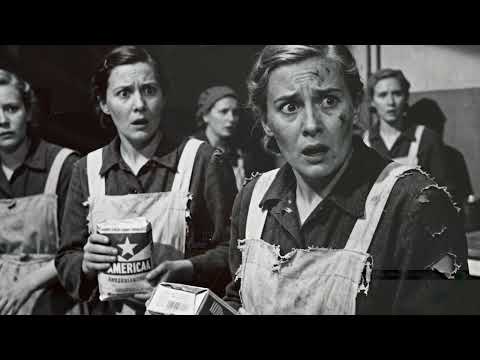
Inside Camp Ashcan, the Americans noticed something unusual. The German POWs requested yeast, not tobacco. A corporal noted in his log: “They’re asking for kitchen duty, not escape, not better beds. Kitchen duty.” It was an inversion of norms. Most POWs avoided manual work. These men sought it. But their new kitchen wasn’t built for finesse. It was a converted stable—smoke-filled, soot on every wall, flour rationed by the ounce.
Carl began testing his hands again. He pressed dough with a soldier’s precision, measuring heat by scent, not thermometer. He knew the American flour—high-gluten Kansas wheat—would behave differently than the rye of home. He adapted quietly, reducing proofing times, adjusting salt levels. The Americans watched, curious. To them, a POW baking bread seemed almost comical, a man needing humility itself. But this was only the beginning. Within weeks, his small act of labor would become the foundation for one of the strangest experiments of the war: enemy cooks feeding their captors.
Christmas morning, 1944. Snow pressed against the tin roofs of Camp Ashcan, muting every sound except the clatter of empty trays. Inside the mess hall, steam rose from kettles that hadn’t boiled in two days. The Americans were short on everything—fuel, sugar, even manpower. Official rations were grim: 1,800 calories per man, half the recommended intake for winter. Some prisoners had dropped fifteen pounds in a month. When an army medic took blood samples, he noted in his report: “Morale low, complexion gray, breadcrusts traded like currency.”
In the corner stood the enemy cooks—Carl Müller, Otto Becker, and two others—waiting for orders. The Americans distrusted them. After all, these were men who once fed the Wehrmacht. They might sabotage a meal as easily as season it. Still, there was no choice. The American cooks had been reassigned to the front. The ovens were empty. Lieutenant Sam O’Hara, the camp’s supply officer, issued a simple, risky command: “Put the Germans in the kitchen. Feed everyone. No exceptions.”
It sounded absurd. Feed the guards and the prisoners from the same pot—against every regulation. But the camp stores were worse than the fear. They had ten sacks of flour, one tin of lard, two dozen cans of beans, and no replacements coming until January. Carl studied the storeroom like a battlefield. He counted out rations by instinct: three pounds of flour for twenty men—two for bread, one for dumplings. He taught his team to stretch flavor, frying stale crusts in bacon grease, reusing steam water for soup stock. When Otto suggested saving the best ingredients for the Germans, Carl shook his head. “If we feed them worse, we stay enemies. If we feed them better, we become thieves. So we feed them the same.”
The first batches came out uneven. One tray burned black, another fell flat. The Americans jeered. “Guess the Reich ran out of yeast, too!” shouted a guard. Carl ignored it. He marked down the oven’s hot spots using charcoal and memory, adjusting the trays by rotation—a small act of precision in a world of chaos. By dusk, the smell of baking bread filled the compound. It wasn’t perfect—heavy, uneven, cracked at the edges—but it was real bread, the kind both sides remembered. An American private approached the counter, sniffed, and muttered, “Smells like home.”
That night, the officers logged an unprecedented note: All personnel, including POWs, received identical meals. No incident. It was a first in that camp—maybe in the entire war theater. And though the prisoners were still behind wire, the barrier between us and them had thinned, replaced for a moment by the scent of warm bread.
Three days later, the American sent in Inspector Harold L. Burns, a logistics officer from the Quartermaster Corps. His assignment was straightforward: ensure no rations were being redirected by German hands. But what he found was efficiency. Burns noted in his field report: “POW kitchen exceeded quota by 12%. Output consistent despite limited supplies. Recommend observation.” In other words, the captured cooks were feeding more people with less food—and no one could explain how.
Inside the converted stable, Carl Müller was running experiments like a field scientist. He’d improvised a proofing chamber from a coal locker, maintaining steady heat with damp cloths and a thermometer he’d repaired from broken watch parts. Otto rigged a dough mixer using a salvaged bicycle chain. They replaced scarce lard with mashed beans, substituting flavor from brown flour and saltwater glaze—the kind of wartime alchemy born from desperation.
Each morning smelled of yeast and iron. Dough rose beside fuel cans. Steam clouded the windows. When the Americans peeked in, the scene looked chaotic—white dust everywhere, men arguing in half English, half German. But beneath it all was precision. Carl tracked ratios in chalk on a stable wall: Flour 100, water 60, yeast 2, salt 1.5. A formula that never failed, no matter the flour’s origin.
Burns asked, half joking, “You trying to feed the whole camp or win the war?” Carl replied softly, “Feed first, then maybe the rest.”
But improvisation carried risk. One afternoon, the temperature dropped to eight degrees Celsius. The proofing dough froze solid overnight. Their next batch emerged flat, lifeless—a wasted forty pounds of flour. A week’s ration. The Americans threatened to pull the Germans from the kitchen. Carl didn’t argue. Instead, he returned to his notes, adjusting the recipe again—this time, lowering the yeast and proofing longer by the stove’s residual heat. The next morning’s loaves came out perfectly browned. Burns tasted a slice and said simply, “Keep at it.” It was more than permission. It was trust—and trust in wartime was as rare as sugar.
By January 1945, production had doubled. The POW bakery was turning out over six hundred loaves per day—enough to feed guards, prisoners, and even nearby labor crews. The Americans began sending observers. What they witnessed went beyond food. It was discipline, pride, and structure—returning to men stripped of all three. Carl logged everything: flour weights, heat retention curves, cooling times. He wasn’t baking for survival anymore. He was testing a system—a system built not on ideology, but on shared hunger.
But as the smell of success spread beyond the wire, so did suspicion. Some officers worried the Germans were building influence—or worse, sympathy. An order came down from headquarters: Reduce autonomy. Supervision required. That single line would spark the next transformation—one that would push the experiment from improvisation into ideology.
January 8, 1945. A letter arrived, stamped HQ, Allied Psychological Warfare Branch. It carried one simple instruction for Camp Ashcan: Continue POW kitchen operations. Extend meals to all. Observe for morale effects. The experiment had become official.
Lieutenant O’Hara gathered his men in the mess hall and read the order aloud. Some laughed; others grumbled. Feeding the enemy was one thing. Studying their happiness was another. But O’Hara had no say. The command came from higher than him—from officers who believed morale was a weapon.
Outside, the snow thickened. Inside, Carl Müller and his cooks listened as the interpreter translated the new rule: “You will feed everyone—American and German alike—every meal. Same rations, same portions.” Otto frowned. “Same?” Carl nodded. “Then we must make it worthy of both.”
From that moment, the kitchen became neutral ground. Each day began before dawn—all four thirty hours. The Germans were woken by the same bell as the guards. Dough mixed with water rationed by the half cup. The ovens glowed faintly red against the darkness. They weren’t just baking bread now. They were baking discipline into routine. One American corporal later recalled: “It was strange. You’d see them sweating over the ovens, humming their own songs. For a few hours, nobody cared who wore what uniform.”
But the stakes were rising. The camp’s population had swelled from twelve hundred to eighteen hundred POWs, and food shipments lagged behind. Every pound of flour mattered. Every miscalculated batch could starve fifty men. To meet the quota, Carl introduced a radical new method—a continuous bake rotation. Three shifts overlapping, using oven heat from one batch to ignite the next. It saved twenty percent of the coal supply, a figure confirmed in O’Hara’s log book.
The Americans began taking notes. Efficiency methods observed—could apply to field kitchens, forward units. And so the cooks who’d once baked for the Wehrmacht were now unknowingly shaping the logistics of their captors. But Carl’s focus wasn’t politics. It was precision. He began training new assistants—younger POWs, barely twenty. He showed them how to test dough elasticity by feel, how to listen for the dull thud of underbaked loaves. He corrected in whispers, not orders. In the evenings, when the ovens cooled, he wrote quietly in a notebook made from ration wrappers: Bread. Order. Order. Dignity.
For the first time, the Americans noticed something unquantifiable: the German cooks were happier. Discipline, productivity, even posture improved. A psychologist from the Allied branch wrote in a memo: “Culinary labor appears to restore identity faster than manual labor. Recommend further trials.” The kitchen had become a social experiment—and a fragile one. Because outside the wire, news from the front was grim. The Battle of the Bulge still raged. American rations were being redirected to Belgium. The next supply truck might not come.
So when O’Hara stepped into the bakery one morning and said, “Men, we’re out of lard, sugar, and half the salt,” Carl didn’t hesitate. He simply wiped his hands, looked up, and said, “Then we start again without them.”
January 18, 1945. The temperature at Camp Ashcan dropped to twelve degrees. The supply trucks never arrived. O’Hara counted aloud: “Flour, one sack. Beans, five tins. No fat, no salt.” Two days to feed nearly two thousand men. Impossible—and yet Carl simply nodded.
They lined the trays with waxed paper peeled from ration boxes. They kneaded with water from melting snow. One man cut his hand on a tin edge; another kept mixing despite frostbitten fingers. The air filled with the rhythmic thump of dough against wood, steady as a drumbeat. The first loaves came out dense and pale. Carl split one open, watched the steam rise, and smiled faintly. “Slice thinner, feed more.”
By dusk, every table held the same meal—half a slice of bread, one ladle of bean broth, hot water for tea. Guards and prisoners stood in the same line, breath clouding in the cold. Then a private from Iowa raised his slice: “Merry Christmas, I guess—even if it’s January.” Laughter followed. Not mockery this time, but something lighter.
O’Hara wrote that night: Bread was hard, but morale high. No conflict recorded. When the ovens cooled, Carl sat alone by the coals and wrote one line in his notebook: Even hunger can be shared.
Years later, archivists would measure what that winter began—treaties in flour, peace in loaves. But for now, in the stillness, it was enough. They had fed everyone.
So the next time you smell bread, remember Camp Ashcan. If a single loaf could turn enemies into neighbors in 1945, what small act of yours could do the same today?
Report this article
Select a reason for reporting:






