The war was over, but the women didn’t know it yet. Not really. In the smoldering ruins of Europe, where Hitler’s thousand-year Reich had collapsed in just twelve, 120 German women sat in a holding camp in Singapore, waiting for the monsters they’d been promised. They had served the Reich as nurses, communications officers, auxiliaries. Now they were prisoners, and the propaganda had been clear: the Australians were barely civilized. They would treat captured women like animals.
So when the transport ship Dantrun finally docked in Australia, the women lined up on deck with stiff spines and stone faces, bracing for cruelty. They had no reason to doubt the warnings. When a regime controls every newspaper and radio broadcast, you believe what you’re told.
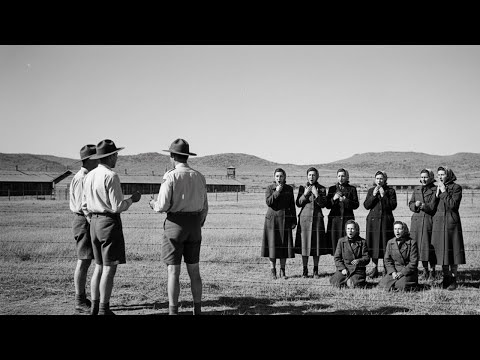
Then a young Australian soldier approached. He didn’t snarl. He didn’t carry a whip. He nodded politely and said, “Ladies, if you’ll follow us, please.”
Ladies. The word hit like a bomb. A former nurse turned to her friend and whispered, “Did you hear that?” Her friend’s eyes went wide with confusion.
In the 200 yards from ship to truck, the women saw guards holding doors open. One soldier picked up a fallen bag and handed it back with a smile. Another offered his canteen to an older woman who looked thirsty. These small kindnesses felt like explosions in their minds. This wasn’t how enemies behaved. This wasn’t what they’d been taught.
The camp was called Tatura, in Victoria. Barbed wire topped the gates, but the wire looked almost decorative compared to the prison camps of Europe. Low white buildings with red roofs gleamed in the afternoon sun. Roses climbed trellises. Vegetable patches showed neat rows of tomatoes and beans. It didn’t look like a prison. It looked like a small village.
Each woman received her own bed. Not a bunk shared with three others, but an individual metal frame with a real mattress, clean white sheets, two wool blankets, and a soft pillow. One woman sat down and bounced slightly, testing it. She had slept on wooden boards for the last year of the war. “They’ll take it away tomorrow,” she whispered to herself. “This must be a mistake.”
But nobody came to take the mattresses away.
That evening, the women walked to the dining hall expecting watery soup and a crust of bread. Instead, the smell hit them first—rich, cooked meat that made their stomachs clench with desperate hunger. The first woman in line held out her plate and watched in disbelief as the server placed a piece of roasted chicken on it. Four ounces of real meat, golden brown and steaming. Then potatoes mashed with butter that glistened on top. Then carrots, bright orange and tender. Then a thick slice of white bread, soft and fresh, with a pat of yellow butter beside it.
The woman carried her plate to a table and sat staring at it. Other women joined her, all silent, all looking at their plates like they were seeing a magic trick. “This can’t be for us,” one finally said. “This must be Officer Rations. They made a mistake.”
A guard walking past heard her and smiled. “No mistake, love,” he said in his Australian accent. “That’s your dinner. Eat up.”
The women ate slowly at first, afraid the food would vanish. Then faster, scooping potatoes into their mouths, tearing at the chicken with their fingers, soaking the bread in butter until it dripped. Some cried while they ate. The last time they had tasted this much food at once had been before the war, in a different lifetime, in a world that no longer existed.
That night they found hot showers, clean towels, and bars of soap that smelled like lavender. They stood under the hot spray until their skin turned pink, washing away months of dirt and fear and the gray dust of a broken empire.
The days that followed brought more shocks. Clean sheets every week. Work assignments in the kitchens and gardens—with small wages they could save. A doctor visited twice a week, free of charge. A dentist came once a month. All of this was given to them, the defeated enemy, by the people who had won the war.
In December, summer arrived, and a truck pulled up carrying large metal containers filled with ice cream—vanilla and chocolate, cold and sweet and creamy. “Merry Christmas,” a guard said with a grin. The women stood in the shade of a tree, eating ice cream with little wooden spoons. One woman laughed out loud, a sound that surprised even her. She couldn’t remember the last time she had laughed.
Slowly, quietly, the women began to question everything. They whispered in the barracks after dark. If the enemy was this kind in victory, what did that say about the propaganda they had believed? If these rough Australian men showed more humanity than their own leaders had, what did that mean about the cause they had served?
The questions grew like cracks in a dam—small at first, then wider, then impossible to ignore.
Easter Sunday arrived in April 1946, almost a year after the women had first stepped off the ship. The Australian autumn was warm and gentle, blue skies stretching forever, a breeze that smelled like grass and flowers. The women had gained weight. Their cheeks had filled out. Their hair had grown longer and healthier. They no longer looked like the hollow-eyed prisoners who had arrived expecting cruelty.
But inside their heads, a war still raged—a battle between what they had been taught and what they were living.
That morning, the guards did something that broke the last walls around the women’s hearts. They organized an Easter egg hunt. The guards had spent the previous evening hiding chocolate eggs all around the grounds—tucked behind bushes, placed on window ledges, hidden among the tomato plants and bean vines. When the women came out after breakfast, an Australian sergeant with red hair and a kind smile stood in the center of the yard holding a basket.
“Ladies,” he called out, using that word again. “We’ve hidden some Easter treats around the camp. Go ahead and find them. They’re yours to keep.”
The women stood frozen, unsure if this was real or some kind of test. Then one of the younger women, a former communications officer named Greta, only twenty-two years old, walked forward slowly and spotted a chocolate egg wrapped in bright foil sitting on a fence post. She picked it up and turned it over in her hands, feeling its weight, seeing her own reflection in the shiny wrapper. She looked back at the sergeant, waiting for him to tell her to put it back, to say it was a joke.
Instead, he smiled and nodded. “That’s yours, love. Happy Easter.”
Greta unwrapped the chocolate and bit into it. The sweetness exploded on her tongue, rich and creamy and real. She started to cry.
Other women began searching, at first hesitant, then with growing excitement. They found eggs hidden in flower pots and under benches, balanced on tree branches and tucked into the corners of the dining hall steps. They laughed and called to each other when they discovered a particularly clever hiding spot. They were playing a game. They were hunting for chocolate. They were being treated not like prisoners of war, not like criminals, not like the defeated enemy, but like guests at a party—like human beings who deserved a moment of joy.
The sound of their laughter filled the camp yard, bright and clear, rising into the blue Australian sky like birds taking flight.
One woman, Ilsa, who had been a nurse in a field hospital near the Russian front, sat down on a bench with three chocolate eggs in her lap. She was thirty-five years old. She had seen men die screaming in her arms. She had worked eighteen-hour shifts with no sleep, no food, and no hope. And now she sat in the sunshine in an enemy prison camp holding chocolate eggs, listening to women laugh, and something inside her chest cracked open like an egg itself.
She thought about the German officers she had served under—the ones who had called her nurse but never her name, who had slapped her for moving too slowly, who had told her that her value was only in what she could do, never in who she was. And she thought about the Australian guards who called her miss and asked if she needed anything, who brought extra bandages when she worked in the camp medical station.
That evening, Ilsa sat in her bunk and wrote in the small diary she had been keeping—a gift from one of the Australian volunteer teachers, a woman named Margaret, who had given each student a little notebook for practicing English. Ilsa wrote in German, her handwriting small and careful.
They treat us with more dignity than our own officers often did, she wrote. When I was sick last month with a fever, the camp doctor came to check on me every day. He brought me aspirin and cool water. He spoke to me gently, like I was a person who mattered. I cannot remember a German doctor doing this for me, even when I was the one caring for his patients. What does this mean? What does it say about us that our enemies show more care than our own people?
The women began to talk more openly in the barracks at night. They spoke in quiet voices, but the words were heavy with meaning. One woman said, “I thought the Australians were poor. The propaganda told us they were backwards and struggling. But look at how they live. The guards eat the same food we do. They don’t eat special officer meals while we starve. Everyone here has enough.”
Another woman, a former auxiliary named Anna, nodded. “They’re not rich because they stole from other countries. This is just how they live. This abundance is normal for them. We were told the Allies were taking food from their own people to feed their armies. But that was a lie. They have so much that they can give it to us—prisoners—and still have plenty.”
The realization settled over them like heavy snow. Everything they had been told about the enemy was backwards. The propaganda had called the Allies subhuman monsters, but the monsters had been the ones creating the propaganda.
One night, Greta sat on her bunk and spoke the thought that all of them had been dancing around for months. “We were on the wrong side,” she said quietly.
The barracks went silent. Someone could have argued. Someone could have defended the Reich, defended Hitler, defended everything they had believed. But nobody did. The silence was agreement. The silence was the sound of a belief system collapsing—of propaganda dissolving like sugar in hot tea, of lies being burned away by the simple truth of kindness.
A woman named Freda, who had worked as a communications officer and had once been proud of her role in the Reich, wrote in her own diary that night. Her words would later be preserved and quoted in historical records. We’d never seen men like this, she wrote. Men who were strong but gentle, who’d won but showed mercy, who could have been cruel but chose kindness. These men treated us better than we’d been taught to treat ourselves. They showed us what real strength looks like. It doesn’t come from cruelty or fear or making others feel small. It comes from having enough power to be gentle, from being secure enough to be generous. We served leaders who told us we were superior, but those leaders treated us like tools to be used and discarded. These Australian soldiers—who we were told were inferior—treat us like human beings with value and dignity. I will never forget this. I will never forget that the people who defeated us showed us more humanity than the people we served.
The transformation was complete. The women who had arrived as loyal servants of the Reich—frightened and defensive—had become something else entirely. They had become people who understood that they had been lied to, used, and thrown away by their own government. And they had learned this lesson not through lectures or punishment, but through the simple act of being treated well by people who had every reason to treat them poorly.
The repatriation orders came in late 1947, more than two years after the women had first arrived at Tatura. By then, the camp had become home in a strange way. The women knew which garden plots grew the best tomatoes. They knew the names of all the guards and which ones told the funniest jokes. Some had learned enough English to read Australian newspapers. Others had taken up hobbies—knitting sweaters, painting watercolors during their free time.
They had gained twenty or thirty pounds on average. Their bodies were finally healthy after years of starvation and stress. They looked nothing like the hollow, frightened women who had stumbled off the transport ship in May 1945.
But now it was time to go home.
They packed their few belongings into the same bags they had carried off the ship—but the bags were heavier now. Savings from camp work, about fifty Australian pounds each. Photographs taken by guards who had become friends. Books in English from the volunteer teachers. A few had letters from Australian families who had visited the camp and written afterward—friendly words from people who had once been the enemy and were now just people.
The ship that would take them back to Germany was called the Sterling Castle. The women stood on deck as Australia disappeared behind them, the red roofs of coastal towns growing smaller and smaller until they were just dots on the horizon, then nothing at all. Some of the women cried. They were going home, but home felt like a foreign country now. Australia, the place where they had been prisoners, felt more familiar than the Germany they were returning to.
The ship docked in Hamburg in late December 1947. The women walked down the gangplank carrying their bags, their feet touching German soil for the first time in years. The air was cold and damp, a bitter wind cutting through their coats. The smell hit them immediately—smoke from coal fires, wet concrete and mold, the sour smell of too many people living in too little space with not enough soap or clean water. Nobody smiled. Nobody laughed.
The contrast to the sunny camp yard at Tatura, where guards had grinned and called them ladies, was so sharp it felt like a slap.
Greta made her way to Berlin to search for her mother. The train was crowded and cold, with broken windows that let in the winter wind. When she finally reached Berlin, she found her mother living in the basement of a half-destroyed apartment building with six other families. Her mother was thin—so thin her bones showed through her skin. She cried when she saw Greta, cried and held her and asked why she looked so healthy, so strong.
Greta tried to explain what had happened to her in Australia, but the words came out wrong. How could she make her mother understand that the enemy had fed her better than her own country ever had? Her mother listened with confusion in her eyes. “But they were the enemy,” she kept saying. “They were supposed to be monsters.”
Greta held her mother’s thin hand and said quietly, “They were never the monsters, Mama. We were told lies. Everything was lies.”
In the months and years that followed, the women who had been prisoners at Tatura carried their experience with them like a secret treasure. They didn’t talk about it much with strangers because the story sounded too unbelievable—enemy soldiers who were kind, prisoners who were fed well and treated with respect. But the women told their children. They whispered the truth to the next generation. “The people who defeated us,” they said, “treated us better than our own leaders ever did. Remember that. Remember that real strength doesn’t need to be cruel.”
Freda had been among the last to leave. On a warm December day in 1947, after most of the other women had already sailed for Germany, she walked out of the camp gates for the final time and turned to look back. The white buildings with their red roofs gleamed in the sunshine. The gardens were still green and growing. The place where she had been a prisoner looked peaceful and beautiful.
She spoke aloud, even though no one was there to hear her. “I came here a prisoner of war. I’m leaving a prisoner of memory—because I’ll never forget that our conquerors showed us what our Führer never could. That strength doesn’t require cruelty, and victory doesn’t demand vengeance. We’d been taught that losing the war would mean our destruction. Instead, it meant meeting men who proved everything we’d believed was a lie. That’s a harder truth to carry home than any defeat. But it’s a truth I’ll carry anyway, because it’s the most important thing I learned in this place. The enemy wasn’t who they told us it was. The enemy was the one who lied to us, who used us, who threw us away when we were no longer useful. And the supposed monsters who captured us—they were the ones who showed us what humanity really looks like.”
She picked up her bag and walked toward the waiting truck, carrying that truth with her back across the ocean, back to a broken country that needed to learn the same lesson she had learned in captivity.
What would you have believed, if you had been told the same lies?
Report this article
Select a reason for reporting:






